
[youtube https://www.youtube.com/watch?v=90TzDXjWTdo?feature=oembed&enablejsapi=1&origin=http://safe.txmblr.com&wmode=opaque&w=250&h=187]
Oh yes. Oh very yes.
Books, I think, are dead. You cannot fight the zeitgeist and you cannot fight corporations. The genius of corporations is that they force you to make decisions about how you will live your life and then beguile you into thinking that it was all your choice. Compact discs are not superior to vinyl. E-readers are not superior to books. Lite beer is not the great leap forward. A society that replaces seven-tier wedding cakes with lo-fat cupcakes is a society that deserves to be put to the sword. But you can’t fight City Hall. I also believe that everything that happens to you as you grow older makes it easier to die, because the world you once lived in, and presumably loved, is gone. As I have said before, when Keith Richards goes, I’m going too. Same deal with books.
Elektroschutz in 132 Bildern (Electrical Protection in 132 Pictures) by Viennese physician Stefan Jellinek (1878-1968). (via 30 Ways to Die by Electrocution - Retronaut)
Google searches and reception history
A while back the Atlantic Tech Channel’s Megan Garber was entertaining us with adventures in Google’s search-autocompletion features: what she called Google Psyche. (Google gives their own explanation of the feature here, but essentially it makes suggestions for you based on the frequency of previous searches.
Again, all this is pretty funny – but it may even be useful, at least to some of us. Maybe even academics like me.
Recently I was looking for some poems by the late Michael Donaghy, and saw this:
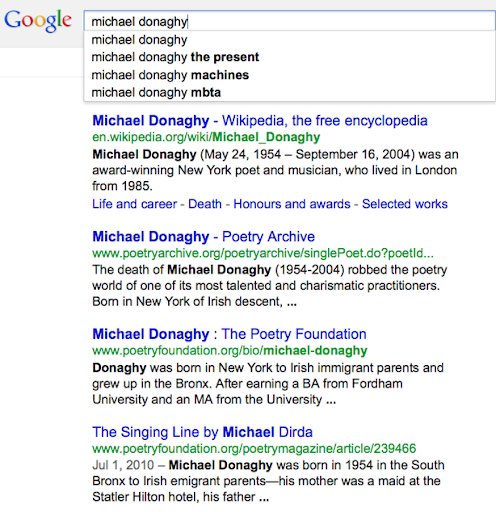
(The “mbta” Michael Donaghy is not the poet.) These results tell me that the two most searched-for poems by Donaghy are “The Present” and “Machines”: the former, presumably, because it might plausibly be read at a wedding, but the latter because – well, because it’s just utterly beautiful, a fabulously intricate yet accessible poetic construction. “Machines” is my favorite poem by Donaghy, but Google’s algorithm suggests that it is beloved by others as well, something I didn’t suspect until I ran that search.
When I searched the name of another poet, Jane Kenyon, here’s what I saw:
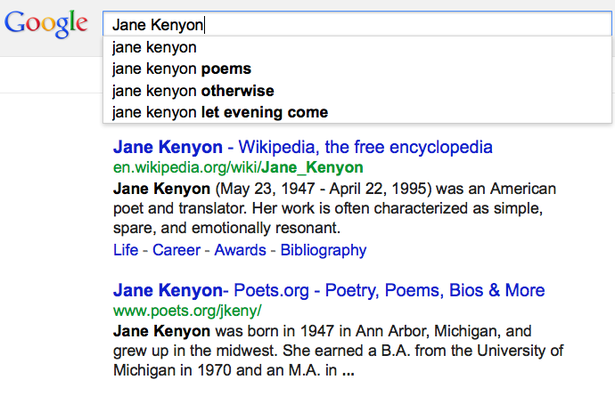
It surprised me to bit to find “Otherwise” listed before what I always think of as the definitive Jane Kenyon poem, the simple but perfectly graceful “Let Evening Come”, but actually running the search for “Otherwise” revealed to me that it is often taught in American high schools.
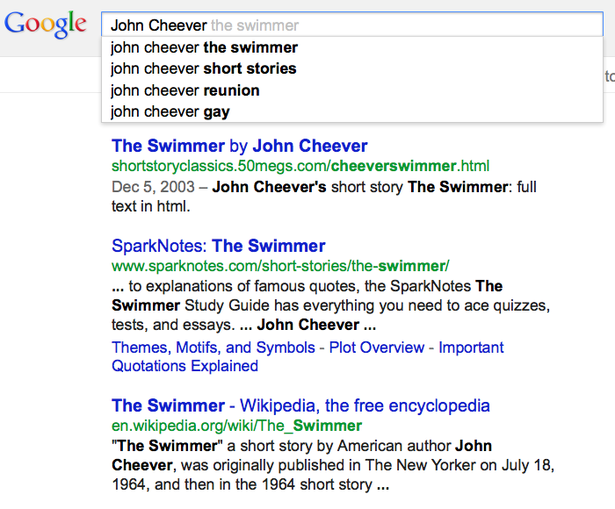
Clearly high-school literature classes contribute heavily to Google’s algorithm, as witnessed by a search for “John Cheever,” whose most anthologized story is clearly “The Swimmer”:
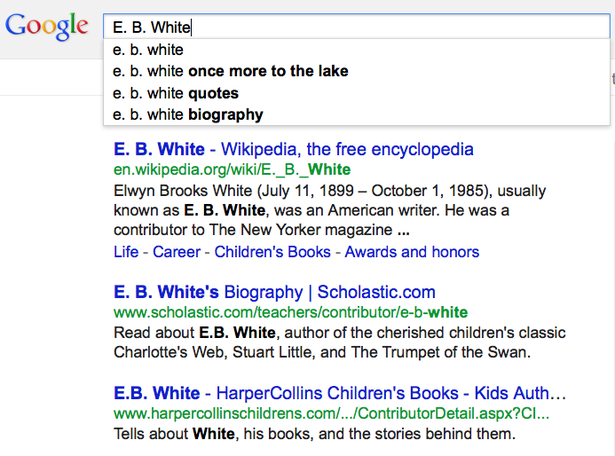
Or E. B. White, whose fine (but in my view somewhat overrated) essay “Once More to the Lake” is taught so frequently that it jumps right to the top of a list from which Charlotte’s Web is completely absent:
But other factors play a role as well. If you do a search for David Foster Wallace, you’ll see that the only work of his that shows up is his Oberlin Kenyon College commencement address “This is Water” – no Infinite Jest, no Pale King – but if you add “story” to your search string you get this:
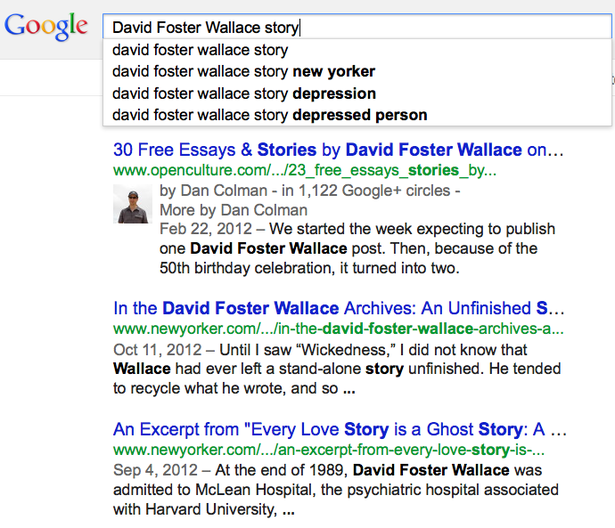
Clearly the chief interest is in “The Depressed Person,” a 1998 story thought to be revelatory of Wallace’s own experiences with depression.
A search for W. H. Auden shows that the first poem of his people want to know about is “Funeral Blues”, a poem that hardly anyone knew until it showed up in the 1994 film Four Weddings and a Funeral.
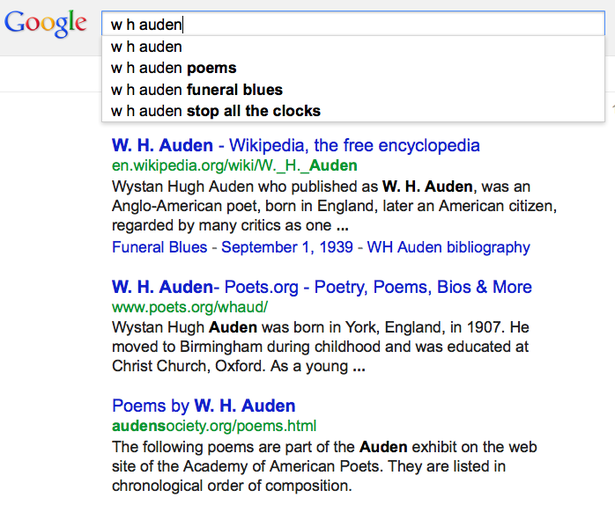
It seems to me that this information is not trivial: anyone interested in a particular author or topic could, with sufficient discipline and knowledge of how to make a screen cap, track shifts in public interest and knowledge over time. It would be like Ngrams for searches instead of published material.
Google is of course already providing us with its own accounts of its most searched-for terms, in the Google Zeitgeist; but I’m suggesting the value of tracking searches that don’t rise so high in the public consciousness, but significant to scholars and other researchers who focus on particular topics. Because I’m a literature teacher, I focused here on literature, but this kind of tracking could be done in almost any field. Digital humanists – and social scientists, and historians of science, and Lord knows who else – take note!
If one listens to academics, one might make the mistake of thinking they would like their complaints to be remedied; but in fact the complaints of academics are their treasures, and were you to remove them, you would find either that they had been instantly replenished or that you were now their object. The reason that academics want and need their complaints is that it is important for them to feel oppressed, for in the psychic economy of the academy, oppression is a sign of virtue.
The mystery book sculptor of Scotland strikes again!
'As a non-Christian, indeed a committed atheist, I was worried about how I’d feel about this book but it pulled off a rare feat: making Christianity seem appealing to those who have no interest in ever being Christians.' - Alain De Botton, choosing
You can find him in the café down the street, the one that serves fair-trade coffee and takes a dollar off if you donate a canned good at Christmas. Look for him at the school fundraiser, the Obama rally, the gay pride parade, the ethnic arts festival. He’s the one championing—sometimes fashionably, often genuinely—a just, diverse, and open-minded America.And he’s the ones who passes a misspelled sign on the florist’s door and spends the next 10 minutes hating the world and every last moron in it. He is the liberal grammar fanatic (LGF), and he is, at least in my circles, ubiquitous….
The LGF judges the contents of his neighbors’ shopping cart: Spam, Coors, and white bread—nary an organic vegetable in sight! But the sight doesn’t cause him actual pain. God help us all, however, if the meat counter advertises that “theirs a special” on drumsticks.
Jacobs thinks we're stuck with mediocre Bible translations because the divorce between belletrist and philologist will remain, given our ever-increasing specialization, even within the humanities. A major part of the problem is the way students are taught biblical languages. Prior to the Second World War, scholars would have learned their Greek by mastering Homer, Hesiod, Aeschelus, and Sophocles before moving to the New Testament. Now they are taught to master the grammar and vocabulary of the New Testament.This leads to a raw substitutionary plug-and-play of dynamic equivalence as we encourage them to try and stick abstract content into English words. In short, we’re still structuralists (perhaps unwittingly) who forget were living in a post-structuralist age, and for good reason. Structuralists reduce human phenomena — language, art, literature, music, indeed all of culture — to the presumed structural relations of a few basic non-linguistic building blocks behind the phenomena, running roughshod over the dynamics of the biblical texts as we try to extract a few basic ideas we can stick into simple English. No wonder our Bible translations are often brutal and banal.
I’m more sanguine than Jacobs, however, for a few reasons. I see younger scholars and theologians reacting against the centrifugal forces of specialization and compartmentalization and engaging in interdisciplinary endeavors in English and literature. I see a renewed concern for beauty in all things, including language. I see an increasing rejection of the now-naive linguistic theories of the sixties. I see a large Christian body, the Anglophone wing of the Catholic Church, revising its liturgical texts and Bibles in the converging directions of fidelity and beauty.