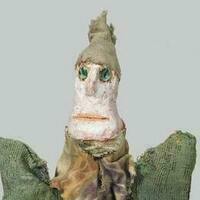
The great thing about art is that it’s there whether the academic humanities are or not. And if you make the study of literature and the arts your own, which is incredibly easy to do with the internet being what it is, it means so much more than if you passively imbibe received wisdom in classrooms for grades. The academic humanities may have committed slow suicide – but the art is alive and well, much of it many centuries old. It’s freely available to us. It’s ours.
We are unique as a species in our ability to point meaningfully. Chimps may draw saleable pictures and create tools, but they do not point. If I point in the direction a thrown ball has gone for the benefit of my slow-witted border collie, she looks intently at the tip of my finger. Declarative pointing – ‘there’s an eagle!’ – is also one of the fundamental triangulations of our social being. I point; I use my arm and forefinger to describe a line in space; I point at something or someone; but, for it to be meaningful, there has to be another person there to observe and comprehend the gesture. Raymond Tallis’s fourth chapter is concerned with a major exception: that of people on the autistic spectrum, whose inability to appreciate the subjectivity of others is confirmed by a failure to point.
The big difference Facebook and, especially, Twitter has made is that it is easier for critics to hear other people’s opinions. Even then, though, you tend to hear similar views to your own; after all, if you follow someone on Twitter it’s because something about them appeals to you. I tweeted about PJ Harvey’s new album the other day. The excited response I got from followers was amazing. But then, what did I expect? I wasn’t talking to fans of Justin Bieber. We don’t really connect.
Late last year there was a confluence of critical opinion in America the likes of which the nation hadn’t seen in years. Every single film critic in the traditional media – 350 “best” lists, the ads boast – seemed to anoint The Social Network, director David Fincher’s semi-fictionalised account of the founding of Facebook, as the movie of the year, maybe even of the decade. Every single literary critic in the traditional media seemed to agree that Jonathan Franzen’s Freedom, his saga of a dysfunctional American family, was the novel of the epoch. And just to make it three for three, just about every television critic in the traditional media seemed to genuflect before Martin Scorsese’s Boardwalk Empire, an HBO series that depicts the depredations of a mob kingpin in Atlantic City during Prohibition.
Every now and then I see this kind of story about America in the Brisith papers: the kind of story in which a critic says quite absolutely that something is true that is in fact, not at all true. Critical opinions about Franzen’s novel were seriously divided. For instance, Ruth Franklin absolutely trashed the book in The New Republic, a very prominent journal; and she was not alone. It sometimes seems that the English love to tell one another that the whole of America is of one mind about something. Such a claim fulfills desires and fears alike. But you rarely see it done as straightforwardly as here.
None of these observations is intended to condemn technology. They say that we have put in place a powerful technology and have not yet learned to use it in the best way. But these are early days. Just because we grew up with the internet, we tend to believe that the internet is all grown up. It is still up to us to make and shape it. I wrote my new book Alone Together: Why We Expect More from Technology and Less from Each Other to mark a time of opportunity. I criticise the notion of internet “addiction” because addictive substances need to be discarded.We are not going to discard connectivity technology. We need to form a more empowering partnership with it. In some areas the need for empowerment is now urgent, for example, in the area of privacy. Mark Zuckerberg, the founder and CEO of Facebook, has declared privacy to be “no longer a social norm”. In Alone Together, I question such proclamations and the assumptions behind them. For what is intimacy without privacy? What is democracy without privacy? Privacy may not be convenient for social networking technology, but it is essential to people.
Eagleton suggested three ways we engage with the tragic dimension: “social transformation” which passes through disillusionment; “psychoanalysis” which engages with the person at depth – not the therapeutic fallacy of believing that what matters is what makes you feel good; and Christianity – not the “being nice” variety but the one that brings a sword rather than peace, divides truth from falsehood and puts Christ on the cross. They all have failure in common, said Eagleton, and they are all deeply suspicious of success.The tragic humanist is saying that when we struggle with oppressive powers, or penetrate to the body of human fragility, or confront the darkness of the human soul, we need more than optimism and a few good books on evolution to see us through. This “twice-born” view of life arises out of brokenness and disillusionment. And you have to surrender your old dreams – your ideals or image of yourself or others – to be reborn into something new. Christ could not have said: “OK, I’ll just suffer the agony on the cross and in three days I’ll be up again.” We have to enter the abyss with no expectation, no promise of anything better. This is a very different form of hope to the liberal humanist’s belief in our ongoing moral progress.
And so Eagleton, from his Marxist starting point, enters the terrain of Christian faith.
Too many of the elderly do not have the family or the communal attachments necessary to feel valued; too many are widowed or otherwise alone; too many live in surroundings where they are essentially without the companionship necessary to stimulate a mind in danger of deteriorating. Too many are so poor or unable to obtain social services that they cannot remain in their own homes, and are certainly without the wherewithal to live in an upscale retirement community or assisted-living facility. Too many have passed their entire lives without the level of education and general knowledge necessary to take advantage of what is available to their peers raised in circumstances of greater awareness. For the vast majority of such men and women, so often socially and even physically more or less isolated, modern gerontology and its discoveries might as well not exist.
The Whale and the Reactor (final installment)
The Whale and the Reactor (final installment)
Let me conclude these posts on Winner’s book by looking at its third and last section, “Excess and Limit.” Winner’s approach throughout the book has been to pursue (as the book’s subtitle has it) “a…
Aaron Belz, "You Can't Pick Your Friend's Nose"
You can pick your friends,
we used to say, and
you can pick your nose,
but you can’t pick your friend’s
nose. We said it often and
understood what it meant:
man lives within constraints,
be they moral or natural;
our little lives were limited
by rules or laws, boundaries
we knew were there and
dared not cross. Nowadays,
my son tells me, you
can pick your friend’s nose,
you just can’t eat the booger.
So there are still constraints,
but things have changed,
and I’d say for the worse.
My father says in his day
you couldn’t even pick your
nose. For him things have
been changing for a long time.
(here)
It’s hard to imagine a revolution in understanding a popular sport that could entirely circumvent that sport’s followers. But that, weirdly, is what the soccer clubs seem to be aiming at: a great, obscurantist leap forward that will enable them to win more matches without anyone outside their own offices knowing precisely why. You can’t really blame the clubs for this; it’s their job to win more matches, after all. But in the meantime, fans are left looking in on a world of hidden complexity, a world in which experts sift through data we can’t see to make decisions we can’t understand. This isn’t exactly the bright beam of American math the media keep anticipating. Instead, it’s as if the more you try to quantify soccer, the more mysterious it gets.