
why racism is wrong
My friend and colleague Frank Beckwith is singing my song in a recent blog post. Responding to an essay by Princeton’s Keith Whittington, Frank writes,
Without a doubt, racism ought to be opposed at every turn. But that is only because racism is a false view about the nature of human beings. At religious institutions, such as the university at which I am honored to serve (Baylor), the rejection of racism is baked into the very Christian idea of the imago dei, that human beings are by nature made in the image of God. But that image is not merely symbolic, it is descriptive of the aspect of our nature that is the most “Godlike,” our intellects. As St. Thomas Aquinas put it: “Since man is said to be the image of God by reason of his intellectual nature, he is the most perfectly like God according to that in which he can best imitate God in his intellectual nature.” Consequently, it would be a mistake for Christian institutions to try to emulate the project envisioned in the Princeton faculty letter. For it would undercut the epistemic grounds for why we believe racism is wrong: it is wrong because it is false. But that judgment depends on what the truth is, something that we can only know because of the power of our intellects. Thus, a Christian university that takes its stand against racism by giving identity politics and group perceptions pride of place over the pursuit and acquisition of truth not only diminishes the imago dei and violates the very reason for its existence but cultivates in its students reflexes that do not fulfill the demands of Christian charity: “Love is patient; love is kind; love is not envious or boastful or arrogant or rude. It does not insist on its own way; it is not irritable or resentful; it does not rejoice in wrongdoing, but rejoices in the truth. It bears all things, believes all things, hopes all things, endures all things.” (I Corinthians 13: 4–7).This is related, I think, to something I wrote recently about Baylor, where Frank and I teach:
President Livingstone likes to say, “The world needs a Baylor.” If Baylor simply echoes the language and the policies of other institutions, then no, the world really doesn’t need a Baylor. But if we think and speak and act out of a deep commitment to the Gospel of the Crucified and Risen One, then we can make a difference indeed.If Baylor has a problem with racism — and I think it does — then that didn’t happen because we were insufficiently up-to-date with whatever the outrage of the moment is. It happened because we did not think and live out of the Christian convictions we claim to have. It happened because our adherence to our tradition was nominal rather than substantive. It hapened because, while we may have agreed, if asked, that all human beings are made in the image of God, we had not internalized that doctrine in such a way that it shaped our thoughts. And that’s the shortcoming that we should be attentive to. It is a moral and spiritual one, but also an intellectual one. That matters especially at a university.
After the killing of George Floyd, when universities around the country were scrambling to put together anti-racism statements, Baylor scrambled too. But if we had consistently lived up to our convictions we wouldn’t have had to. A Christian institution should be leading the way in critiquing racism, and should be doing so in distinctively Christian language that arises from specifically Christian convictions; it shouldn’t be chasing the pack and echoing the pack’s language. Think of William Wilberforce and the other evangelicals who led the way in ending Britain’s slave trade — and Phillis Wheatley, and Olaudah Equiano. Those people should be our models.
There’s opportunity for some serious self-reflection here, should we choose to take it. A few years ago I wrote a post about Christian organizations that were changing their views on sexuality, and there I argued that there are three ways to interpret such a change:
1) At one point, the organization held views about sexuality that were largely determined by its social environment, but it has now reconsidered those views in light of the Gospel and has come to a more authentically Christian understanding of the matter.I would apply the same logic to Christian institutions that are just now discovering the tragedy of American racism. If racism has always been endemic in American life, and the Christian faith gives us the intellectual and equipment we need to diagnose and combat racism, why are you just now noticing the problem? How have you been thinking about racism in the past — or not thinking about it? Isn’t it likely that when a kind of quiet racism was socially acceptable you accepted it, and when it became socially imperative to denounce it you denounced it?
At one point, the organization held authentically Christian views about sexuality, but has succumbed to public pressure and fear of being scorned or condemned and now holds views that are determined by its social environment.
The organization has always held the views about sexuality that were socially dominant, bending its understanding of Scripture to suit the times; it just changed when (or soon after) the main stream of society changed.
Note that there is no way to read this story as one of consistent faithfulness to a Gospel message that works against the grain of a dominant culture.
Self-reflection is hard, and it’s easier, even if stressful, just to chase the pack. And there’s another factor to be considered. The cause of the moment is anti-racism, and Christianity, properly understood, is full-throatedly anti-racist, even if its reasons for taking that view are quite different from those of many activists, and its preferred means for redressing it will often be different too. But if you try to think from the heart of the Christian tradition, often you will find yourself moving in a direction very different than that of the pack — and the pack is not tolerant or forgiving of dissent. “Joining the crowd / is the only thing all men can do,” and for the crowd joining is mandatory. In these circumstance chasing the pack, even if it’s not heroic, will always be not just easier but also safer.
Had to give myself a reward after my first class.

This morning’s newsletter is about silence, and a legendary young woman of the Lakota Sioux.

on being Bombadil
I am not privy to anything that happens in the upper reaches of Baylor University’s administration, but as far as this close observer can tell, Baylor wants to be an R1 university with successful sports teams, especially in football. There are some of us who want very different things, but those who actually make decisions about the direction of the university as a whole want that.
Except for those at the top of their category, institutions are governed by their aspirations. They look around at the institutions they admire and ask, “What must I do to be recognised as their peer?” They figure that the most likely route to such recognition is imitation.
So if you want to know where Baylor is headed, look at what R1 institutions with successful sports programs are up to. What Baylor’s aspirant peers do on Monday, Baylor will do on Wednesday. It really is as simple as that.
But Baylor is a big place, and contains several subcultures with their own priorities. For instance, I think it is fair to say — I welcome correction from my colleagues — that in the Honors College we are not opposed to becoming an R1 institution or being competitive in sports, but those achievements would not be priorities for us, and we wouldn’t want the pursuit of them to distract us from what we really care about, which is truly liberal education grounded in a deeply Christian account of the life that is good for human beings to live.
In relation to the university as a whole, then, I think we in the Honors College are rather like Tom Bombadil’s litle realm in The Lord of the Rings. Like Tom, we go about our business regardless of what conflicts are brewing, or what wars are raging, in the rest of Middle Earth. Like Tom, we consider ourselves not owners or controllers of our realm, but rather lovers and stewards of it. It requires and deserves our constant attention, so we give that attention, regardless of how peculiar our behavior may appear to the larger and more obviously ambitious lands that surround us.
Now, those of you who know that I have recently advocated the Gandalf Option may wonder if I am now discarding that in favor of the Bombadil Option. No, for on all essential matters Gandalf and Bombadil are of one mind. The words of Gandalf that I quoted as my own guideline are words that old Tom would have warmly endorsed. And after all, when the great War is over Gandalf makes a special point of visiting Tom. We should think of Gandalf as providing a model for thinking in motion and Tom as providing a model for acting in place.
In one of his letters, Tolkien says this about Bombadil:
The story is cast in terms of a good side, and a bad side, beauty against ruthless ugliness, tyranny against kingship, moderated freedom with consent against compulsion that has long lost any object save mere power, and so on; but both sides in some degree, conservative or destructive, want a measure of control. but if you have, as it were taken ‘a vow of poverty’, renounced control, and take your delight in things for themselves without reference to yourself, watching, observing, and to some extent knowing, then the question of the rights and wrongs of power and control might become utterly meaningless to you, and the means of power quite valueless. It is a natural pacifist view, which always arises in the mind when there is a war. But the view of Rivendell seems to be that it is an excellent thing to have represented, but that there are in fact things with which it cannot cope; and upon which its existence nonetheless depends. Ultimately only the victory of the West will allow Bombadil to continue, or even to survive. Nothing would be left for him in the world of Sauron.I think we in the Honors College should not expect Baylor as a whole to take our view of things; but I also think we should do what we can to encourage Baylor to think of us as Rivendell thinks of Tom. Because the alternative….
UPDATE: It occurs to me that I should connect this post, not just to others with the same tags, but to two essays of mine:
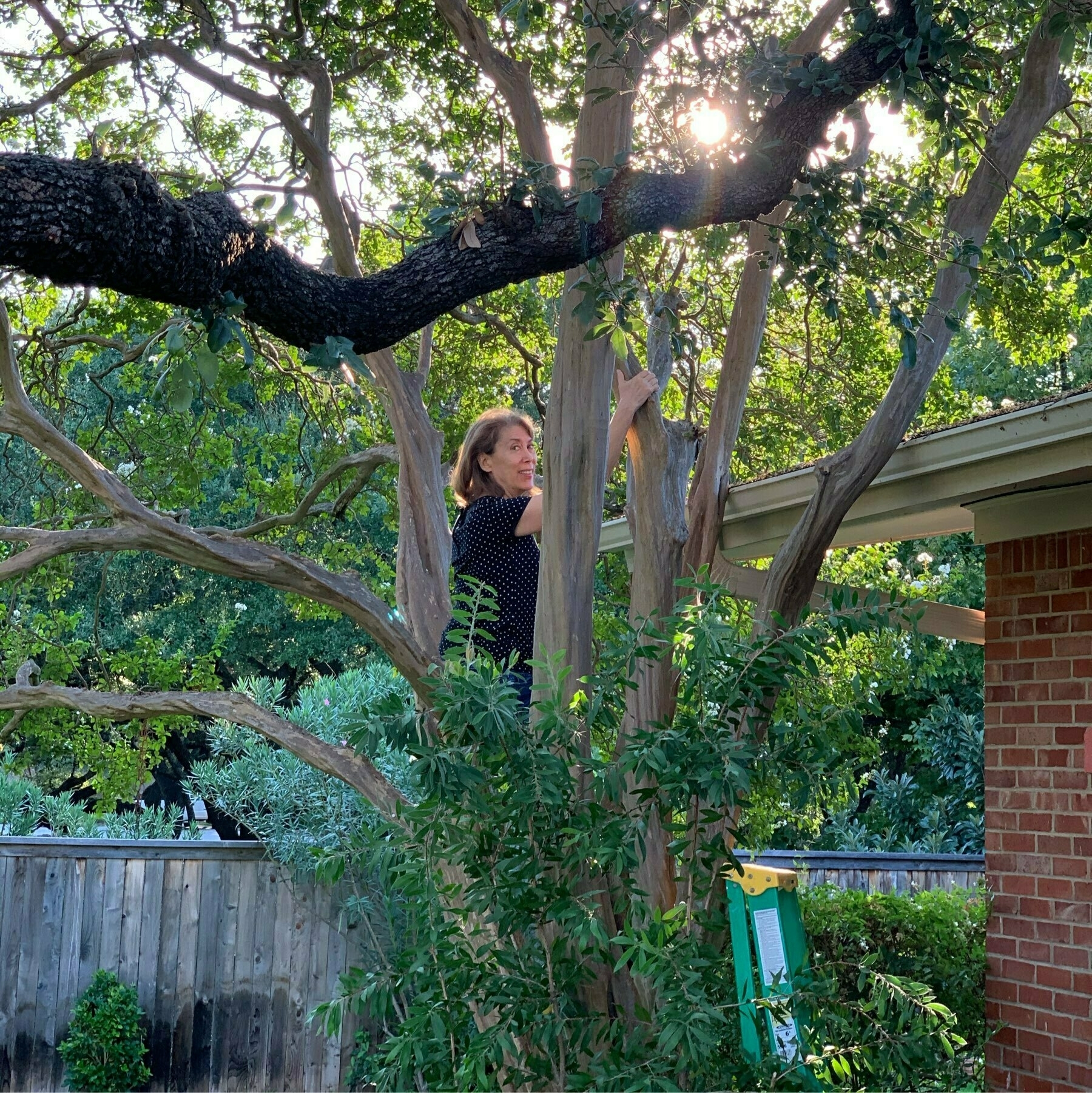
Looked all over the place for my beloved this morning. Finally found her in a tree.
summary, with tags
I’ve spent some time recently sorting through my online writings, and it’s not easy, given my susceptibility to logorrhea. But I’m thinking it would be useful to summarize a few things.
First, I have links to all of my recent essays and the various sites at which I have written over the years on my home page, so please check that out if you’re interested. And I have reposted some older essays of mine that I want to preserve.
Second, I want to talk about this here site. My posts here are organized by tag, or mostly they are — I have never been as disciplined or consistent about tagging as I should be. But I’ve done some work lately to clean things up, which has been useful in part because there are some topics that I had been thinking of writing about that, it turns out, I have already written about. Quelle surprise.
Anyway, I’m thinking it could be useful for me to summarize the key themes of this blog by listing some of the most frequently used tags — though first, I should note that my chief general imperative at this stage of my career is rejecting the smooth things and heading for the rough ground.
- My major project these days is one I call Invitation & Repair.
- Another theme that’s on the back burner now but will come to the front one day is Mid-Century Modernity.
- Here I write on themes associated with my book How to Think — largely cognitive errors of various kinds.
- Here I write about whether there is such a thing as a “Christian intellectual” and, if there is, what sort of person that might be.
- It seems that I have written a good bit on that vexed term evangelical.
- I have posts on the Christian life and posts specifically on theology — though I’m not sure I do a good job of distinguishing those.
- I’ve written about Left Purity Culture (LPC) and race and racism.
- I’ve written too much about politics here, but let this one post stand for what I most deeply and consistently think about politics. The posts specifically on pluralism reflect something I think about a lot. Likewise my posts on ethics.
- Here I write about certain pathologies and absurdities of academic life, and here I write about the nature and character of the university more generally.
- I write sometimes about movies.
- There are some lovely images in my posts on architecture and drawing, many of which feature John Ruskin.
- In addition to Ruskin, I have posts on several thinkers who have been especially important to me over the years, including Rowan Williams, W. H. Auden, and Michael Oakeshott.
And finally, I have written some things that I want to revisit, for my own sake, on the uses and purposes of blogging:
- new uses for old blogs
- the blog garden
- control and surrender, architecture and gardening
- trying
- smooth things and rough ground
- The Homebound Symphony (maybe the most important post of all)
This has been a useful exercise for me because it reminds me that, when I look at this blog along with my published essays, I’ve said all I ever need to say about a great many subjects. I don’t have to revisit the “What is an evangelical?” question again. I have fully developed my Unified Theory of Wokeness. I have no new thoughts about the character of the university and where it’s headed.
Moreover, with the release of Breaking Bread with the Dead I have completed my Pedagogical Trilogy, which is to say, I have now related for the benefit of the public pretty much everything I have learned as a teacher. For the next year or so I will be working on my critical edition of Auden’s Shield of Achilles and focusing on teaching, which will be challenging. So this will be a good time for me to do a lot of slow thinking about what to do next. I’ve got some ideas — but I want them to simmer slowly on the back burner for quite some time.
iPad update
Herewith an update to this post.
Since I still don’t have a Mac I can easily use without broiling my fingers, I have continued to work on being a better user of the iPad. I’m running the iPad OS 14 beta, and am find it very useful to create Shortcuts for common actions and put them among the other widgets and also directly on the Home screen. For instance, here are my widgets:

For those top two I created emails addressed to myself with the students in those classes BCC’d. So when I need to email my classes, as often I do, I just tap the relevant widget and an already-addressed compose window appears. Then I type the email, hit send, and I’m back where I was. Very neat.
The Daily widget opens a spreadsheet in Numbers where I keep track of various daily activities (exercise, food, and the like). I don’t need an additional app for that kind of thing because the one-tap access to a particular file fulfills that function.
Yeah, it’s hot in Texas.
The Drafts widget allows instant access to an app that I have come to love and rely on heavily. The library of add-ons for Drafts makes the app almost infinitely customizable and automatable. Most of what I write starts in Drafts, and many things finish there as well, because I can send text messages directly from Drafts and likewise post directly to my micro.blog page. (Posting directly to this blog from Drafts doesn’t seem possible right now but I am working on it.)
Here are some Shortcuts I’ve added to my Home Screen:

The “Reading Mode” shortcut is one from Apple that I have edited to meet my needs. When I tap it, it (a) puts my iPad in Do Not Disturb mode for a pre-set number of minutes, (b) starts up my preferred background sound in Portal, and (c) opens my Kindle app. The “St. Alban’s” shortcut also puts the iPad in Do Not Disturb mode and opens my parish’s YouTube page. I do this each weekday morning at 7:30 — well, okay, most weekday mornings at 7:30, which is the time when one of our priests, either our rector Aaron Zimmerman or our associate rector Neal McGowan, says Morning Prayer for his socially-distanced flock. Note that Apple allows me to choose an appropriate glyph for my “church app.”
There are still some things I need to do that I can’t do from the iPad, or can do only with great difficulty, but those are growing fewer in number. Certainly I’ve never had a Mac that was as precisely calibrated to my needs as this iPad is, though I suppose I could have had one if I had devoted enough attention to apps like Keyboard Maestro, or to the power of AppleScript. But Drafts and Shortcuts make automation very, very simple. It wouldn’t be easy for me to abandon the system I have developed over the past few months.
so sue me
I have developed a theory about academic life in America today, one that started as a kind of joke but has developed into a genuinely held view. Here’s my theory: A great many university administrators want to get sued, or at least to get seriously threatened with lawsuits.
Many university administrators are under heavy, heavy pressure from politically agitated students and faculty to combat racism by introducing speech codes, implementing racial quotas in hiring, expelling noncompliant students, firing noncompliant faculty members even when they’re tenured, compelling speech in favor of their policies, and essentially creating an enormous panoptic surveillance state to discipline and punish. The whole business is logistically impossible and would be a nightmare to build and an even worse nightmare to maintain.
Fortunately for these administrators, almost all of the proposed remedies for racism are legally forbidden to public institutions, and many of them are forbidden to private ones as well. When organizations like FIRE show up to remind administrators of that, those administrators have a card to play in their tense poker game with protestors. FIRE has actually had a good deal of success in getting colleges and universities to rescind fundamentally illiberal and often illegal policies, and the success has come through meaningful threats to take the universities to court. (FIRE itself has no standing to sue, of course, but its lawyers can represent those who do have such standing.)
My theory is that many administrators love it when FIRE shows up, or when other plausible threats of legal action come across their desk. Then they can go to the protestors and say, I did everything in my power to create Social Justice U, and I would’ve gotten away with it too, if it hadn’t been for that pesky Bill of Rights!

wokeness as Counter-Reformation
My old friend Jody Bottum thinks that the various Woke movements amount to a kind of post-Protestantism. I think this is wholly wrong. Wokeness is aspirationally Roman Catholic in its structure. It already has:
- magisterial teaching that one must hold de fide in order to belong
- the pronouncing of anathemas upon those who dissent from that magisterial teaching
- a distributed Inquisition devoted to unearthing and prosecuting heresy
- an ever-growing Index of Prohibited Books
Wokeness despises the fissiparousness of Protestantism and wants to replace it with Real, Substantial, and Visible Unity under its banner. It’s basically a secularized Counter-Reformation.
a message to my students
I have been starting school each August for the past fifty-six years. A great many things have changed in my life over the decades, but not that. And here we are in August 2020 and school is about to start … but not in a way I have ever experienced before.
If we were beginning an online semester, I would find the experience less familiar but also less disturbing. I learned a lot last semester about teaching online, and if we need to go back to online teaching and learning again, I will be prepared. Fair warning: I don’t do it the way most of your teachers do it. I won’t use Canvas at all, and I think there are better tools than Zoom for the kind of teaching I do — though I would be happy to use Zoom to chat with y’all individually. (Zoomy office hours aren’t a bad thing at all.)
But for now we’re coming to class together, physically. I have argued that, with proper precautions in place, this is a good idea, but I have to admit that as the time draws nearer I doubt my position more. I try not to worry — and when worry creeps in I pray for the peace that surpasses understanding, a practice that I would recommend to you all — but while I have absolutely no health issues that I know of, my wife has some quite serious underlying conditions that would make contracting COVID-19 very, very dangerous for her. So I have to be exceptionally attentive to all risks. I will be spending as little time as possible on campus — basically I will be coming in to teach our classes and then heading back home again — but I promise that you will find me accessible and responsive to you.
A related point: I humbly but fervently ask your cooperation with all of Baylor’s precautionary policies, even when you think they’re extreme. Your compliance or non-compliance could make a big difference in the lives of others, and maybe in your own as well.
And one more thing. I’m hearing from a number of students who are themselves concerned about their health, and who want me to make various adjustments for them. You need to understand that this is not possible. A great many things have changed, but one thing that has not changed is that there are many more of you (the students) than there are of us (your professors). Plus, we teachers are all having to plan and prepare for two very different ways of conducting our classes, and furthermore must be ready to take over for colleagues if they get sick. (All of us have had backup teachers assigned to our classes, and have been assigned as backup teachers for others.) This is definitely the most demanding and stressful period of preparation for a semester that I have ever had.
I mention that because y’all need to understand that if we can’t make the kinds of accommodations and adjustments that you want, that’s not because we are mean and selfish, but rather because we are finite human beings with limited amounts of energy and a fixed number of hours in each day.
So let’s be patient with one another. I will try not to ask more of you than is reasonable in the circumstances, and I hope you will do the same for me. And I would encourage you all to keep in mind, as we begin this strange term, these words from the Apostle Paul’s letter to the Colossians: “Bear with one another and, if anyone has a complaint against another, forgive each other; just as the Lord has forgiven you, so you also must forgive. Above all, clothe yourselves with love, which binds everything together in perfect harmony. And let the peace of Christ rule in your hearts, to which indeed you were called in the one body. And be thankful.”
This spindly rose bloomed a bit in the spring, after which it offered no blooms at all for three months. Recently it decided to announce itself again.

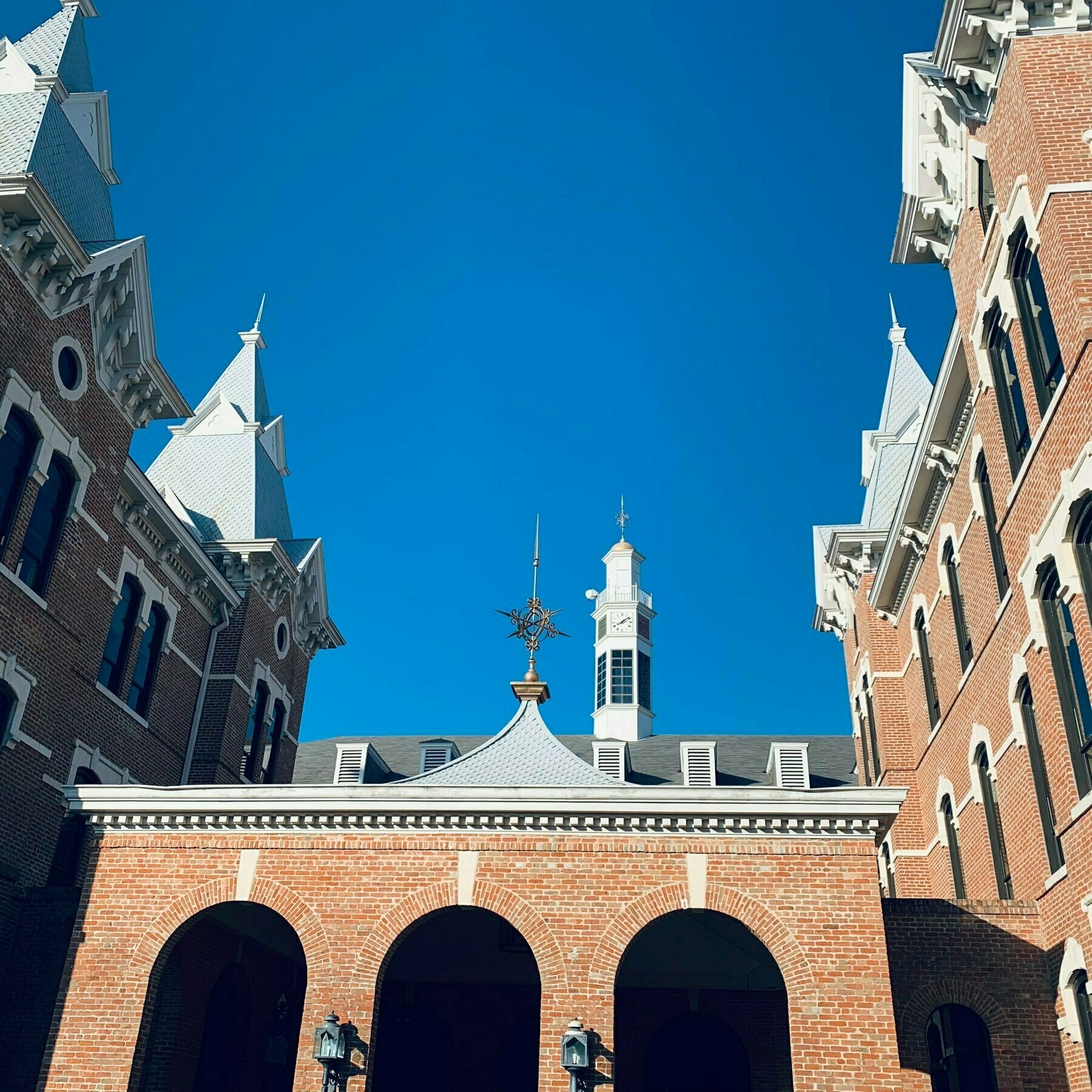

Campus was looking lovely this morning except for the ongoing construction of tent cities.





Texas City

The official death count for the Texas City explosions was 581, but there’s good reason to believe that many more died. And Stephen Harrigan, in Big Wonderful Thing: A History of Texas, adds this mournful postscript:
Of the 468 bodies deposited at the local funeral home and at a makeshift morgue in the garage of a gas station, 63 could not be identified. It was decided that they would be buried in the same location, with best guesses made about which body parts should go into which coffins. Preliminary arrangements were made for a parcel of land a few miles away in the town of Hitchcock to be used for the burial, but the citizens there wanted to know beforehand whether there were any black people among the dead. When they were told there were, they canceled the deal.