
what's in my bag
The Cool Tools site does a regular series in which people describe what they carry around and what they carry it around in. I thought I might do my own entry in the series, even though I don’t have affiliate links.
First comes my Tom Bihn Synapse 19 backpack, which I find to be brilliantly designed — with the right number of pockets in all the right places — extremely comfortable to wear, and sufficiently rugged that I will probably have it for the rest of my life. (I’ve had it for seven or eight years and it still looks basically new.) The chief things you’ll find inside it are …
- My 12” MacBook, in Tom Bihn’s bespoke sleeve
- Apple AirPods Pro
- Pentel Energel pens
- Palomino Blackwing pencils + sharpener
- Leuchtturm A5 Hardcover notebook
- Kindle Voyage
- Whatever books I happen to be teaching at the moment
- Ibuprofen and hand sanitizer
Other things come and go but those are the permanent essentials. I’m not adding links (except to the Tom Bihn site) because the most obvious place to link to is Amazon and I don’t really want to promote Amazon. Just search for items you’re interested in!
one more post about Twitter
I deactivated my Twitter account more than a year ago, and set a recurrent reminder to log in every 28 days to reactivate and then deactivate again. I wasn’t sure I wanted to let my handle go to some other person who would no doubt bring shame onto the noble ayjay name. This little dance became tiresome, and my publishers like it when I broadcast useful (read: sales-related) info on social media, so I decided to make the account active again and leave it that way.
Twitter is even worse than I remember it being. The same compulsive temporary madness-of-crowds obsessions — sure, of course, Kobe Bryant is the most important person in your life, even though you’ve never mentioned him before and will probably never mention him again — but conducted with a greater intensity than I had remembered. Also, it seems that the reply function is now reserved as a dedicated performance space for sociopaths (if you don’t believe me, look at the first ten replies to any widely-read tweet).
What a horrible, horrible thing Twitter is. If the people who work there weren’t sociopaths themselves they’d shut the whole thing down for the good of humanity.
So I’m bringing back Freedom, which I had used in the past but set aside when I left Twitter. There will be 20 minutes a day when I can see Twitter, mainly to be sure that things I post here actually show up there. I’ll spend the rest of my time praying that the whole platform will die a swift and irreversible death.
a perfect ratio
There is no shortage of water in the desert but exactly the right amount, a perfect ratio of water to rock, of water to sand, insuring that wide, free, open, generous spacing among plants and animals, homes and towns and cities, which makes the arid West so different from any other part of the nation. There is no lack of water here, unless you try to establish a city where no city should be….
Time and the winds will sooner or later bury the Seven Cities of Cibola — Phoenix, Tucson, Albuquerque, all of them — under dunes of glowing sand, over which blue-eyed Navajo bedouin will herd their sheep and horses, following the river in winter, the mountains in summer, and sometimes striking off across the desert toward the red canyons of Utah where great waterfalls plunge over silt-filled, ancient, mysterious dams.
— Edward Abbey, Desert Solitaire (1968)
loss and grief
To go from Ray Kurzweil's The Age of Spiritual Machines to the Dark Mountain Manifesto is to take a 180° turn — a turn downward. If Kurzweil reached up towards the stars, the authors of the Manifesto tell us to walk down that dark mountain to re-enter the world of “nature" which we had thought to have conquered, to have risen above, to have mastered, to have become capable of disregarding. “We believe it is time to look down.” But what might it mean to “look down”?
In my class we try to get at that question by reading Helen McDonald's magnificent book H Is For Hawk. Because, partly intentionally and partly unintentionally, this is the story of how a woman looked down into the world that we call “nature” — and became a hawk.
For years I’d scoffed at [T. H.] White’s notion of hawk-training as a rite of passage. Overblown, I’d thought. Loopy. Because it wasn’t like that. I knew it wasn’t. I’d flown scores of hawks, and every step of their training was familiar to me. But while the steps were familiar, the person taking them was not. I was in ruins. Some deep part of me was trying to rebuild itself, and its model was right there on my fist. The hawk was everything I wanted to be: solitary, self-possessed, free from grief, and numb to the hurts of human life. I was turning into a hawk.
The really fascinating thing here is that the same thing prompts McDonald's immersion in the training of her goshawk Mabel as prompts Ray Kurzweil's frantic experiments with life extension and ultimately immortality: the loss of a father. It is the death of Ray Kurzweil's father that he continually grieves, it is the hope of somehow being reunited with his father which drives much of his work. And so too, in a strange inverted sort of correspondence, Helen McDonald deals with the death of her beloved father by turning to the world of nature. To learn to think as a hawk thinks — or, rather, and more to the point, to not think as a hawk doesn't think. (“Goshawks are nervous because they live life ten times faster than we do, and they react to stimuli literally without thinking.”)
Perhaps the ocsillations I have been describing between a quest for an enchanted world and the acceptance of a disenchanted one are motivated by the same fundamental experience: Death, and grief.
oscillations
Here’s a brief summary by Charles Taylor of a contrast that’s vital to his thinking: porous vs. buffered selves. The porous self is open to a wide range of forces, from the divine to the demonic; the buffered self is protected from those forces, understands them as definitively outside of it. The attraction of the porous self is that it offers a rich, multidimensional cosmos that’s full of life and saturated in meaning; but that cosmos also feels dangerous. One’s very being can become a site of contestation among powerful animate forces. The buffered self provides bulwarks against all that: it denies the existence of those forces or demotes them to delusions that can be eradicated through therapy or medication. But the world of the buffered self can feel lonely, empty, flat. “Is that all there is?”
The positive valence of porosity is fullness; its negative valence is terror.
The positive valence of bufferdness is protection; its negative valence is emptiness.
Taylor’s thesis is that over the past five hundred years Western culture has moved from a general condition of porosity to a general condition of bufferedness. That claim can be, and has been, contested: see this post on my old Text Patterns blog for an example. But I think he’s probably basically right. Taylor doesn’t see this movement occurring in a straight line; he discerns again and again dillusionment with the disenchanted world of the Modern Modern Order generating alternatives, from nature-worship to spiritualism; but he does see a general trend towards accepting a disenchanted world.
Even if that’s true, I am interested in the ways that individuals and cultures oscillate between the porous and the buffered condition. As terror grows, we seek protection; but as emptiness grows, we seek fullness. And I am, further, interested in the ways that people seek an escape from this oscillation, some structure of experience that claims to provide fullness without terror, protection without emptiness. That’s why, having in the past taught a course called The History of Disenchantment, I’m now teaching one called Beyond Disenchantment.
The story I’ve just sketched out is, I believe, proper context in which to read, as we just have, Ray Kurzweil’s The Age of Spiritual Machines. The one thing needful for the person encountering Kurzweil’s book is to realize that, for all his technological talk, it’s not a narrative that arises from the “technological core” of society but rather from the “mythical core” — indeed, it is itself a myth, the myth by which Kurzweil himself hopes to live. Kurzweil’s myth promises the security, stability, safety of a self that’s uploaded to the cloud and multiply backed up, and the fullness that comes from the ability always to fulfill not only our sexual desires but our spiritual ones, located in the God module. No terror, no emptiness — so says the myth.
If you grasp this, you will understand why Meghan O’Gieblyn responded to the book the way she did:
I first read Kurzweil’s 1999 book, The Age of Spiritual Machines, in 2006, a few years after I dropped out of Bible school and stopped believing in God. [...]O’Gieblyn was “not more skeptical” of Kurzweil’s promises for one overriding reason: because they provided a mythological framework to replace the mythological framework that she had recently lost.At Bible school, I had studied a branch of dispensational theology that divided all of history into successive stages by which God revealed his truth: the Dispensation of Innocence, the Dispensation of Conscience, the Dispensation of Government … We were told we were living in the Dispensation of Grace, the penultimate era, which precedes that glorious culmination, the Millennial Kingdom, when the clouds part and Christ returns and life is altered beyond comprehension. But I no longer believed in this future. More than the death of God, I was mourning the dissolution of this teleological narrative, which envisioned all of history as an arc bending assuredly toward a moment of final redemption. It was a loss that had fractured even my subjective experience of time. My hours had become non-hours. Days seemed to unravel and circle back on themselves. […]
It’s difficult to account for the totemic power I ascribed to the book. Its cover was made from some kind of metallic material that shimmered with unexpected colors when it caught the light. I carried it with me everywhere, tucked in the recesses of my backpack, though I was paranoid about being seen with it in public. It seemed to me a work of alchemy or a secret gospel. It’s strange, in retrospect, that I was not more skeptical of these promises. I’d grown up in the kind of millenarian sect of Christianity where pastors were always throwing out new dates for the Rapture. But Kurzweil’s prophecies seemed different because they were bolstered by science.
At the time, I would have insisted that my rituals of self-abuse — drinking, pills, the impulse to put my body in danger in ways I now know were deliberate — were merely efforts to escape; that I was contending, however clumsily, with the overwhelming despair at the absence of God. But at least one piece of that despair came from the knowledge that my body was no longer a sacred vessel; that it was not a temple of the holy spirit, formed in the image of God and intended to carry me into eternity; that my body was matter, and any harm I did to it was only aiding the unstoppable process of entropy for which it was destined. To confront this reality after believing otherwise is to experience perhaps the deepest sense of loss we are capable of as humans.And “what makes the transhumanist movement so seductive,” especially to someone who has undergone that profound loss, “is that it promises to restore, through science, the transcendent hopes that science itself obliterated.” It is a myth against myth. When Kurzweil tells you that nanobots — he loves to talk about the infinite powers of nanobots — will do nondestructive scans of your brain and upload your identity to the cloud forever, such utterances are functionally identical to “Angels and ministers of grace defend us!” And about as empirically justified.
So now on to a myth that is essentially the opposite of Kurzweil’s: The Dark Mountain Manifesto.
reading Paul: 2
Nota bene: This is not a scholarly exercise but rather a readerly one. My students and I are not reading theologians or scholars of the New Testament. We are going so far as to try to forget what we know about the later development of Christianity. (Trying and failing, of course, but that doesn’t make the trying valueless.) We seek to place ourselves imaginatively in the minds of those for whom the Way was an emergent phenomenon. What did Paul’s letters sound like to them?
Now we come to Romans, and what a change. All of our previous readings have been letters in the primary familiar sense of that term, clearly written from a distinct person to distinct other persons, emotionally colored by a highly particular history of experience. Not so this one. The differences are obvious from the opening salutation — dignified, expansive, layered with dependent clauses, adumbrating the themes of the letter as a whole:
Paul, a servant of Jesus Christ, called to be an apostle, set apart for the gospel of God, which he promised beforehand through his prophets in the holy scriptures, the gospel concerning his Son, who was descended from David according to the flesh and was declared to be Son of God with power according to the spirit of holiness by resurrection from the dead, Jesus Christ our Lord, through whom we have received grace and apostleship to bring about the obedience of faith among all the Gentiles for the sake of his name, including yourselves who are called to belong to Jesus Christ,
To all God’s beloved in Rome, who are called to be saints:
Grace to you and peace from God our Father and the Lord Jesus Christ.
There’s no question that this is no hurriedly-dashed-off note, but rather a considered performance, full of oratorical flourishes. We might expect from this not a few notes based on the questions and concerns of a particular local congregation, but rather a highly organized treatise. And indeed that’s just what we get: a semi-systematic exposition of the Gospel as Paul understood it, in a fashion almost denuded of personality, at least as compared to the previous letters.
And as far as Chapter 8. After the glorious heights of that section of the letter — "For I am convinced that neither death, nor life, nor angels, nor rulers, nor things present, nor things to come, nor powers, nor height, nor depth, nor anything else in all creation, will be able to separate us from the love of God in Christ Jesus our Lord” — the tone alters markedly. Paul’s personality asserts itself, and we see flashes of the cranky and anxious man we have come to know from earlier letters. But now it is not “anxiety for all the churches” that afflicts him, but rather for the children of Israel: "I have great sorrow and unceasing anguish in my heart. For I could wish that I myself were accursed and cut off from Christ for the sake of my own people, my kindred according to the flesh.” And what is perhaps even more striking about this section of the letter is how uncertain Paul’s views are: it seems obvious that he has received no clear revelation of the precise relationship of the Lord’s covenant with Israel and the salvation that has been accomplished by Jesus Christ. So in the end he can only say: "O the depth of the riches and wisdom and knowledge of God! How unsearchable are his judgments and how inscrutable his ways!”
reading Paul
This blog has been on hiatus, mainly, but now I’m thinking that I should return from time to time. My classes this term are really enjoyable and I’m learning a lot, but I have an unusually heavy teaching load, and I fear that if I don’t take note of some of the things I’m thinking I’ll forget them. And a blog is a good way to give a responsible account of one’s thoughts. So I’ll be here occasionally with field reports.
A small group of Baylor University Scholars and I are reading the New Testament, in a slightly peculiar fashion. I’ve asked them to read each book not in the canonical order, but in the likely order of composition, and to imagine themselves as followers of the Way, this new faith centered on Jesus of Nazareth, whom we believe to be the Messiah of Israel and the Savior of the whole world. But we don’t know whether we’re doing it right. The Way is quite recent, has spread by word of mouth, and no one account of its essentials meshes perfectly with the others. When someone brings to us a painstakingly-copied letter or narrative from what we believe to be an authoritative source, we pounce on it, we treasure it, we read it with forensic attention. And what do we learn?
We have all been struck by certain matters of tone.
We begin with some of the letters of Paul. He begins hopefully. Most scholars believe that the earliest of Paul’s letters is is his first to the Thessalonians, and while he’s happy to answer some of the Thessalonians’ questions about when Jesus will return, his main concern in this letter is to praise them for their faithfulness in following the Gospel that he taught to them. Maybe at that point in his career he thought that this whole “evangelist to the Gentiles” thing was going to be relatively simple.
But his very next letter, most scholars think, is that to the Galatians, and it radiates utter exasperation. "I am astonished that you are so quickly deserting the one who called you in the grace of Christ and are turning to a different gospel — not that there is another gospel, but there are some who are confusing you and want to pervert the gospel of Christ.” Here we discern a note of high anxiety creeping into Paul’s letters: he can visit and teach the members of a particular church, but once he has departed to teach elsewhere, he has no idea how faithful a given community will be to his instruction. He spends a lot of time reminding the Galatians of his God-given authority, of how he was converted not by human persuasion but by the direct intervention of Christ himself. (“Saul, Saul, why do you persecute me?”) Nevertheless, he notes, the other apostles, the ones who knew Jesus in the flesh, have heard from him and have accepted his apostolic authority. Why do “you foolish Galatians” fail to do so? The self-commendation here is relentless and, to some of us, rather off-putting.
In the next letter, the first to the Corinthians, Paul continues to fret: in this case, about divisions within the community. There are soaring heights of rhetoric in this letter, most famously the great paean to love in chapter 13, and soon afterwards the hopeful looking forward to the resurrection of the dead, but the overall tone is anxious. Paul sees this church beginning to pull apart and from the distance at which he writes to them there is nothing he can do about it. In order to convince them to heed his advice he once again beats the drum of his apostolic authority.
We are accustoming ourselves to this Paul, this stressed and determined man, confident in his own calling but increasingly doubtful that that calling will be recognized by his fellow followers of the Way. There are so many false teachers out there, so many ways to go astray. He is like a shepherd whose sheep are scattering over a vast field.
But then we come to the letter to the Philippians, and it is difficult to imagine a greater contrast to what we have been reading.
For at this point Paul is in prison, and clearly doesn’t think he has much of a chance of getting out again. But instead of leading him to despair, this miserable situation gives him a mysterious peace. He realizes that the Gospel of Jesus Christ is infinitely greater than he is, and that even if he dies it will live and thrive. All of his anxiety passes away, and he can earnestly counsel the members of the assembly at Philippi to “be anxious for nothing”: if they but make their requests known unto God, then the peace of God, which surpasses all understanding, will keep their hearts and minds in Jesus Christ their Lord. There is no self-defense here, no self-commendation, no stress — just the serenity of a man who has resigned himself to his own death, who suspects that his earthly story will soon be over, at which point he will enter the company of his loving Lord.
But Paul is not killed; instead, he is released. And when we come to the second letter to the Corinthians we see that the memory of the peace he gained in prison remains, but his old habits of worry return to gnaw at him. He begins again to defend himself, to assert his authority, but now admits that when he does so he is "speaking as a fool.” He seems to know that the profound gift of peace that he received in prison is slipping from his grasp, but he just can’t help himself. The instinct to self-defend is too strong, even though he knows the absurdity of it, when he thinks about the Corinthians ignoring him and giving their homage to those whom he derisively calls Super-Apostles, Hyper-Apostles (Ὑπερλίαν ἀποστόλων).
But whatever anyone dares to boast of — I am speaking as a fool — I also dare to boast of that. Are they Hebrews? So am I. Are they Israelites? So am I. Are they descendants of Abraham? So am I. Are they ministers of Christ? I am talking like a madman — I am a better one: with far greater labors, far more imprisonments, with countless floggings, and often near death. Five times I have received from the Jews the forty lashes minus one. Three times I was beaten with rods. Once I received a stoning. Three times I was shipwrecked; for a night and a day I was adrift at sea; on frequent journeys, in danger from rivers, danger from bandits, danger from my own people, danger from Gentiles, danger in the city, danger in the wilderness, danger at sea, danger from false brothers and sisters; in toil and hardship, through many a sleepless night, hungry and thirsty, often without food, cold and naked. And, besides other things, I am under daily pressure because of my anxiety for all the churches.
It’s that last line that really catches me: Paul has had all sorts of afflictions heaped upon him, but what weighs heaviest on him is this: I am under daily pressure because of my anxiety for all the churches. The peace that overwhelmed him in prison when he thought his race was run has evaporated. And maybe this is the strongest sense in which he has become a fool, ἄφρονα, without wisdom: he has forgotten that, great though his responsibility is, the Gospel of Jesus Christ can survive and even thrive without his interventions.
nature and freedom
The notion that we "have a nature," far from threatening the concept of freedom, is absolutely essential to it. If we were genuinely plastic and indeterminate at birth, there could be no reason why society should not stamp us into any shape that might suit it. The reason people view suggestions about inborn tendencies with such indiscriminate horror seems to be that they think exclusively in one particular way in which the idea of such tendencies has been misused, namely, that where conservative theorists invoke them uncritically to resist reform. But liberal theorists who combat such resistance need them just as much, and indeed, usually more. The early architects of our current notion of freedom made human nature their cornerstone. Rousseau's trumpet call "Man is born free, but everywhere he is in chains," makes sense only as description of our innate constitution as something positive, already determined, and conflicting with what society does to us.
— Mary Midgley, Beast and Man: The Roots of Human Nature (1979)

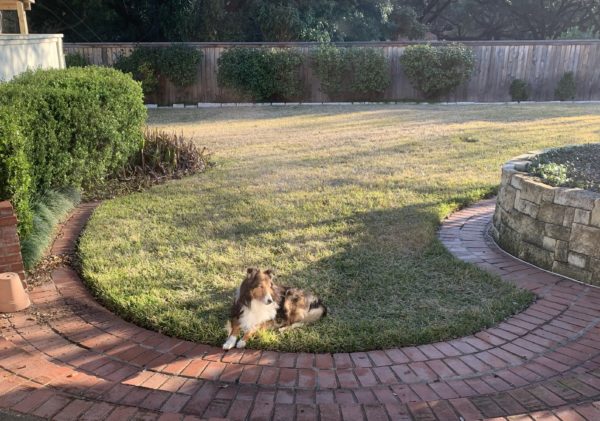
Oh, how this northern Illinois boy misses the snow he used to play in. So this morning he sits in the dusting that is all central Texas can muster, and remembers deep drifts.
understanding Christians (and others) on social media
The Devil chooses to deceive some people in the following way. He will marvelously inflame their brains with the desire to uphold God’s law and destroy sin in everyone else. He will never tempt them with anything that is manifestly evil. He makes them like anxious prelates watching over the lives of Christian people of all ranks, as an abbot does over his monks. They will rebuke everyone for their faults, just as if they had their souls in their care; and it seems to them that they dare not do otherwise for God’s sake. They tell them of the faults they see, claiming to be impelled to do so by the fire of charity and the love of God in their hearts; but in truth they are lying, for it is by the fire of hell surging in their brains and their imaginations.
— The Cloud of Unknowing (14th century), Chapter 55

a few items added
One little project that I’ve been working on as time allows — and time very rarely allows — is to move some things I’ve written from somewhere else online where they might disappear to this here site o’ mine. Here are three essays I originally published on Medium before I decided that Medium is a deceptive hellhole:
- “A Different Kind of Reader”
- “From the Abundance of the Heart”
- “The Devil’s Bargain” (this one is actually pretty important to me, though I haven’t lived up to its appeal)
It begins.
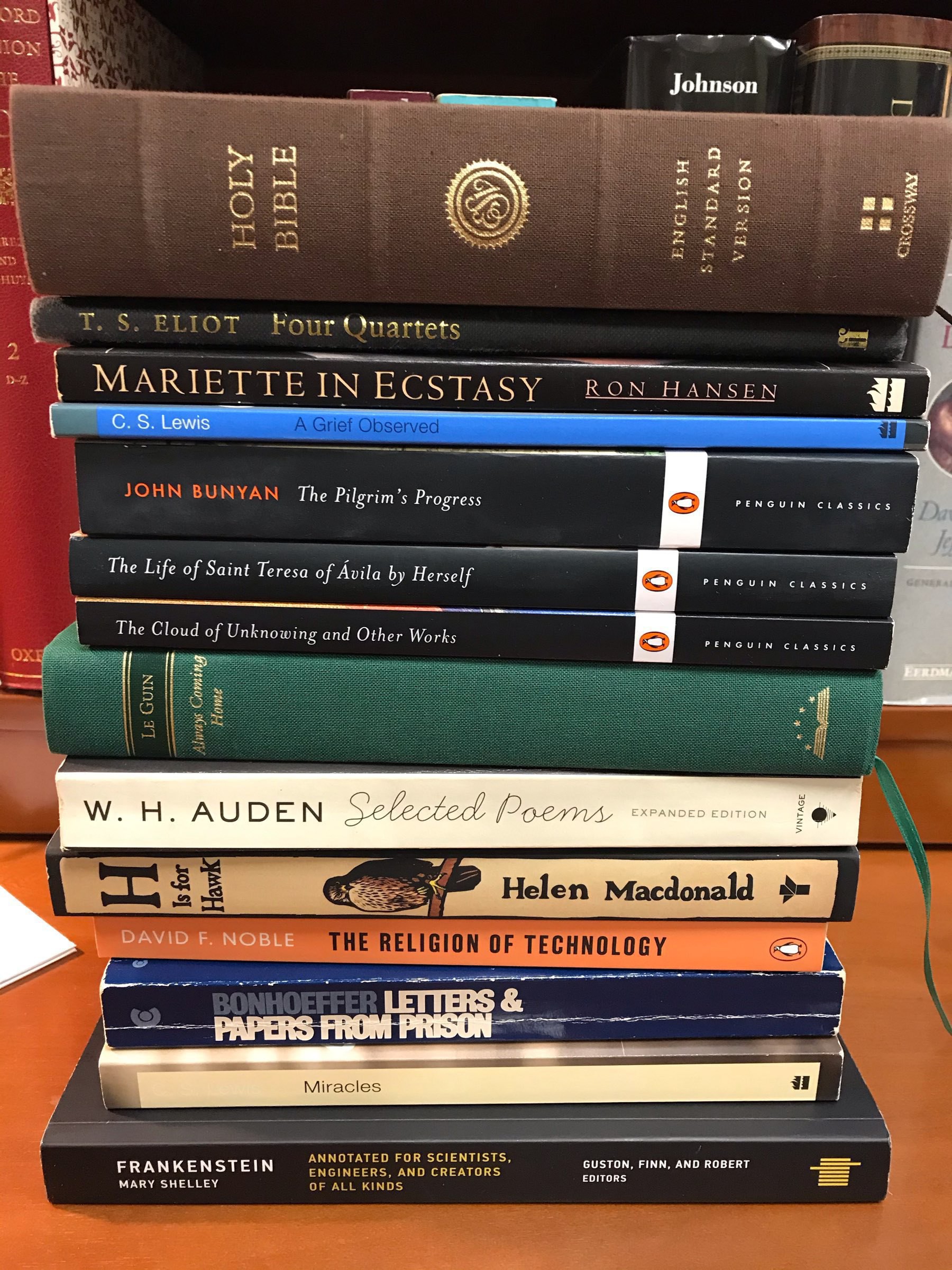
The chief texts for this semester — good companions for the journey.
summing up
I said in my previous post that I would be taking a break from this blog, but it occurred to me that a good way to mark that break would be to take a look back at the decade that’s just now concluding (or that everyone thinks is just now concluding, except for the precisians who insist that the decade will end a year from now).
For my family, it’s been eventful. Teri and I moved to Texas after twenty-nine years in Illinois, and have come to love Texas very much. Our son graduated from college and started his own life as a grown-ass man. I once again became a member of an Episcopal parish, something that in 2010 I would have deemed inconceivable. I entered my sixties. I am still a teacher.
I published six books, a few dozen articles, hundreds of blog posts, and thousands of tweets. I regret all the tweets and some of the blog posts. The rest of the blog posts did no harm, but also did precious little good. Given that I don’t regret the books or the articles, maybe I should focus on that kind of thing in the decade to come.
I miss Books & Culture, and the First Things that was: for many years those were my two periodical-publishing homes. I now write for several venues that I never imagined I would be able to write for, but I would have been very happy to spend the whole of my career writing long reviews for Books & Culture and essays for First Things. Now B&C is defunct and FT is not interested in the kind of thing I write — which is fair enough, I suppose, because I’m not interested in the kind of thing they now publish.
The world overall is not in the worst shape it could be in, but online life seems to be chiefly a cesspool. I am glad that it is only a part of life; I hope that in the coming decade it will be, for me and for others, a decreasing part. One can always hope.
I won’t say that I’ll never return here, but right now I feel that the blogging season of my life, which started around 2007, is over. I’m excited about the work to come, the reading and thinking and writing that awaits me, and I’m especially excited about doing all of it in a less internet-connected way.
A blessed next decade to us all!
unforthcoming attractions
This is why algorithmic time is so disorienting and why it bends your mind. Everything good, bad, and complicated flows through our phones, and for those not living some hippie Walden trip, we operate inside a technological experience that moves forward and back, and pulls you with it. Using a phone is tied up with the relentless, perpendicular feeling of living through the Trump presidency: the algorithms that are never quite with you in the moment, the imperishable supply of new Instagram stories, the scrolling through what you said six hours ago, the four new texts, the absence of texts, that text from three days ago that has warmed up your entire life, the four versions of the same news alert. You can find yourself wondering why you’re seeing this now — or knowing too well why it is so. You can feel amazing and awful — exult in and be repelled by life — in the space of seconds. The thing you must say, the thing you’ve been waiting for — it’s always there, pulling you back under again and again and again. Who can remember anything anymore?— Buzzfeed. It’s really great to be out of all this. I’ve been away from Twitter and Instagram for more than a year now, and the thought of going back to either of them prompts nightmares. Partly, but not wholly, because of my recent troubles with WordPress, I have even become disillusioned with this blog. Step by step by step I’m removing more of my life from the online world.
I still love posting to my Pinboard page and writing my newsletter, so those are the primary places to find me in 2020. It’s also possible that I will post the occasional photo here, though I’m not sure about that. I will have another little project to announce … later. But I expect I will make that announcement, and others, on my official home page. There won’t be much, if anything, going on here for the near future.
a partial fix
Still lots of weird things going on in my WordPress installation; a complete fix would take, yeeeesh, weeks probably. ButI’ve sorted out a few things. More of the recent posts at least should appear in the timeline, and the posts tagged “Christmas” should all be there. So there’s that.
something strange
Some very strange stuff is happening to my blog right now. Many posts, at least recent ones, have disappeared from the homepage, though they’re still online and visible if you know the URL. At first I thought only photo posts were missing — see for instance this and this and this — but now I see that some text posts are missing also. And tags don’t seem to be working properly: some of them turn up no posts, others turn up only a few when there are in fact many.
Ironically enough, one of the posts missing is one in which I admit that I don’t own my turf.
I don’t know when I’ll get a fix. Other things are on my mind this Christmas Eve!