
two points about A Hidden Life
- Terrence Malick’s A Hidden Life is a great, great masterpiece, and you must see it. It is his most linear film since The New World — also a masterpiece, and one of the most underrated films ever made, IMO, for reasons explained by John Patterson here — but in the fourteen years since The New World came out Malick has deepened both his vision and his craft. I will have more to say about it, but only after more people have seen it.
- When you see the film — I admit no doubt on this point — and if you sit through the credits, you will see a card titled “Special Thanks” which contains a list of names. One of them is mine. 😉
the call
“I call bullshit.” I used to see that a lot on social media, back when I was on social media. But what does it mean? It means, “I disagree.” That’s all. The statement has no further content. But “I disagree” sounds bland and flat while “I call bullshit” — well, that sounds badass. You must have some powerful Refutation Mojo if you can call bullshit, just like that, right there on the internet in front of everybody.
When we were kids, on some excursion in a parental automobile, and were leaving the mall or the grocery store or the McDonald’s, someone would shout “Shotgun!” And then one of the bigger kids who hadn’t said anything would calmly climb into the shotgun seat, after which a little voice from the middle of the back seat would whine, “But I called it!” — and would simply be ignored. Calling bullshit is like that.

it's official ...
… MacOS is now more stable than iOS/iPadOS. Which I wouldn’t have believed even a couple of months ago. Marco Arment has gone on an appropriate rant about this, concluding, “Your software quality is broken, Apple. Deeply, systemically broken. Get your shit together.”
I’ve had plenty of problems since iOS 13 arrived, but here’s my most recent story: I was using Instapaper and Fantastical in split screen view on my iPad, and then one of them (I think it was Instapaper) crashed, which brought down the other. Tapped on one, both showed up for an instant, then both crashed. Tapped on the other, same result. Used swipe-up-to-quit both apps, tried again, same result. Re-booted the iPad, same result — the two apps are apparently joined in a suicide pact. So if I want to use my iPad I have to do so without using either of those two apps, both of which are longtime daily fixtures to me. I guess I have to wait for an update to one of the apps or for the next point release of iPadOS.
So I’m on my MacBook, whose keyboard I’m not crazy about — though at least it actually registers the keys I type, and does so only once per keystroke, which sets it apart from the Macs of many users.
These persistent Apple problems have been enough to drive longtime Mac user and developer David Heinemeier Hansson to Windows. But that didn’t go so well.

My beloved is in Prague right now and the evidence suggests that it is hard to take a bad photo there.
on blogging
Brent Simmons is right: It’s weird to see people bemoan the decline of blogging and do it on Twitter. You can blog! You can blog for free if you want! (Though the best options require a few bucks.) Get over your social-media Stockholm Syndrome and start doing the thing you know is better. Cross-post to Twitter or Facebook if you must, but own your turf and tend your garden. Now that you can register your own domain name at micro.blog you have no excuse: it’s easy-peasy.
I am still hoping for a Blogging Renaissance, but lately I’m thinking that one necessary element of a true renaissance will be to get the readers of blogs on the same page as the writers. Everyone who writes a blog for a while knows that one of the best things about it is the way it allows you to revisit themes and topics. You connect one post to another by linking to it; you connect many posts together by tagging. Over time you develop fascinating resonances, and can trace the development of your thought. Venkatesh Rao has thought a lot about this in his series of posts — he calls it a “blogchain” — on blogs as “elder games.”
But this is not typically how readers read blogs. Not many people read this blog, but those who do typically just read the most recent posts — three days back, max. I add links to earlier posts, but almost no one clicks on them. People don’t click on tags either. And I think that’s because we have all been trained by social media to skim the most recent things and then go on to something else. We just don’t do deeper dives any more. So one of the things I want to be thinking about is: How can I encourage readers of my blog to seek some of the benefits that I get from it?
Xhaka is not the problem
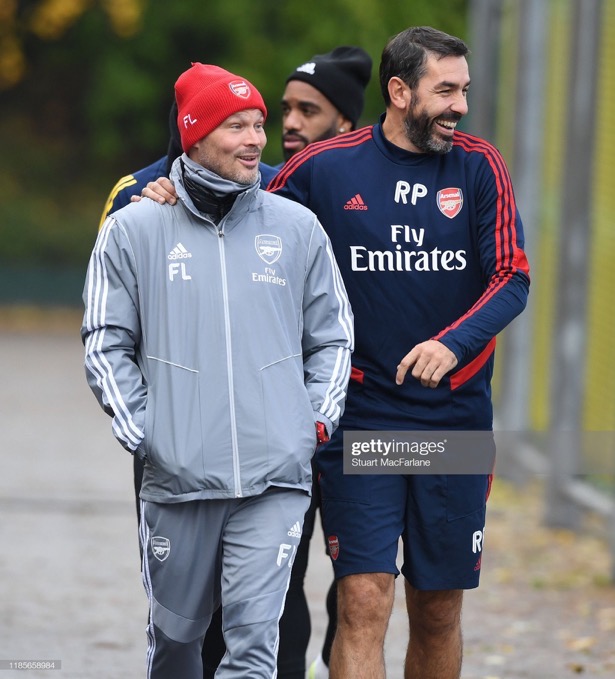
Granit Xhaka is nothing like the player Arsenal supporters thought he was, or could become, when the club signed him in 2016. The idea then was that he would provide steel in deep midfield, a combination of defensive strength and playmaking from a deep position — something Arsenal haven’t had since the departure of the great Patrick Vieira. It turns out that Xhaka has one skill and one skill only: he can make a good long pass, usually diagonally, when he has plenty of time on the ball. He can’t dribble, he can’t make runs into the box, he can’t shoot except for the occasional long-range blast. On defense he is both slow and positionally unaware, which means that he is always a booking waiting to happen.
But Xhaka is not the problem. The problem is a manager who makes Xhaka perhaps one of the most constant figures in the teams he selects (along with Leno and Auba). Week after week Emery sets Xhaka up for failure and week after week Xhaka experiences precisely what Emery has set him up for.
Torreira can’t make the long passes that Xhaka makes, but in every other respect bar none he is a far superior footballer, and it’s simply stupid to sit him in favor of Xhaka. Maitland-Niles, for all his struggles at fullback, would be better than Xhaka as a holding midfielder. Dani Ceballos could actually make plays from the deep-lying position, though I would prefer to see him farther up the pitch. Emery could pick names out of a hat and do better than he has been doing.
The one trait that we have consistently seen from Emery since he took over Arsenal is this: he makes personnel decisions without reference to what works on the pitch. We started seeing that last year when Arsenal were far more dangerous with Auba and Lacazette on the pitch together, but Emery wants to play a single striker, so they rarely paired up. This year we have seen the team utterly lacking in midfield creativity and playmaking, yet Özil has been completely sidelined and Ceballos plays only occasionally. (I know the problems with Özil, but the team is offensively moribund. Scrappy set-piece goes from your center backs are not a recipe for Premier League success.) Emery is holding desperately to some model of football that he cannot implement nor even articulate. He is stubborn in his commitment to an indescribable will-o-the-wisp.
Every day I check my RSS feed hoping to learn that he’s been sacked. Every day I am disappointed. There’s no reason to give up on this season — Arsenal are a very talented squad, by far the most talented in recent years — but many of the more gifted players are riding the pine. If Emery doesn’t go soon, supporters will need to write off another season. And that simply shouldn’t be necessary.
options


toss them out of the window
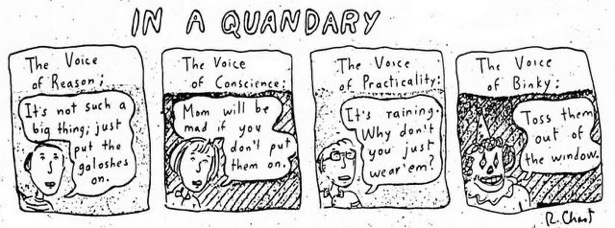
I don’t think I’m becoming a grumpy old man, but I am, I know, increasingly inclined to heed that voice inside me — let’s call it the Voice of Binky — that always asks “Why should you do this simply because it’s the kind of thing you’re expected to do?”
Professors give lectures, so why don’t you give lectures? Don’t want to. Look, this proliferation of administrative offices is just the way life is in the university today, so why don’t you adapt? Don’t want to. This country has a two-party political system, so quit complaining and just pick a side. Don’t want to.
You hand me all the defaults and say Do these. I say, “Toss them out of the window.”

credit, blame, and the unrewindable tape
Most political discourse is epideictic, which is to say, it’s about credit and blame. For instance, whenever we get an economic downturn in this country, the party not in the White House will blame the President, and the President and his supporters will blame his predecessor, whose bad policies have finally come home to roost, or a recalcitrant Congress, or bad judicial decisions, or whatever. If there’s an economic upturn, the President will take the credit, while his detractors will insist that he is merely benefitting from the wise decisions of his predecessor.
The problem with these disputes is that they are almost always irresolvable, and they’re irresolvable for two reasons. The first is that political and economic circumstances are so immensely complex, with so many forces mutually interacting, that it is simply impossible to know which ones have the greatest influence. And our inability to understand that complexity is related to a second factor: we can’t rewind the tape of history. We don’t know what would have happened if the former President had pursued policies similar to those of the current President, or if some particular judicial decision had gone the other way, or if Congress had passed the bill that the President wanted to have passed. Understanding how our ungoverned and ungovernable world works is not something we can do in laboratory conditions; controlled experiments are, and always will be, beyond our capabilities.
But political partisans don’t understand these factors, or refuse to consider them. They construct explanatory schemes that reinforce their political preferences, and then decry all alternative explanations as fake news. And this behavior will continue no matter what Facebook does to monitor the factual status of political statements on its platform.
teachers at the margins
Lisa Marchiano, a psychoanalyst, describing her encounter with a student who had a “panic attack” during an exam and didn’t want to take any more exams:
I asked this young patient of mine what in fact had happened during the first exam. She responded again, I had a panic attack. I lightly pressed her to move beyond the jargon and tell me about her actual experience as she took the exam. Eventually, she was able to tell me that, as the papers were being handed out, she become flushed and light-headed. Her heart was pounding, and her hands felt clammy. What happened then? I asked. She felt like running out of the room, but she was able to calm herself down enough to take the test. Though she successfully completed the first exam — and did okay on it — the fear that she might have another “panic attack” had prevented her from attempting the second exam.Reflecting on this experience, Marchiano raises a key issue: “I found myself wondering where she had learned that she ought not to be expected to tolerate ordinary distress or discomfort. How have we come to the point where we believe that emotional disquiet will cause harm, that we ought to be soothed and tranquil at all times?”What had happened here? One way of understanding this young person’s experience is indeed that she had had a limited-symptom panic attack. According to the diagnostic criteria for panic attacks in the Diagnostic and Statistical Manual of Mental Disorders (DSM), a limited-symptom panic attack can be diagnosed based on a pounding heart, sweating, and shaking. Of course, as anyone knows who has ever taken an exam, performed in front of an audience, or asked someone they like out on a date, these are in fact utterly normal reactions to feeling nervous. I gently attempted to reflect this back to my young patient. “So you were nervous about taking the exam, but you didn’t run out of the room. You did it. You pushed through the fear feelings.” I wanted her to see this as a success, one that she could build on, that could help alter her stuck story that tells her she is too anxious to function adequately. Her response to my positive reframing was telling. She looked up at me from under her brows and held my gaze. “Yes,” she responded firmly. “But I had a panic attack.”
Some years ago I had a student — I’ll call her M — who came to me and said that she could no longer take the reading quizzes that I give at the beginning of many classes. If she had to take them, she preferred to do so in the office on campus that deals with students who have disabilities, even if that meant missing most or all of my classes. And M clearly, though in no way angrily or aggressively, expected that I would do as she preferred.
I ended up talking with the case worker assigned to M, and the case worker told me that M was anxious about not having time to finish the quizzes, and, further, that M had problems, not to be disclosed to me, that made it necessary for me to accommodate her preferences.
Several elements of this situation puzzled me. First, M was usually among the first to complete her quizzes. Second, she had the highest quiz average in the class, and it wasn’t even close. Third, her very intelligent contributions to class discussions about the quizzes added significantly to the value of our class time. And fourth: those facts, and my observations, had absolutely no bearing on the expectations my university had for me. M’s feelings and preferences, as interpreted by her case worker, were all that mattered — I was strongly discouraged from sharing with M any of my thoughts, no matter how positive.
I didn’t know what else to do, so I agreed to make any accommodation necessary. But M kept coming to class, kept taking the quizzes, and kept excelling in them. Why she didn’t follow through on her request I can’t say. Maybe her knowledge that I would do what she wanted was enough to relieve the pressure the had been feeling.
I’m glad M stayed in class, and that there was a peaceful resolution to the situation, but the whole sequence of events troubled me then and troubles me now. The first, and larger, problem is that we’re now in a moment at which any attempt to resist the pathologizing of perfectly ordinary experiences of nervousness or uncertainty is tagged as indifference (at best) or cruelty (at worst). To encourage students to believe that they can overcome their anxieties is, it appears, now a form of abuse.
And second — perhaps not as important but still significant to me — there is the marginalization of the teacher-student relationship. It was made very clear to me that the case worker — who had never been in my class, who had never observed either M or me — could dictate the response to M’s concerns. I didn’t push back, because I didn’t want to bring any further anxiety to a student who was already anxious, but I wonder what would have happened if I had insisted that my own view of the matter, which was after all backed by some experience, should be taken into account.
More seriously, it seemed to me that the case worker was constructing, or allowing M to construct, a narrative in which I was M’s antagonist and it was the case worker’s job to intervene to assist M in her struggle against her antagonist. The idea that I might be on M’s side and want to help her, and indeed should, as part of my job, help her was never considered.
The work done by the “bias prevention units” or “diversity offices” that have proliferated in many universities might seem to be a very different phenomenon, but that work has a similar effect on the relationship between teachers and students. A key premise — sometimes unstated but sometimes quite explicit — of such administrative offices is that faculty are often the enemies of diversity and the perpetrators of bias, and therefore these programs must step in to correct the injustices inherent in the system. Again the faculty member is cast as the students’ antagonist, or at least as a possible antagonist. I do not know of any circumstances in which the “learnings” or “training modules” produced by these offices — which are often mandatory for all students — have received any faculty input, though I suppose some faculty may occasionally be involved. The “learnings” seem to be designed to emphasize the untrustworthiness of teachers.
I think students in general have a pretty good grasp of these dynamics. My observations suggest that disgruntled students these days rarely take their complaints to department chairs or deans, but rather to these amorphous “offices” which exist independently of the faculty structure and are typically empowered by the university to impose decisions without consulting anyone in that faculty structure.
I also think that this way of doing our academic business exacerbates, quite dramatically, one of the worst features of academic life, which is its legalism. Knowing that they are being overseen by these distant and almost invisible “offices,” faculty end up writing more and more detailed syllabuses, working to close every possible loophole which might be exploited by students to get what they want even when, from the faculty point of view, they don’t deserve it. And the more desperately faculty look to close such loopholes, the more the students search for them. It’s no way to run a university — at least if the university cares about learning.
There were certainly flaws in the old way of doing these things, in which individual teachers almost certainly had too much power. But certain experiences of learning were possible in that system that the current, or emerging, system is rapidly making impossible. The marginalizing of the student-faculty relationship is not a good recipe for addressing those old flaws.

iPadOS
iPadOS has rendered my iPad unusable, with a very strange combination of errors. For instance:
- The screen freezes in many different apps, usually requiring the app to be quit and restarted, sometimes requiring the iPad to be rebooted
- The Smart Keyboard Folio occasionally fails to connect to the iPad
- When the Smart Keyboard Folio connects, sometimes it types in ALL CAPS and cannot be made to stop doing so without a reboot
- All Bluetooth connections are inconsistent and unreliable
- Some iCloud folders will not sync from other devices, even after days
(Strangely enough, while everyone else has been having miseries with Catalina it has worked great for me: in particular, it seems to have fixed the Wi-fi and Bluetooth connectivity issues that have plagued my Macs for the past several OS X releases. Go figure.)
against lectures
At the very heart of the academy we find a series of genres — discursive genres, which are also genres of social interaction — the mastery of which constitutes, more or less, mastery of the academic profession itself. Some of these are universal: that is, they may be found in all academic work. Others are specific to certain disciplines or disciplinary families. Some of them are performed in relation to colleagues, others in relation to students. Here are a few that I, as a professor of humanities, have had to practice:
- the classroom lecture
- the “job talk” lecture
- the invited public lecture
- the short lecture that you give when you’re on a panel at a conference
- the conference-panel discussion
- the “Socratic” seminar discussion
- the symposium based on a paper everyone is supposed to have read
- the peer-reviewed article
- the book review
- the peer-reviewed monograph
Some of these wear, over several decades, better than others. Some I will probably never do again (the peer-reviewed article, the job talk); others I will be doing to the end of my career (the classroom discussion, the monograph). Some I enjoy, some … not so much.
But I have one definitive and unshakeable opinion: I never want to hear, or deliver, another lecture as long as I live.
For one thing, lectures are very, very hard to do well. I’ve surely heard more than a hundred public or semi-public lectures in my life, and only one of them has been excellent: when I was a grad student at UVA I heard Stephen Greenblatt deliver a lecture that later became his famous essay “Shakespeare and the Exorcists,” and it was electrifying. (I was sitting next to one of my professors, and at the end of the talk he leaned over and said to me, sotto voce, “Do you still have your wallet?”) Otherwise they have been not-crushingly-boring at best. And while I work hard to make my lectures vivid and interesting, I am always aware that there are better ways to accomplish what the lecture is supposed to accomplish.
The lecture is an unfortunate holdover from the pre-Gutenberg age. It makes no sense to have me come and talk to you on a subject in circumstances in which I could write something, send it to you, and have you read it and think about it, after which you could bring me to your institution for a conversation. That would be more intellectually productive for everyone concerned. Of course, one might reply that a lecture is not as polished as a finished, publishable essay or article. Indeed: that’s a major reason why lectures aren’t much fun to listen to. Better to embrace the tentative and unfinished character of your thoughts by having a conversation about them instead.
It is true that fewer people can participate in such a conversation than can attend a lecture. But note the difference between “participate” and “attend.” Certain kinds of intellectual exchange simply do not scale. I truly believe that if, instead of asking me to deliver a lecture at your institution, you asked me to come prepared to talk with four different groups about my published work, or even my work-in-progress, the experience would be better for all of us. (And I would be much more likely to say yes, since I wouldn’t be committing myself to all those hours of lecture-writing — a problem for me, because my conscience won’t allow me to deliver the same lecture repeatedly at different places.)
Well, one can hope. Or lose hope. But this I am sure of: When I am lying on my deathbed, I shall heave a breath and whisper to whoever is near, “Thank you, Lord. I shall never have to attend, or deliver, another lecture.”