
a case of simple theft
I subscribed to the digital edition of the late, lamented Weekly Standard before its owner killed it and decided to throw his resources into a replacement, the Washington Examiner. Today I got an email thanking me for subscribing to the digital edition of the Examiner, which I did not do.
Now that’s chutzpah: kill a magazine someone subscribes to and then, without even asking, take their money to support a wholly different magazine. It’s also fraud and theft. I have of course demanded that they cancel the subscription I never signed up for and delete my information. I wonder whether they will.
I hope the Examiner gets its pants sued off for this.
on rum and baseball
For decades, late February and early March were for me a season of preparation: preparation for baseball. I watched my favorite baseball websites come to life in my RSS reader, I bought some books that analyzed last year’s performances and predicted this year’s, I got excited about new signings and promising rookies.
But not this year.
John Thorn, the great historian of baseball, wrote in November,
The stolen base and the bunt are on the way out. The reasons for the decline in both have to do with analysts revealing that run expectations are radically lessened not only by the unsuccessful attempt but also, in the a case of the sacrifice bunt, by the successful execution. One may blame analysis, knowledge, and science for these outcomes, but it is hard to give three cheers for ignorance.This is more or less precisely what I wrote last summer, when I described the complete victory of the Earl Weaver model of baseball strategy that I cheered on when I was a kid: “As boxing fans have always known, styles make fights. What made Earl’s Way so fascinating all those years ago was its distinctiveness; and that’s what made the arguments among fans fun too…. Strangely enough, baseball was better when we knew less about the most effective way to play it.”The dilemma for owners and players and fans may be understood as The Paradox of Progress: we know the game is better, so why, for so many, does it feel worse? I submit that while Science may win on the field, as clubs employ strategies that give them a better chance of victory, Aesthetics wins hearts and minds.
Thorn is exactly right that “it’s hard to give three cheers for ignorance.” Me again:
It’s important to be clear about this: Coaches and players understand the percentages better than they ever have in the history of the game, and are acting accordingly. All of these changes I have traced are eminently rational. Players are giving themselves the best possible chance of success, in hopes of more money for them and more wins for their team. Even when they don’t try to bunt or slap a single into the vast open space on one side of a shifted infield, they’re being rational, because, as noted earlier, Earl was right: those base-at-a-time one-run strategies are highly inefficient.So it’s hard to see what the solution to this might be. What are the moguls of MLB supposed to do, mandate less rational tactics? In a way that’s precisely what they do plan to do, for instance by requiring pitchers to face at least three batters, even when bringing in, say, a lefty to face only the one left-handed hitter in the other team’s lineup might make more sense. But that kind of thing is just nibbling around the edges. It’s not going to do anything to change the overall strategies that are common today, as when batters are so committed to the long ball that they are content to have created a game in which there are more strikeouts than base hits.So you can’t blame anyone for the way the game has developed. It has become more rational, with a better command of the laws of probability, and stricter, more rigorous canons of efficiency. But for those very reasons it’s not as fun to watch.
In this context, I keep thinking about a passage from Claude Levi-Strauss’s Tristes Tropiques, a passage that’s relevant to so much in our modern order:
In Martinique, I had visited rustic and neglected rum-distilleries where the equipment and the methods used had not changed since the eighteenth century. In Puerto Rico, on the other hand, in the factories of the company which enjoys a virtual monopoly over the whole of the sugar production, I was faced by a display of white enamel tanks and chromium piping. Yet the various kinds of Martinique rum, as I tasted them in front of ancient wooden vats thickly encrusted with waste matter, were mellow and scented, whereas those of Puerto Rico are coarse and harsh. We may suppose, then, that the subtlety of the Martinique rums is dependent on impurities the continuance of which is encouraged by the archaic method of production. To me, this contrast illustrates the paradox of civilization: its charms are due essentially to the various residues it carries along with it, although this does not absolve us of the obligation to purify the stream. By being doubly in the right, we are admitting our mistake. We are right to be rational and to try to increase our production and so keep manufacturing costs down. But we are also right to cherish those very imperfections we are endeavouring to eliminate. Social life consists in destroying that which gives it its savour.Note that Levi-Strauss speaks of “the paradox of civilization,” John Thorn about “the Paradox of Progress.” It’s the same point. I was right to be rational in cheering on the sabermetric revolution; and these days I cherish the very imperfections I once wanted to see eliminated. But the savor is now gone, and I don’t know how it can be restored.
academic wishful thinking
Elite Colleges Don’t Understand Which Business They’re In, says John Fabian Witt of Yale. Alas, they understand perfectly well. It’s just not the business Witt and I wish they were in. The Yale administrator who said that his university, and others like it, are a “high-level service industry to the 1%” understood the real business model.
a clarification, eighteen years later
I was at work, in the LRB office, when I first watched the first plane fly into the first tower: like half the planet, we’d turned the television on as soon as we heard the news. And then, at some point as we watched, a thought suddenly hit me with a physical force: a kind of punch in the gut that made me shout out an involuntary ‘Jesus!’ One of my colleagues turned to me and asked the question so many people were asking: ‘Oh no, do you know someone who’s there?’ I didn’t, but I didn’t want to explain what it was that had made me yell, and I never did. The thought was this: if someone had done this to America, what will the mightiest warrior nation on earth do back?— Daniel Soar. It seems to me quite characteristic of the LRB political sensibilities that, after all these years, Soar feels the need to insist that his emotional response to the destruction of the Twin Towers was in no way contaminated by compassion for the people who died in those buildings.
Remembering David Martin
The great sociologist of religion David Martin has died: you may read an overview of his incredibly wide-ranging career, written by a former colleague, here. (I was fascinated to learn there that he wrote a so-far-unpublished book on “secularization through the lens of English poetry”!) Today I am giving thanks for his life and witness, and remembering in prayer his family: his wife Bernice and his daughter Jessica Martin — my friend, and a priest whose sermons I sometimes quote or post in toto here.
Much attention will be given, in reflections on Martin’s career, to his work on secularization, and rightly enough, given its influence. But it will be very hard for us to get our minds around the totality of that work, for what it did, above all, was complicate all previous work on secularization. And the primary way it complicated that work was by decentering the Western European account (WEA, I’ll call it) of secularization, which Western intellectuals have always had a tendency to see as the normal or expected path of change in religious practice and experience. But, as Martin wrote in his concise and accessible Forbidden Revolutions (1996), “We can observe at least four distinct trajectories in Christian cultures: Eastern Europe, Latin America, Western Europe and North America. If social differentiation is the working core of the theory of secularization, it takes at least four forms, which do not necessarily converge.”
That WEA model of secularization, Martin argues, “acts as an implicit guide and censor on what we permit ourselves to see” — and therefore obscures from us how secularization happens, if it happens at all, elsewhere. The influence of the WEA model led to it being imposed in Eastern Europe, “the guiding spirit [of] an explicit programme to enforce secularization.” To a somewhat lesser extent attempts at enforced secularization happened in certain Latin American countries as well, and Forbidden Revolutions describes how stubborn practitioners of the Christian faith were able to resist such imposition. Why that resistance took Catholic forms in Eastern Europe and Pentecostal forms in Latin America is the meat of Martin’s story.
Forbidden Revolutions is not generally thought of as one of Martin’s central works — it’s less academic and more Christian than his most celebrated texts — but I find myself thinking of it often these days, even though I only read it once, many years ago. I think perhaps it is time for me to return to it. In the meantime, thanks be to God for the life and work of David Martin. Rest eternal grant unto him, O LORD: and let light perpetual shine upon him. May he rest in peace.
a plea to journalists
Candidates who make policy-by-Twitter, the ones who chase every micro-news-cycle, risk losing sight not just of what voters care about, but also why they’re running for president in the first place. […]This pattern of self-sabotage-by-Twitter is being repeated in various circles of our culture. Consider, for instance, the knots that publishers of young adult fiction are twisting themselves into by trying to appease tiny groups of angry people who have declared themselves the voices of their ethnic group — a pathetic phenomenon that Jesse Singal has recently been documenting, in depressing detail, in his excellent newsletter.Those loudest voices on Twitter aren’t marginal. The platform has become a petri dish for the formation of elite opinion, with outsized power in the political press, and it has provided a lane for smart and clever people who deserve a voice to have one. But the convulsions of everyday Twitter, a small club of media elites and professional opinion-havers, are plainly disconnected from the concerns of most Democratic voters. There’s a real risk that otherwise smart, promising 2020 candidates begin to self-sabotage in their haste to appease this microscopic cluster of social-media activists just because they’ve got a megaphone.
It’s really astonishing how few people can summon the critical facility necessary even to ask whether a person who claims to speak for all black or Latinx or trans people actually does. But I think it’s very relevant that this dance between triumphant resentment and instantaneous appeasement happens on Twitter: the pace of the medium seems to activate users’ fight-or-flight instinct. And then the ordinary mechanisms of human pride kick in, and people double down on their first responses rather than step back and question themselves.
I’m not even going to bother asking politicians to get off Twitter, because how many of them have ever declined the offer of a megaphone? But if we’re going to start repairing the damage that Twitter has done, and continues to do, to our social fabric, the leaders in this endeavor need to be journalists.
Recently a journalist commented to me that he is on Twitter because, for better or worse, that’s where the conversations in his profession take place. I think that’s definitely for worse, not better, and I think every journalist would be better off not participating in those conversations. Here’s why:
- Journalists talking to other journalists ad nauseam all day long leads to a kind of professional hermeticism, which in turns leads to limited intellectual horizons and a lack of independence.
- The utterly false assumption that people on Twitter are characteristic of the society as a whole leads to laziness: asking questions to the people who follow you on Twitter is something you can do in bed — way easier than putting on some clothes and going out to talk to your fellow citizens.
- That assumption also leads journalists to treat lunatic-fringe ideas as though they are commonplace. When your daily journalistic practices render you unable to distinguish between the most vitriolically-expressed ideas and the most widely-shared ones, you cannot do fair and accurate assessments of the national, or even the local, mood.
So, journalists on Twitter, for the sake of accuracy in reporting, for the sake of your professional integrity, for the sake of our nation: Delete your account.
futurists and historians
Martin E. P. Seligman and John Tierney:
What best distinguishes our species is an ability that scientists are just beginning to appreciate: We contemplate the future. Our singular foresight created civilization and sustains society. It usually lifts our spirits, but it’s also the source of most depression and anxiety, whether we’re evaluating our own lives or worrying about the nation. Other animals have springtime rituals for educating the young, but only we subject them to “commencement” speeches grandly informing them that today is the first day of the rest of their lives.
A more apt name for our species would be Homo prospectus, because we thrive by considering our prospects. The power of prospection is what makes us wise. Looking into the future, consciously and unconsciously, is a central function of our large brain, as psychologists and neuroscientists have discovered — rather belatedly, because for the past century most researchers have assumed that we’re prisoners of the past and the present.
I wonder what evidence exists for the claim that "What best distinguishes our species is an ability that scientists are just beginning to appreciate: We contemplate the future.” What if we are more clever and resourceful readers of the past than other species? What if it was our singular power of retrospection that "created civilization and sustains society”? After all, while it's true that we homo sapiens alone give commencement speeches, it’s also true that we homo sapiens alone build things like the Lincoln Memorial and inter our distinguished dead in places like Westminster Abbey. Why should the former count for more than the latter?
In the preface to his translation of Thucydides (1629), Thomas Hobbes wrote that "the principal and proper work of history [is] to instruct and enable men, by the knowledge of actions past, to bear themselves prudently in the present and providently towards the future.” That is to say, validity of prospection depends upon accuracy of retrospection. Those who do not understand the past will not prepare themselves well for the future. Even if they read fizzy opinion pieces in the New York Times.

Merton and the quest for God
I warmly encourage you to read this lovely and thought-provoking essay by my friend Matt Milliner. Here’s a key quotation from the essay:
For readers of my time and place, Thomas Merton remains an important guide. I had heard varying opinions as to whether he remained faithful to Christianity in his Eastern experiments. I was surprised, therefore, to realize that Merton never lost his bearings. Merton died in 1968, and in his 1967 Mystics and Zen Masters he insists, “[Zen] is not by itself sufficient. We must also look to the transcendent and personal center upon which this love, liberated by illumination and freedom, can converge. That center is the Risen and Deathless Christ.”
I think Matt is right to quote this passage, which is very important — though “deathless” is a carelessness — but there are other passages from the late Merton that may point in other directions. For instance, here’s a passage from my own recent essay on Merton, concerning the Asian Journal he wrote at the very end of his life:
The most interesting sentence here is: “May I not come back without having settled the great affair.” Two years earlier, when recuperating from back surgery in Louisville, he had fallen in love with a student nurse and had thought of abandoning his vows for her, though they never had sex. But that cannot be the “great affair” he had in mind; his rededication to the monastic life had been settled by then. It is hard to see “the great affair” as anything other than the status of Christianity among the religions of the world. Is Jesus Christ the world’s one Savior? Or is Christianity just one among several ways to reach toward the divine?
There are hints of how he might have settled it. For instance, he wrote of meeting an Indian hermit called Chatral Rinpoche, “The unspoken or half-spoken message of our talk was our complete understanding of each other as people who were on the edge of great realization and knew it and were trying, somehow or other, to go out and get lost in it.”
The passage Matt quotes from Mystics and Zen Masters is indeed very late Merton, but later still is this passage from Zen and the Birds of Appetite (1968), the last book published in his lifetime:
Suffering, as both Christianity and Buddhism see, each in its own way, is part of our very ego-identity and empirical existence, and the only thing to do about it is to plunge right into the middle of contradiction and confusion in order to be transformed by what Zen calls ‘the great death’ and Christianity calls ’dying and rising with Christ.’
Is Christianity’s “dying and rising with Christ” the same thing as Zen’s “great death,” just under different names? My answer would be No: they are not the same, and indeed are utterly incompatible. But did Merton really mean to identify them as closely as he does here? Or was that just a concession to an ecumenical context? I don’t know, and I don’t think Merton knew. Trying to decide his answer to that question was, I think, “the great affair,” and I would not venture to say with any confidence where he might have settled if he had been spared. Matt seems sure that Merton “never lost his bearings”; I am not. Or maybe I should say that I am not sure that he never altered his bearings.
To be sure, there’s no doubt that Merton understood that he needed to pursue his spiritual vocation from within Christianity — that was effectively settled for him as early as his fateful 1938 meeting with Mahanambrata Brahmachari — but that’s not the same as saying that it would be best for everyone to follow Jesus. In the end I suspect that we are faced with a quite fundamental question of theological anthropology, and what may well be the incompatibility of two anthropologies.
I think in the last decade of his life Merton moved closer and closer to an understanding of human beings, or at least human beings called to the contemplative life, as people who seek God, who are on a quest for God. And indeed this model has a strong presence in Christian tradition: think, for instance, of Bonaventure’s great Itinerarium mentis in Deum. But over-reliance on this model can lead to an image of God as a kind of fixed monad, a transcendental Rome to which all roads at least potentially lead; or a sun which all contemplatives, Christians and Buddhist and Hindu alike, orbit. And I am not sure that that image can be wholly harmonized with one in which God is — not just might be figured as but fundamentally is — a loving Father who sees us in our self-chosen misery from a long way off and comes running to greet us and welcome us home.
Maybe the Merton model, or the model that he was flirting with, has a great appeal to those who have already dedicated their whole lives to the monastic life, who eagerly seek some “great realization” and hope to get lost in it; but for the rest of us, talk of “the human search for God” may sound as it did to the ears of the young C. S. Lewis: like “the mouse’s search for the cat.”
still true

It’s time.

I think of this as two imperative sentences.

Diderot
“Rameau’s Nephew” is, in this way, the first debate between two such materialists, both of whom reject superstition and the supernatural but end in radically different places. We live within that dialogue today, with some of us accepting that the material view of a world without inherent meaning can produce only fatalism, others that it can give us the great if ambiguous gift of freedom.
— Adam Gopnik. “We.”
a very, very great deal
Men's ultimate ends sometimes conflict: choices, at times agonising, and uneasy compromises cannot be avoided. But some needs seem universal. If we can feed the hungry, clothe the naked, extend the area of individual liberty, fight injustice, create the minimum conditions of a decent society, if we can generate a modicum of toleration, of legal and social equality, if we can provide methods of solving social problems without facing men with intolerable alternatives — that would be a very, very great deal. These goals are less glamorous, less exciting than the glittering visions, the absolute certainties, of the revolutionaries; they have less appeal to the idealistic young, who prefer a more dramatic confrontation of vice and virtue, a choice between truth and falsehood, black and white, the possibility of heroic sacrifice on the altar of the good and the just — but the results of working for these more moderate and humane aims lead to a more benevolent and civilised society. The sense of infallibility provided by fantasies is more exciting, but generates madness in societies as well as individuals.
— Isaiah Berlin, “The Three Strands in My Life” (1979)
out on the town


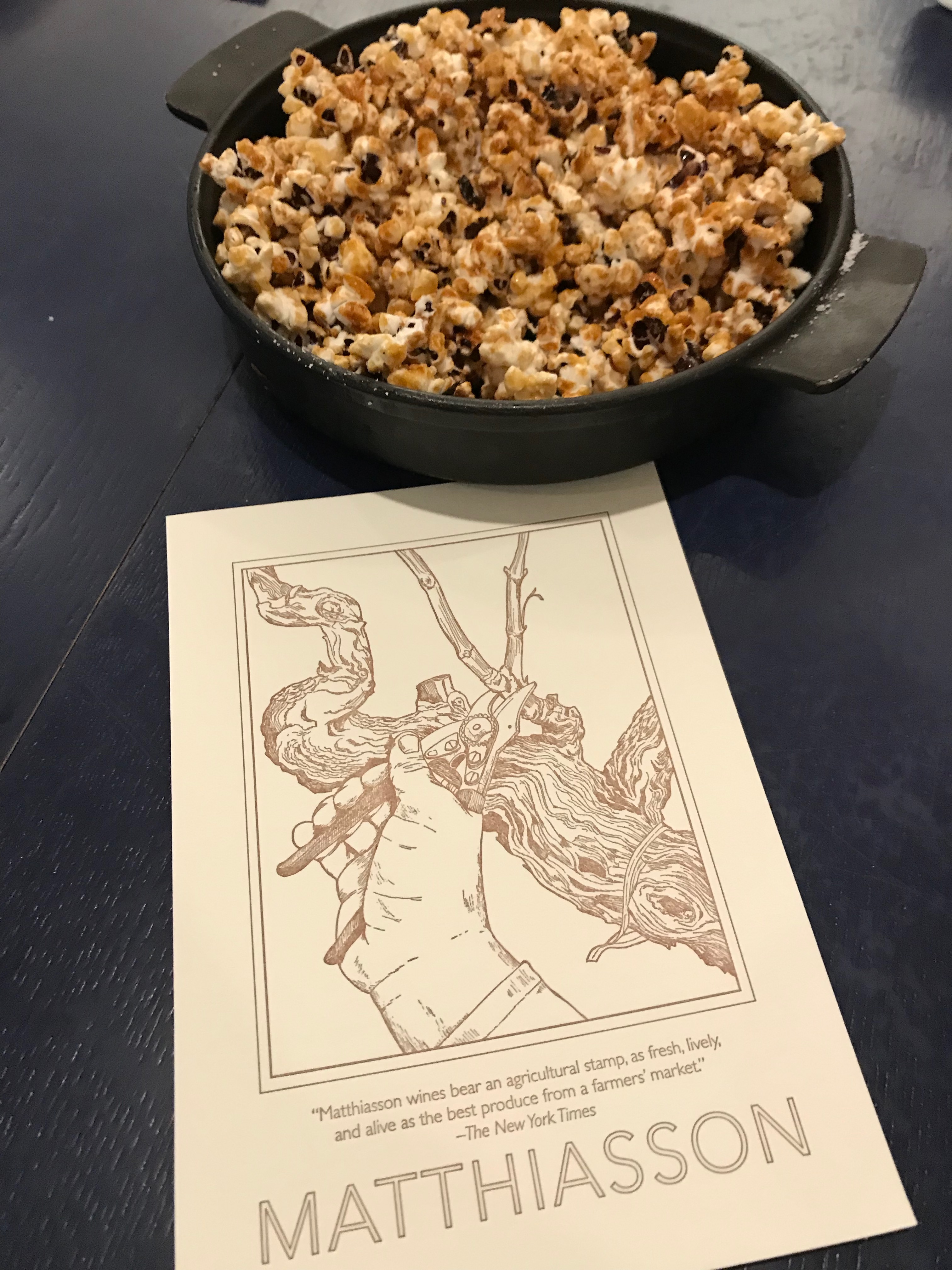
The combination of Corey McIntyre's food and Matthiasson wines is one I won't forget for a very long time. It was wonderful to have Jill Matthiasson at the table to describe the wines and her family’s approach to winemaking.
UPDATE: In response to questions, the food you see is (a) duck fat salted caramel popcorn; (b) carrot and cabbage "barbacoa" on blue corn tortillas, with some amazing queso fresca; (c) scallops and pork tenderloin with some kind of delicious sauce; (d) biscuits with blackcurrants marinated in Matthiasson vermouth with sliced strawberries, candied fennel, and sweet brown butter. AMAZING stuff.



A really special night last night at Milo. (That’s duck fat salted caramel popcorn, which you wouldn’t even believe. And each of the Matthiasson wines was absolutely wonderful.)
nested

I just came across this chart I made for my students a few years ago when we were reading the Arabian Nights — I wanted to show them the layers of nesting of tales.
placeholder for further reflection
- The one central and indispensable axiom of metaphysical capitalism is “I am my own” — I am a commodity wholly owned and operated by myself in service to my own interests, as defined by me. I am my own store of capital.
- Therefore, the socio-political order is to be evaluated strictly in terms of whether it helps or hinders my autonomy.
- Also therefore, questions of political economy are empirical and pragmatic rather than dogmatic. Should I determine that the pursuit of metaphysical capitalism is best aided by economic socialism, then a socialist I shall become.