
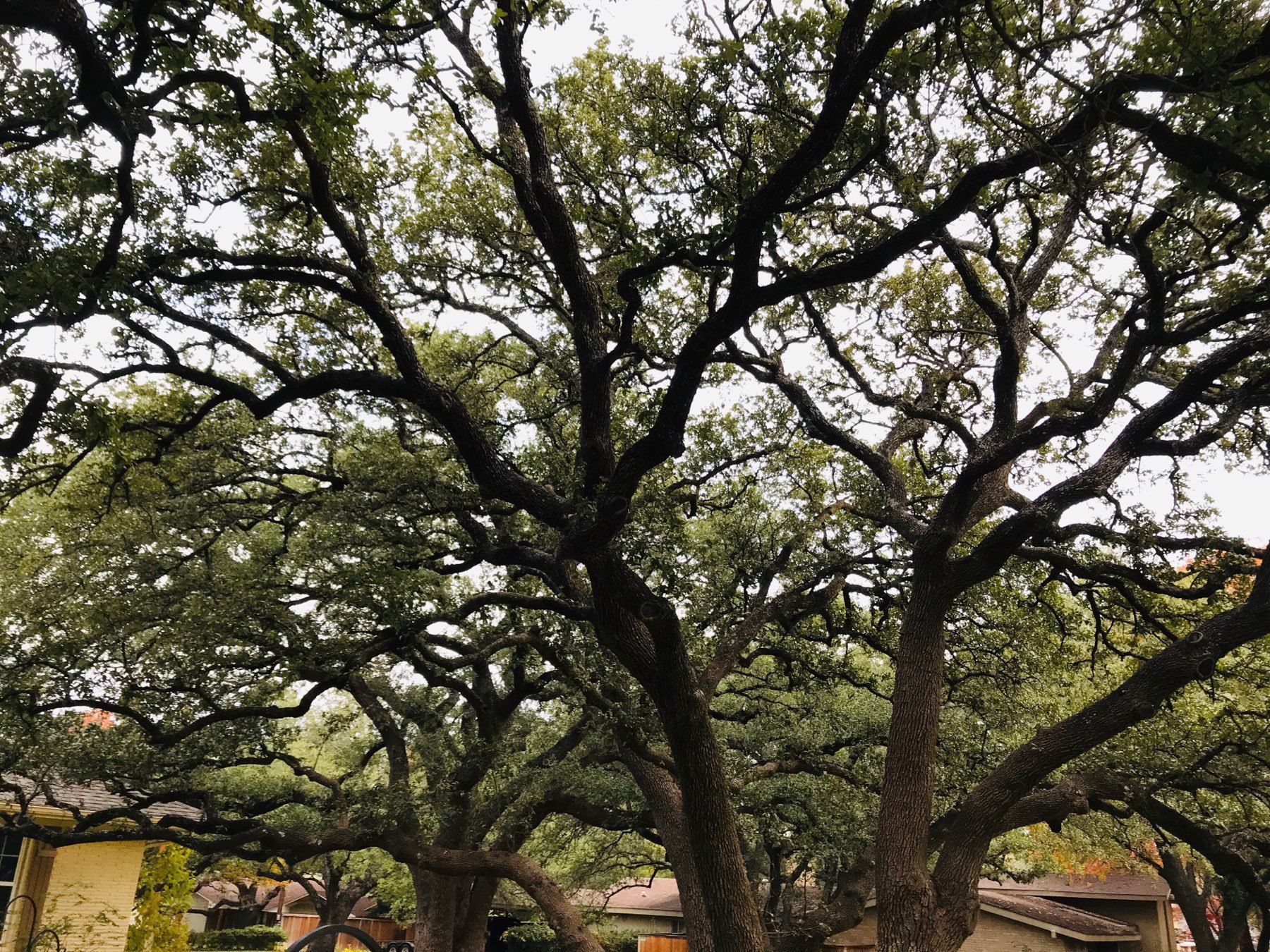

And again.

I seem to have accidentally taken a photograph of a masterpiece of abstract art.

Spanish Is the Loving Tongue

One of the most surprisingly interesting, and moving, moments on Dylan’s More Blood, More Tracks comes on the third disc, when, a few songs in, you suddenly hear the zzzzz of a tape recorder starting up. Apparently the engineer had just realized that something was going on worthy of being recorded.
So we come in near the end of the first verse of “Spanish Is the Loving Tongue.” This is not one of Dylan’s originals: it’s an early-20th-century cowboy poem that was set to music in the 1920s. Almost everyone has recorded it, and Dylan seems to have loved the song deeply. He has played it many times in concert over the years — as YouTube amply demonstrates — and recorded two versions in studios. One of those, done when he had stopped smoking and found that weird crooning voice that you hear, most famously, on “Lay Lady Lay,” just might be the worst recording of his entire career. I can’t even bring myself to link to it.
Here, when the recording engineer flips his switch, Dylan is playing guitar and is accompanied by the bassist Tony Brown and the pianist Paul Griffin. Griffin, by the way, is a remarkable figure. He played with Dylan on his great trio of mid-60s electric albums — you can see him with the whole band here, and there’s an unfortunately tiny photo of him and Dylan here — but he turns up all over American pop music, and often very distinctively. Yes, that’s him on “Just Like Tom Thumb’s Blues,” but that’s also him on Dionne Warwick’s “Walk On By”; that’s him playing electric piano on Steely Dan’s “Peg,” and, perhaps most famous of all, that’s him on “American Pie.” What a career.
Anyway, here he is with Dylan again. Bob has, I suspect, just launched into “Spanish Is the Loving Tongue,” and Griffin and Brown are finding their slots in the song. I’m sure Dylan had no thought of putting it on his new record; he just loved the song and started playing it. And it’s magnificent.
“Spanish Is the Loving Tongue” is a thoroughly inauthentic song. It’s not a real cowboy ballad; it’s belated, imitative. Like “Loch Lomond,” a 19th-century parlor song pretending to be an ancient Scots ballad, it’s completely fake and completely wonderful. And here, fooling around in the studio, Dylan finds something deep inside the song — something emotionally real and raw and utterly compelling.
Dylan and his wife Sara were going through their divorce at this time, and it is almost universal to hear Blood on the Tracks as a breakup record — perhaps the greatest breakup record ever made. In his liner notes for this collection, Jeff Slate notes that Dylan has disavowed such an interpretation, claiming that he got his lyrical ideas for the album from reading Chekhov stories. Slate treats that disavowal as definitive. Please. Blood on the Tracks is the greatest breakup record ever made, and the pain of that divorce is etched into every song. It’s also etched into many of the takes and rehearsals here: I defy you to listen to the first four cuts of disc 1 — two takes of “If You See Her, Say Hello” and two of “You’re a Big Girl Now” — and conclude that they arise from thoughtful reflection on Chekhov.
And all that pain makes its way into this performance of “Spanish Is the Loving Tongue.” Brown quietly accents the melody with his bass, and Griffin finds a wonderfully appropriate groove, like a barrelhouse piano player who’s had too much to drink and is noodling through an old tune before heading off for bed. It’s relaxed and meditative; it sounds almost designedly unprofessional. It perfectly suits the deep melancholy of Dylan’s voice, which gives itself over unreservedly to this sentimental old song and makes of it something unforgettable.
my Zettelkasten

Over the last few years I have adopted, with increasing confidence and pleasure, a new means of organizing my research. For my most recent book and the one I’m working on now, I have developed a version of Niklas Luhmann’s Zettelkasten system, and it it by far the best system of research-based note-taking I’ve employed.
For a long time I hesitated to try the Zettelkasten system because I believed that Luhmann depended on a single system, a single collection of cards that ramified and extended indefinitely. Now, that may not be strictly true, but it was certainly his ideal. And I felt that I had come upon the Zettelkasten model too late in life to adopt it. It would have been wonderful if I had learned about it when I was 30, or even 40, but in my fifties? Too late.
So I thought. But ultimately, when I was working on The Year of Our Lord 1943, I realized that the demands of my research — trying to track the thought and writing of five figures working in complete isolation from one another — called for something like a Zettelkasten system. (It would take a long time to explain why, but it had to do with cross-referencing ideas that were related to one another in a variety of ways: by author, by date, by theme.) Well, I thought, why not have a collection of Zettel that is based not on a lifetime of research but on a single project? So I tried that. And it worked wonderfully.
Now I’m back to work on another book, and again I’m finding Zettel the best way to keep track of quotes and ideas. Don’t Zettel for less than the best, is what I say!
Ahem.
Just a random note before I go further, from Wiktionary:
Early Modern High German zeddel, zedel, from Middle High German zedele, zedel, a loan from Italian cedola, from Medieval Latin cedula, schedula, the diminutive of scheda, scida (“strip of papyrus”), ultimately from Ancient Greek σχίδη (skhídē, “splinter, fragment”).That’s an interesting history, no?
One of the best things about making Zettel is the ability to go back to an old card and add related cards. So if I make a note about Barbara Tuchman’s idea of history as a distant mirror, I can make a note on that, and label it BBD26. (BBD because this project is called Breaking Bread with the Dead.) And then when I come upon a fascinating essay by Daniel Mendelsohn that treats the Aeneid as a kind of “distant mirror” of our own time, I can add a card to that effect and label it BBD26a. And if later still I have a further thought about Mendelsohn’s essay I can add another card and label it BBD26a1; or, if I want to return to the “distant mirror” theme but with reference to a different text, I can label that card BBD26b. And then if I realize that some other card already in my stack treats a similar theme, I can add cross-references at the bottom or on the back of the relevant cards. (This is not quite how Luhmann numbered his cards but it’s what I like to do.)
I could of course use any number of apps to build a digital Zettelkasten, and indeed I have tried, but paper cards work much better for me. I like keeping my text editor in full screen mode in front of me and then arranging the relevant cards around the computer. I like sifting through the pack and being reminded of things I wasn’t looking for (Luhmann thought this proximity to serendipity one of the most important features of his system.) I enjoy “building a deck,” as it were.
And then, when I’m done with this project, I can put all the cards in a box with my other cards, most of which, by the way, are about the books I teach rather than those I write. (Whenever I am preparing for class I make notes about the themes and passages I want to explore on index cards.) By the time I retire, from teaching and writing alike, I’ll have a pretty interesting collection of cards. Nothing like Luhmann’s, but interesting. Something to look over between sips of my well-earned single malt….
maintaining lines of connection
I feel like I want to see some more thought around getting the fuck off social networks but being able to maintain lines of connection between friends, comrades and fellow-travellers in addition to the Republic Of Newsletters and the Isles Of Blogging. Status pages as the signals from the Invisible Monastery, or, possibly, Hobo Code marks on the walls of the web. Planning for the oncoming dark age?I’ve been getting a good many ideas from Ellis lately: he mentions here status pages, for the second time in a week, and I decided to make one — there a link to it at the bottom of my home page. And status pages are indeed nice — I wish more of my friends had them — but they do sort of belong to the monastic world, the world of people who need to hole up for long periods of time to get work done but don’t want to be hermits.Radio beacons.
I dunno. I feel like it’s either a fragment of an idea for maintaining connections while routing around toxic internet, or it’s MySpace pages.
But if you’re somewhere between being a monk and being an incessant chatterbox, it’s hard to know what to do, online anyway.
Here’s what I’m doing now: I still see Twitter and Instagram occasionally, but it’s very occasionally. I have Freedom set up to block those apps, on all my devices, for all but two hours each day (an hour in the morning and another in the evening). And that’s sufficient — more than sufficient: there are days when I forget to check either of them. I post to my blog and my micro.blog, and those posts get auto-cross-posted to Twitter.
As much as I still love, and will always love, RSS, I have purged it of almost all news and current-events sites. I have unsubscribed from all newspapers — though I get free access to the WSJ through Baylor — and try to get my news through weekly and monthly magazines. That’s much saner. I subscribe to a dozen or so newsletters, but for me, newsletters are just not All That.
Overall I am reading more codex and less internet.
But I never have stopped missing the friendships I used to experience through Twitter. For a while I tried chatting with people on micro.blog, but that didn’t work — which may be because I just don’t have the knack of social-media chatting any more, but also may be because people have learned certain discursive habits from Twitter and Facebook that they then bring to every other platform, and I don’t like those discursive habits. In any case, for now I’m just posting to micro.blog and not trying to converse. Maybe that will change. Or maybe I’ll move everything back to the blog. Time will tell.
My guess is that social media are dead to conversation and conversation on them cannot be revived. But if that’s true, how to “maintain lines of connection between friends, comrades and fellow-travellers” while “routing around the toxic internet”? That is indeed the question, and I don’t have a clue how it might be answered. I suspect that there is no answer: that it’s the toxic internet or hermetic life or, for those who are blessed, what Auden called “local understanding.” And if so, though I don’t want to be a hermit, I’d definitely prefer that to trying, yet again, to talk to strangers on social media.
Anyway: like Ellis, I am waiting and hoping for ideas. Maybe a revival of listservs? That’d be way better than Slack.
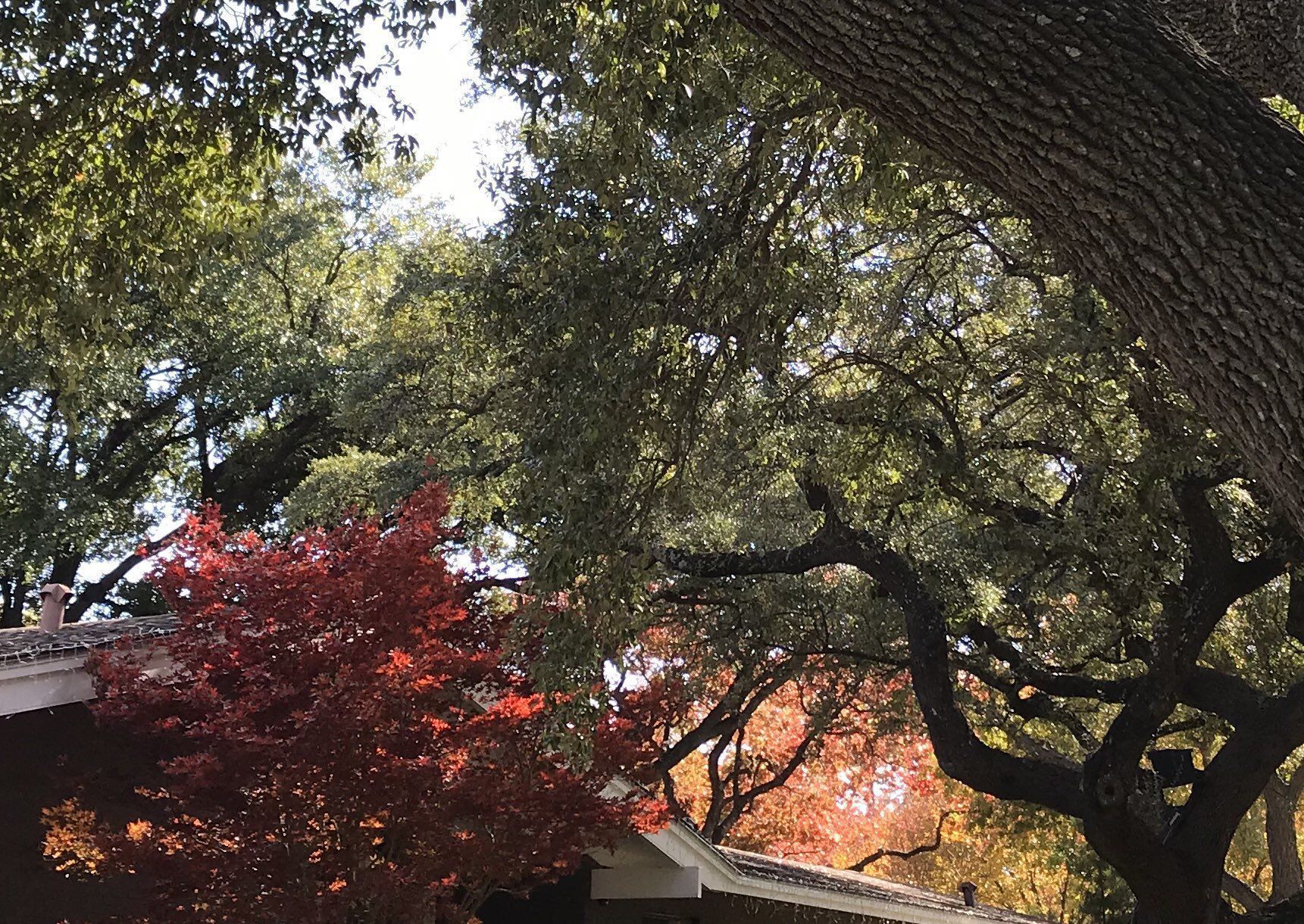
We’re not completely without autumn color here in central Texas. (No filters.)



totalitarian presentism
Senator Ben Sasse doesn’t read modern fiction, only old books, and people on social media are getting seriously freaked out.
Let’s stop and think about this. Sasse’s day job requires him to spend dozens of hours a week immersed in the affairs of the moment. When he turns on his TV: affairs of the moment. When he ferries people around as an Uber driver, he hears about people’s take on the affairs of the moment. When he listens to the radio: affairs of the moment. When he’s on social media: affairs of the moment. But if, in his leisure hours, he wants to read old books, he’s THE WORST. He has committed the unpardonable sin.
It is not enough for many people that they be so utterly presentist in their sensibility that their temporal bandwidth is a nanometer wide. Everyone must share their obsession with the instant. No one may look to other times. It’s not just presentism, it’s totalitarian presentism.
Yeah, I really do need to write this book.
This is going to be hard to believe, but these pastries from @milowaco taste just as good as they look.

race and ethnicity in the Potterverse
Race and ethnicity are pretty weird in the Potterverse because of the peculiar ways that fictional world overlaps with our own. This weirdness emerges frequently in Fantastic Beasts: The Crimes of Grindelwald, as my friend Adam Roberts recently commented to me. What follows is an expansion of my response to Adam.
Consider Lela Lestrange: a member of a family notorious for its obsession with purity of wizarding blood, and yet also a mixed-race woman. If you were reading her story in a book, you’d be able to focus on her pure-blood status; watching her in a movie, you are continually reminded of the color of her skin and how it differs from that of the very white Scamander boys who love her.
Or think of Nagini: a Maledictus, a woman under a curse that transforms her into a snake, a woman (we are told) from Indonesia — and who is played in the film by a South Korean actress. That she is a Maledictus is the only thing that matters in the context of the story; but that may not be the only thing that viewers see.
Strangest of all, note this scene: a group of Aurors from various Ministries of Magic find themselves in the midst of a rally led by Gerrit Grindelwald. There is also among them one Muggle, Jacob Kowalski, and one might think that he would be especially frightened and endangered, since Grindelwald’s message is implicitly anti-Muggle. (Grindelwald keeps saying that he doesn’t hate Muggles, that he only wants wizards to live freely in the open — to have Lebensraum, one might say — but come on.) Yet when the camera looks away from Grindelwald, it tends to linger on the anxious face of one of our lead characters, Tina. Why is she so anxious?
The immediate and obvious reason is that she is an Auror, and Grindelwald has just announced to the crowd that there are Aurors among them. (This leads one witch to pull her wand threateningly on someone she perceives to be an Auror, which leads in turn to his killing her — an event which suits Grindelwald’s purposes very nicely, because it allows him to portray his movement as a peaceable one, its members constantly under threat from the violent policing of the magical world’s official bodies.) So Tina could well be fearful that the crowd will turn on her.
Might there be another reason for her to fear? Well, the sleuths of Potter fandom have discovered that she is a half-blood. (Their primary evidence: this.) Does that make her vulnerable among Grindelwald’s supporters? Maybe not: so far he has not sounded the pure-blood clarion the way Voldemort will later do — at least, not that I recall. His emphasis is strongly on the Magic-Muggle dichotomy. So maybe half-blood status doesn’t matter. Yet.
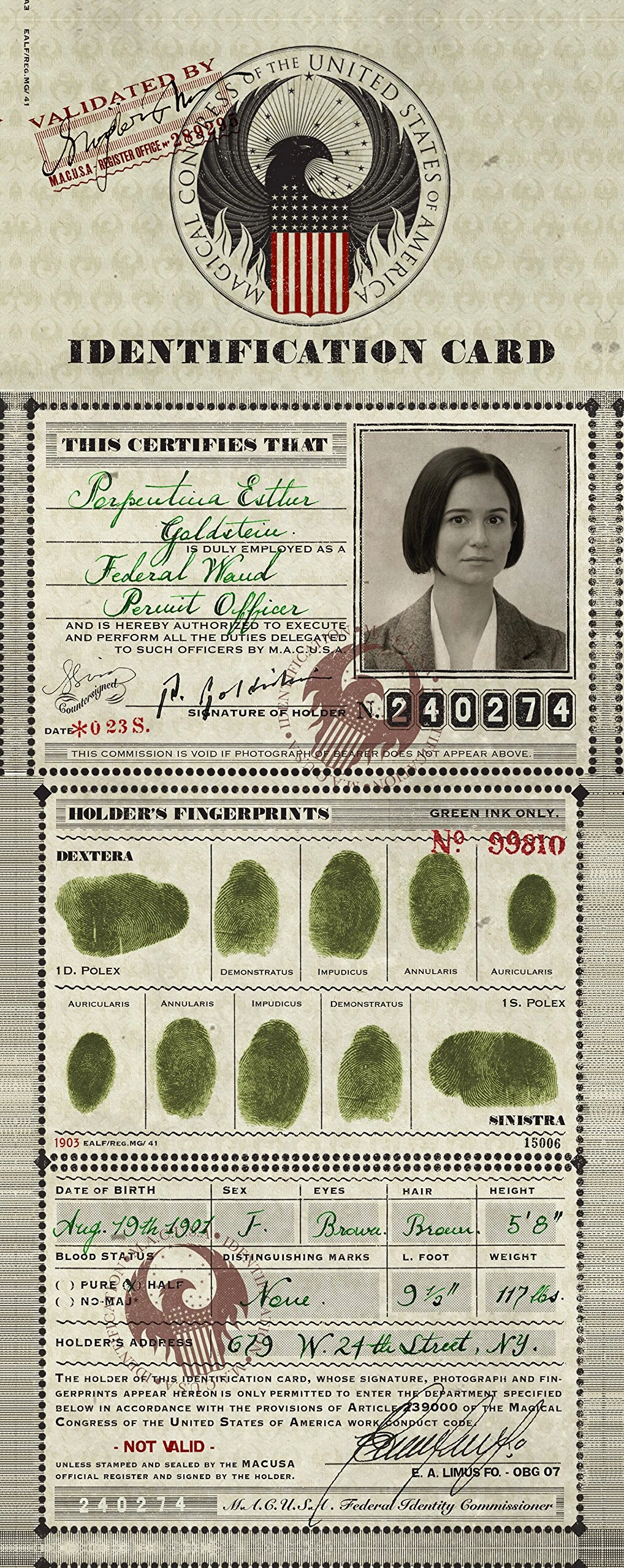
But then there’s this: Tina’s full name is Porpentina Goldstein, something that’s very hard to forget when she stands in a crowd of people who follow the extravagantly Aryan Grindelwald. Does being Jewish matter in the wizarding world? Do the various prejudices and racial identifications that do such powerful work in our Muggle world have any purchase among the magical? The general tone and tenor of the Potterverse would suggest not, but at moments like these….
Adam Roberts also recently pointed me to a series of poets by Phil Edwards on Rowling’s worldmaking. Edwards posits a rough taxonomy of fantasy worlds — the nuts-and-bolts, the numinous, and the satirical/polemical — and suggests that the Potterverse is “a hazy amalgam of all three, covered by repeated register-switching between them.” This seems right to me, and it helps to explain why the racial logic of our social order keeps floating in and out of view. It’s a rather disorienting phenomenon.
To some extent this kind of thing happens in all Fantasy — thus the permanent tendency of readers to see The Lord of the Rings as an allegory of the Second World War, and thus also Tolkien’s endless frustration with that reading. In Edwards’s terms, Tolkien had, he thought, done enough nuts-and-bolts work to rescue his story from such easy analogies. But Rowling seems positively to court such allegorical readings — only to swerve away from them later.
the call to maintenance
I’m full of ideas after reading this amazing essay by Shannon Mattern, “Maintenance and Care: Fixing a Broken World”:
In many academic disciplines and professional practices — architecture, urban studies, labor history, development economics, and the information sciences, just to name a few — maintenance has taken on new resonance as a theoretical framework, an ethos, a methodology, and a political cause. This is an exciting area of inquiry precisely because the lines between scholarship and practice are blurred. To study maintenance is itself an act of maintenance. To fill in the gaps in this literature, to draw connections among different disciplines, is an act of repair or, simply, of taking care — connecting threads, mending holes, amplifying quiet voices.Mattern links to the site of The Maintainers, who set themselves in ironic opposition to “the innovators”:
“Innovation” has become a staple of analysis in popular histories – such as Walter Isaacson’s recent book, The Innovators: How a Group of Hackers, Geniuses, and Geeks Created the Digital Revolution.This converges with David Edgerton’s marvelous book The Shock of the Old, with its account of how familiar technologies get continually renewed and repurposed, but also resonates with the great call of Tikkun olam: the repair, the renewal, the maintenance, of the world.The Maintainers is a global, interdisciplinary research network that takes a different approach, one whose conceptual starting point was a playful proposal for a counter-volume to Isaacson’s that could be titled The Maintainers: How a Group of Bureaucrats, Standards Engineers, and Introverts Made Technologies That Kind of Work Most of the Time.
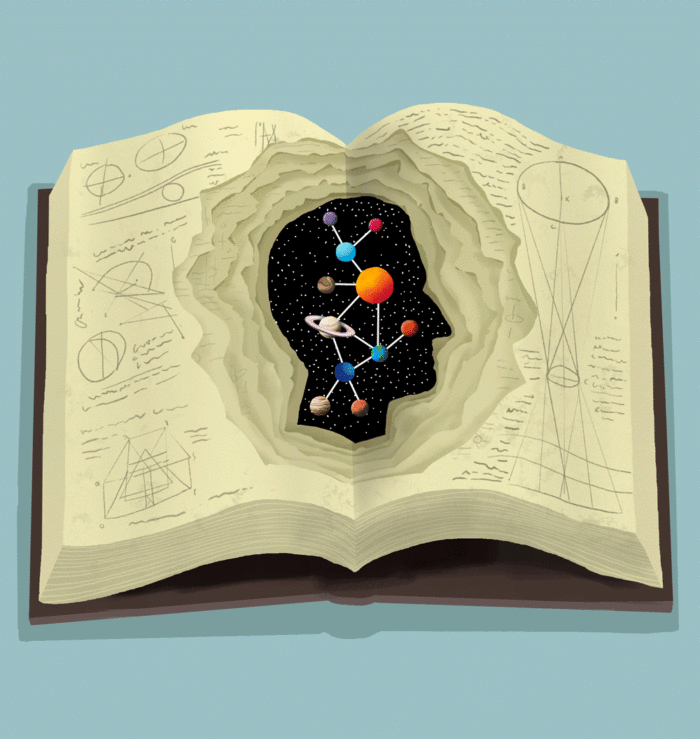
As a Christian and a professor of humanities, I find all this especially intriguing because it offers a subtle but vital correction to more familiar ideas of “conserving” or “upholding” a tradition. Traditions, seen from the perspective of a Maintainer, need active caring for. They must be kept in constant repair. To put them away in glass cases is to render them useless, so they must be taken out and used, but that exposes them to wear and tear to which the Maintainer must always be sensitive. They must be actively tended to, like an internal combustion engine, or a garden. There’s a whole Theory of Life here. Or my life, anyway.
what I hear in church
The Episcopal Church, on the other hand, couldn’t trick me with promises of divinely ordained succession or sharply define anything that happened in any given sacrament. I appreciated the humility about what we could know and the sense of contingency. Everything could have been different, but this is how things turned out. The Book of Common Prayer was beautiful, its language homely in the most exalted meaning of the term. It was human-sized.— B. D. McClay. If that’s what I had learned in Anglican churches — that I shouldn’t trouble God, that there’s nothing to touch and nothing to consult, that I shouldn’t or can’t reach toward a God who reaches toward me (or maybe doesn’t), that if I crossed “some bright red line” my sins would be mine to bear, without the hope of forgiveness — then I might well be a Catholic too. Certainly I wouldn’t be an Anglican.But alongside this humility, there was something else, a kind of stiff-necked quality — attractive at the human scale but less so when applied to the divine. Don’t trouble God, he’s busy and has other things to do; no hysterical weeping, no over-the-top saints, nothing to touch, nothing to consult. Mary, when she’s present, stays decently off to the side. Instead of reaching over the gap toward a God who reaches back to you, you quietly stay in your place.
And if you cross over some bright red line, that’s it. Your sins are yours to bear. There’s nothing else that can be done for you. Assessing what you’ve done and what to do about it are up to you. Up to you to figure out when you’d done enough. But you won’t ever do enough, and you’ll never be forgiven. And why, with all the advantages afforded to you, and with the harm you will always have done, should you be?
But when I go to church, I (with the rest of the congregation) ask for God’s forgiveness, and then the priest says these words to me:
Almighty God, our heavenly Father, who in his great mercy has promised forgiveness of sins to all those who with heartfelt repentance and true faith turn unto him: have mercy on you, pardon and deliver you from all your sins, confirm and strengthen you in all goodness, and bring you to everlasting life, through Jesus Christ our Lord. Amen.And then that priest says to me the Comfortable Words, which conclude with this sentence from St. John: “If any man sin, we have an Advocate with the Father, Jesus Christ the righteous; and he is the perfect offering for our sins, and not for ours only, but for the sins of the whole world.” And that’s what I count on.
To any churches out there that proclaimed the message that B. D. McClay heard, and that brought her so much pain: great is your sin.
I love pretty much everything about Anglican worship, but I have a special fondness for the procession.





Tim Larsen on John Stuart Mill
My friend Tim Larsen has written an absolutely fascinating brief biography of John Stuart Mill. (It appears in the Oxford Spiritual Lives series, of which Tim is also the editor.) Everyone knows that Mill had little time for or interest in religion, and that his father James Mill, aide-de-camp to that great enemy of faith Jeremy Bentham, was even more hostile than JSM himself. Given JSM’s secular and rationalist upbringing, it cannot be surprising that, as he put it, “I looked upon the modern exactly as I did upon the ancient religion, as something which in no way concerned me. It did not seem to me more strange that English people should believe what I did not, than that the men I read of in Herodotus should have done so.”
However, as Tim shows convincingly, this statement is seriously misleading to the point of being simply untrue. The same must be said for the familiar family story. James Mill was a licensed preacher and had turned to the life of a writer and public intellectual only after failing to get the kind of pastoral position he thought he was qualified for — a fact he carefully hid from his children — and probably didn’t become a complete unbeliever until he was in his mid-forties, by which point JSM was already a ten-year-old, or older, prodigy. James’s wife Harriet was a Christian, each of their nine children was baptized in the Church of England, and probably only two of them (JSM and his youngest sibling George Grote) departed in any significant way from standard-issue Victorian religion. JSM grew up learning not only the Bible but the worship of the Church of England. Nothing about that religion was strange to him.
Moreover, Tim also demonstrates that throughout the course of his life JSM held to a minimal but stable theology, which he summarizes thus:
Even from a scientific point of view and without any intuitive sense or direct experience of the divine, there is still sufficient evidence to warrant the conclusion that God probably exists; God is good, but not omnipotent; the life and sayings of Christ are admirable and deserve our reverence; the immortality of the soul or an afterlife are possible but not certain; humanity’s task is to co-labour with God to subdue evil and make the world a better place; the affirmations in the previous points such as that God exists and is good cannot be proven, but it is still a reasonable act to appropriate these religious convictions imaginatively not he basis of hope.(One of the most interesting parts of Tim’s book is his exploration of the potent role “hope” played in Mill’s moral and intellectual lexicon.) There is much more than I might comment on, especially Mill’s alliances with evangelical Christians in his campaign for the rights of women — his rationalist friends were generally cold to this idea — and the interestingly varied religious beliefs of his family, but I will just strongly suggest that you read the book. Its subtitle is “A Secular Life,” and JSM’s life was indeed secular, but not in a modern sense. As Tim puts it, in the Victorian era, even for atheists “the sea of faith was full and all around.”