
thanks and a plea
I’m already getting some emails in response to my earlier post, and they’re incredibly generous and kind. The message tends to be: Your writings do make a difference, so please write that book! Again, that’s amazingly kind, and God bless y’all for the support. But at the risk of sounding totally ungrateful and churlish, I have to admit that that’s just the response I was afraid I would get. Afraid, because that’s a message that encourages me to consider results and effect — the kinds of considerations that are always subject to counter-evidence, and to unhealthy externalizations of the motives for writing. What I need instead is to think — and to take plenty of time to think — of what I need to do, of what projects I myself most completely believe in. Simply put: I am past the point in my career at which I can write books because other people want them. So if you would like for me to keep writing books, and if you would I bow before you, then maybe instead of exhorting me you might pray for me? If you did I would be even more in your debt.
Episcopalian exclusionism
It is worrisome that despite the soaring temperatures of Austin, the current Prayer Book conversations take place in an ecumenical winter. There are numerous important reasons why things have changed in our dialogues with other groups since the 1960s and ’70s, but a profound question remains largely untouched in this debate: How will our liturgy reveal and help create the unity of the Body of Christ, whose relationship with the Episcopal Church is, well, inexact and incomplete?McGowan here identifies what I think is most worrisome about the current push for revision of the BCP: it is radically exclusionist. The Orthodox don’t matter, Catholics don’t matter, Anglicans outside of the U.S. don’t matter, non-revisionist Episcopalians don’t matter. Literally no one in the world matters except the revisionists themselves.This shouldn’t mean we just borrow the insights of other traditions as ritual toys. One of the faintly tragic elements on display in the 1979 Prayer Book are the numerous borrowings from Orthodox liturgy, which reflect not just scholarly knowledge, but prayerful conversations with Russian and Greek scholars of the mid-20th century who were then genuine dialogue partners. It is hard to find such engagement with eastern Christianity in the Episcopal Church now, beyond the somewhat hollow testimony of facsimile icons in Church bookstores.
ages of revolution
If a man in the fullness of his days, at the end of his life, can pass on the wisdom of his experience to those who grow up after him; if what he has learned in his youth, added to but not discarded in his maturity, still serves him in his old age and is still worth teaching the then young — then his was not an age of revolution, not counting, of course, abortive revolutions. The world into which his children enter is still his world, not because it is entirely unchanged, but because the changes that did occur were gradual and limited enough for him to absorb them into his initial stock and keep abreast of them. If, however, a man in his advancing years has to turn to his children, or grandchildren, to have them tell him what the present is about; if his own acquired knowledge and understanding no longer avail him; if at the end of his days he finds himself to be obsolete rather than wise — then we may term the rate and scope of change that thus overtook him, “revolutionary.”
— Hans Jonas, from Philosophical Essays (1974), p. 46
soccer and the impediments to success
Soccer is beautiful because soccer is hard. Most popular sports artificially enhance the human body. Soccer diminishes it. Instead of giving players a bat, a racket, protective armor, or padded gloves — tools that allow players to reach farther, return a ball faster, absorb harder hits, or hit harder themselves — soccer takes away players’ hands. It prohibits the use of the nimblest part of the body, and then it says, “Be nimble.” Moreover, because the action in soccer so seldom stops, because there are so few moments when play resets to a familiar starting point, soccer requires players to work within the limitations it imposes for much longer, and through many more situational complications, than other sports.This is perfect. I might suggest that Brian’s description pairs nicely with the account of the offside rule, and the emergent complexity of on-pitch action, I give here.Clumsiness and confusion are thus inherent to the game, and this is soccer’s perverse genius, because what happens when you force people to move a ball around in a highly unnatural way is that they find a way to do it. Human ingenuity and talent manage to outwit the restrictions the game places on them. And when this happens at a high enough level — when a goal is scored after a breathtaking run, or when a series of one-touch passes makes it seem as though players are telepathically linked — then what results is beauty, because creativity and grace have momentarily overcome the forces that oppose them.
and he cried when he realized that there were no more stars to exploit
The cosmic horizon is changing. Hooper has worked out how this will affect our neighborhood in the universe, which astronomers call the Local Group. This is the set of about 50 nearby galaxies that are gravitationally bound to the Milky Way and on course to collide sometime within the next trillion years to form a single supergalaxy. Consequently, the Local Group will be humanity’s home for the foreseeable future. Over billions of years, we might even colonize it, hopping from one star system to another and exploiting each sun’s energy along the way.I have to say, this concern is high on my list also: the possibility of running out of stars for human beings to exploit.However, the accelerating expansion of the universe is sending galaxies over the horizon at a rate that is increasing. “As a result, over the next approximately 100 billion years, all stars residing beyond the Local Group will fall beyond the cosmic horizon and become not only unobservable, but entirely inaccessible,” says Hooper.
That’s a problem for an advanced civilization because it limits the number of new stars that are available to exploit. So the question that Hooper investigates is whether there is anything an advanced civilization can do to mitigate the effects of this accelerating expansion.
More seriously, I am bemused by this line of thinking. Billions of humans live in poverty, are daily endangered by hunger or disease or war; we lack a cure for cancer — we lack a cure for the common cold — we lack a cure for male pattern baldness —; and yet there are people worrying that we will eventually have no more stars to plunder to satisfy our energy demands.
Well, enough of this. Time for me to get back to planning the first year of my reign as God-Emperor of Terra. Because it could happen, you know, and I’d rather not be caught unprepared.
Milton’s God (and Google’s)
What is God? It is only a subject that has inspired some of the finest writing in the history of Western civilization—and yet the first two pages of Google results for the question are comprised almost entirely of Sweet’N Low evangelical proselytizing to the unconverted. (The first link the Google algorithm served me was from the Texas ministry, Life, Hope & Truth.) The Google search for God gets nowhere near Augustine, Maimonides, Spinoza, Luther, Russell, or Dawkins. Billy Graham is the closest that Google can manage to an important theologian or philosopher. For all its power and influence, it seems that Google can’t really be bothered to care about the quality of knowledge it dispenses. It is our primary portal to the world, but has no opinion about what it offers, even when that knowledge it offers is aggressively, offensively vapid.If Harold Bloom or Marilynne Robinson had engineered Google, the search engine would have responded to the query with a link to the poet John Milton, who is both challenging on the subject of God and brave on the subject of free speech—and who would have been a polemical critic of our algorithmic overlords, if he had lived another four hundred years.
The Rings of Saturn
On Monday Robert Macfarlane will be hosting a Twitter book club on W. G. Sebald’s The Rings of Saturn, which is one of the most compelling and memorable books I have ever encountered. I’ve read it three times now and hope to read it at least twice more.
Years ago, in the first flush of my fascination with it, I bought a copy and sent it to Frederick Buechner, who, if you don’t know, is one the best writers of English now living. He read it, and wrote back to say, “I have no idea what any of that means but it is absolutely mesmerizing.” Which is a pretty good summary.
the Ministry of Amnesia
I’ve just read, with great interest, John Lanchester’s latest essay on the global financial situation, and as always, Lanchester is informative, precise, lucid, and compelling — though maybe not wholly compelling. At one point he writes,
Remember that remark made by Robert Lucas, the macroeconomist, that the central problem of depression prevention had been solved? How’s that been working out? How it’s been working out here in the UK is the longest period of declining real incomes in recorded economic history. ‘Recorded economic history’ means as far back as current techniques can reach, which is back to the end of the Napoleonic Wars. Worse than the decades that followed the Napoleonic Wars, worse than the crises that followed them, worse than the financial crises that inspired Marx, worse than the Depression, worse than both world wars. That is a truly stupendous statistic and if you knew nothing about the economy, sociology or politics of a country, and were told that single fact about it – that real incomes had been falling for the longest period ever – you would expect serious convulsions in its national life.Right — and yet — there aren’t any “serious convulsions” in the UK, or the USA for that matter, are there? Lanchester also writes, “In the US there is enormous anger at oblivious, entitled, seemingly invulnerable financial and technological elites getting ever richer as ordinary living standards stay flat in absolute terms, and in relative terms, dramatically decline.” But is the anger really so enormous? I’d say there’s not nearly as much as there ought to be, or that one would (as Lanchester suggests) expect there to be.
And many of the people who have been hit hardest by an economic system in which, Lanchester rightly says, the rich in pursuing with laser-focus their own further enrichment “have seceded from the rest of humanity,” say almost nothing about that situation but wax eloquent and wroth about the supposedly imminent danger of their being murdered by vast roaming gangs of illegal immigrants. Brexit and Trump are not about fixing economic inequality — which is why Trump’s version of populism has almost nothing to do with the “Share Our Wealth” vision of Huey Long, back in the day, but rather focuses with a passionate intensity on stoking fear of anyone and everything not-American.
So why is that? Why, though certainly there is some anger at the global-capitalist system, is there, relative to reasonable expectations, so little? Why don’t people care that, since the massively reckless incompetencies of 2008, almost nothing has changed? (Lanchester documents the insignificance of the changes very thoroughly.)
The first answer is that almost nobody — almost nobody — remembers what happened in 2008. And why don’t they remember? Because of social media and smartphones.
I cannot, of course, provide documentary proof for that claim. But as the Marxists used to say I believe it is no accident that the shaking of the foundations of the global economy and “the longest period of declining real incomes in recorded economic history” happened just as the iPhone was taking serious hold on the imagination of the developed world, and Facebook and Twitter were becoming key components of everyday life in that world. On your smartphones you can get (a) a stream of prompts for visceral wrath and fear and then (b) games and distractions that accomplish the suddenly-necessary self-soothing. Between the wrath and fear and the subsequent soothing, who can remember what happened last week, much less ten years ago? Silicon Valley serves the global capitalist order as its Ministry of Amnesia. “What is it I was so concerned about?”
re-reading Trollope
I am re-reading the Palliser novels, for the first time in 20 years, which means I have largely forgotten what happens in them, and I am reminded that Trollope really is the most underrated novelist in the world. The casualness of his manner, and his intermittent insistence is that he is telling simple and insignificant stories, disguise from us just how penetrating his mind was, how clearly he sees the inmost workings of his characters’ lives, and how justly he deals out condemnation and mercy alike. I’m reading Can You Forgive Her? right now, and there is an extraordinary moment when George Vavasor has entered Parliament, having run a successful race thanks to the money he has extracted from his cousin Alice, whom he has manipulated into agreeing to marry him though he knows perfectly well that she does not love him. So when he comes to see her immediately after his election, he begins by thanking her for her financial contribution to his success – thanks which she does not want – but then strives to extract from her some expression of affection which she knows she does not feel. And Trollope pauses in the middle of George’s conversation with Alice and says, with brutal simplicity, “He should have been more of a rascal or less.” It’s one of the most devastating comments that any novelist has made about one of his characters.
George wants to be treated as an honorable man without being one. He wants Alice to give him credit for virtues and intentions which he has in a thousand ways made it clear that he does not possess. He insists upon being given credit for traits which as soon as he walks away from her he repudiates mockingly. He should have been more of a rascal or less. He should have frankly acknowledged the terms on which he and Alice have come to an agreement, or realized that he desperately needed to amend his life. But he does neither, and by doing neither makes himself and Alice equally miserable.
Can You Forgive Her? contains plenty of the broadish comedy that Trollope did so well – the protracted attempts of the farmer Mr Cheeseacre to woo the widow Greenow really are funny, even if there is more of it than one might think ideal – but the effect of these scenes is primarily to relieve the tension of what in other respects is a rather agonizing novel to read. Some may think “Ah, well, we know that everything will turn out all right in the end” – but we do not know that, not in a Trollope novel. Some of his most appealing and memorable characters (Lady Laura Kennedy, Lily Dale) do not receive the eucatastrophic resolution we would rightly expect from a lesser writer. If you know that, you know that you cannot simply expect a happy ending for his protagonists.
Which makes it all the more delightful when they get one.
Principalities, Powers, and BLM
For the most part, BLM activists – like the post-1965 SNCC activists, the Black Panther Party, and assorted other radical black groups before them – exhibit little interest in, or comprehension of, the larger lessons of history. This is because they lack the deep spiritual and moral insight that must be the grounding for any sustainable movement. Having rejected the God of their fathers, they have also rejected the fatherhood of God.This philosophical rejection is an act of spiritual and cultural suicide. Failure to discern the demonic character of white supremacy limits these activists’ ability to understand the fight they are engaged in, and hinders their efforts to develop long-term strategies. They can only describe the sadistic violence they witness and never fully understand or conquer it, so long as they ignore its spiritual source.
More importantly, they fail to use the only means of combatting the demonic: intercessory prayer. Instead, they are easily sucked into the spirit of the demonic themselves as they resort to violence, anger, and hate – a failing less common in the BLM movement than in Antifa, though the danger applies to both.
signed with that cross
African-American Christianity has continuously confronted the nation with troubling questions about American exceptionalism. Perhaps the most troubling was this: If Christ came as the Suffering Servant, who resembled Him more, the master or the slave? Suffering-slave Christianity stood as a prophetic condemnation of Americas obsession with power, status, and possessions. African-American Christians perceived in American exceptionalism a dangerous tendency to turn the nation into an idol and Christianity into a clan religion. Divine election brings not preeminence, elevation, and glory, but — as black Christians know all too well — humiliation, suffering, and rejection. Chosenness, as reflected in the life of Jesus, led to a cross. The lives of his disciples have been signed with that cross. To be chosen, in this perspective, means joining company not with the powerful and the rich but with those who suffer: the outcast, the poor, and the despised.
where citizens were, there shall users be
The real problem is that [the scooters] just appeared out of nowhere one day, suddenly seizing the sidewalks, and many citizens felt they had no real agency in the decision. They were here to stay, whatever nonusers felt about them.Which was all by design. The scooter companies were just following Travis’s Law. In Santa Monica, Bird’s scooters appeared on city streets in September. Lawmakers balked; in December, the city filed a nine-count criminal complaint against Bird.
Bird responded with a button in its app to flood local lawmakers with emails of support. The city yielded: Bird signed a $300,000 settlement with Santa Monica, a pittance of its funding haul, and lawmakers authorized its operations.
If you love the scooters, you see nothing wrong with this. But there was a time, in America, when the government paid for infrastructure and the public had a say in important local services. With Ubers ruling the roads, Birds ruling the sidewalks, Elon Musk running our subways and Domino’s paving our roads, that age is gone.
The Atomic Theory of Human Life
To me, the most interesting and significant element of the opposition to Amy Coney Barrett is the inability of some of her critics to achieve even the most basic comprehension of the character of an organization like People of Praise. Many Americans are so thoroughly catechized into the Atomic Theory of Human Life — the belief that all significant life-decisions are properly made by autonomous monads, with only the State to set boundaries and provide a safety net — that a genuinely functional community, in which some of the burdens of decision-making are distributed throughout a network of people bound to one another by mutual affection, can only be seen as a “cult.”
Alan Jacobs is a writer who
Alan Jacobs is a writer who has a degree of talent in this app that I would love for you haven’t heard anything from the app that I would love for you haven’t seen you haven’t been able for you a couple weeks was a couple weeks is a couple weeks I would like a couple more opportunities for y’all and I will make you happy again if I can get it done
a position in life
It happens that I have practically some connexion with schools for different classes of youth; and I receive many letters from parents respecting the education of their children. In the mass of these letters I am always struck by the precedence which the idea of a "position in life" takes above all other thoughts in the parents'—more especially in the mothers'—minds. "The education befitting such and such a STATION IN LIFE"—this is the phrase, this the object, always. They never seek, as far as I can make out, an education good in itself; even the conception of abstract rightness in training rarely seems reached by the writers. But, an education "which shall keep a good coat on my son's back;—which shall enable him to ring with confidence the visitors' bell at double-belled doors; which shall result ultimately in establishment of a double-belled door to his own house;—in a word, which shall lead to advancement in life;—THIS we pray for on bent knees—and this is ALL we pray for." It never seems to occur to the parents that there may be an education which, in itself, IS advancement in Life;—that any other than that may perhaps be advancement in Death; and that this essential education might be more easily got, or given, than they fancy, if they set about it in the right way; while it is for no price, and by no favour, to be got, if they set about it in the wrong.
— John Ruskin, Sesame and Lilies. I know a number of people who work to recruit students to Baylor (where I now teach) and to other universities, and they have commented that it is virtually impossible to get parents interested in what kind of education, what kind of experience, their children will have in their undergraduate years. Parents only want to know whether their children will get into medical school or dental school or law school -- the four years of undergraduate education are simply a very large hurdle to be leaped over to get to that STATION IN LIFE that they want for their children. Many, many parents do not care one iota about what their offspring will actually do and read and think between the ages of 18 and 22, as long as whatever it is helps (or at least does not impede) their admission to professional training.
Update: I should add that I don’t blame the parents for this — they’re being asked to pay a shocking amount of money for their children’s education, and they are desperately hoping for a return on investment. I get that. But when your job is to teach those young people, the situation is regrettable — especially since so many of the students have adopted the attitudes of their parents.
the social utility of religious freedom
Reading this post by Rod Dreher, which considers (among other things) the extent to which overt hostility towards tradition-minded Christians is a product of the Trump years or, by contrast, predates the current shitstorm -- spoiler alert: it's the latter -- I was reminded of a conversation I had on Twitter some years ago with a friendly, easygoing academic acquaintance. I had posted something in relation to religious freedom, and he replied along these lines: I just want you to know that religious freedom is not something I see any value in.
I said, You know religious freedom is deeply embedded in the Constitution, right? And of course he did. And that it's a key part of the United Nations Universal Declaration of Human Rights? Yeah, he knew that too. I don't expect legal commitments to religious freedom to go away any time soon, he said, but I wish I could get rid of them. They have negative social utility.
The conversation has stuck with me primarily because, as I noted above, this is a perfectly friendly and easygoing guy, and someone that I am confident strives to treat all his students fairly, even when they're Christian fundamentalists. But if he could wave a magic wand and eliminate all legal protections of religious freedom, he would, simply because he thinks religion in general does more harm than good. It occurred to me that there are probably millions of people like him in America, which I find a sobering thought, to say the least.
intra-Anglican ecumenism
TEC and ACNA are still suing one another. The day, now foreseeable, when the suits are over, one way or another, is the day when a serious conversation between them could occur. As an Episcopalian, I would challenge my own church with this question: If we can consider full communion with Methodists, why could we not, on that post-litigious day, open ecumenical talks with our own fellow Anglicans? Perhaps the offer would be refused. But then again, a day finally came, for example, when combatants in Northern Ireland were willing to talk with one another. Could such a day come for us? Would the Archbishop of Canterbury not be an appropriate convener of such a meeting, someday, given his own evangelical commitments and his interest in reconciliation?Let us hope.
but how far Underground?
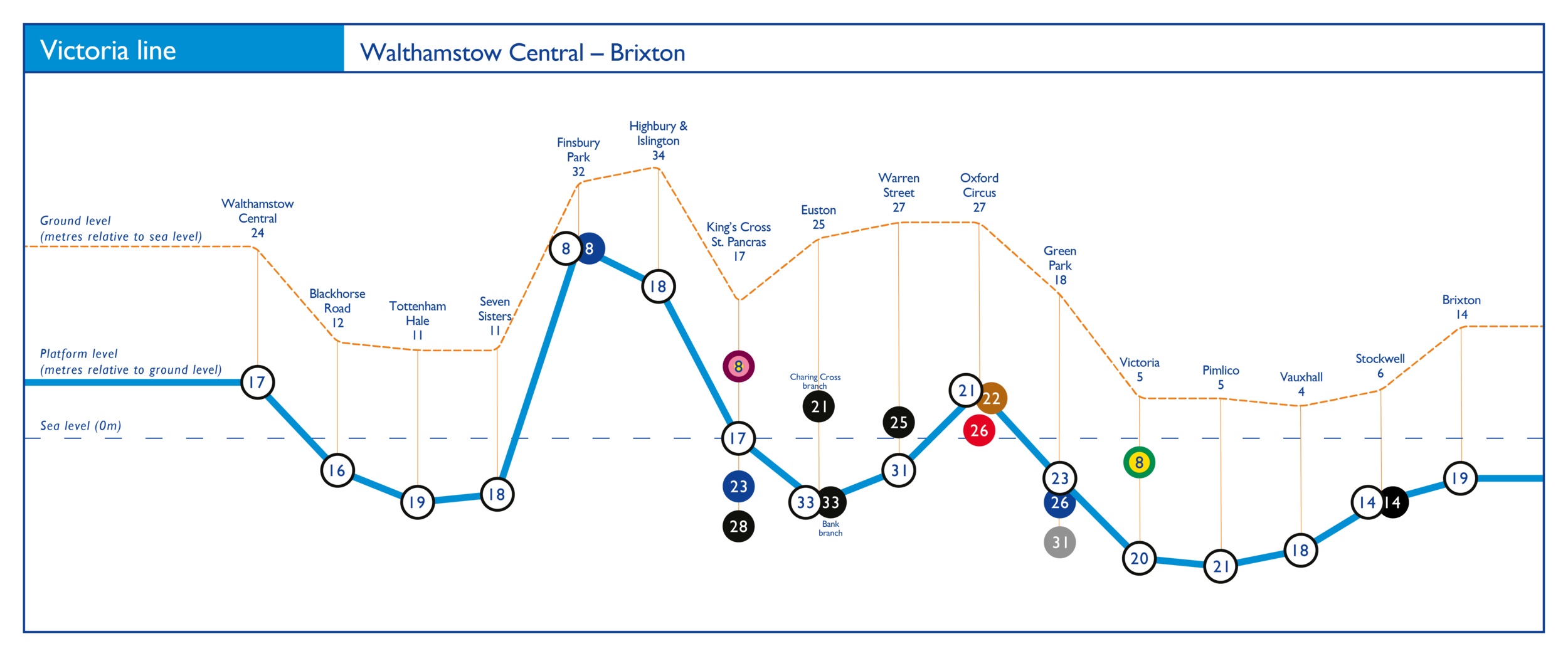 This is amazing. Daniel Silva has created a series of maps showing just how far underground any given station of the London Underground is. Note that the brown dotted line traces the changes in ground elevation, while the blue line below shows the depth of the railway. Some of the lines (like the Victoria, above) maintain a general consistency of depth in relation to the ground, but others don’t. Silva has created a simple representation of what had to have been some very complicated engineering decisions.
the Aspen Tech Solutionism Festival
I have long loved the Atlantic and am proud of my association with it, but every time the Aspen Ideas Festival rolls around my inner Unabomber emerges and wants to burn the entire endeavor to the ground. It’s the only time of year when reading posts in the Atlantic makes me so angry I want to go kick something.
I think I would be okay with it if the shindig had a more accurate name, like the Ideas from Our Technocratic Overlords Festival. Often it seems that there are no ideas at the Aspen Ideas Festival that don’t serve to consolidate transnational technocracy, even the ones that seem to be offering critiques.
Maybe Code for America is reconsidering some of its priorities but it’s still Code for America and its “solutions” inevitably involve deepening people’s dependence on Big Tech. (“We can give you a texting tool that allows you to text with people and it’s been shown to decrease the rates of failure to appear.”)
Is there a crisis of affordable housing in Silicon Valley? Indeed there is. So let’s see what Google can do about it!
This is how it goes, session after session, year after year.
My recommendation: stop calling it an Ideas festival until at least two or three ideas featured there don’t defer to, appeal to, or consolidate the authority of, the world’s biggest technology corporations.
I’m exaggerating, of course. There are always a few sessions about “sustainable development” and “rethinking nutrition” and “civic engagement.” But nine times out of ten there’s an app for that — and, probably, an accelerated Master’s degree at a mid-tier university for only $80,000, please click through to apply for a loan.
For those of us who think there are interesting non-smartphone-connected ideas to be had about family, or faith, or poetry, Aspen is the one place you don’t want to be this summer, or any other.
memory and invention
In her book The Craft of Thought, Mary Carruthers identifies the purpose of memorization in medieval intellectual culture:
The orator’s “art of memory” was not an art of recitation and reiteration but an art of invention, an art that made it possible for a person to act competently within the “arena” of debate (a favorite commonplace), to respond to interruptions and questions, or to dilate upon the ideas that momentarily occurred to him, without becoming hopelessly distracted, or losing his place in the scheme of his basic speech. That was the elementary good of having an “artificial memory.” …Today people will tell you that memorization is the enemy of creativity; these medieval thinkers understood that precisely the opposite is true: the more you have memorized the greater will be your powers of invention.I repeat: the goal of rhetorical mnemotechnical craft was not to give students a prodigious memory for all the information they might be asked to repeat in an examination, but to give an orator the means and wherewithal to invent his material, both beforehand and — crucially — on the spot. Memoria is most usefully thought of as a compositional art. The arts of memory are among the arts of thinking, especially involved with fostering the qualities we now revere as “imagination” and “creativity.”