
the politics of long joy
Ten years ago I briefly wrote an online column for the late lamented Books & Culture, and what follows was the first entry. It still seems relevant, to me anyway.
Near the middle of Milton's Paradise Lost, the archangel Raphael describes for Adam — who has not yet fallen, not yet disobeyed — the War in Heaven between Satan's rebellious angels and those who have remained faithful to God. Throughout this portion of the poem a major figure is a loyal angel named Abdiel. It is his task, or privilege, to cast the first blow against Satan himself: his "noble stroke" causes Satan to stagger backwards and fall to one knee, which terrifies and enrages the great rebel's followers. This happens as Abdiel expected; he's not afraid of Satan, and knows that even the king of the rebels cannot match his strength, since rebellion has already sapped some of the greatness and power of the one once known as Lucifer.
But what if the combat hadn't gone as expected? What if Satan had been unhurt by Abdiel's blow, or had himself wounded the faithful angel? In that case, says one Milton scholar, John Rumrich, "God would by rights have some explaining to do." What right would God have to send Abdiel into a struggle where he could be wounded or destroyed? To Rumrich's claim that most eminent of Miltonists, Stanley Fish, replies: Every right. God's actions are not subject to our judgment, because he's God — a point which, Fish often reminds us, modern literary critics seem unable to grasp.
Moreover, Fish notes, Abdiel himself doesn't think that God owes him success, or indeed owes him anything at all. In Abdiel's understanding of what it means to be a creature, all the owing is on his side; all the rights are on God's. As it happens, there are moments in the story when things don't go as Abdiel expects, where his efforts seem futile or pointless — or seem so to us. Yet this doesn't bother him at all. Why not? Because in each case he did what he was made to do: he obeyed. Obedience is the creature's calling; the ultimate outcome and disposition of events belongs to God, and only to God. God does not need to adjust events to meet our expectations, nor must he offer us an explanation when our expectations are thwarted. And if we focus on our own obedience we will not ask such things of God.
In the long and brilliant preface that Fish wrote for the second edition of his landmark book Surprised by Sin: the Reader in Paradise Lost, he calls Abdiel's attitude "the politics of long joy," and sees Milton as a passionate advocate for that politics. Milton himself strove to live by it: having made an impassioned case for freedom of the press in his tract "Areopagitica," he pauses to say that his argument "will be a certain testimony, if not a Trophy." That is, whether his argument succeeded or not (and in fact it didn't), he wrote it simply in order to testify to his convictions. It was within his power to make such a testimony; it was not within his power to control the minds of the members of Parliament.
"The politics of long joy" is an odd phrase, but a rich one. Fish derives it from another moment in Paradise Lost, when the archangel Michael reveals to Adam a vision of "Just men" who "all their study bent / To worship God aright," who then are approached by a "bevy of fair women" and determine to marry them. Adam likes this vision; two earlier ones had shown pain and death, but this one seems to Adam to portend "peaceful days," harmony among peoples. But Michael immediately corrects him. This is in fact a vision of the events described in Genesis 6, when, after the "sons of God" become enamored with the "daughters of man," God discerns that "the wickedness of man was great in the earth, and that every intention of the thoughts of his heart was only evil continually." "Judge not what is best / By pleasure," Michael warns Adam, "though to nature seeming meet." Instead, Adam should judge according to the "nobler end" for which he was created: "conformity divine," that is, obedience to God. And when Adam hears this rebuke Milton tells us that he was "of short joy bereft." Of short joy bereft: for the joy which comes from judging according to appearances and immediate circumstances, according to what we now like to call "outcomes," is always short. Only the joy of conforming our will to God's is long.
Most important of all, Fish goes on to say, "It cannot be too much emphasized that the politics of being—the politics of long joy—is not quietism. Its relative indifference to outcomes is not an unconcern with the way things go in the world, but a recognition that the turns of fortune and and history are not in man's control and that all one can be responsible for is the firmness of one's resolve." Milton says of the loyal angels fighting against Satan's forces that "each on himself relied" as though "only in his arm the moment lay / Of victory." Or, in Fish's summary, "each acts as if the fate of the world is in his hands, while knowing full well it isn't."
It seems to me that this politics of long joy is the one thing needful for the Christian cultural critic, as for a warring angel like Abdiel or a poetic polemicist like Milton. Perhaps the chief problem with the "culture wars" paradigm that governs so much Christian action and reflection, in the North American context anyway, is that it encourages us to think in terms of trophies rather than testimonies. It tempts us to think too much about whether we're winning or losing, and too little about the only thing we ultimately control, which is the firmness of our own resolve. If the culture warrior would prefer not to be governed by Stanley Fish, or even by John Milton, maybe Koheleth provides an acceptable model: "In the morning sow your seed, and at evening withhold not your hand, for you do not know which will prosper, this or that, or whether both alike will be good" (Ecclesiastes 11:6).
It seems to me that the careful dance, the difficult balance, of Christian cultural criticism is to be endlessly attentive to the form and the details of the world around us, while simultaneously practicing the "politics of long joy"—and in this way avoiding an unhealthy obsession with "trophies," and avoiding also being conformed to the ways of this world. It's a tough walk to walk, because one of the peculiarities of fallen human nature is that we find it difficult, over the long haul anyway, to remember that there is a world of difference between "I have no control over this" and "this isn't very important." We tend, against all reason, to diminish the importance of everything we cannot shape or direct. But our joy will be short if it is grounded in circumstances and events, because circumstances and events always change: if they please us now, they will displease us later. And then what will we do?
Central to this discipline, for me anyway, is a constant striving to remember who human beings are and what we are made for. Which brings me to the title of this column. On Bruce Cockburn's 1980 recording Humans there's a song called "Rumours of Glory"—a song about "the extremes / of what humans can be," but also about the imago Dei which each of us bears, the divine image that waits always for the discerning eye to notice it. In the song, perhaps his best (which is saying a lot), Cockburn sees the "tension" between what we were made to be and what we in fact are; he sees that human culture is produced by that tension, which generates "energy surging like a storm." At once attracted and repelled by that energy, "you plunge your hand in; you draw it back, scorched." And the hand that has been plunged truly into the human world is always marked by that plunging: it's "scorched", yes, but beneath the wound "something is shining like gold — but better." The truth of who we are, given the extremes of divine image and savage depravity, is hard to discern; perhaps we can only achieve it in brief moments; perhaps we only catch rumors of the glory that is, and is to be. But even those rumors can sustain us as we walk the pilgrim path.
the habitual passenger
The habitual passenger cannot grasp the folly of traffic based overwhelmingly on transport. His inherited perceptions of space and time and of personal pace have been industrially deformed. He has lost the power to conceive of himself outside the passenger role. Addicted to being carried along, he has lost control over the physical, social, and psychic powers that reside in man's feet. The passenger has come to identify territory with the untouchable landscape through which he is rushed. He has become impotent to establish his domain, mark it with his imprint, and assert his sovereignty over it. He has lost confidence in his power to admit others into his presence and to share space consciously with them. He can no longer face the remote by himself. Left on his own, he feels immobile.The habitual passenger must adopt a new set of beliefs and expectations if he is to feel secure in the strange world where both liaisons and loneliness are products of conveyance. To “gather” for him means to be brought together by vehicles. He comes to believe that political power grows out of the capacity of a transportation system, and in its absence is the result of access to the television screen. He takes freedom of movement to be the same as one’s claim on propulsion. He believes that the level of democratic process correlates to the power of transportation and communications systems. He has lost faith in the political power of the feet and of the tongue. As a result, what he wants is not more liberty as a citizen but better service as a client. He does not insist on his freedom to move and to speak to people but on his claim to be shipped and to be informed by media. He wants a better product rather than freedom from servitude to it. It is vital that he come to see that the acceleration he demands is self-defeating, and that it must result in a further decline of equity, leisure, and autonomy.
— Ivan Illich, "Energy and Equity" (1974)
keep the body receptive
I think that Bob Dylan knows this more than all of us: you don’t write the songs anyhow.... So if you’re lucky, you can keep the vehicle healthy and responsive over the years. If you’re lucky, your own intentions have very little to do with this. You can keep the body as well-oiled and receptive as possible, but whether you’re actually going to be able to go for the long haul is really not your own choice.
I'm listening
Like many people of my generation, I did a lot of damage to my hearing in my youth, but I can still hear the difference between streamed music and music played on CDs. (Anything above CD-quality encoding is usually unnoticeable by me.)
Before I go any further: Kids, take care of your hearing. Please. Wear earplugs at concerts. Don’t blast music through your earbuds. You’ll thank me later.
Anyway, I have been for some time trying to spend more and more of my listening time on CDs, and reducing my time listening to streams. Sound quality is not the only reason for this: I also want to separate the listening of music from being online. I want to sit down and listen to music without being distracted by Twitter or the temptation to look up some piece of information — if I really need to do that I can make a note on a piece of paper and look it up later. I want my attention to go wholly to the music and maybe the liner notes (especially when I’m listening to classical vocal music in a language other than English and want to know what words the singers are uttering).
CDs are not the only option for my program, of course. I could go vinyl — except that I sold all my vinyl when I moved to Texas five years ago and don’t have the heart to start over from scratch. (When I was in college, thanks in part to a friend who sold stereos, I had a NAD integrated amp, a Luxman belt-drive turntable, and a pair of Magnaplanar speakers. I will never again have such a magnificent stereo system — but then, I’ll never again hear as well as I did then.) In an ideal world, which is to say a world in which I am filthy rich, this is the option I’d choose: lossless audio files on a massive hard drive with an elegant app through which to play them. But four thousand bucks is just a little bit outside my price range.
So: CDs it is. I’m looking forward to many years of more attentive, less distracted musical enjoyment. Wish me well.

Teresa Bejan on free speech
I simply don’t understand Teresa Bejan’s argument here. To wit:
While trigger warnings, safe spaces, and no-platforming grab headlines, poll after poll suggests that a more subtle, shift in mores is afoot. To a generation convinced that hateful speech is itself a form of violence or “silencing,” pleading the First Amendment is to miss the point. Most of these students do not see themselves as standing against free speech at all.Well, no — but then, no one ever does. The universal line is, “Of course, I believe in free speech, but” — with the next line likely to be something about shouting and and fire and crowded theaters. Whether people admit to being “standing against free speech” is not the question at issue.
What they care about is the equal right to speech, and equal access to a public forum in which the historically marginalized and excluded can be heard and count equally with the privileged. This is a claim to isegoria, and once one recognizes it as such, much else becomes clear — including the contrasting appeal to parrhesia by their opponents, who sometimes seem determined to reduce “free speech” to a license to offend.As best I can understand, the claim here is that, for instance, the students who shut down Charles Murray’s lecture at Middlebury felt that they were being denied a right to speak equal to that of Murray’s, and would have been perfectly happy to allow him to speak if their opportunity had been equal to his. If indeed that is the claim, I see absolutely no evidence that it is true. Certainly Bejan does not provide any.
Recognizing the ancient ideas at work in these modern arguments puts those of us committed to America’s parrhesiastic tradition of speaking truth to power in a better position to defend it. It suggests that to defeat the modern proponents of isegoria — and remind the modern parrhesiastes what they are fighting for — one must go beyond the First Amendment to the other, orienting principle of American democracy behind it, namely equality. After all, the genius of the First Amendment lies in bringing isegoria and parrhesia together, by securing the equal right and liberty of citizens not simply to “exercise their reason” but to speak their minds.Indeed, but how is any of this at issue in campus protests? Is anyone saying that either Charles Murray, or Ann Coulter, or students who protest their presence on campus, are not allowed to “speak their minds” at all? Who, from the perspective of “American democracy” Bejan invokes here, is being silenced, and by whom?
In contexts where the Constitution does not apply, like a private university, this opposition to arbitrariness is a matter of culture, not law, but it is no less pressing and important for that.I haver no idea what the phrase “opposition to arbitrariness” means. What is “arbitrariness” in this context? (Earlier Bejan writes of “Diogenes the Cynic, who famously lived in a barrel, masturbated in public, and told Alexander the Great to get out of his light — all, so he said, to reveal the truth to his fellow Greeks about the arbitrariness of their customs.” But who is the equivalent of Diogenes in the current debate?) Who is opposing “arbitrariness”? Are they right or wrong to oppose it? And why?
As the evangelicals, protesters, and provocateurs who founded America’s parrhesiastic tradition knew well: When the rights of all become the privilege of a few, neither liberty nor equality can last.Again: yes, indeed. So the obvious conclusion, to me, is that when the “few” who want to shut down speech they disagree with win, then liberty and equality (within that particular community) are alike endangered. But I don't think that’s Bejan’s conclusion. Can anyone help me make sense of this essay?
unmanly emotion
In my squandered youth I was a friend of Ian Hamilton, the biographer of Robert Lowell and J. D. Salinger and a justly renowned figure in London’s Bohemia. His literary magazine The New Review was published from a barstool in a Soho pub called the Pillars of Hercules, and editorial meetings would commence promptly at opening time. One day, there came through the door a failed poet with an equally heroic reputation for dissipation. To Ian’s undisguised surprise, he declined the offer of a hand-steadying cocktail. “No,” he announced dramatically. “I just don’t want to do it anymore. I don’t like having blackouts and waking up on rubbish dumps. I don’t like having no money and no friends, smelling bad and throwing up randomly. I don’t like wetting myself and getting impotent.” His voice rising and cracking slightly, he concluded by avowing that he also didn’t like being repellently fat, getting the shakes and amnesia, losing his teeth and gums, and suffering from premature baldness. A brief and significant silence followed this display of unmanly emotion. Then Ian, fixing him with a stern look, responded evenly by saying, “Well, none of us likes it.”

my response to Douthat's response to my answer to Douthat's question
Ross Douthat, responding in part to this post of mine, writes:
But it’s also possible that evangelical intellectuals and writers, and their friends in other Christian traditions, have overestimated how much a serious theology has ever mattered to evangelicalism’s sociological success. It could be that the Trump-era crisis of the evangelical mind is a parochial phenomenon, confined to theologians and academics and pundits and a few outlier congregations — and that it is this group, not the cultural Christians who voted enthusiastically for Trump, who represent the real evangelical penumbra, which could float away and leave evangelicalism less intellectual, more partisan, more racially segregated … but as a cultural phenomenon, not all that greatly changed.Typical NYT columnist! — interested in evangelicalism only in terms of “sociological success,” as a “cultural phenomenon.” SMH.
Slightly more seriously:
- I don’t think it matters, either in the City of God or the City of Man, whether there are a great many people who (when surveyed by Barna or Gallup or Pew) call themselves evangelical, or only a few.
- I do think it matters, for both cities, and in a variety of ways, that they contain people who seriously hold to the convictions traditionally associated with evangelicalism, whether those convictions are summed up in the Bebbington Quadrilateral or the Larsen Pentagon.
- I think it matters a lot more, and again for both cities, whether generally orthodox Christians from all traditions — and including those who have moved from evangelicalism to one of the more ancient traditions — understand what they hold in common and seek to hold still more in common, pursuing the unity in Christ that they are commanded by Him to embody. There were orthodox Christians before there was an evangelical movement; there will be orthodox Christians long after the evangelical movement is but a distant memory.
Joe Posnanski wises up
About 15 or 20 years ago, I realized that talk radio was wrecking my writing process. I would be writing a column, and I would hear the talk radio voices in my head screaming, and I thought: “This isn’t helping me.” And so I stopped listening to talk radio. That’s sort of how I feel about Twitter now. All of the good — and there’s a lot of good in Twitter — just doesn’t for me outweigh the negativity, the rashness, the time-suckitude. At some point — I wrote about this — I figured out how many words I have written on Twitter, and it just about broke my spirit. I’ve written a full book on Twitter. A full, lousy, grammatically challenged, snarky, largely unfunny book of snap judgments and surface-level philosophy. I don’t have time for that. I have real books to write.— Joe Posnanski. Every few days or so I check in on Twitter and I see people still trying to write about important, complex matters there. They think, Hey, we have 280 characters per tweet now and I can link thoughts together in a tweetstorm. And then they produce inarticulate, disconnected, logically-challenged clumps of assertion— even when they're perfectly capable of writing articulate, connected, logically clear arguments, at least when they're on platforms that don't enforce the equivalent of the electrical jolts used to keep Harrison Bergeron from thinking clearly.
If you’re trying to address complex issues on Twitter, you are serving as your own Handicapper General. Please stop. Get a blog. You’re damaging your brain and the quality of public discourse. We all deserve better.
leaving the Oasis
I’m pretty sure my body has a peculiar electromagnetic field that wreaks havoc on the batteries of electronic devices. Not all of them: all of my iPhones have had more-or-less the advertised battery life. But all of my Mac laptops, going back fifteen years, have gotten around four hours from a charge. No announced improvement in battery power has ever changed that. (I’m typing this on a MacBook that’s supposed to get around 10 hours from a charge under normal use. It gets four. It has always gotten four.) And my Kindles have been even worse — though never quite as bad as my new Kindle Oasis, which promises “weeks” of battery life on a single charge and gets … about two days. And that’s with limited use of the light. Two days.
So I’m sending it back. It’s all boxed up and ready to go, which leaves me, if I want to read on an e-reader, with this old thing:
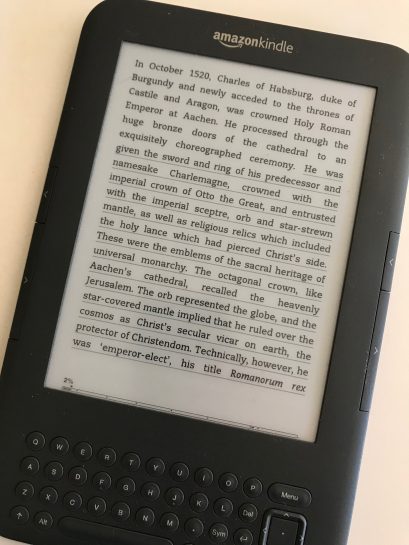
And you know, it’s not bad — not bad at all. Yes, it’s a little heavier and the type isn’t quite as sharp, but it has advantages: no touchscreen, so I don’t have to wipe off prints; a hardware keyboard, which is much more user-friendly for someone like me who actually annotates books; underlining of marked text, which I think more readable and less distracting than highlighting. It doesn’t have a light, of course, but I rarely use the light because I read outdoors a lot and even when reading inside it’s easier on my eyes to read by lamplight.
So maybe I’ll just keep using this device I bought seven years ago — as long as the battery holds out.
Babette the Artist
This is a slightly edited version of a post I published a long time ago at The American Conservative. The original has disappeared — removed, I suspect, by someone who has a different interpretation of Babette than I do. Well, this is another reason for me to own my own turf!
Rod Dreher calls our attention to this post about cooking the central dish from Babette’s Feast. The movie is rightly legendary among food lovers and cooks, partly for reasons specified by J. Bryan Lowder here:
Contrast that with Babette. My favorite scene in the film comes after the last, glistening course has been served, when she finally sits for a moment in the kitchen, her skin dewy from work, quietly sipping a glass of wine. The satisfaction on her face is the kind that can only come from the knowledge that you have created something that sustains both the bodies and the spirits of the people in your care. Indeed, Babette’s story is an argument for the idea that spending money, time, and energy cooking for friends is the best gift a home cook can give, especially if they enjoy themselves so much that they practically forget who’s behind the stove.But: in the great story by Isak Dinesen on which the movie is based, Babette isn’t cooking for anyone else at all. She knows that when she cooks she makes people happy, but that isn’t why she cooks. At the end of the story, when the women who employ her learn that she spent all her savings to buy the ingredients for the magnificent meal they and their friends have just eaten, they are deeply moved. But they get a response from Babette they don’t expect.
Philippa’s heart was melting in her bosom. It seemed that an unforgettable evening was to be finished off with an unforgettable proof of human loyalty and self-sacrifice.Indeed, Babette’s art gives great pleasure to others — but she does not care. How other people feel about her work is a matter of complete indifference to her, because she knows herself to be a great artist and therefore to be utterly superior to them, to be made of different stuff. Lowder writes, “The satisfaction on her face is the kind that can only come from the knowledge that you have created something that sustains both the bodies and the spirits of the people in your care” — but nothing could be farther from the truth for the Babette of the original story.“Dear Babette,” she said softly, “you ought not to have given away all you had for our sake.”
Babette gave her mistress a deep glance, a strange glance. Was there not pity, even scorn, at the bottom of it?
“For your sake?” she replied. “No. For my own.”
She rose from the chopping block and stood up before the two sisters.
“I am a great artist!” she said.
She waited a moment and then repeated: “I arn a great artist, Mesdames.”
Again for a long time there was deep silence in the kitchen.
Then Martine said: “So you will be poor now all your life, Babette?”
“Poor?” said Babette. She smiled as if to herself. “No, I shall never be poor. I told you that I am a great artist. A great artist, Mesdames, is never poor. We have something, Mesdames, of which other people know nothing.”
There is, from our point of view, which is necessarily that of the sisters, something inhuman about Babette. “Philippa went up to Babette and put her arms round her. She felt the cook’s body like a marble monument against her own, but she herself shook and trembled from head to foot.” Lowder believes, and I guess the movie believes, and certainly I believe, in the beauty of a gift that is both given and received in love. But that is not what happens in the story. There Babette loves only her art. That that art pleases us is not, in her view, worthy even of consideration, and when the importance of our pleasure is suggested to her she responds with contempt.
The movie of Babette’s Feast is lovely, I think, but it takes, or can be read to take, Philippa’s view of the matter: “It seemed that an unforgettable evening was to be finished off with an unforgettable proof of human loyalty and self-sacrifice.” It is therefore something of a sentimentalizing of the story on which it is based, which does not care about gift and grace but rather limns the peculiar character of the capital-A Artist.
on evidence and the life of the mind: a follow-up
A twofold follow-up to yesterday’s post:
- Some people have written to ask me what my evidence is for the claims I made in that post. There’s a good bit of general evidence for what American evangelicals believe, as well as what larger populations of young Americans believe; and there have been some excellent in-depth ethnographies of small groups of believers; and some studies over several years of, for example, biblical knowledge among students at one Christian college — that last badly in need of updating. But we don’t have (and probably can’t have, given the work that would be required) large-scale, longitudinal studies of how evangelicalism operates day-to-day, of whether what churches preach and teach match up with what they say they believe, of the degree to which congregants accept that they’re taught in church, and so on.
So I have supplemented those accounts with my experience, over 35 years, of talking with young evangelicals from all around the country (and often from overseas as well) about their upbringing and their church experiences; talking with friends and family about their churches; visiting many churches, evangelical and otherwise, often in the role of guest speaker; and reading a great many first-person accounts online. I don’t have an ideal body of data, but it’s not negligible either.
- In the tweet that kicked this off, Ross Douthat asked specifically about the intellectual life of young evangelicals, so let me say something about that. Mostly, of course, it’s shaped by forces altogether outside of Christianity: as I have frequently commented, our current power/knowledge regime is far better at catechesis than any churches are. But insofar as the Young Evangelical Mind is shaped by forces within Christianity, those almost never involve the local church. The minds of young evangelicals are shaped overwhelmingly by music and stories — I have tried to sketch the emergence of the latter development in this essay. In general, evangelical churches have not understood the intellectual formation of their congregants as part of their mission. As always you reap what you sow — and when you fail to sow….
Ray's Yellow Plane
[caption id="" align=“aligncenter” width=“1920”] Ray’s Yellow Plane (Film Notes), 2013 by Rose Wylie. Photograph: Soon-Hak Kwon/Courtesy the artist and David Zwirner, London[/caption]
where young evangelicals are headed
A long, long time ago, Ross Douthat tweeted this:
Reading this makes me wish for an @ayjay take on what he sees as the trends in young-evangelical intellectual life:https://t.co/lKxxMVPhkh
— Ross Douthat (@DouthatNYT) September 26, 2017
I’ve been thinking this over. I may not be as well-placed to answer that question as I was when I taught at Wheaton College — Baylor is a much more religiously diverse institution — but then Wheaton was not exactly representative of the people who now call themselves evangelicals, so maybe I have a clearer view from Waco?
Anyway, as far as I can tell, where young evangelicals are headed is simply out of evangelicalism. They have been, as Jared C. Wilson recently wrote, theologically and spiritually orphaned by pastors and other Christian leaders who were willing to entertain them and occasionally to hector them but who had no interest whatsoever in Christian discipleship. Millions of today’s young evangelicals have been utterly betrayed by a generation of pastors who could pontificate about how essential sexual purity is while simultaneously insisting that every real Christian should vote for Donald Trump, supporting their claims by a random handful of Bible verses wrenched from their context and utterly severed from the great arc of biblical story without which no piece of scriptural teaching can make sense. As I noted here, they cannot even distinguish a penitent from an impenitent sinner — that is how thoroughly they have emptied themselves of moral and spiritual understanding.
And yes: betrayed is precisely the word. A great mass of many* evangelical leaders have betrayed their young followers and congregants — and, equally, betrayed the theological and spiritual inheritance they received from their mothers and fathers in the faith. They exchanged a rich and truly evangelical birthright for a cold pottage of vague moral uplift and cultural resentment. Verily, they have their reward.

So if young evangelicals are leaving evangelicalism, where are they going? Not many, I think, will head for complete unbelief, but some will; a great many will drift further and further into moralistic therapeutic deism, which will offer them very little but, on the plus side, will ask even less from them; a smaller but still significant number will head for the older liturgical traditions, either for aesthetic or theological reasons.
There will of course continue to be vibrant congregations that define themselves as evangelical, but fewer and fewer as the years go by, I think. Most churches that would claim the label have abandoned their historic mission, and the historic Christian faith, no matter what their explicit theological formularies might say. (This, for instance, is simple idolatry, served up straight, no chaser.) As my old friend and long-time colleague Mark Noll has long contended, evangelicalism at its heart a renewal movement within orthodox Christianity, and such renewal will continue — but not in the forms that some of us have grown accustomed to over the past half-century. Renewal will need to find new strategies, new institutions. Some corpses can’t be revived.
UPDATE: See follow-up post here.
*Edited to avoid association with the phrase “the great mass,” typically meaning “a substantial majority.” Thanks to Ted Olsen for the heads-up.
Auden adapted
The desires of the heart are as crooked as corkscrews, Not to be born is the best for man; The second-best is a formal order, Tweet, tweet, for the figure is easy, The tune is catching and will not stop; Tweet till the stars come down from the rafters; Tweet, tweet, tweet till you drop.
Hazlitt hating
In private life do we not see hypocrisy, servility, selfishness, folly, and impudence succeed, while modesty shrinks from the encounter, and merit is trodden under foot? How often is "the rose plucked from the forehead of a virtuous love to plant a blister there!" What chance is there of the success of real passion? What certainty of its continuance? Seeing all this as I do, and unravelling the web of human life into its various threads of meanness, spite, cowardice, want of feeling, and want of understanding, of indifference towards others, and ignorance of ourselves, — seeing custom prevail over all excellence, itself giving way to infamy — mistaken as I have been in my public and private hopes, calculating others from myself, and calculating wrong; always disappointed where I placed most reliance; the dupe of friendship, and the fool of love; — have I not reason to hate and to despise myself? Indeed I do; and chiefly for not having hated and despised the world enough.
— William Hazlitt, "On the Pleasure of Hating" (1826)
the enlightenment of books
I think all the time about alternative ways of organizing my books, but am always thwarted by the fact that some are at home and some at the office. Probably what I’m most looking forward to about retirement is having all my books in one place. (But that may be what my wife is least looking forward to.) I think at least half of the Kindle books I own I bought because that was easier than getting into the car and driving to the office where I already had a codex copy. I cherish the fantasy that when I finally have all my books in the same building, and discover the ideal way to organize them, then all the chaos of my mind will resolves itself in a single great orderly pattern, and all the connections I have failed to make over the years will suddenly snap into place, and everything I have so persistently proved incapable of understanding will reveal itself in a moment of perfect clarity and unity. And then I will sit cross-legged in the midst of my books smiling like a Buddha. Enlightenment at last.
Verticals
[caption id="" align=“aligncenter” width=“1600”] Anni Albers, With Verticals (1946)[/caption]