
Bernard of Clairvaux: “It is not necessary for you to cross the seas, nor to pierce the clouds, nor to climb mountains to meet your God. It is not a lengthy road that is set before you; you have only to enter into yourself to find him.”
Teens on screens: Life online for children and young adults revealed - Ofcom:
This year also saw the rise of ‘split-screening’. Split-screen social media posts allow children to watch more than one short-form video simultaneously, on a single-screen, side-by-side or stacked on top of one another. This appears to be a progression of the ‘multi-screening’ behaviours seen in previous research waves, where children reported difficulties focusing on one screen-based activity at a time.
Distinctions needed here: There is a difference between genuinely watching “more than one short-form video simultaneously” and merely having more than one short-form video on one’s screen at a given time. I seriously doubt that it is possible for any human being to watch two videos at the same time; the best we can do, I suspect, is to switch rapidly between two videos, and a good deal of research indicates that we’re not good at doing even that. Every time our attention switches to one information source we cease to attend to the other.

Finished reading: The Earthsea Quartet by Ursula K. Le Guin. What a joy to revisit these glorious books. 📚
This is a very basic point, but I find that it’s consistently under-discussed: to close achievement gaps like the racial achievement gap, not only must Black and Hispanic students learn more, white and Asian students must learn less than they do. Closing any gap has to entail the poorly-performing students not just learning but learning at a sufficiently faster pace than the high-performing students that the gap closes. This is not a minor point! American students of all races have been improving over time. But gaps have persisted because… students of all races have been improving over time. As long as white and Asian students learn as much as Black and Hispanic, the gap cannot close. This is so obvious it feels like it should go without saying, but the point is frequently obscured, for a couple of reasons. First, because “every kid can learn” is a more pleasing and simplistic narrative than “kids from disadvantaged subpopulations can not only learn but can learn sufficiently to close large gaps against competitors who are still learning more themselves.” Second, because the problem suggests a solution that is politically untenable, to put it mildly — to close gaps, we need to prevent the students who are ahead from learning at all.
I think there are a great many people on the so-called left who would be glad to accept that deal. Close the gap by any means necessary. There’s no necessary connection between wanting equality of outcomes and wanting better outcomes.
Our new baby dogwood is looking good.

my proposed law
“Any online platform and/or application that delivers content to users may deliver only content explicitly requested by said users.”
That’s it. No algorithms, no autoplay, no “You may also like,” no “Up next.” Only what human beings (AKA “consumers”) choose. Now you don’t have to ban TikTok, and you will reduce the power that Facebook, Twitter, and all the other social-media platforms have over the minds and emotions of their users. It will even reduce, though not eliminate, the ability of Spotify and other streaming platforms to ruin music.
(I’m sure many other people have made this suggestion.)
libraries vs. publishers
Libraries have dramatically increased their spending on e-books but still cannot come close to meeting demand, which unsurprisingly rose during the pandemic. Because publishers view each circulation of a library e-book as a potential missed sale, they have little incentive to reduce costs for libraries or make it easier for libraries to lend digital copies.
All digital transitions have had losers, some of whom we may care about more than others. Musicians seem to have a raw deal in the streaming age, receiving fractions of pennies for streams when they used to get dollars for the sales of physical media. Countless regional newspapers went out of business in the move to the web and the disappearance of lucrative classified advertising. The question before society, with even a partial transition to digital books, is: Do we want libraries to be the losers?
The answer certainly appears to be Yes. But, as Dan writes later in the essay,
libraries are where the love of reading is inculcated, and hurting libraries diminishes the growth of new readers, which in turn may reverse the recent upward trend in book sales. This will be particularly true for communities with fewer resources to devote to equitable access. Ultimately, we should all seek to maximize the availability of books, through as many reasonable methods as we can find. The library patron who is today checking out an e-book, or a digitized book through Controlled Digital Lending — should the practice be upheld on appeal — will be the enthusiastic customer at the bookstore tomorrow.
Dan does’t emphasize this point in his essay, but one of the fruits of the last few decades’ Merger Madness in publishing is that the industry — a telling word, that — is now controlled by international mega-conglomerates who have the financial muscle to bring massive legal pressure to bear against libraries, whom they obviously consider their enemies. And then when our political representatives try to take action to protect libraries and readers, that same financial muscle is used to throw angry lobbyists at those representatives. Nice elected office you have there, shame if something happened to it.
Whatever forces are arrayed against libraries are also arrayed against readers. But publishing conglomerates don’t care about readers; they only care about customers. If they had their way reading would be 100% digital, because they continue to own and have complete control over digital books, which cannot therefore be sold or given to others. They are the enemies of circulation in all its forms, and circulation is the lifeblood of reading.
beseball revisited
Five years ago I wrote about giving up on baseball — after a lifetime of fandom. Should the new pitch clock bring me back? I’m not sure it will. A speedier game — which is to say, a return to the pace of the past — will certainly be an improvement, but it won’t change the fact that running has largely disappeared from baseball, as pitchers go for strikeouts and batters are happy to oblige them if they can just increase their chances of hitting dingers. It’s a very static game now, and that seems unlikely to change.
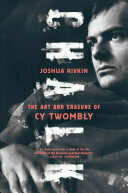
Finished reading: Chalk: The Art and Erasure of Cy Twombly by Joshua Rivkin. Rivkin is very clear up front that this is not a straightforward biography; but as I read I often found myself longing for a straightforward biography. 📚