
An appropriate day to remember one of Waco’s greatest heroes.
Trying out the new global shortcut for microposting in MarsEdit 5 – looks like it works perfectly. Long live MarsEdit and long live blogging!
oh, okay, one more post
On these matters. This from Roald Dahl’s story “The Great Automatic Grammatizator” (1952):
“That’s exactly it, Mr Bohlen! That’s where the machine comes in. Listen a minute, sir, while I tell you some more. I’ve got it all worked out. The big magazines are carrying approximately three fiction stories in each issue. Now, take the fifteen most important magazines—the ones paying the most money. A few of them are monthlies, but most of them come out every week. All right. That makes, let us say, around forty big stories being bought each week. That’s forty thousand dollars. So with our machine—when we get it working properly—we can collar nearly the whole of this market!”
“My dear boy, you’re mad!”
“No, sir, honestly, it’s true what I say. Don’t you see that with volume alone we’ll completely overwhelm them! This machine can produce a five-thousand-word story, all typed and ready for dispatch, in thirty seconds. How can the writers compete with that? I ask you, Mr Bohlen, how?”
At that point, Adolph Knipe noticed a slight change in the man’s expression, an extra brightness in the eyes, the nostrils distending, the whole face becoming still, almost rigid. Quickly, he continued. “Nowadays, Mr Bohlen, the hand-made article hasn’t a hope. It can’t possibly compete with mass-production, especially in this country — you know that. Carpets … chairs … shoes … bricks … crockery … anything you like to mention — they’re all made by machinery now. The quality may be inferior, but that doesn’t matter. It’s the cost of production that counts. And stories — well — they’re just another product, like carpets and chairs, and no one cares how you produce them so long as you deliver the goods. We’ll sell them wholesale, Mr Bohlen! We’ll undercut every writer in the country! We’ll corner the market!”
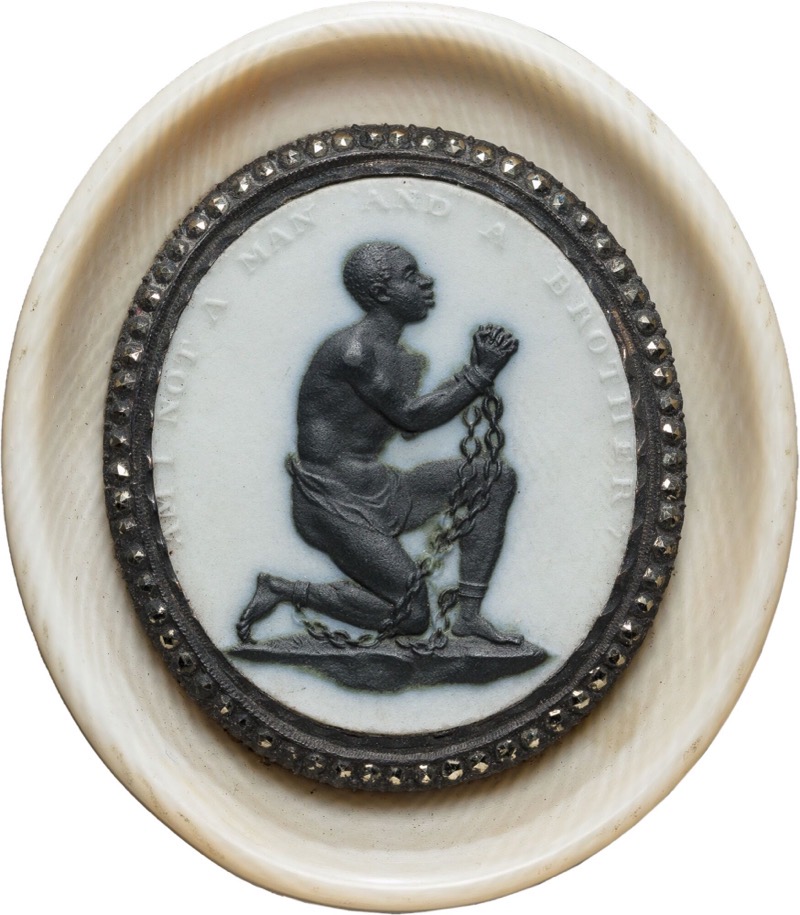
An anti-slavery medallion by Josiah Wedgwood
But:
Wedgwood seems to have thrown himself behind the cause of abolition out of genuine conviction. The medallion presented a marketing opportunity of sorts, but he manufactured it in large numbers at his own cost and ran the risk of alienating wealthy customers who opposed abolition. At the same time, as Hunt acknowledges, Wedgwood’s business was inextricable from the socioeconomic structures that sustained the slave trade. He depended on secure colonial shipping routes and sold extensively to the American colonies: Boston and Kingston were the perfect place to offload wares that had passed the peak of fashion back in Britain. Closer to home, many of his British customers derived their fortunes, one way or another, from colonial trade, including the trade in human beings. This trade helped to fuel the boom in domestic consumption that allowed Wedgwood to dream of selling high-quality artistic tableware to a growing middle-class market. Colonial commodities such as coffee, tea and sugar, with their accompanying social rituals, provided the raison d’être for many of Wedgwood’s most successful products.
a year of new avenues
A year of new avenues: a fantastic post by Robin Sloan, just fizzing with ideas. Here are the ones dancing in my head like a vision of sugarplums:
- “It’s plain that neither the big tech companies nor the startup financiers are going to produce the tools we need for the next decade. Almost by definition, any experiment that’s truly pathbreaking and provocative is too weird and tiny for them to suffer. They are trapped in their stupendous scale; lucky us.”
- “Publishing on the internet is a solved problem; finding each other on the internet, in a way that’s healthy and sustainable … that’s the piece that has never quite fallen into place.”
- “Back in the 2000s, a lot of blogs were about blogs, about blogging. If that sounds exhaustingly meta, well, yes — but it’s also SUPER generative. When the thing can describe itself, when it becomes the best tool to talk about itself, some internal flywheel gets spinning, and interesting things start to happen.”
- “This isn’t a time for ‘products’, or product launches. It’s not a time to toil in secret for a year and then reveal what you’d made with a shiny landing page. Rather, I believe it’s a time to explain as you go.”
- “I’m not saying you shouldn’t create a Mastodon account, or that you can’t have fun, percolating conversations there. I’m just saying that it doesn’t represent a sufficiently interesting experiment, because it accepts too much as settled.”
Currently listening: Van Morrison, Veedon Fleece (one of my favorite records for more than forty years now). 🎵
In Douglas Rushkoff’s new book, he acknowledges that he was wrong to say, as he was perhaps the first to do, that to the social media platforms you are not the customer but the product. Rather, he now argues, the company’s stock is the product; you are the unpaid labor that increases the value of that product.
When I read crypto-bro stories like this one I always think of Yeats: “The rhetorician would deceive his neighbor, / The sentimentalist himself.”
Currently listening: Charles Mingus, Blues and Roots ♫
