

Why Ted Gioia thinks that victory, for artists, is assured.
Currently reading 📚
I’m doing a bit of blogging again, and about weird scholarly stuff – perhaps a sign that my spirit is beginning to recover some of its long-muted energy.
Vulcanology
Here’s a little offshoot of my work on Auden’s The Shield of Achilles.
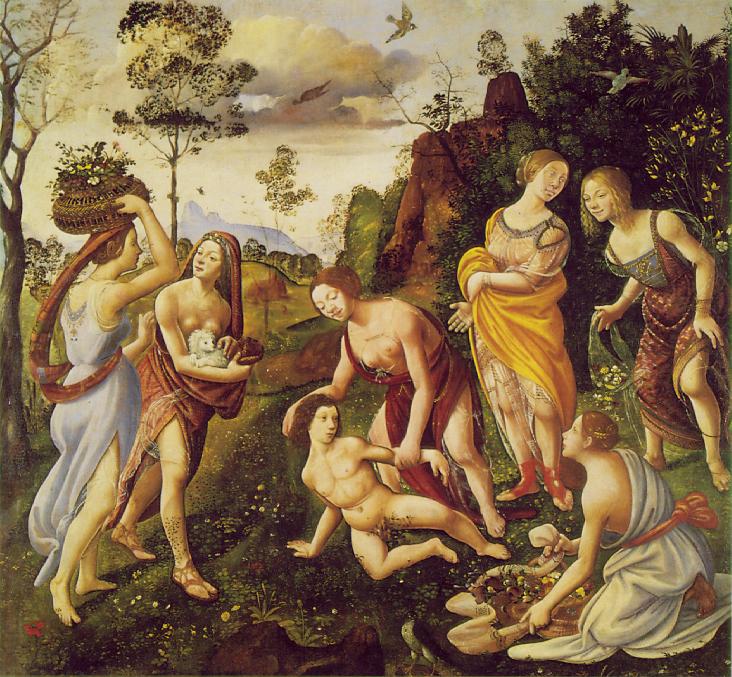
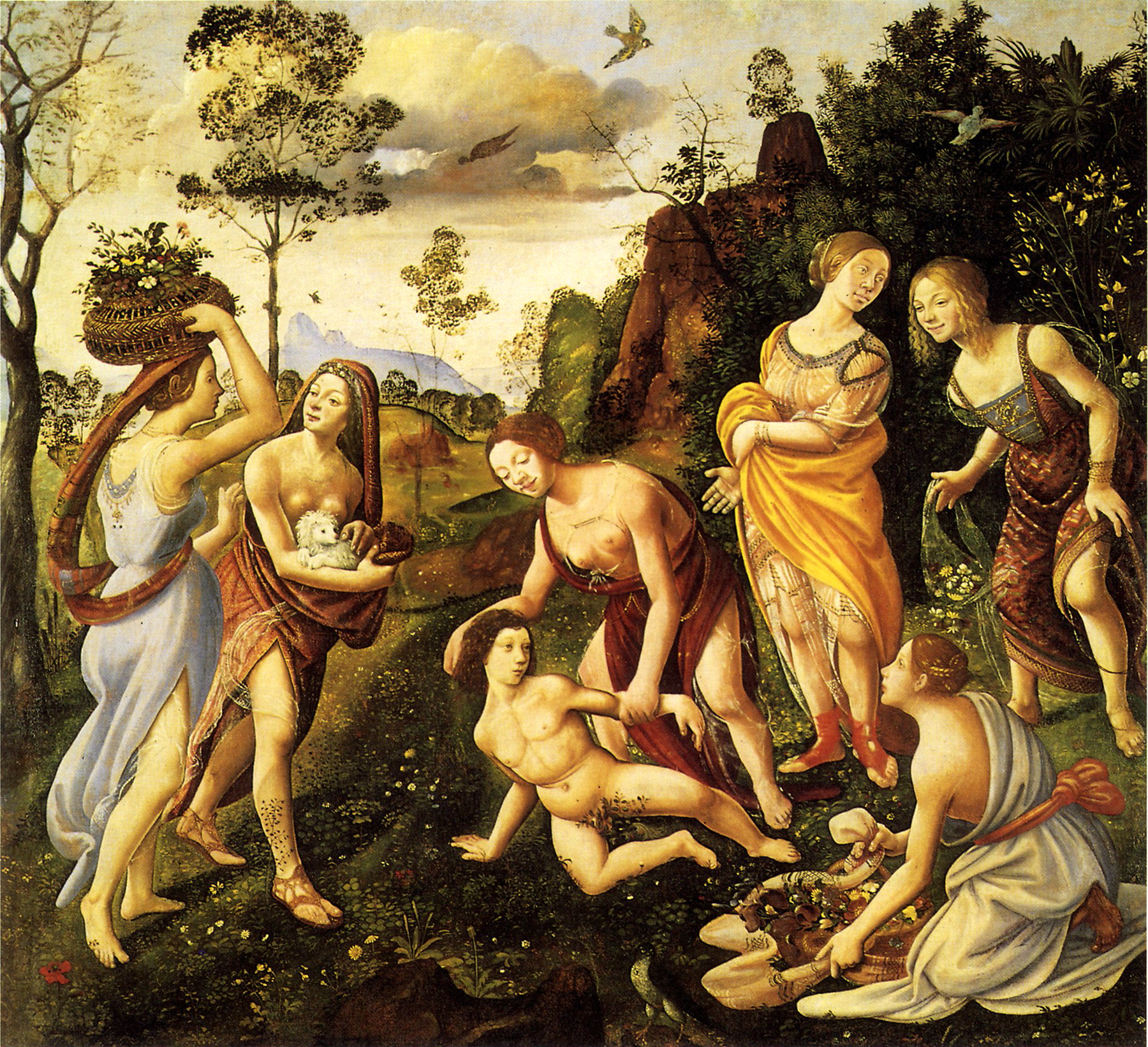
This painting by Piero di Cosimo — see a larger version here — is called The Finding of Vulcan on the Island of Lemnos, but it wasn’t always called that. For a long time it was thought to represent the story of Hylas, the beautiful warrior and companion of Heracles who was abducted by nymphs. But, the great art historian Erwin Panofsky pointed out in his 1939 book Studies in Iconology, the image doesn’t really fit the story. Compare Piero’s painting with that of John William Waterhouse and you’ll see the difference: Waterhouse’s nymphs are clearly drawing Hylas into the water, in accordance with the myth, but Piero’s nymphs are doing something different: they’re helping a fallen youth get up from the ground. (Or, rather, one of them is: the others are looking on with curiosity, amusement, or concern, and talking about this odd stranger.)
What’s going on here? To answer you have to go back to Homer: Iliad, Book I. There Hephaestus speaks to his mother Hera:
You remember the last time I rushed to your defense?
[Zeus] seized my foot, he hurled me off the tremendous threshold
and all day long I dropped, I was dead weight and then,
when the sun went down, down I plunged on Lemnos,
little breath left in me. But the mortals there
soon nursed a fallen immortal back to life.
But “the mortals there” is not what Homer wrote; instead he wrote Σίντιες ἄνδρες, the “Sintian men.” The problem for later scholars is that nobody knows who the Sintian men were. Servius, a Latin grammarian and contemporary of Augustine of Hippo, wrote a learned commentary on Vergil in which he drew on that passage from Homer: Vulcano contigit, qui cum deformis esset et Iuno ei minime arrisisset, ab Iove est praecipitatus in insulam Lemnum. illic nutritus a Sintiis…. “Vulcan, because he was deformed and Juno did not smile on him, was hurled by Jove onto the island of Lemnos. There he was nurtured by the Sintii.”
This caused great confusion for scholars in the Renaissance for whom the word Sintii was meaningless. They therefore assumed, as learned philologists of that era were wont to assume, that some scribal error had occurred. Instead of nutritus a Sintiis Servius's original text surely was nutritus absintiis, nurtured on wormwood. No, said others, it was nutritus ab simiis: He was nurtured by apes — and thus, we might say, a type of Tarzan. (Lord Greystoke, meet your ancestor Vulcan.) Boccaccio, in his enormously influential Genealogy of the Pagan Gods, accepted the Simian Hypothesis, and so evidence of it turns up in, for instance, an allegorical fresco, possibly by Cosmè Aura, in the Palazzo Schifanoia in Ferrara:

See in the upper-left corner Vulcan’s forge, and, nearby, the apes pulling some kind of elaborate palanquin?
But there was a third opinion — philologically the least convincing, surely, but artistically the most appealing: Servius’s text read nutritus ab nimphis — nurtured by nymphs. And that, Panofsky convincingly argued, is the reading Piero adopted. Those nymphs aren’t drawing Hylas into the water — there is no water — they’ve come running when they heard a big thump, or perhaps saw “Something amazing, a boy falling out of the sky,” and now they’re chattering away about this remarkable event as one of them helps the stunned but unharmed god to his feet. Poor little fellow. (He looks about two-thirds their size.) Some of the nymphs seem to find the whole thing funny, but in the end they’ll take good care of him.
UPDATE: I’ve been corresponding with Adam Roberts about this and we’ve both been searching for the mysterious Sintians. The wonderful Sententiae Antiquae blog quotes from the Homeric scholia:
“[The Sintian men}: Philokhoros says that because they were Pelasgians they were called this because after they sailed to Brauron they kidnapped the women who were carrying baskets. For they call “harming” [to blaptein] sinesthai.
But Eratosthenes says that they have this name because they are wizards who discovered deadly drugs. Porphyry says that they were the first people to make weapons, the things which bring harm to men. Or, because they were the first to discover piracy.
This story of a god being raised by PIRATE WIZARDS sounds like the best idea for a fantasy novel I have ever heard.

so let's chill
So, Elon Musk bought Twitter. Personally, I’m pretty sanguine about this development. It’s no secret that I think that Twitter is a uniquely dystopian feature of the modern media sphere — a bad equilibrium that traps the nation’s journalists, politicians, and intellectuals in close quarters with all the nastiest and most strident anonymous bottom-feeders. There’s a nonzero chance Musk will be able to improve this situation; if not, it’s hard to see how he could make it particularly worse. If he destroys the platform, we’ll find something else — probably a number of different somethings, which I think would be good for the media ecosystem. Our entire society was not meant to be locked in a single small room together; we need more room to spread out and be ourselves.
This is the right take, I think. For those who haven’t seen it, here is a collection of my posts on micro.blog in particular and and open web more generally. And here is a useful brief guide to getting started with blogging.
Currently listening: The Campfire Headphase - Boards of Canada 🎵