
As Qatar 2022 looms the US look like who they are: Concacaf’s third best team. Too true to be good.
When the Church leads with its moral code — and elevates that moral code over even the most basic understandings of Jesus Christ himself — the effect isn’t humility and hope; it’s pride and division. When the Church chooses a particular sin as its defining apostasy (why sex more than racism, or greed, or gluttony, or cruelty?), it perversely lowers the standards of holy living by narrowing the Christian moral vision.
The result is a weaker religion, one that is less demanding for the believer while granting those who uphold the narrow moral code a sense of unjustified pride. Yet pride separates Christians from each other, and separates Christians from their neighbors.
Millions of Christians are humble and hopeful. Millions are also prideful and divisive. Why? One answer is found in the LifeWay-Ligonier survey. In the quest for morality, they’ve lost sight of Jesus — but it is Jesus who truly defines the Christian faith.
AMEN.
comparisons are odorous
Don't Fear the Artwork of the Future - The Atlantic:
What is so tiresome about the fear of AI art is that all of this has been said before—about photography. It took decades for photography to be recognized as an art form. Charles Baudelaire famously called photography the “mortal enemy” of art. The Museum of Fine Arts in Boston, which was among the first American institutions to collect photographs, didn’t start doing so until 1924. The anxiety around the camera was nearly identical to our current fear of creative AI: Photography wasn’t art, but it was also going to replace art. It was “mere mechanism,” as one critic put it in 1865. I mean, it’s not art if you’re just pushing some buttons, right?
This is one of the laziest tropes of pseudo-thinking, but also one of the most common. If you want to try it for yourself, follow these steps:
- Note that people are afraid of something;
- Find something in history that people were unnecessarily afraid of;
- Conclude that if people were wrongly afraid of something in the past, then, logically, people who are afraid in the present must also be wrong.
Indubitable! (Just make sure you don’t notice any situations in the past in which the people who were afraid were right. Nobody says, “Those who worry about appeasing Putin should remember that in the late 1930s a bunch of nervous Nellies worried about appeasing Hitler too.”)
But often there’s another element of dumbness to this kind of take: not just the inability to reason sequentially, but the ignoring of inconvenient facts. For while photography didn’t “replace art,” it largely did replace certain kinds of art, and radically changed the cultural place of drawing and painting.
For my part, I think some of these changes were good and some were not so good. When it became clear that to most people photographs looked more “real,” more precisely representational, than paintings, painters began exploring various alternatives to straightforward representation: first Impressionism, pointillism, and later on completely non-representational painting. (Nowadays “photorealistic painting” is merely a joke or meta-artistic game, as in the works of Chuck Close.) I think these were exciting and vital developments, and I wouldn’t want to see them undone. But, that said, when I think about how Picasso could draw at the age of eleven —

— I do find myself wondering how he might have developed as an artist if he had been working in the days before photography. If much was gained when Picasso was liberated from straightforwardly representational art, we can’t know what was lost. But we lost something.
The rise of photography had a broader cultural consequence too. Before photography became commonplace, an ability to draw was almost a requirement for travelers. People needed to be able to make competent sketches of the exotic places they visited, because otherwise how would they be able to remember everything, or properly describe it to others? A world in which Ruskin had simply taken photographs in Venice rather than draw its monuments would be a diminished world.
So, did photography kill art? By no means. Did it change it radically? It certainly did. And were all those changes positive ones? Nope.
fighting the good fight
Some initial axioms:
- The U.S. has some genuine conservatives and genuine liberals, but not enough — or maybe it’s just that they’re not vocal enough;
- Our attentional commons is dominated by a perverse so-called Right and a perverse so-called Left, people with profoundly deformed sensibilities and broken moral compasses;
- These people are doing terrible damage to that commons and at least some degree of damage to our polis (they are sometimes restrained in the latter endeavor by a still-functioning legal system);
- It’s very difficult to write or speak about what these people are doing without falling into some of their own rhetorical excesses;
- Therefore those who think and write and speak seriously and responsibly about the flailings of our Imps of the Perverse do the Lord’s work (whether they believe in the Lord or not).
If you want roughly equal attention to pathologies across the political spectrum, then I don’t think you can do much better than Andrew Sullivan. And while I am not in general a podcast guy, Andrew turns out to be a wonderful interviewer, and his conversations with his guests often take delightfully unexpected turns.
Regular readers here will know that I have long been concerned by Christians who are willing to sacrifice obedience to Jesus if it will get them political power and/or cultural influence. Well, their gentle and equable scourge is David French, whose work you can find many places, but especially here and here.
There’s an extremely vocal school of trans activism that has come to control much our our media and a large part of the academy as well. To put it bluntly, in these matters we are regularly being lied to by our media, and a troublingly large number of scientists appear quite willing to cook their books in order to satisfy the demands of this movement. Jesse Singal does yeoman work digging into the details of this pervasive mendacity and putting hard questions to the perpetrators — but he does it in a consistently measured way and is always forthright in admitting when he gets something wrong. If you’re a podcast person, then you may well enjoy Blocked and Reported, the podcast he does with Katie Herzog, AKA “the last lesbian.”
By the way, the special report on sexuality and gender produced by The New Atlantis six years ago (!) is still very helpful. And of course, as a long-time contributor, I love that journal. A new issue came in the mail today and I leaped into it.
On the problems that arise when academics don’t care about what’s true any more, but only about what serves their political ends — and their careers — a couple of people are key, and they’re both named Jonathan. The first is Jonathan Haidt, who is prolific and sometimes seems omnipresent; I’d start with the essays listed here. The other is Jonathan Rauch, whose work is more scattered but just as valuable. His book The Constitution of Knowledge is essential, but you might want to begin with this recent essay on politicized science.
If Katie Herzog is the Last Lesbian, Freddie deBoer may be the Last Socialist.
Finally, here are a few newsletters on (broadly speaking) political topics that I find consistently useful — and useful because they’re not shilling for anyone or anything, a rare virtue these days:
- John McWhorter
- Yair Rosenberg
- Zeynep Tufecki
- Damon Linker
- Noah Millman
- Leah Libresco Sargeant (though Leah is more culture-oriented, like me)
I’m grateful to these writers because they do the hard work that makes it possible for me to focus on arts and culture. I care about the things they care about, but I don’t have their very particular set of skills, and the skills (the knowledge, the sensibilities) I do have are best employed in other venues.
P.S. Sometime I’ll do a list of arts/culture/technology blogs and newsletters that I like. Or maybe I’ll go totally retro and make a blogroll!
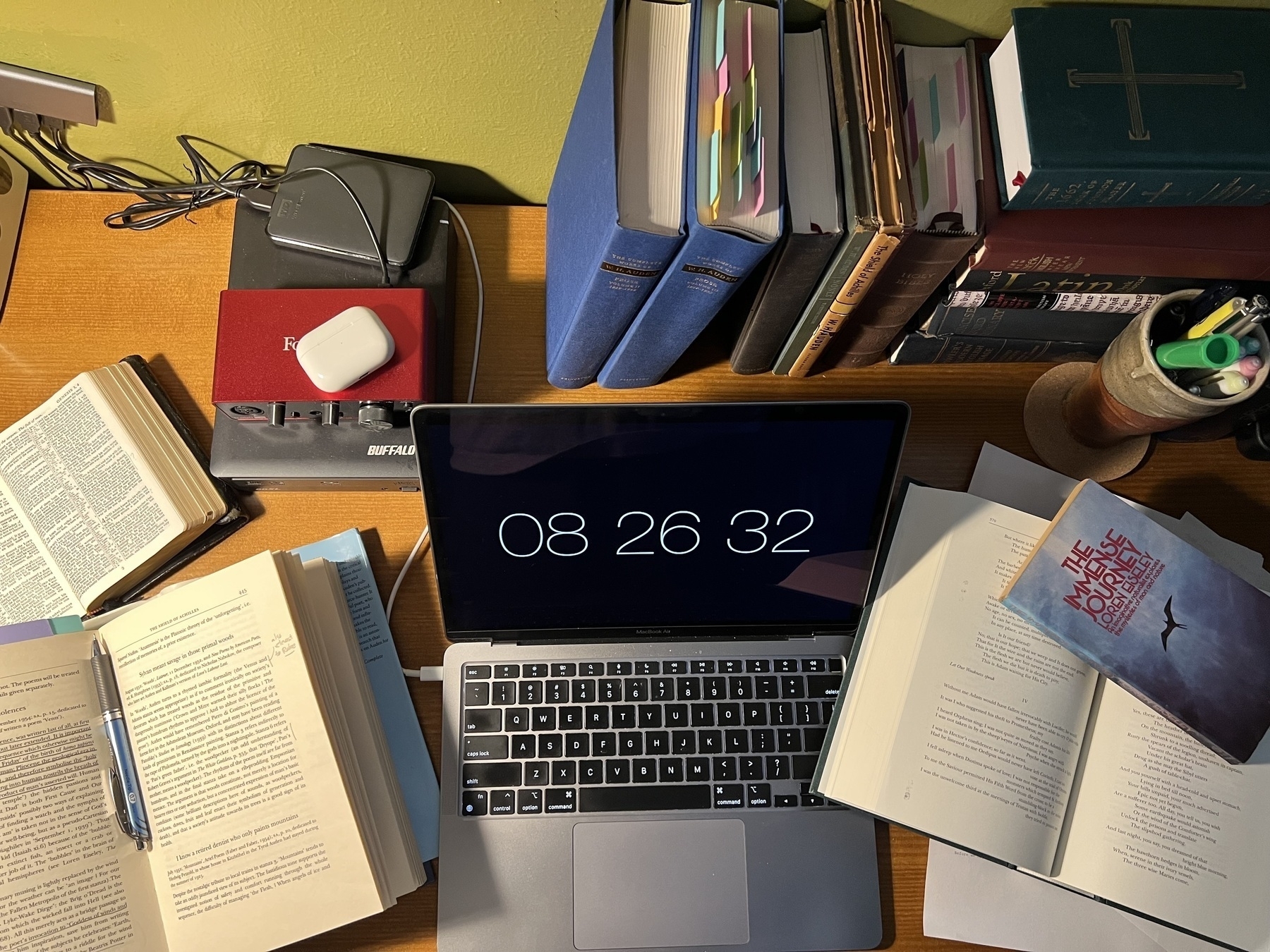
The workshop.
the arts our country requires
In a famous letter, John Adams wrote from Paris to his beloved Abigail:
To take a Walk in the Gardens of the Palace of the Tuilleries, and describe the Statues there, all in marble, in which the ancient Divinities and Heroes are represented with exquisite Art, would be a very pleasant Amusement, and instructive Entertainment, improving in History, Mythology, Poetry, as well as in Statuary. Another Walk in the Gardens of Versailles, would be usefull and agreable. But to observe these Objects with Taste and describe them so as to be understood, would require more time and thought than I can possibly Spare. It is not indeed the fine Arts, which our Country requires. The Usefull, the mechanic Arts, are those which We have occasion for in a young Country, as yet simple and not far advanced in Luxury, altho perhaps much too far for her Age and Character.Only the last two sentences of the letter are typically quoted, but I think it’s useful to see the larger context, especially Adams’s regret at the matters of great interest to him that he doesn’t fully understand and simply cannot take the time to understand. He had recently been engaged in complicated and tense negotiations with the French foreign minister, the Comte de Vergennes, which around this time resulted in the Frenchman declaring that he wouldn’t deal with Adams any more but only with the less astringent Benjamin Franklin. (Perhaps Adams should have been working harder at the study of the Art of Negotiation.)I could fill Volumes with Descriptions of Temples and Palaces, Paintings, Sculptures, Tapestry, Porcelaine, &c. &c. &c. — if I could have time. But I could not do this without neglecting my duty. The Science of Government it is my Duty to study, more than all other Studies & Sciences: the Art of Legislation and Administration and Negotiation, ought to take Place, indeed to exclude in a manner all other Arts. I must study Politicks and War that my sons may have liberty to study Painting and Poetry Mathematicks and Philosophy. My sons ought to study Mathematicks and Philosophy, Geography, natural History, Naval Architecture, navigation, Commerce and Agriculture, in order to give their Children a right to study Painting, Poetry, Musick, Architecture, Statuary, Tapestry and Porcelaine.
It’s interesting to note the change of mind he undergoes between the penultimate and final sentence: in the former he thinks his sons may well study Painting and Poetry, but then he reconsiders and thinks, well, perhaps it would be better for them to pursue “Naval Architecture, navigation, Commerce and Agriculture” and the like so that their sons can study Painting and Poetry. His was, after all, “a young Country, as yet simple and not far advanced in Luxury” — and not likely to be much further advanced in a single generation.
Well, right now we seem to be regressing towards Adams’s state of affairs. Everyone in power, or aspiring to power, in this country seems to be studying Politics and War, though they will sometimes cover that study with a flimsy disguise.
On the so-called Left we see surveillance moralism (and often enough the sexualization of children and early teens) masquerading as science.
On the so-called Right? It’s wrathful trolling masquerading as political philosophy.
None of these folks, God bless their earnest if shriveled hearts, have any room inside for the arts. Everything has to serve their political purposes, and works of art are rarely sufficiently blunt instruments. Thus Michael Lind writes — in an otherwise useful essay — that the goal of the public intellectual is to “influence voters,” because what other reason could an intellectual possibly have for writing? (Michael Lind is a very intelligent and often illuminating writer, but he really does seem to think that nothing exists in the human world except electoral politics.) The one arguably-artistic preference these would-be elites of Left and Right share is a liking for Game of Thrones (and now House of the Dragon) but only because that world is a wish-fulfillment dream for aspiring tyrants.
Well, here at the Homebound Symphony I’ll be focusing on the arts more and more, and if sometimes connecting their wisdom to the social and political concerns that trouble our minds and dreams, I’ll try never to do it in a way that blunts those sharp instruments that pierce soul and spirit. And I’ll do this in honor of John Adams, so that his sacrifice was not in vain.
(I also think there are every good reasons for Christians to be especially attentive to the arts — even those Christians who don’t think of themselves as arty. That may be a topic for future posts, because my reasons for so thinking are not common ones.)
But I can do all this because of others who are doing some necessary but ugly work. The internet’s own John Adamses … sort of. I’ll write a follow-up post on some of these helpful people.
“The Godfather is shit. But there is a part of me that loves shit.” — Jean-Luc Godard
defeaters
Ukraine Can Win This War - by Liam Collins and John Spencer: Two or three times a day I see an article like this one: a confident prediction that Ukraine is in a winning position that never once considers the possibility that Russia will use nukes. I don’t see how this is anything other than the purest wishful thinking. The Ukrainian politician who says that Russia is like a monkey with a hand grenade is reckoning more seriously with the real conditions of this war.
Here’s my thesis about our current political discourse: The more controversial the topic, the more likely that writers on it will simply ignore any perspective other than their own. They won’t consider it even to refute it; they’ll just pretend it doesn’t exist.
My secondary thesis is that such people try really hard not to think of alternatives because they know they can’t deal with the objections. A. E. Housman used to say that many textual critics simply ignore possibilities for establishing a reading of a text other than the one they prefer because they’re like a donkey poised equidistant between two bales of hay who thinks that if one of the bales of hay disappears he will cease to be a donkey.
Epistemologists like to talk about defeaters of a particular proposition: it’s SOP, for them, when making an argument to ask: What eventuality would defeat my proposition? People writing enthusiastically that Ukraine will win this war never ask that question because the answer is both obvious and terrifying: Ukraine won’t win this war if Russia uses nuclear weapons against them.
monarchy
Having written recently about the death of Queen Elizabeth, I’d like to call attention to some of the things I’ve written in the past about what I believe to be the essentially monarchical character of the human imagination:
- My essay for the Cambridge Companion to C. S. Lewis on the Narnia books, which I argue have a single theme: disputed sovereignty
- A post on the very idea of the return of the King
- An essay on how Emile Durkheim’s portrayal of the dominant concerns of traditional or “primitive” societies has a modern afterlife
- An essay on the ongoing power of what Leszek Kołakowski calls “mythical thinking” (and do check out the Kołakowski tag at the bottom of this post)
Short version of all this: Every distinction we make between our “modern” selves and our “primitive” ancestors is wrong. We’re exactly like them in all the ways that really matter for our own self-understanding.