

Very much looking forward to Jamie's latest, which seems the natural — indeed the wonderfully inevitable — next step in his thoughtful and provocative Augustinian journey. I might want to read it in conjunction with a re-read of this.
Hmm, a couple of Premier League games at 2 — I wonder how VAR will ruin them?
Ken Burns’s ‘The U.S. and the Holocaust’ - Dara Horn:
Burns has a soft spot for Franklin and Eleanor, the subjects of one of his prior films, and here he treats them with kid gloves, blaming most of the missteps on State Department antagonists. The series makes a point of establishing the bigoted, racist atmosphere of the U.S. at the time, showing Nazi rallies in New York, clips of the popular anti-Semitic broadcaster Father Charles Coughlin, and colorized footage of a Nazi-themed summer camp in New Jersey. But the film goes out of its way to outline the pros and cons of Roosevelt’s decisions, leaving his reputation intact. To be clear, Roosevelt is an American icon and deserves to remain one. The problem with this approach is less about Roosevelt (there are plenty of convincing arguments in his favor, not least that he won the war) than about how it contradicts the rest of the film’s premise. The goal of the series is seemingly to reset America’s moral compass, using hindsight to expose the costs of being a bystander. But every bystander, including Roosevelt, can explain his choices. The film’s refusal to judge the commander in chief plays into a larger political pattern: offering generosity only toward those we admire.Or whom we perceive to be on Our Team. The whole essay is excellent, but I especially appreciate the unpacking of this point: “Democracies, for all their strengths, are ill-equipped for identifying and responding to evil.”
Auden, nature, history
(A draft preface for my forthcoming edition of Auden's book The Shield of Achilles, with some images and links that won’t be in the book.)

In 1952, Barbara Cohen and Marianne Roney, two recent graduates of Hunter College in New York City, started a company called Caedmon Records, with the goal of presenting the finest living poets reading their own work. They began with Dylan Thomas, who duly showed up in the studio with poems in hand – but only enough to fill one side of a record. Fortunately, he remembered that he had written a brief prose memoir that they could use to fill out the other side. Thanks largely to this casual inclusion of A Child’s Christmas in Wales the LP sold very well indeed and established the company’s reputation. The next year Cohen and Roney approached W. H. Auden, who entered a recording studio on 12 December 1953 to read enough poems to fill an LP.
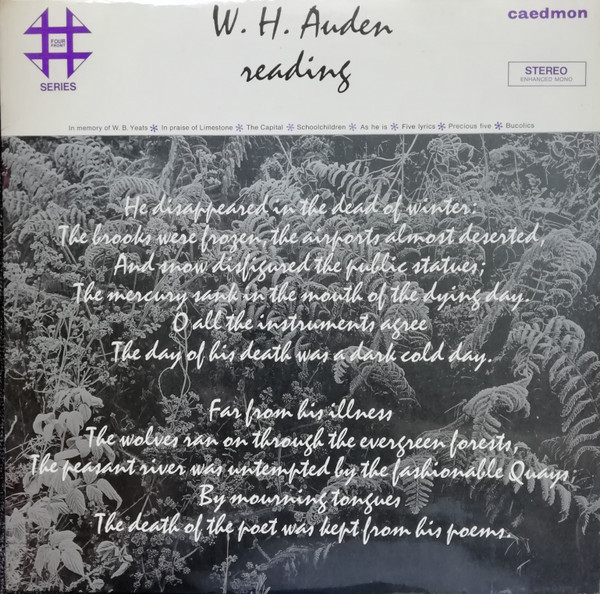
His famous 1939 poem “In Memory of W. B. Yeats” was chosen to begin the record, but most of the poems Auden read were recently-written ones. The second poem on the first side is “In Praise of Limestone” (1948), which he describes, in the liner notes he wrote to accompany the record, as “a kind of prelude to the series of Bucolics on Side Two.” That he would think of this ambitious and complex poem as mere “prelude” says something about where his mind was at the time. The seven “Bucolics” fill the whole of Side Two, and his liner notes say that they “have in common the theme of the relation of man, as a historical, or history-making person, to nature.”
Here’s Auden reading “Woods” — one of the “Bucolics” — in an unfortunately echoey space. (The Caedmon folks improved their recording techniques over the years.) Never forget: “A culture is no better than its woods.”
This theme of our double lives — in a nature shared with the other creatures, in a history that those creatures cannot know — dominated Auden’s thoughts, and his verse, for a decade or more. On March 9, 1950, Auden visited Swarthmore College, where he had taught between 1942 and 1944, to deliver a lecture called “Nature, History and Poetry.” He had already given an almost identical lecture at Mount Holyoke College in January and at Fordham University in February, and would give it once more, on March 11, at Barnard College. Except at Barnard, he provided for the audience a typed, mimeographed handout featuring a poem he had recently written, “Prime,” and, curiously, two early drafts of that poem. The subject of his talk was the human experience of living in “natural time” but also in “historical time,” and how poetry might capture that twofold temporality.
Auden gave four versions of the same talk not only because it enabled him to make more money with less work – though surely that was a factor – but also because the themes had risen to the point of obsession for him. (And again, not just recently: After reading “Prime” to the Swarthmore audience he says, “Actually this poem was written last August, in Italy, but a number of things go back much further than that.”) Nones, the collection of poems that Auden published in 1950, while it contains some of his finest poems, including “Prime,” is best understood as a kind of bridge between his long poems of the 1940s, which are focused almost wholly on the inner life, and the complex, resonant account of living-in-nature and living-in-history that he would achieve in this collection, The Shield of Achilles.
redirect
I love this from Tom McWright: A script that redirects anyone who comes to his site from Hacker News to Google. He’s had enough experience with jerks who read Hacker News to make a point of sending them elsewhere. I might adapt that JavaScript to redirect people who come here from Twitter. I told a friend recently that my goal is to write posts that no one on Twitter will ever link to.
Currently lstening to: Gershwin, Rhapsody in Blue ♫ (It’s good to be reminded what an extraordinary and unprecedented work it is)
sequence
A: I don’t know, I think we need to get our own house in order before we launch into critiques of our enemies.
B: There’s no time for that! The situation is too dire.
A: But what if the situation is dire precisely because we never got our house in order, because we tolerated dishonesty, corruption, and short-term and shabby thinking for so long?
B: Maybe that’s true, but we can’t worry about that now. Our enemies are taking over and we have to stop them at all costs!
A: But isn’t that what you were saying years ago, in a situation that you now see as less dire than the current one?
B: This is a do-or-die moment. You’re just denying reality if you don’t see that.
A: You said that years ago also. If every moment is one of absolute crisis, then no moment is. I know a guy, a maker, a very successful small businessman, who is running way behind on his work. He’s facing a genuine crisis. And yet he just took six weeks off to completely reorganize his workflow and his workspace. He did so because he knows that (a) he should have done it long ago and (b) his problems won’t go away — unless people stop ordering his products because he doesn’t deliver. In that case his problems will have gone away because his business will have gone away. He’s taking a big hit to his business in the short term because that is the only way for him to be successful over the long haul. That’s precisely how we ought to be thinking. It is never the wrong time to get your house in order. And maybe the greater the crisis the more essential it is to take a good hard look at ourselves before flailing at our opponents.
B: Stop blaming the victims!
(P.S. I’m A. You wouldn’t have guessed.)
shorts
I have read a great deal about the Russian invasion of Ukraine and I have many thoughts — and a few strong opinions — but I am keeping them all to myself. Why? Because I don’t have any first-hand or even second-hand knowledge about the matter. It’s a useful spiritual discipline for me to shut up about all this. Indeed, over time I want to increase the number of things I shut up about until I finally achieve perfect silence.
•
The primary — not the only, but the primary — reason journalists decline to name their sources is simply this: They don’t want us to be able to evaluate those sources. Readers fear some things and hope for other things, and journalists stay in business by feeding the fears and the hopes alike. They can best do this by writing that “an expert told me that the worst will indeed happen” or “a person close to the situation told me that the event you’ve all been praying for will soon come to pass.” The expertise of the supposed expert might not bear up under inquiry, nor the closeness of the person supposedly close to the situation; so identities stay under wraps.
•
The vast majority of journalists, TV talking heads, talk-radio hosts, and politicians never ask themselves whether what they are about to say is true. They ask whether they’ll get in trouble for saying it.
•
A line from an entry in my journal: “Everybody lied, and lied all the time.” Could be about any period, any place. (I’d say more about this, but I have an essay forthcoming on lying and truthtelling, so I’ll save my comments for its appearance.)
•
Another line from my journal: “Nobody can be bothered to find out how the world actually works.”
•
Charles Spurgeon (on Luke 15:20): “The eyes of mercy are quicker than the eyes of repentance. Even the eye of our faith is dim compared with the eye of God’s love. He sees a sinner long before a sinner sees him.”
Le faux samouraï
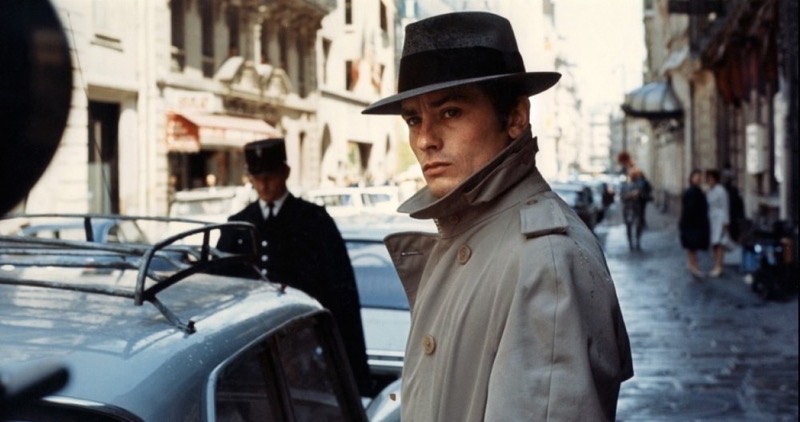
Criterion describes the film thus: “In a career-defining performance, Alain Delon plays Jef Costello, a contract killer with samurai instincts. After carrying out a flawlessly planned hit, Jef finds himself caught between a persistent police investigator and a ruthless employer, and not even his armor of fedora and trench coat can protect him.“ Well … the hit may have been flawlessly planned, but it wasn’t flawlessly executed.
Nothing Jef does is flawlessly executed, and the problems start (and to some extent end) with his choice of clothing: trench coat and fedora. Like Jean-Paul Belmondo’s cheap crook in Breathless — R.I.P. Jean-Luc Godard, by the way — Jef has clearly watched too many Bogart movies. With the partial exception of an older man we see in a police lineup, nobody else in the movie — set in a very Sixties Swinging Paris — dresses remotely like Jef, so he might as well have a spotlight on him everywhere he goes. And then after he has completed his hit he just walks thoughtlessly out of the room and into a hallway where is is immediately seen. Similarly, after each hit he has the license plates changed on his car, but never considers the value of driving a different car. Jef may think he’s a smooth hitman “with samurai instincts,” but he’s really pretty bad at his job.
He only survives as long as it does because (a) the police aren’t very good at their jobs either and (b) the woman who sees him after that first hit, a pianist at the nightclub, tells the police that she doesn’t recognize him — for no reason we are ever told. But eventually his own carelessness — combined, I’m inclined to think, with a desire to die, to be done with the charade — catches up with him anyway.
We can make some guesses about what motivates the pianist who claims not to have seen him, and about why Jef returns to the nightclub to point an empty gun at her; we can try to connect these dots, and others; but we can’t be sure. One of the best things about the movie is its reticence, though not absolute silence, about what’s motivating people. As a character in The Rules of the Game says, “The awful thing about life is this: everyone has their reasons” — but in Le Samourai we never learn what those reasons are. But I don’t think there’s any way to tell the story that makes Jef good at what he does.
Too many viewers of the movie, including critics, take Jef at his own self-valuation, buy into his illusory self-image. Perhaps this is because Alain Delon is so outrageously good-looking. But in any case it’s a mistake. Jef is a young French guy pretending (for whatever reason) to be a Bogartesque hard man, and the story of the movie is how his pretense eventually becomes more than he can sustain.
the King

There’s a great moment in the Beatles’ Get Back documentary — the 9 January 1969 session — when Mal Evans points out that the previous day had been Elvis’s birthday. Paul puts on his best Elvis voice and sings “God save our gracious King” … funny and appropriate too. Here are some relevant numbers:
- Elvis had just turned 34
- Paul was 26
- Queen Elizabeth II had reigned for just short of 17 years
- Paul had been 9 when Elizabeth came to the throne
So Paul probably remembered (and perhaps still remembers) singing “God Save the King.” What goes around comes around.