
Robert A. Caro, Master of the Senate: The Years of Lyndon Johnson, Volume III:
“Whenever I was late, no matter what the reason, Johnson called me a lazy, good-for-nothing n****r,” Parker wrote. And there was an incident that occurred one morning in Johnson's limousine while Parker was driving him from his Thirtieth Place house to the Capitol. Johnson, who had been reading a newspaper in the back seat, “suddenly lowered the newspaper and leaned forward,” and said, “‘Chief, does it bother you when people don't call you by name?’” Parker was to recall that “I answered cautiously but honestly, ‘Well, sir, I do wonder. My name is Robert Parker.’” And that was evidently not an answer acceptable to Johnson. “Johnson slammed the paper onto the seat as if he was slapping my face. He leaned close to my ear. ‘Let me tell you one thing, n****r,’ he shouted. ‘As long as you are black, and you’re gonna be black till the day you die, no one’s gonna call you by your goddamn name. So no matter what you are called, n****r, you just let it roll off your back like water, and you'll make it. Just pretend you're a goddamn piece of furniture.’”
Parker found that incident in Johnson's limousine difficult to explain or forgive. Years later, as he stood beside Lyndon Johnson's grave thinking of all Johnson had done for his people, Parker would say he was “swirling with mixed emotions.” Lyndon Johnson, he would write, had rammed through Congress “the most important civil rights laws this country has ever seen or dreamed possible.” Because of those laws, Parker would write, he felt, at last, like a free man. “I owed that freedom to him.... I loved the Lyndon Johnson who made it possible.” But remembering the scene in the limousine — and many other scenes — Parker was to write that on the whole working for Johnson was “a painful experience. Although I was grateful to him for getting me a job I was afraid of him because of the pain and humiliation he could inflict at a moment's notice. I thought I had learned to fight my bitterness and anger inside.... But Johnson made it hard to keep the waves of bitterness inside... But I had to swallow or quit. If I quit, how would I support my family? I chose survival and learned to swallow with a smile.” And, Parker would write, “I hated that Lyndon Johnson.”
Here is Robert Parker’s book.
And I’ve been saying for a long time now that we need to get out of this rut. You can shut things down for 15 days to slow the spread. You can even keep things semi-closed for a year until the arrival of vaccines. But you can’t just permanently impair the basic functioning of society due to a new respiratory virus; it doesn’t pass cost-benefit scrutiny. But that doesn’t mean there are no costs. We are living with lots of people dying of a virus that didn’t previously exist. We also have people going to the hospital and suffering long-term damage to their lungs or other organs. What the Covid hawks get right is that this is genuinely a very bad situation, and not just something we can declare ourselves “over.”
But the response we need is a pharmacological one, and that’s where we are failing.
The virus is evolving faster than our vaccines. And while scientists keep diligently plugging away at next-generation vaccination ideas, the idea of a whole-of-America effort to do R&D and production and fast-tracked regulatory approval seems gone and forgotten. That’s a disaster for the country, and we need to change course.
The whole post is very good, and unfortunately accurate in its diagnosis. See also this Eric Topol post. I’m not afraid, but I’m concerned.
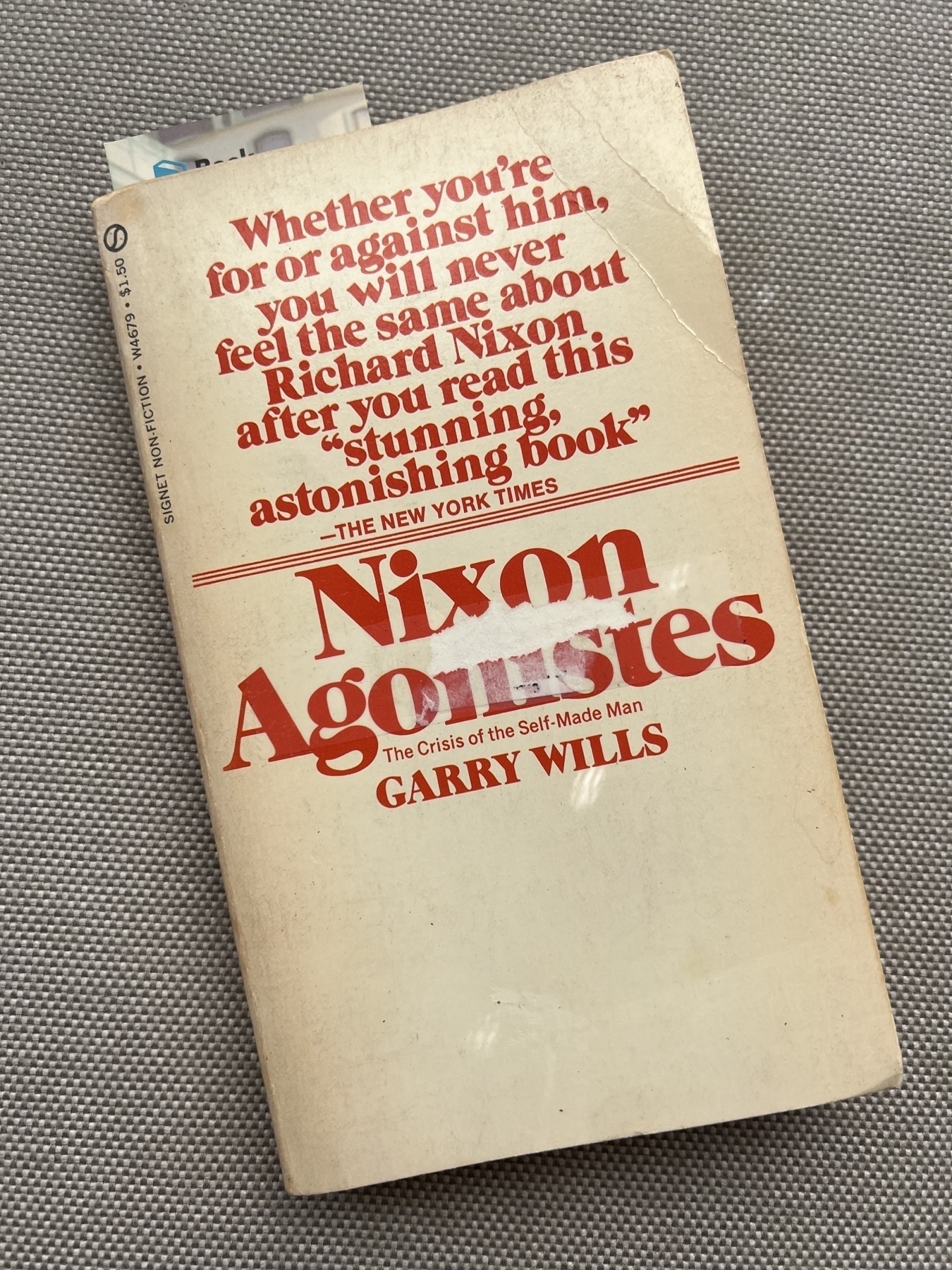
📚 Currently reading, in a copy I acquired in (I think) 1972:
A heartbreaking and powerful essay from Leah Libresco Sargeant:
A previous surgeon had told me to stop crying during a miscarriage, so this time my husband and I took a train ride to reach the hospital of a Catholic surgeon in New Jersey. We wanted a surgeon who took the loss of our child as seriously as the danger to my life.
The first person to see us was another ultrasound technician. Her voice got sharp when I asked if our baby had a heartbeat. “It’s not a baby, don’t talk like that,” she told me, as I lay on the table. Her voice softened a little, “You don’t have to think of it that way.” For her, part of providing care was denying there was any room for grief. […]
Doctors can’t value women more by dismissing our babies as worth less. Even women who support abortion access may find it jarring to have their child’s life dismissed when they hoped they would hold this baby. It’s better to be honest about tragedy and loss, than to pretend that only one person is on the table.
Caro's LBJ
After all these years, I am finally getting around to reading Robert Caro’s biography of Lyndon Johnson, and you know what? It is just as great as everyone says it is, maybe even greater. I’ve never read a better biography. What astonishes me is the skill with which Caro paces his story, considering its length, and considering how many digressions are necessarily embedded in it.
Caro is fabulously skilled at those digressions; he knows just how long they need to be in order to give the information that readers need if they are to grasp what LBJ was doing and why it mattered. In the first volume, his portrait of Sam Rayburn is a masterful mini-biography that tells us everything we need to know about that remarkable man in a dozen pages; it faithfully guides us when we see Rayburn’s actions later in the story. There are many such character sketches in this book, and each of them is a little marvel of lucidity, compression, and the art of the well-chosen detail. Thus we hear that W. Lee “Pappy” O’Daniel, the supposedly populist governor, when told that some people thought that his policies were betraying his supporters, plaintively replied, “How can they say I’m against the working man when I buried my daddy in overalls?”
But of these digressions, the best one in the first volume, surely, accompanies the account of how LBJ brought electricity to the farms and ranches of the Texas Hill Country. Caro gives us a brief but brilliant history of the daily lives of people of that region in the years before electricity: how they got their water; how they cooked and cleaned; how they milked their cows in the dark, not daring to bring a kerosene lantern into the barn for fear of fire. (Also: precisely how much light kerosene lanterns of the time provided.) He tells us why many of them were afraid of the coming of electricity, and afraid that the government would cheat them, as it had so often cheated them in the past. And then he tells us just how the electrical lines were built:
The poles that would carry the electrical lines had to be sunk in rock. Brown & Root’s mechanical hole-digger broke on the hard Hill Country rock. Every hole had to be dug mostly by hand. Eight or ten-man crews would pile into flatbed trucks – which also carried their lunch and water – in the morning and head out into the hills. Some trucks carried axemen, to hack paths through the cedar; others contained the hole-diggers. “The hole-diggers were the strongest men,” Babe Smith says. Every 300 or 400 feet, two would drop off and begin digging a hole by pounding the end of a crowbar into the limestone. After the hole reached a depth of six inches, half a stick of dynamite was exploded in it, to loosen the rock below, but that, too, had to be dug out by hand. “Swinging crowbars up and down – that’s hard labor,” Babe Smith says. “That’s back-breaking labor.” But the hole-diggers had incentive. For after the hole-digging teams came the pole-setters and “pikemen,” who, in teams of three, set the poles – thirty-five-foot pine poles from East Texas – into the rock, and then the “framers” who attached the insulators, and then the “stringers” who strung the wires, and at the end of the day the hole-diggers could see the result of their work stretching out behind them – poles towering above the cedars, silvery lines against the sapphire sky. And the homes the wires were heading toward were their own homes. “These workers – they were the men of the cooperative,” Smith says. Gratitude was a spur also. Often the crews didn’t have to eat the cold lunch they had brought. A woman would see men toiling toward her home to “bring the lights.” And when they arrived, they would find that a table had been set for them – with the best plates, and the very best food that the family could afford. Three hundred men – axemen, polemen, pikers, hole-diggers, framers – were out in the Edwards Plateau, linking it to the rest of America, linking it to the twentieth century, in fact, at the rate of about twelve miles per day.
All of this comes not from reading books – there’s much here that no book has told – but from interviewing people who were present when the electrification of the Hill Country happened. (In the late Seventies Caro and his wife, though lifelong and happy New Yorkers, moved for a couple of years to the Hill Country, because it took that long to acquire the older folks’ trust.)
Eventually, twelve miles a day, the electrification was done, though not without strain of many kinds. Here’s how the chapter concludes:
Brian Smith had persuaded many of his neighbors to sign up, and now, more than a year after they had paid their five dollars, and then more money to have their houses wired, his daughter Evelyn recalls that her neighbors decided they weren’t really going to get it. She recalls that “All their money was tied up in electric wiring” – and their anger was directed at her family. Dropping in to see a friend one day, she was told by the friend’s parents to leave: “You and your city ways. You can go home, and we don’t care to see you again.” They were all but ostracized by their neighbors. Even they themselves were beginning to doubt; it had been so long since the wiring was installed, Evelyn recalls, that they couldn’t remember whether the switches were in the ON or OFF position.
But then one evening in November, 1939, the Smiths were returning from Johnson City, where they had been attending a declamation contest, and as they neared their farmhouse, something was different.
“Oh my God,” her mother said. “The house is on fire!”
But as they got closer, they saw the light wasn’t fire. “No, Mama,” Evelyn said. “The lights are on.”
They were on all over the Hill Country. “And all over the Hill Country,” Stella Gliddon says, “people began to name their kids for Lyndon Johnson.”


Currently reading: The High Sierra: A Love Story by Kim Stanley Robinson 📚
The Amazon store experience, while presented as frictionless, contains a lot of friction—so much so that many people are excluded from entry. On top of the complex surveillance system, every customer needs to have a smartphone, have downloaded the Amazon app, logged in to an Amazon account, and connected a means of payment. When an Amazon Fresh store opened in West London in March 2021, a journalist observed an old man trying to go in to pick up some groceries, but he gave up when he was told all the steps he would have to take just to enter. “Oh f*** that, no, no, no — can’t be bothered,” he said, then kept walking to reach a normal grocery store. But in the future he may run into similar issues at even more stores, as countries like Sweden pioneer a cashless economy and the Amazon model inevitably spreads.
The extension of inequities, and even the creation of new ones, is a key part of the frictionless society that gets hidden by the digital services that claim to increase convenience and reduce barriers to consumption. Researcher Chris Gilliard coined the term “digital redlining” to describe the series of technologies, regulatory decisions, and investments that allow them to scale as actions that “enforce class boundaries and discriminate against specific groups.” In the same way that biases in artificial intelligence systems were long ignored, if not purposefully hidden, to protect companies' business interests, these frictionless tools also claim they will eliminate inequities, even as Gilliard argued that “the feedback loops of algorithmic systems will work to reinforce these often flawed and discriminatory assumptions. The presupposed problem of difference will become even more entrenched, the chasms between people will widen.”
The great thing about humility tweets is that you’re not trying to show that you are better than anybody else. You are showing that you are a regular, normal person, despite the fact that your life is so much more fabulous than those of the people around you. You are showing the world that you haven’t let your immense achievements go to your head! You’ve remained completely egalitarian — you just happen to be a better egalitarian than most people (and you are humbled by that fact). It’s easy to be humble when you’re most people. But just think about how amazing it is to be humble when you’re as impressive as you!