Ross's prediction and mine

Ross Douthat:

I will make a prediction: Within not too short a span of time, not only conservatives but most liberals will recognize that we have been running an experiment on trans-identifying youth without good or certain evidence, inspired by ideological motives rather than scientific rigor, in a way that future generations will regard as a grave medical-political scandal.
I think this prediction will partly, but not wholly, come true. I do believe that there will be a change of direction, but for the most part it will be a silent one, an unspoken course correction; and on the rare occasions that anyone is called to account for their recklessness, they’ll say, as a different group of enthusiasts did some decades ago, “We only did what we thought was best. We only believed the children.” But they won’t have to say it often, because the Ministry of Amnesia will perform its usual erasures; and even the children who have been sacrificed on the altar of their parents’ religion, metaphysical capitalism, may not recognize or remember what was done to them.

The same will be true of those who suffer the various derangements in what passes for the Right today. People will later briefly wonder at “all that happened to us, around us, and by us” — but then a notification will hit their phone and the wondering will cease. And the demonic realm will persist in its sleepless labor.

I’ll be back after Easter.

waiting for persuasion

Leon Wieseltier’s long essay on postliberal Catholic integralists, or whatever we should call them, is a mixture of the insightful and the dismissive. (When he writes, “The difference between theology and philosophy is that philosophy inspects the foundations, whereas theology merely builds on them,” that just tells you how little theology he has read.) Mainly Wieseltier demonstrates how different the integralists’ core commitments are from his — but then we knew that already, didn’t we? 

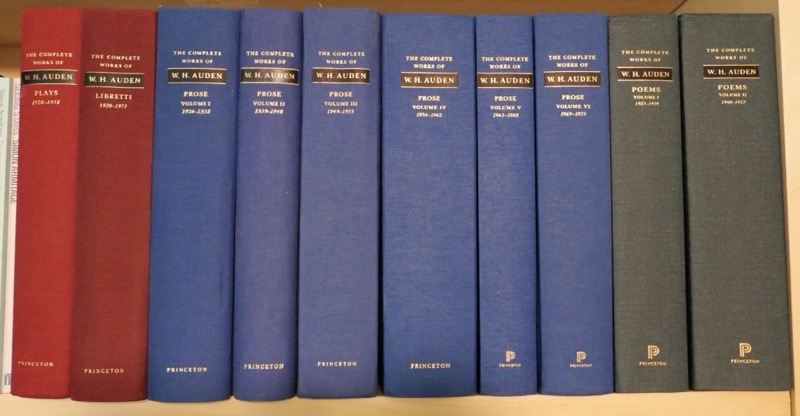
In “Vespers,” the fifth of Auden’s “Horae Canonicae,” the poet imagines a brief crossing-of-paths in the city, at dusk: he, the nostalgic Arcadian, passes his “antitype,” the Utopian. “When lights burn late in the Citadel,” the poet thinks, “Were the city as free as they say, after sundown all her bureaus would be huge black stones”; but the Utopian thinks, “One fine night our boys will be working up there.” The integralists are in this sense Utopian: they think of power chiefly to long for it. 

They tell us what they’ll do when their boys occupy the Citadel; but what they never tell us, as far as I have been able to discover, is how they plan to get there. It’s perhaps understandable that they’re not trying to persuade Leon Wieseltier; but they’re not even trying to persuade me. They’re just talking to one another. Were they ever to begin seeking allies I might well pay close attention; but not until.  

discounting the past

People on the left will typically be amazed and gratified by any good that has been achieved recently, and will treat any goods achieved by our ancestors as matters of course for which none of us need be grateful. Likewise, they are predisposed to see new developments as goods and are therefore unlikely to criticize them. 

People on the right will typically be obsessively horrified by any new wrong, and uninterested in wrongs that have been long embedded in our social order — indeed, they will be so predisposed to see new developments as ills that they may, by way of compensation, grow inclined to see old ills as positive goods. But even if they see the ancient wrongs for what they are, they won’t feel their seriousness; it’s the new wrongs that engage their emotions. 

In both cases, the looming power of the present moment distorts our judgment. Neophilia and neophobia alike occur because the present is so BIG that we can’t see around it; or because everything not-now seems small in comparison. 

In other words, just as there are social discount rates for the future, there are also social discount rates for the past. And in both cases, our media environment encourages stronger and stronger discounts as we move away from the present moment (something that remains true even when the media try to tell us about climate catastrophe). But because the future has not occurred and could take many forms, it remains fuzzy for us, whereas the past can be seen more clearly. So I think that if we want people to have a stronger regard for future — to discount it less heavily — then, paradoxically, we need to make people more attentive to the past, its errors and its achievements alike. 

self-Haysing

As Nikil Saval pointed out some years ago, “The arc of scientific management is long, but it bends towards self-Taylorizing.” (See further development of these ideas in this essay by Alexa Hazel, and a few comments by me, on related matters, here.)  

I might coin an analogous phrase: The arc of creative product development is long, but it bends towards self-Haysing. 

Thou Shalt Not Whitey Schafer 1940

For several decades the Motion Picture Production Code, commonly known as the Hays Code, governed what could and could not be shown in movies. I was thinking of it the other day while watching Ernst Lubitsch’s glorious Trouble in Paradise (1932), made just pre-Code and therefore full of Inappropriate Content.

A very funny moment early on comes when the two thieves-pretending-to-be-aristocrats, played by Miriam Hopkins and Herbert Marshall, are having dinner together and gradually revealing what they’ve pinched from each other. He returns her brooch; she returns his watch. They resume their meal and then after a moment he says, “I hope you don’t mind if I keep your garter.” Her eyes widen and her hand inspects her leg as he displays the garter, kisses it tenderly, and replaces it in his pocket. 

Trouble 1200 1200 675 675 crop 000000

The Hays Code did away with such immoralities. Eventually it was repealed in favor of our current movie rating system, and now we can have anything, right? Right? Well.... 

Alan Rome has a fine essay in The New Atlantis on recent developments in the Star Trek world in which he points out that earlier installments in the series were governed by a kind of liberal idealism: “In Star Trek’s future, the United Federation of Planets is a liberal-democratic regime encompassing hundreds of different alien species, all devoted to peace, freedom, and equality. The Federation is the United Nations writ galactic, led by an Americanized humanity.” But more recently it has become necessary to cast strong doubt on all that nonsense: “Government is somehow both the only possible guarantor of justice and also structurally implicated in all social evils. The current system is therefore illegitimate and needs to be dismantled in favor of some sort of utopian solution.” That no one seems to know what that Utopia might look like is another of Rome’s points, but for now I just want to focus on the fact that a series like Picard cannot do anything but portray any existing social system as hypocritical, complicit in oppression, structurally unjust, etc. etc. That’s intrinsic to the Code. 

As Foucault spent his career demonstrating: Written Codes are strong, but Codes unwritten are stronger. And I don’t think I need to list the ways in which recent movies and TV shows have exhibited a frantic determination to depict all that Must Be Shown and to refrain from depicting all that Must Not Be Shown. I also don’t think I have to list the ways in which this kind of manaical ticking of checkboxes inhibits creativity. It’s self-Haysing: disciplining yourself in order to avoid being disciplined by others, and that’s always kind of pathetic. No need to belabor this point. I just want to make a few others: 

  1. Whether written or unwritten, Codes are always present, though some periods (like our own) are more prone to code fetishizing than others;
  2. While you will surely approve of some Codes and disapprove of others, they always inhibit creativity; 
  3. But they also inspire creativity, because real artists look for ways to evade the force of Codes or, through jujitsu moves, use them to advantage; 
  4. Figuring out whether in any given case a Code is more productive than destructive is not easy, though as a general rule, the more feverishly people strive to enforce a Code the more destructive it is; 
  5. And, finally, if you don’t like what the current Code is doing to movies and TV, there’s a vast body of work out there that you’ll like better.

I don’t know why people think it’s so important that there are always new products being developed that will suit them. If there’s one thing that our current moment does well, it’s to make available to us the great cultural achievements of the past, in multiple forms and formats. If I don’t like Old Disney, there’s Woke Disney; if I don’t like Woke Disney, there’s Old Disney. Break bread with the dead, is what I say. (But also maybe stock up, just in case.) 

I’ve been watching this regularly for the past couple weeks, and I’ve never been so mesmerized. 

Currently reading: Tristes Tropiques by Claude Levi-Strauss 📚

We have four mature live oaks on our property, but this is the one I look at the most often. It has a curiously sinuous interior architecture.

Cosmati pavement coloured star pattern jpg

The Cosmati Pavement in Westminster Abbey: “In the year of Christ one thousand two hundred and twelve plus sixty minus four, the third King Henry, the city, Odoricus and the abbot put these porphyry stones together. If the reader wisely considers all that is laid down, he will find here the end of the primum mobile.” From a story in the Guardian: “Only a handful of brass letters remains of the original long inscription, but it was transcribed centuries ago. It names the king, the chief craftsman as Odoricus, gives the date in a tortuous riddle, and then mysteriously suggests that the world will last for 19,683 years, by adding together the life spans of different animals: "add dogs and horses and men, stags and ravens, eagles, enormous whales….” 

Cosmati pavement 2010 photomosaic jpg