

Really glad to get this fine book in the mail. Isaac has pulled off a very difficult task here: his book is straightforward and practical, charitable and wise. I hope many, many people read it.
why?
Let me just say a bit more about why I’m doing this Buy Me a Dragon thing. My thinking can be condensed into three simple points.
First: I’ve never been able to get published the things I am most interested in writing. I do not blame editors for this – they are professionally required to think of what won’t lose money, or what fits with their periodical’s mission and purpose, or what the people above them in the hierarchy will tolerate. And look, I’m a pro at this game – I have rarely even asked editors to publish my less marketable thoughts. I have trimmed my sails appropriately in advance. (Though I remember with great delight the rare exceptions – for instance, when John Wilson warmly agreed to let me write a 30th-anniversary essay on Walker Percy’s Lost in the Cosmos. That was a red-letter day for me.) But…
Second: I have been thinking a lot about this from the English novelist M. John Harrison: “The idea you have when you’re young, to reach the edge of what can be done with your abilities and find out what might happen if you went past it? You promise yourself you’ll try but then wake up fifty years later to discover that you were in fact always too sensible to push things until they fell over, in case people thought less of you. In your seventies, though, it doesn’t seem to matter any more what other people think. That’s probably the first phase of your life in which you can actually do what you want. And certainly the last.” I’m still several years from my seventies … but I’m ready to be in that frame of mind now. And this blog may be the only venue where such exploration — as Eliot said, “Old men ought to be explorers” — is possible for me.
Third: I have been genuinely moved by the messages I received from people when I suspended this blog last month, and by what they have written on my Buy Me a Coffee page. I had no idea that this blog meant anything to more than a dozen people. This recent encouragement has given me heart to resume my writing here – after a period in which I felt it was a completely pointless activity.
So that, in sum, is why I’m here. Buy Me a Coffee allows me to continue this work that’s meaningful to me without feeling that I’m losing money. It allows me to get paid — some, anyway — for what I really really want (and on some level need) to write. And that’s a wonderful feeling. So massive thanks to all who have supported me in this endeavor.
the cross-pressured self
In a key passage of A Secular Age, Charles Taylor writes:
Although we respond to it very differently, everyone understands the complaint that our disenchanted world lacks meaning, that in this world, particularly youth suffer from a lack of strong purposes in their lives, and so on. This is, after all a remarkable fact. You couldn’t even have explained this problem to people in Luther’s age. What worried them was, if anything, an excess of “meaning”, the sense of one over-bearing issue — am I saved or damned? — which wouldn’t leave them alone. One can hear all sorts of complaints about “the present age” throughout history: that it is fickle, full of vice and disorder, lacking in greatness or high deeds, full of blasphemy and viciousness. But what you won’t hear at other times and places is one of the commonplaces of our day (right or wrong, that is beside my point), that our age suffers from a threatened loss of meaning. This malaise is specific to a buffered identity, whose very invulnerability opens it to the danger that not just evil spirits, cosmic forces or gods won’t “get to” it, but that nothing significant will stand out for it.A very basic traditional Christian account of the cross-pressured self would probably look something like this:There was indeed, a predecessor condition with some analogies to this one, and that was “melancholy” or “acedia”. But this was, of course, enframed very differently. It was a specific condition, one might say, a spiritual pathology of the agent himself; it said nothing at all about the nature of things. It cast no doubt on the ontic grounding of meaning. But this ontic doubt about meaning itself is integral to the modern malaise….
Meanwhile, this malaise, and other similar ones, speak to the condition of the buffered identity. This condition is defined by a kind of cross-pressure: a deep embedding in this identity, and its relative invulnerability to anything beyond the human world, while at the same time a sense that something may be occluded in the very closure which guarantees this safety. This is one source … of the nova effect; it pushes us to explore and try out new solutions, new formulae.
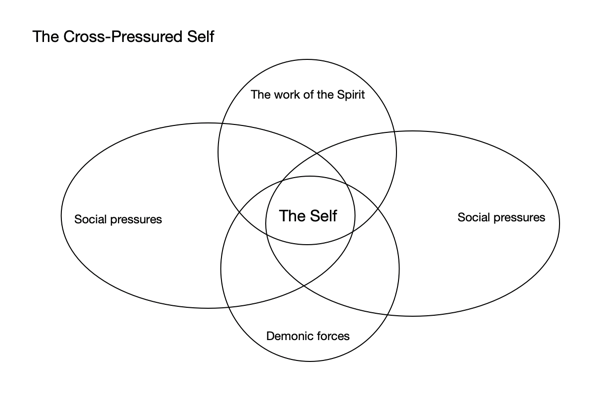
But of course a “very basic” account is not what we need. And this is where literature and the other arts come in. Great works of art offer non-schematic, finely-grained accounts of how people navigate these cross-pressures. (A phrase that Martha Nussbaum borrows from Henry James, “finely aware and richly responsible,” seems apropos here.) Tolstoy, Dostoevsky, Auden, Pynchon, Percy, Bach, Caravaggio, Vermeer, and many others — these artists collectively shape my understanding of (a) the complexity of the cross-pressuring forces and (b) the multifarious ways we humans respond to those forces.
Such complexity and multifariousness make me wonder whether we can ever come up with a valid general account of the Cross-Pressured Self. And yet we need one … I think.
I’ve written before about the value of moderation in consistency, of the need when cross-pressured by countering winds to tack back and forth. Similarly, there’s the need, when trying to understand one’s world, to alternate between specificity and generality. I do a lot better with specificity, because I have seen the ways that the embrace of a Big Theory tends to shut down people’s minds. But lately I have been feeling the absence, in my thinking, of a more general account of who we are, how we got here, and how we might navigate the prevailing winds of the future.
Or is that feeling merely a temptation? — Is the “general account” rather a snare and a delusion? Last month I had a stimulating conversation with Tal Brewer, a philosopher at UVA, in which Tal made the point that practical rationality is not a matter of calculating the means to a given end but rather acting in such a way as to instantiate that end right now, as best you can. (I think he explores the distinction, which is largely a distinction between a Kantian and an Aristotelian model, in this essay, but I haven’t yet acquired and read it.) I like that idea in part because it resonates with my understanding of Daoism. Daoism is big on doing the immediate right thing — and thus, in turn, rhymes with biblical ethics, focused as it is on obeying God (i.e., following Jesus) this day, and being held by God this day. Which is the special focus of Franciscan spirituality, and as I have said before, St. Francis is a kind of Jesus-loving Daoist sage.
So maybe a “general account” is not what is needed so much as equipment for acting wisely and lovingly — in a Christlike way — this day. A Franciscan-Daoist ethic for a surveillance-capitalist hate-media world. What that might look like is something I plan to think about a lot in the coming year. Please stay tuned.
There will be more soon on the specific notion of “equipment.”
an artifact of scale
David Spiegelhalter and Anthony Masters:
We tried this strategy [telling people about the incorrect interpretation before they catch it in the wild] back in June 2021 when Public Health England first published data showing that, among older people who had recently died with Covid-19, most had been vaccinated. We wrote an article pointing out that this did not mean the vaccine was ineffective – just that it was imperfect – and that the great majority of people had been vaccinated: in essence, a small proportion of a large number can be bigger than a larger proportion of a small number. Another useful analogy is with seatbelts: most people who die in car accidents are wearing seatbelts, but this does not mean that seatbelts are not effective – it’s just that nearly everyone wears one and they are not perfect.
The response to our “pre-bunking” was not encouraging. The Twitter link to our article included only its title, Why most people who now die with Covid in England have had a vaccination, and not the subhead, Don’t think of this as a bad sign, it’s exactly what’s expected from an effective but imperfect jab. As such, it was mistakenly interpreted as an anti-vaccination article (or worse) and circulated online. This, in turn, led to critical comments suggesting that we had encouraged vaccine scepticism and even an extraordinary tweet saying we (and the paper’s editors) were “genocidal” and should be “hunted down and destroyed”. We made light of this, saying this seemed a bit harsh, but we had had worse referees’ reports.
Morals of this story: People only read the headlines — at most — and no matter what opinion a public person has, someone on Twitter will demand his or her death.
Also — and I think this is largely a matter of scale, with which I have been so concerned for a while now — it is virtually impossible to get people to understand that “a small proportion of a large number can be bigger than a larger proportion of a small number.” Long numbers rocket the mind.
First 🔥 in many months

Special Relationships
If I had another lifetime at my disposal, here’s a book I’d like to write.
Special Relationships: British Sages in America
A history of American infatuation with wise men from Great Britain, structured by changes in technology. In all cases the book trade is essential, but it forms alliances with other technologies: first the lecture tour, then (thanks especially to the Luce empire) the magazine, and finally television. It’s possible that radio would need a chapter, but at the moment my sense is that radio was always more important as a way for Brits to understand America, e.g. Alastair Cooke’s “Letter from America.”General outline with key figures:
Part 1: The Age of the Lecture
- Charles Dickens
- Oscar Wilde
- G. K. Chesterton
Part 2: The Age of the Magazine
- C. S. Lewis
- Arnold Toynbee
Part 3: The Age of Television
- Kenneth Clark
- J. Bronowski
- James Burke
Afterword: The End of an Era
- Christopher Hitchens
FYI: I am doing Big Blogging again, and if you want to support that you can buy me a dragon.
It was 80º here an hour ago – tomorrow morning it’ll be 22º.
Buy Me a Dragon
If you look to the top of this page, you’ll see something new: a Buy Me a Dragon link. Now, before we go any further, let me just say that I do not actually plan to buy a dragon, unless, of course, you are more likely to support my writing if you think I am going to buy a dragon, in which case, yes, I will definitely buy a dragon or two, or three … once I have enough coin. (Then perhaps I can poll my supporters on which city to destroy first.)
Anyway, let me explain: The self-suspension of my blog last month had two major results. First, it showed me how much blogging helps me to think – to order my ideas, to see them in relation to my earlier writings and the writings of others. Second, I got so many lovely responses from people who like the blog that I was encouraged to think that my work here has some value to people other than me.
But, you know, I don’t get paid for this. And that does affect my decisions about what and where to write, largely because – I need to be vague about this – certain members of my family need my support. Writing essays for publication rather than blogging would at least give me the chance to earn some money, but at the cost of depriving me of this little Thought Lab. (This is something I will say more about in a later post.)
So I have decided to turn to you, my readers. The Buy Me a Coffee service allows you to contribute to this curious online project, and, ideally, make it permanently sustainable. I could of course start a Substack, but that’s not a good fit for the kind of writing I plan to do. (If you want to know more about why I say that, read this.) And Patreon doesn’t seem like the right fit either, for someone who’s not doing a job full-time – if I were a musician or a painter or even a freelance journalist, then maybe; but I’m none of those things.
Buy Me a Coffee allows you to support this blog whenever you feel like it, in smaller or larger amounts. It feels low-pressure, for you and for me. But of course, the more support I get through that conduit the easier it will be for me to focus on the kind of writing I do here, which I enjoy so much. I am especially eager to resume work on my Invitation and Repair project.
Please help me out if you can, and if you can’t or choose not to, thank you for reading. This will continue to be on the open web for all to see.
Oh, and I will keep writing books, and my Snakes & Ladders newsletter too.