
Why your AI assistant is suddenly selling to you:
Chatbots are employed every day as teachers, counsellors, coders and escorts. Now they are taking on another role: salesmen. Advertisements are popping up ever more frequently in users’ conversations with large language models, punctuating chats with promotions. Consumers’ search queries, editing sessions and even intimate moments are increasingly at risk of interruption by sponsored messages.
Who could possibly have predicted this???
I believe the notebook provides a basically comprehensive model for information technology:
- Easy to manufacture anywhere on Earth
- Available in many configurations, from cheap to luxe
- Never runs out of power
- Never surprises you with an OS update
- Totally flexible interface: becomes whatever you imagine
- Totally private … yet never locks you out for lack of a password
- Can be shared when needed: as easy as tearing out a page
- Durable and reliable
- Data is sensibly partitioned: loss of a notebook is annoying, not life-ruining
- Compostable 😌
I know some of those sound a bit silly, even glib, but I think they’re all very serious, even the last one. I have purchased and trashed enough e-readers!! I don’t want any more plastic confections. I don’t want any more accounts.
I am so enjoying Robin’s metamorphoses.
You Can’t Game Your Way to a Real Education - The New York Times:
Besides, so the thinking goes, kids today are digital natives. Because they’ve grown up around screens, their brains must be fundamentally different from those of older generations. Teachers need to “meet them where they are” by catering to shorter attention spans and swapping books for multimedia lessons. The more that math and language assignments resemble a video game, the more students will learn.
Every step in this argument is wrong.
This is good news, but not quite as good as I thought it was after reading the first few words
Sober or blotto
This is your motto
Keep muddling through
Ordering the books for my classes … for the last time. (A solitary tear slides down my cheek.) All 19th and 20th century texts, which is somewhat unusual for me, but not altogether unrepresentative of what I do. The one book on the list I’ve never taught before is the Balzac.
- G. K. Chesterton, The Man Who Was Thursday (Modern Library: 9780375757914)
- Simone Weil, Waiting for God (Harper: 9780061718960)
- Dorothy L. Sayers, The Mind of the Maker (Harper: 9780060670771)
- C. S. Lewis, That Hideous Strength (Scribner: 9780743234924)
- Dietrich Bonhoeffer, Letters and Papers from Prison (Fortress: 9781506402741)
- Shusaku Endo, Silence (Picador: 9781250082244)
- W. H. Auden, Selected Poems (Vintage: 9780307278081)
- Balzac, Lost Illusions (Modern Library Classics: 9780375757907)
- Eliot, Middlemarch (Penguin: 9780141439549)
- Tolstoy, Anna Karenina (Oxford: 9780198748847)
- Dostoevsky, The Brothers Karamazov (Picador 9781250788450)
One of those classes will include music, art, and film. So probably the last two things I’ll teach will be The Brothers Karamazov and Malick’s A Hidden Life.
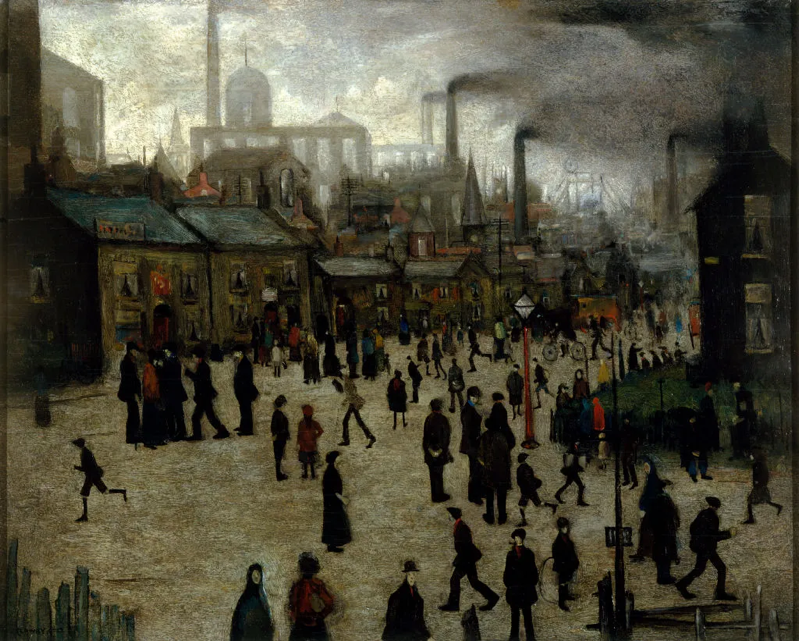
A Manufacturing Town by L.S. Lowry (National Media Museum/Royal Photographic Society/SSPL/Getty Images), from an essay by Salford’s own Terry Eagleton.
When I look at the choices offered to Americans by their two chief political parties, I always remember a line from Woody Allen’s “My Speech to the Graduates”: “One path leads to despair and utter hopelessness. The other, to total extinction. Let us pray we have the wisdom to choose correctly.”
I understand that this won’t be everyone’s cup of tea, but I find Alec Goldfarb’s Indian classical music on guitar fascinating. ♫