Hockney's Rake


David Hockney’s set designs for the 1975 performance of The Rake’s Progress at the Glyndebourne Festival Opera.
I have long had an intense hatred of the telephone — even in the face of eloquent testimonials like this one from Suzanne Fischer — but finally I am ready to be won over. And the key to this change of direction, as Joanna Stern explains, is: Zoom. After a year-plus of Zooming, I now find myself delighted when I get to use the phone instead. I can talk while lying on the sofa with my eyes closed!
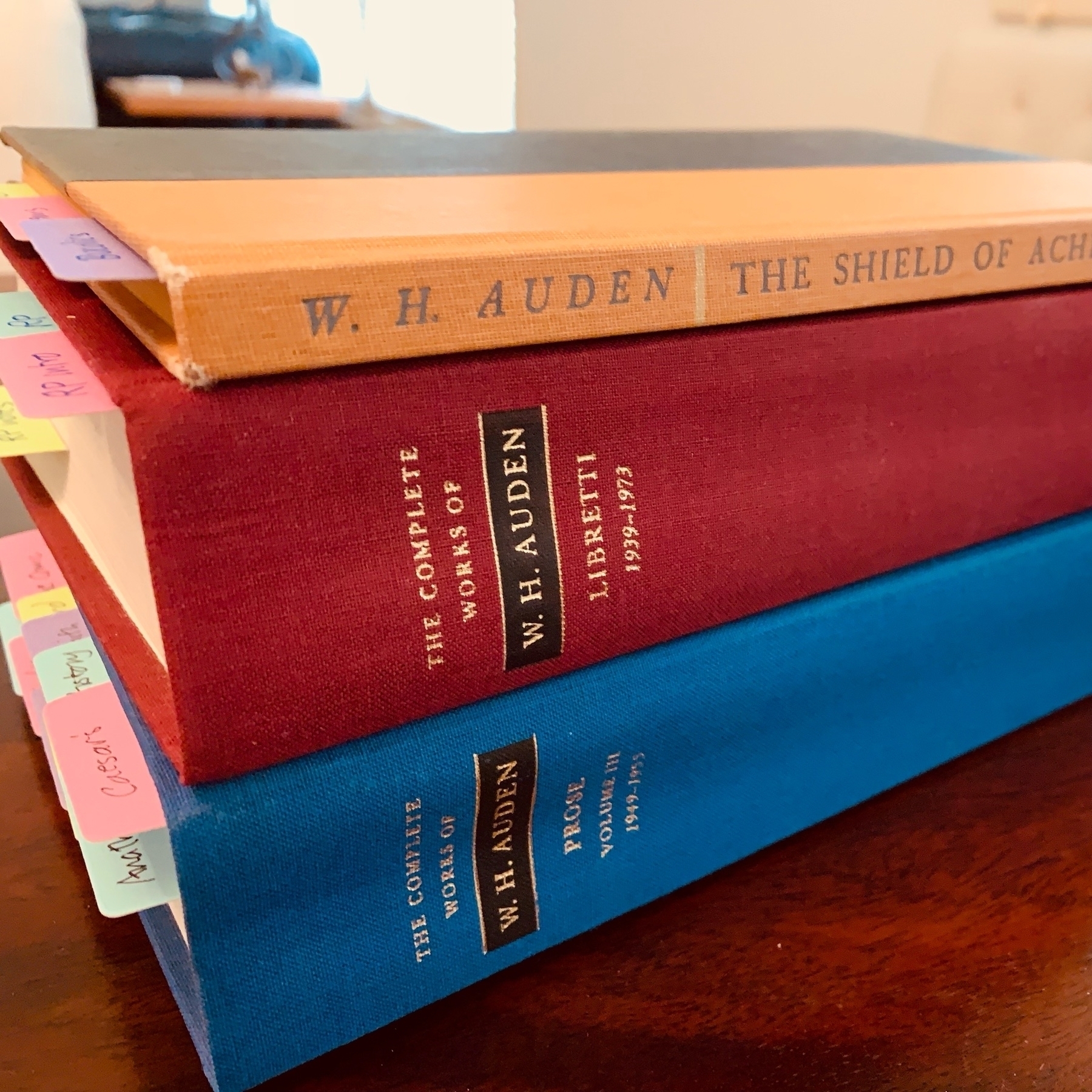
When, in the 1930s, Auden was teaching at The Downs School, he decided that the students should perform a musical, so he wrote the lyrics, composed the music, and directed it. One of the lyrics goes like this:
I've the face of an angel
I've got round blue eyes
And if you knew the things I do
It would cause you some surprise
But when ignorance is bliss my dears
It's folly to be wise
Yet the noble despair of the poets
Is nothing of the sort; it is silly
To refuse the tasks of time
And, overlooking our lives,
Cry — “Miserable wicked me,
How interesting I am.”
We would rather be ruined than changed,
We would rather die in our dread
Than climb the cross of the moment
And let our illusions die.
— Malin, in The Age of Anxiety
”The intellectual arrogance of clever people, intolerable though it often is, is nothing to the intellectual arrogance of ignorant people.” -- Anthony Powell (in his notebook)
linkage
“Now there’s this fame business. I know it’s going to go away. It has to. This so-called mass fame comes from people who get caught up in a thing for a while and buy the records. Then they stop. And when they stop, I won’t be famous anymore.”
One of the highlights of my career: Long ago, I published an essay on bobdylan.com. Bob may even have read it — the guy who ran the website said he “usually” read what was posted there. Also awesome: I didn’t get paid in money but in music. I was told that they’d send me as many Columbia/Sony CDs as I wanted. I agonized over the question of how much would be too much to ask, and eventually settled on 20 CDs. A week later, they all showed up in my mailbox.
My friend and former colleague Jason Long and his colleague Jeremy Cook have written a sobering essay on the long-term social and economic effects of the Tulsa Race Massacre, which happened 100 years ago.
Arnold Kling’s proposal for making Twitter less rude assumes that there are people on Twitter who want to be less rude. I’m sure that there are plenty of Twitter users who would like to constrain other people — but certainly not themselves.
William Deresiewicz’s essay at Harper’s on what the pandemic has done and is doing to artistic careers is powerful:
The pandemic will likely extinguish thousands of artistic careers. And the devastation will extend to the businesses and institutions that connect artists to audiences. The big players with deep pockets — Live Nation, the mammoth concert, ticketing, and artist-management company, or Gagosian, which operates galleries in seven countries — will survive. The entities that founder will be the smaller ones — mid-tier galleries, independent music venues — the kind that are crucial for helping emerging artists gain exposure, for sustaining serious creators and performers who won’t or can’t sell out to the commercial mainstream, and for keeping alive the spirit and soul of the arts. […]
But the most frightening prospect is precisely the degree to which this crisis has entrenched and extended the power of the platforms: Amazon, Apple, Google, Facebook; YouTube, which is part of Google; and Instagram, which is owned by Facebook. Because it is that power that is ultimately behind what has been happening to artists. Art hasn’t really been demonetized. For the companies reaping the clicks and streams, free content is a bonanza. Along with Spotify and a few other players, the tech giants are diverting tens of billions of dollars a year away from creators and toward themselves. They have been able to do so only because of their size, which has given them leverage over labels, studios, publishers, publications, and above all, independent artists, and because of the influence it has given them in Congress.
Finally, I wrote a post over at the Hog Blog about how workers reluctant to return to their morning commutes resemble English peasants after the Black Death.
goods and harms
A few years ago, I invited Mary Beth Tinker to meet with my undergraduate class on the history of American education. Tinker herself is an important figure in that history, because she was one of the students who wore black armbands to school in Des Moines, Iowa, in 1965 to protest America’s involvement in the Vietnam War. Sent home as a punishment, she sued her school district on free-speech grounds. Tinker v. Des Moines made its way to the Supreme Court, which ruled in her favor in 1969. In a ringing decision, the Court declared that neither students nor teachers need to “shed their constitutional rights to freedom of speech or expression at the schoolhouse gate.”
My students loved Tinker’s story, and who doesn’t? Adorable seventh grader confronts Big Bad Authority. Adorable seventh grader wins. Cut to the credits.
But when our class discussion turned to the present, the mood changed. Students insisted that schools and universities should prohibit hate speech, which hurts innocent people. Mary Beth Tinker was fighting the good fight, against the war in Vietnam. But racists and sexists and homophobes and transphobes are different, my students said. They cause harm, offense, and even trauma in their victims. We need to shut them down.
Tinker wasn’t having it. At her middle school in Des Moines, she said, there were students who had fathers, uncles, and brothers who were fighting in Southeast Asia. Don’t you think they were offended and hurt by a snot-nosed kid whose armband suggested that their loved ones were risking their lives for a lie?
Of course they were. Speech hurts, which is why censors across time have tried to stamp it out. So if you’re going to bar speech that hurts someone, well, forget about Tinker’s armband. Forget about free speech, period.
My students took this in, and then they tried another tack. Wasn’t free speech really just a tool of the powerful? That’s why white men like it so much, of course. It lets them have their say while it harms (there’s that word again) people with less status and influence in society.
Mary Beth Tinker wasn’t having that, either. In 1965, she told the class, she was a 13-year-old girl. Free speech was the only power she had! Take that away, and she would have nothing at all.
Welcome, folks, to the world of competing, irreconcilable goods. Also a reminder of why the harm principle will never solve these problems: an unconstrained use of the harm principle can silence anything and everything, because a claim to internal psychological harm can never be assessed independently.
China's intellectual future
Epistemic confidence level: very low. I don’t really know what I’m talking about here, though I’m trying to know more.
In an essay published a few months ago, I looked for a way beyond what I call the Standard Critique of Technology, and suggested that one such way could be found in certain Daoist ideas about the human-built world. And I speculated that, as China grows in power and influence, and insofar as the Chinese technosphere draws upon elements of ancient intellectual traditions, there is at least the possibility that some of those ideas could make their way to the U.S.
In light of all that, I read with great interest this essay in the LRB by Peter C. Perdue. The essay is essentially an overview of the work of a Chinese historian Ge Zhaoguang, with a particular emphasis on this new book. Ge is a passionate advocate for the Confucian intellectual tradition, and sees it not just as valuable in itself but also a kind of binding agent for Chinese culture, a project towards which Perdue is extremely skeptical. He thinks such a return to the past is necessarily Han-centric and therefore manifestly inadequate to the multicultural society that China has become.
Yet Perdue sees the need for some kind of project of cultural and moral renewal — that is, he fully understands why Ge writes as he does. He notes that
In 1895, China suffered a crushing military defeat at the hands of the Japanese and then came under assault from its own intellectuals, who were heavily influenced by the Western thought that had arrived with the conquerors. The result was an almost complete rejection of the Confucian tradition over the next ninety years. Ge ends his Intellectual History of China in 1895, the year in which Yan Fu, the famous translator of Darwinist thought, wrote of the extreme ‘nervous anxiety’ afflicting intellectuals of his time. Ge does not follow the story into the next two decades, when genuine faith in the classical tradition almost completely collapsed. As he writes, by 1895, the loss of territory, cultural confidence, unity and common historical identity had ‘undermined the integrity of the classical tradition’. The abolition of the examination system in 1905 and the collapse of the dynasty in 1911 sealed its fate. But China had faced foreign invasion and cultural challenges before without the collapse of the Confucian tradition.
Other forces have rushed in to fill the gap created by the collapse of the Confucian system, Maoist Marxism above all — but not only that: “After Mao, Chinese endorsed cowboy capitalism of the most corrupt, environmentally destructive kind. Like all of us, they struggle to restrain capitalist greed with moral or legal norms; many of them, amazingly enough, have turned to Christianity for answers, but others search for guidance in Buddhism, Daoism, popular cults, and even Confucius.”
Perdue himself is appalled by “cowboy capitalism,” appalled by the rise of Christianity in China, appalled by Ge’s desire for a return to Classical Chinese thought. Indeed, he seems appalled by every option except China coming to embody the worldview of — well, of the LRB and its readers, I guess. “Is an alternative intellectual history of China possible? If so, it would not seek to define the unity of Chinese civilisation, but to celebrate its multiplicity. It would look to centrifugal forces, marginal figures and frontier contacts as sources of innovation, not threats to order. It would include women, non-Han peoples and non-elite traditions without trying to co-opt them into an orthodoxy.” (I’m not saying that these would be bad things, but it’s noteworthy that, while lamenting the influence in China of Western models of political economy, Perdue can only imagine a good future for China that’s based on a Western leftist cultural frame. As though the possibilities for China’s future involve choosing items from a buffet laid out by the West.)
In my essay for The New Atlantis I invoked the fascinating work of Tongdong Bai — especially his Against Political Equality — and speculated that there might be some interest within the CCP in renewing Confucianism or other elements of the classical tradition. Perdue thinks this is happening, at least on the level of public declaration: “The Chinese state now invokes the once despised Confucius as the bedrock of native values.” But Tongdong Bai isn’t so sure, as he explained in an email to me that he has graciously given me permission to quote from:
I don’t think CCP is that friendly to Confucianism…. My interest in Confucian political philosophy is not directly related to the mainland Chinese government and policies. Although my dear friend Daniel Bell sometimes links his proposal to the present Chinese regime, I am fundamentally different from him in this regard. What I am proposing is normative, and I don’t think the contemporary Chinese regime offers any real-world exemplification of my proposals.
So what do I — again, a novice, if a fascinated one — make of all this? A few things:
- There is a kind of crisis of confidence among China’s intellectual elite, a sense that the power of their state is growing faster than the moral order of their culture;
- For many, capitalism (whether of the cowboy variety or any other) is inadequate to providing the necessary moral order;
- For those many, certain religious traditions — whether the embodied-in-religious-practice forms of the Three Ways (Confucianism, Daoism, Buddhism) or Christianity — offer themselves as alternatives;
- None of these alternatives is yet strong enough to displace or even really to affect the juggernaut of CCP capitalism;
- The hopes I articulate in my essay for a renewal of Daoism seem unlikely, in part because, as both Ge and Perdue explain, Daoism has been largely incorporated into Confucianism, or redefined by Confucianism;
- Christianity might therefore be a better hope for providing a moral order for Chinese culture;
- But Christianity, though I believe it to be true, has never developed the kind of coherent critique of technocracy that Daoism has long embodied;
- So if that new moral center emerges, it’s unlikely to offer significant resistance to the increasingly technocratic character of the Chinese regime and therefore the Chinese nation.
plus ça change
Most poets in the West believe that some sort of democracy is preferable to any sort of totalitarian state and accept certain political obligations, to pay taxes, to vote for the best man or programme, to serve as jurymen, to write letters of protest against this or that act of injustice or vandalism, but I cannot think of a single poet of consequence whose work does not, either directly or by implication, condemn modern civilisation as an irremediable mistake, a bad world which we have to endure because it is there and no one knows how it could be made into a better one, but in which we can only retain our humanity in the degree to which we resist its pressures.
— Auden in Encounter (April 1954)
Summer companions.