Welcome, small stranger. Live long and prosper.

a new old Prayer Book

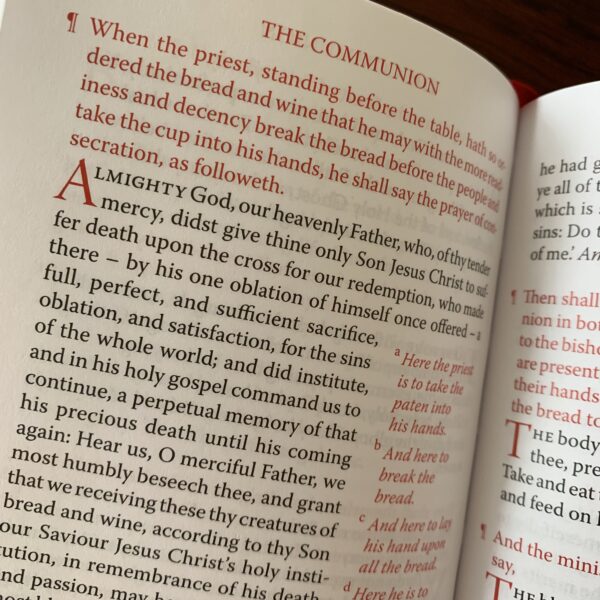
Samuel L. Bray and Drew N. Keane have produced a volume that, I may say with confidence, I will be relying on for the rest of my life. It is The 1662 Book of Common Prayer: International Edition. What they have done is something deceptively simple, with only a few elements:
- Take the 1662 Prayer Book;
- Replace the prayers for the British monarchy with more general prayers for political leaders;
- Replace a few terms that have become wholly archaic or have changed in meaning so much that they will not be understood;
- Add a brief glossary for the unusual terms that it would have been unwise to replace;
- Present the result in beautiful typography.
And if you’d like to learn more about the history of The Book of Common Prayer, well, there’s a book for that.
Keep your eye clear of their For and Against! There is much right there, and much wrong: whoever looks on becomes angry.
— Nietzsche, Thus Spoke Zarathustra
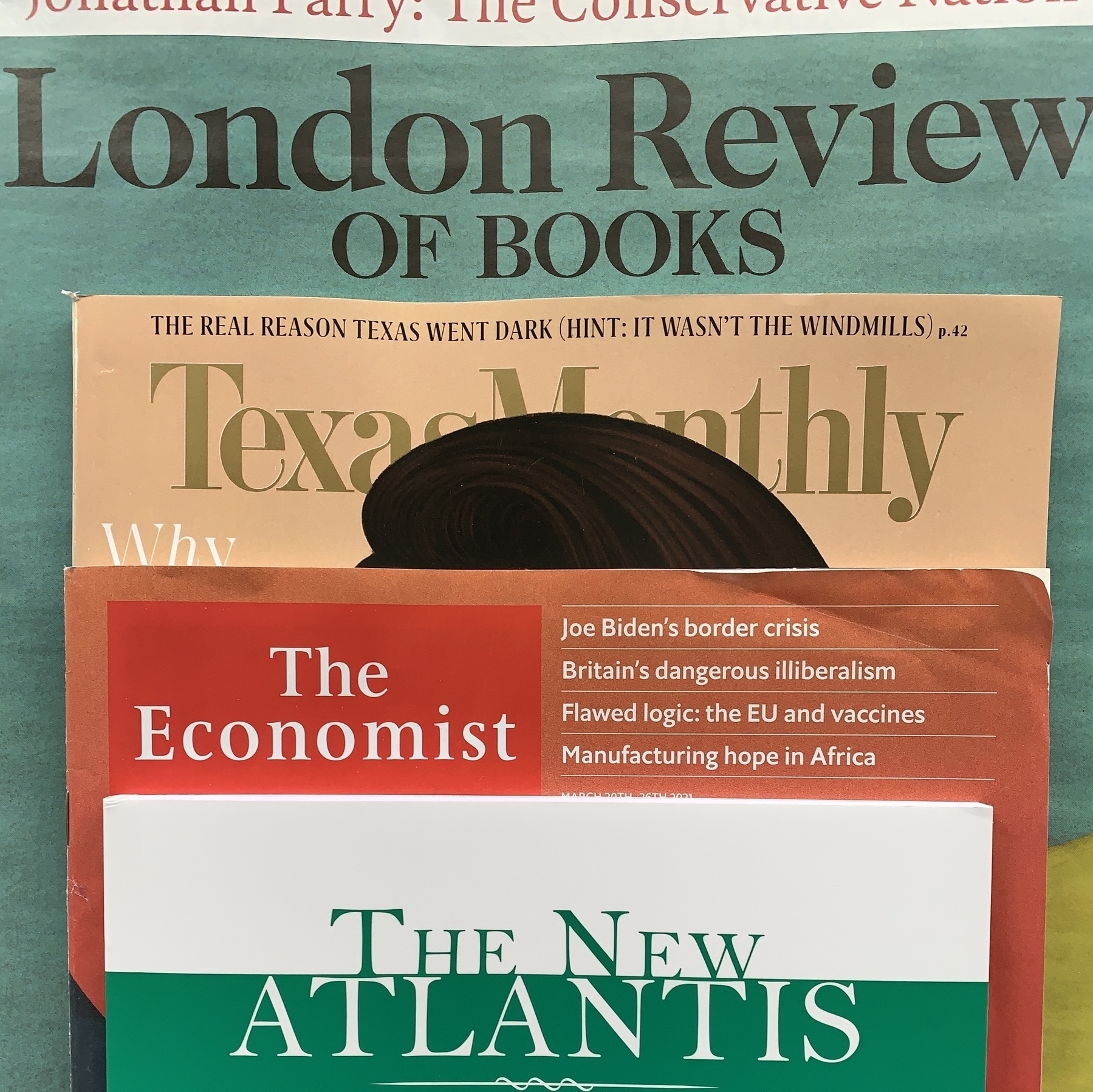
A four-magazine mail day is my equivalent of finding a four-leaf clover.
two quotations on the miraculous
Given some ostensibly miraculous event, almost all scientists will insist on a logical, rational, “natural” explanation. (Scientists dismiss the Miracle of the Sun as the result of local atmospheric effects, spurious images on the retina brought about by staring at the sun, and self-delusion.) If no logical or rational explanation immediately presents itself, most scientists will conclude that a scientific explanation will eventually be forthcoming, rather than abandon their commitment to a totally lawful universe. This prevailing view was articulated to me recently by the Nobel Prize–winning biologist David Baltimore: “If I could not find any way out of believing that a miracle had occurred, would I then believe it to be a miracle? I think the answer is that I would still not believe it to be a miracle, only some outcome that I can’t understand.”C. S. Lewis, Miracles:
In all my life I have met only one person who claims to have seen a ghost. And the interesting thing about the story is that that person disbelieved in the immortal soul before she saw the ghost and still disbelieves after seeing it. She says that what she saw must have been an illusion or a trick of the nerves. And obviously she may be right. Seeing is not believing.For this reason, the question whether miracles occur can never be answered simply by experience. Every event which might claim to be a miracle is, in the last resort, something presented to our senses, something seen, heard, touched, smelled, or tasted. And our senses are not infallible. If anything extraordinary seems to have happened, we can always say that we have been the victims of an illusion. If we hold a philosophy which excludes the supernatural, this is what we always shall say. What we learn from experience depends on the kind of philosophy we bring to experience. It is therefore useless to appeal to experience before we have settled, as well as we can, the philosophical question.
Isolatos
In his brief 1949 book The Enchaféd Flood, Auden writes of what happens when communities — gatherings of persons bound together (Auden does not quote Augustine here but is silently citing him) by a common love — deteriorate into societies — collections of human organisms defined by their social and economic function. One of his touchstone texts in writing about these matters is Moby Dick.
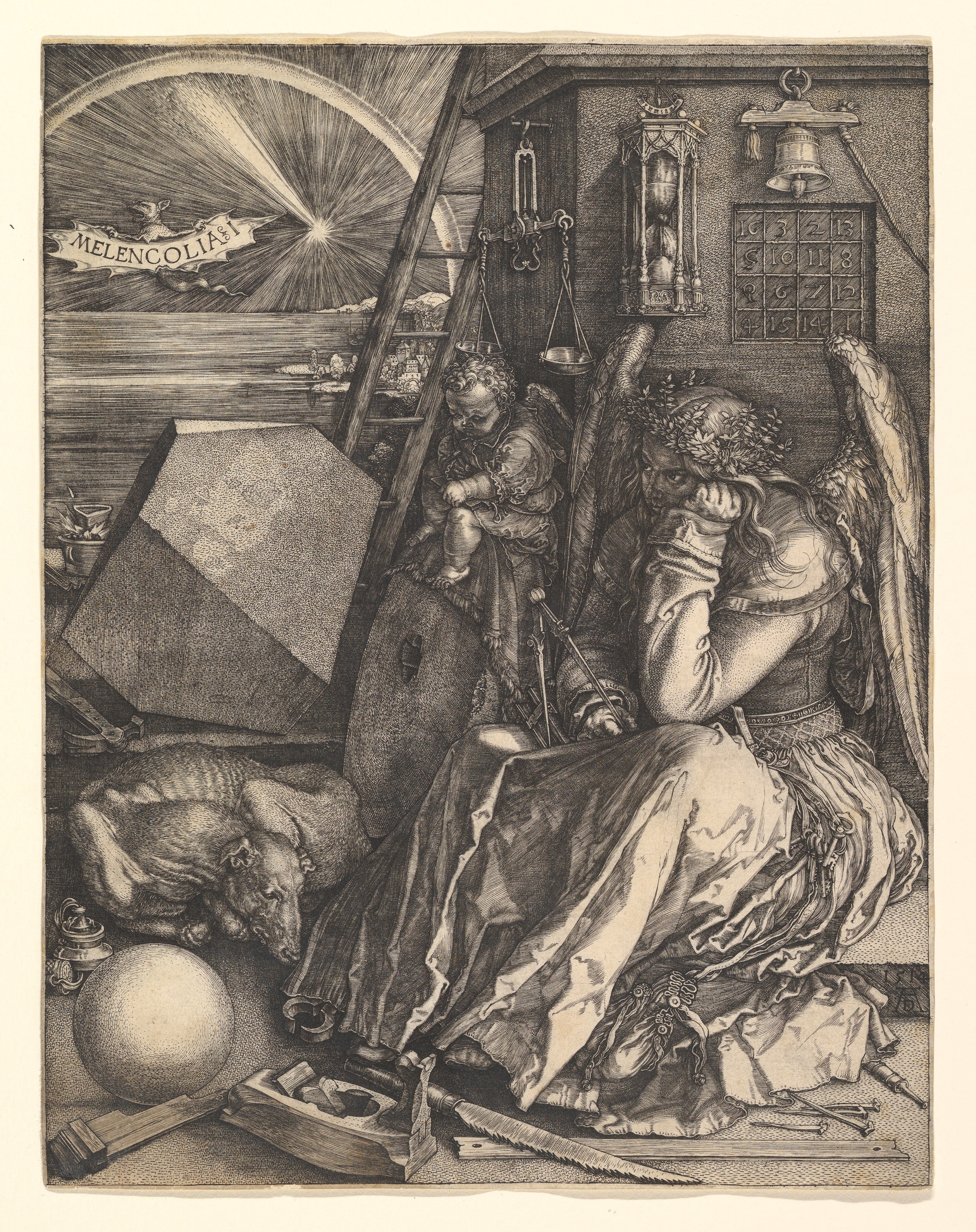
If a community so dissolves, the societies, which remain so long as human beings wish to remain alive, must, left to themselves, grow more and more mechanical. And such real individuals as are left must become Ishmael’s “isolatos, not acknowledging the common continent of men, but each isolato living in a separate continent of his own.”(I’ve adjusted the spelling from “isolatoe” to avoid annoyance.) Auden goes on to make an unexpected and profoundly illuminating connection: “The grand explanatory image of this condition is of course Dürer’s Melancholia.”

Auden:
She sits unable to sleep and yet unable to work, surrounded by unfinished works and unused tools, the potential fragments of the city which she has the knowledge but not the will to build…Earlier in his exposition Auden had drawn on Kierkegaard to describe those more common figures whose response to a lack of community is not to descend into melancholy but rather to accept their roles in a featureless “public” — Kierkegaard in The Present Age: “a public is a kind of gigantic something, an abstract and deserted void which is everything and nothing” — or to join some crowd, a crowd which might descend into a mob. These people are saved from melancholy by passively accepting the anonymity of the public or by attaching their anomie to the will of the crowd. As Auden wrote in an essay, “A mob is active; it smashes, kills and sacrifices itself. The public is passive or, at most, curious. It neither murders nor sacrifices itself; it looks on, or looks away, while the mob beats up a Negro or the police round up Jews for the gas ovens.”What is the cause of her suffering? That, surrounded by every possibility, she cannot find within herself or without the necessity to realise one rather than another. Urban society is, like the desert, a place without limits. The city walls of tradition, mythos and cultus have crumbled. There is no direction in which Ishmael is forbidden or forcibly prevented from moving. The only outside “necessities” are the random whims of fashion or the lifeless chains of a meaningless job, which, so long as he remains an individual, he can and will reject. At the same time, however, he fails to find a necessity within himself to take their place.
On Good Friday, Auden wrote elsewhere, the crowd cried “Crucify him!” But that crucifixion was also enabled by those who shouted nothing but merely averted their eyes from the disagreeable spectacle.
The person deprived of a community who cannot, for whatever temperamental reasons, join the crowd or disappear into the public will inevitably become a melancholic “isolato.” Isolation, anonymous absorption of the self into some abstract social function, the madness of crowds — those are the three chief options for people who are deprived of genuine community.
The question then becomes: By what means might we achieve the restoration of community that will protect us from these dark fates?
It is important that Auden links both Ishmael’s condition and Dürer’s image of Melancholia with the failure of the city: For him what matters most about the unused tools scattered at the melancholiac’s feet, and perhaps also the geometric and mathematical images elsewhere in the print, are what they say about a built environment that has not been built, which indicates not only a loss of imagination and creativity but a failure to construct, which is, among other things, a failure to protect one’s community from natural and social enemies.
Hovering behind these expressed thoughts, I believe, is an ongoing meditation on the Aeneid. When Aeneas and his crew are shipwrecked on the Libyan coast and make their way to Carthage, Aeneas’s first words on seeing that city are “O fortunati, quorum iam moenia surgunt!” — Fortunate are those whose walls already rise — because he is impatient to raise the walls of the city he is pledged to found as a second Troy. But soon enough that impatience, coupled with love for Dido and grief for his lost city and wife, has him directing Carthaginian construction crews, something which Mercury, sent down by Jupiter, fiercely denounces: “tu nunc Karthaginis altae / fundamenta locas pulchramque uxorius urbem / exstruis?” So for love of this new wife of yours you’re building this pleasant city of Carthage? Instead of the one you’ve been commanded by the gods to build?
It looks like work that Aeneas is doing, but it’s not: Mercury says he’s wasting time, idling away the hours. The god thinks it’s love that keeps him in Carthage, but that’s not it, or not chiefly: it’s primarily a kind of structured procrastination born of melancholy.
Just three years before writing the lectures that became The Enchaféd Flood, Auden had held a temporary commission in the U. S. Army (rank: Major) and had participated in the United States Strategic Bombing Survey of Germany — note the initials in the background of this photo:

Think of the ruination Auden saw, and think of the great task of Aeneas, and you will grasp the import of this passage from the conclusion of those lectures:
We live in a new age … in which the heroic image is not the nomad wanderer through the desert or over the ocean, but the less exciting figure of the builder, who renews the ruined walls of the city. Our temptations are not theirs. We are less likely to be tempted by solitude into Promethean pride: we are far more likely to become cowards in the face of the tyrant who would compel us to lie in the service of the False City. It is not madness we need to flee but prostitution.Aeneas’s melancholy — his anomie, his ennui — has led him to prostitute himself to a city other than his own: literally Carthage, but metaphorically and spiritually what Auden calls “the False City.” A city built on comforting but deadly lies; a city which might, at its very best, offer some kind of society but never genuine community. Aeneas has escaped from the dark fate of the “isolato”; but he has done so by being absorbed into a public that is not his own.
What are the virtues, what is the disposition, of the builder of the True City? How might someone be formed to possess the proper disposition? I think we know what the impediments are — That’s surely an iPad in the lap of the putto in Melancholia: he’s obviously pissed off by some jerk’s tweet — but what are the affordances?
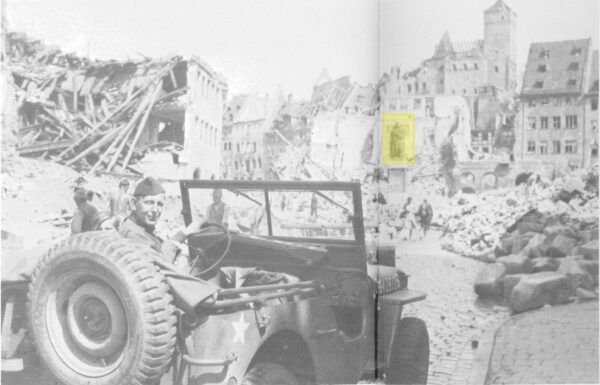
That’s Auden in his USSBS days, in late 1945, visiting the ruins of Nuremberg (photo scanned from this book). I’ve highlighted something curious at the center-right of the image. It’s a statue that by some miracle survived the bombing which, as you can see, completely devastated the rest of the city center. The statue depicts Albrecht Dürer.
blogging and the blogosphere
Robin Sloan’s reply to my last post, which was a riff on something Robin wrote … ah, you’ll figure it out. Follow the links. Robin has been very generous to me.
Children, gather around. Grandpa has a story to tell.
A long, long time ago, there was a a network within the network we call the World Wide Web, which is of course a network within the network of networks that we call the internet … anyway, this demi-network was sometimes called the blogosphere. And once, back in the first decade of the 21st century, Grandpa wrote that “the blogosphere is the friend of information but the enemy of thought.” Of all the millions of words that Grandpa has published, those are the most quoted. And Grandpa is not super happy about that.
See, the blogosphere, when Grandpa wrote those words, was dominated by sites like Andrew Sullivan’s Daily Dish, Glenn Reynolds’s Instapundit, Josh Marshall’s Talking Points Memo. The Dish shut down; TPM morphed into something larger and more complicated, as did Instapundit – though the latter is closer to its original incarnation. When these sites were at their height, fifteen years or more ago, each was basically one person pumping out responses to the most recent news all day every day. Dozens of posts per day, in some cases, and almost all of them what we would now call tweet length.
Which explains why nobody makes that kind of site any more. If you want to post in microbursts from dawn to dusk, Twitter is a superior platform.
When Grandpa wrote against the blogosphere, that kind of site is what he had in mind: a constant stream of hot takes, some of which had to be walked back later because they were offered before, and instead of, reflective consideration. You’d therefore have a better sense of what I meant in that much-quoted line if you replaced “blogosphere” with “Twitter.”
In short: Blogosphere ≠ blogging. Blogging, at least as I try to practice it here, is a different thing. What I like about blogging, and the reason I have chosen this as the venue for my thoughts on Invitation and Repair, is summed up in Austin Kleon’s post on blogging as a forgiving medium: “Blogging feels to me like a world of endless drafting, endless revisioning.”
Exactly. I post a thought; later, I return to it with an update; someone responds and I incorporate their thoughts into a new post that links to them and to the original – basically, what I am doing right now. Note also that blogging, when done in this fashion and in this spirit, is also seriously dialogical, and I think there is a close connection between a dialogue-friendly medium and a forgiving medium. More on that another time, perhaps.
In his Preface to Anarchy, State, and Utopia, Robert Nozick wrote,
One view about how to write a philosophy book holds that an author should think through all of the details of the view he presents, and its problems, polishing and refining his view to present to the world a finished, complete, and elegant whole. This is not my view. At any rate, I believe that there also is a place and a function in our ongoing intellectual life for a less complete work, containing unfinished presentations, conjectures, open questions and problems, leads, side connections, as well as a main line of argument. There is room for words on subjects other than last words.This series of blog posts is one of those “less complete works.” But that doesn’t mean that, for me anyway, it’s any less serious.
UPDATE: Another way to think about blogging, in the spirit that I’ve outlined above, is to see it as a way to open oneself to stochastic resonance.
vendoring culture
Software often has dependencies, and the bigger the codebase the more dependencies the software is likely to have. A dependency is another chunk of code, written and maintained by someone else, that you incorporate into your project in order to fulfill certain functions. Your project then becomes dependent on that external code in order to run properly, which is why it’s called a dependency.
But there is an alternative to employing dependencies, and it’s called vendoring. When you vendor someone’s code, instead of writing instructions to point to the external code, you copy that code directly into your project. Even when such an action is legal — it isn’t unless the relevant code is open-sourced or otherwise explicitly made available to you — it’s not widely done because when you vendor someone else’s code you become wholly responsible for it. If you were using that code as a dependency, then maybe you could count on the person who originally wrote it to maintain it, develop it, extend it, fix it when things go wrong; but when you vendor their code you have no access to the original, and so the running of that code becomes your problem.
On the other hand, if you’re willing to take on that responsibility then you really get to know an alien codebase and may incorporate it not only into your code but also into your thinking. A programmer named Tom MacWright says that he vendors code more often that most other programmers do for just this reason:
When I’m vendoring code - copying it into the project and making it pass my basic eslint [a JavaScript analysis tool] & testing standards, I’ll do light rewrites and refactors of new code, allowing me to get a deeper understanding of how they [sic] work and where their limits lie.So: Vendoring rather than dependencies. This leads me to a comic book.Obviously, other people’s code is their code. I didn’t do 100% of the thinking that led to it - I’m probably doing 5% of it. But absorbing that bit into my mind, instead of seeing only the external API surface, pays dividends.

Now: If you’ve been following this series of posts, you’ll have zeroed in on Robin’s key point:
For me, these are matters not primarily of judgment — who was wrong? Who continues to be wrong? Exactly how wrong are they?? — but of repair.So Robin has already said the thing that most needs to be said, but let me just add this point: What Yang has done is moral repair through vendoring code — in this case not the code of programmers but cultural code. And note that Yang has not created a dependency: he has not simply pointed to code created and maintained by someone else. He has copied that code and pasted it into his own creation, not because he admired it but because he needed to correct it. And he could only correct it by making it his own. Like Tom MacWright, he has thereby enabled for himself a better understanding of how that code works and where its limits lie. He has “absorbed it into his mind”; but his mind is more capacious and generous than what it absorbs. And that is precisely what enables the absorption.And in this case, amazingly, we have an example of what repair might look like.
In this case the code doesn’t remain 95% that of the original text and 5% Yang’s; the proportions are closer to being reversed. When the original is healthier, and stronger, the relation can be more equal and more constructively reciprocal. But even when the original code is destructive, even when it’s a kind of cultural malware, it can seed the act of repair — the act of repair that goes far beyond repair. It is a seed in the same way that a irritating piece of grit trapped within the mantle folds of an oyster eventually generates a pearl.
One down, one to go.