
couldn't have said it better myself
Megan McArdle: “Will is a friend, so naturally I’m dismayed by what happened. I’m also dismayed that it should have happened at Niskanen, a center-to-leftish institution I admire. And I’m even more worried to have yet another example of the damage Twitter is doing to American discourse — damage so profound that I’m beginning to think that the only way to fix it is not to urge tolerance, but for major institutions in the media and think-tank world to tell their employees to get the hell off Twitter.”
Auden on education in America
Reflecting on T.S. Eliot’s book Notes towards the Definition of Culture, W. H. Auden identifies what he believes to be the distinctively “American problem” in transmitting culture from one generation to the next. After noting that few of the 19th-century immigrants to the United States “were conscious bearers of their native culture and few had many memories they wish to preserve,” because they came primarily in order to escape persecution and poverty, he continues,
This, in the absence of any one dominant church has placed almost the whole cultural burden on the school, which has had to struggle along as best it could with all too little help from even the family…. I have never understood how a liberal, of all people, can regard State education as anything but a necessary and – it is to be hoped – temporary evil. The only ground for approval that I can see is the authoritarian ground that Plato gives – that it is the only way to ensure orthodoxy…. It is almost impossible for education organized on a massive scale not to imitate the methods that work so well in the mass production of goods.The New Yorker, 23 April 1949.The greatest blessing that could descend on Higher Education in this country would be not the erection of more class barriers but the removal of one: namely, the distinction drawn between those who have attended college and those who have not. As long as employers demand a degree for jobs to which a degree is irrelevant, the colleges will be swamped by students who have no disinterested level of knowledge, and teachers, particularly in the humanities, aware of the students economic need to pass examinations, will lower their standards to let them.
la crisis del humanismo cristiano

There seems to be a pretty lively conversation going on in Chile about the new Spanish translation of my book The Year of Our Lord 1943. I can with great difficulty read Spanish, but listening to the conversation is beyond my capabilities. Maybe they all hate the book and I am spared from learning that?
Light Perpetual
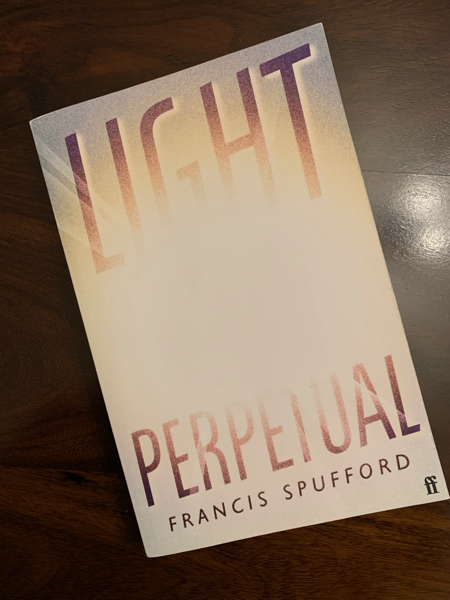
I had the privilege of reading this extraordinary novel in manuscript, and I recommend it to you more warmly than I can easily say. Alexandra Harris’s review in the Guardian tells you a good bit about it, but does not, I think, convey how achingly heartfelt it is — and how profoundly it reflects on that gift from God that makes all other gifts possible: time.

Several years ago Francis wrote and narrated a fascinating show on BBC Radio about J. W. Dunne, whose book An Experiment with Time was strangely influential for many years, prompting, among other things, J. B. Priestley’s 1937 play Time and the Conways. In conjunction with Francis’s show on Dunne, the BBC staged a new performance of Priestley’s play, which, thanks to the inexplicable vagaries of the Beeb’s policies, I have never been able to hear. Maybe someday. I think it would be very interesting to triangulate Francis’s novel with Dunne’s speculative book and Priestley’s play.
UPDATE: This review by Kate Kellaway comes closer than Harris’s did to capturing what’s so special about this novel.

ashes
I have been clinging for months now, and expect to be clinging for years, to this word from Beth Moore:
We have burned down our evangelical witness. Burned it to the ground. But here is what I know. I know God can bring beauty from ashes. I believe He will raise up a people purified by the very fires we set. A people defined by Jesus Himself, not denomination nor political party.
— Beth Moore (@BethMooreLPM) October 19, 2020
unity
Here’s a terrific essay by my friend Rick Gibson on George Washington’s farewell address, national unity, and the possibilities and challenges of this moment.
UPDATE: Rick also shared with me today this powerfully and eternally relevant passage from Dorothy Sayers’s Introductory Papers on Dante:
If we refuse assent to reality: if we rebel against the nature of things and choose to think that what we at the moment want is the centre of the universe to which everything else ought to accommodate itself, the first effect on us will be that the whole universe will seem to be filled with an implacable and inexplicable hostility. We shall begin to feel that everything has a down on us, and that, being so badly treated, we have a just grievance against things in general. That is the knowledge of good and evil and the fall into illusion. If we cherish and fondle that grievance, and would rather wallow in it and vent our irritation in spite and malice than humbly admit we are in the wrong and try to amend our behaviour so as to get back to reality, that is, while it lasts, the deliberate choice, and a foretaste of the experience of Hell.
two quotations on prophecy
When one QAnon channel on the chat app Telegram posted a new theory that suggested Biden himself was “part of the plan,” a number of followers shifted into open rebellion: “This will never happen”; “Just stfu already!” “It’s over. It is sadly, sadly over.” “What a fraud!”But while some QAnon disciples gave way to doubt, others doubled down on blind belief or strained to see new coded messages in the Inauguration Day’s events. Some followers noted that 17 flags — Q being the 17th letter of the alphabet — flew on the stage as Trump delivered a farewell address.
“17 flags! come on now this is getting insane,” said one post on a QAnon forum devoted to the “great awakening,” the quasi-biblical name for QAnon’s utopian end times. “I don’t know how many signs has to be given to us before we ‘trust the plan,’” one commenter said. Yours truly, in How to Think:
In 1954 three social psychologists, Leon Festinger, Henry Riecken, and Stanley Schachter, read in the newspaper about a religious cult whose leader, a woman they called Marian Keech — her real name was Dorothy Martin — was prophesying the end of the world. Keech claimed that she had received messages from the inhabitants of a distant planet named Clarion, and from them she had learned that the world would be destroyed by a great flood on the twenty-first of December 1954. (She received these messages through automatic writing: she felt a tingling in her arm and a compulsion to write, but when she wrote, the words that emerged were not her own, nor in her handwriting. This was the method of communication the beings from Clarion chose to use to warn the world of its imminent destruction.) Those who heeded this warning and joined Keech’s group would be rescued by the arrival of a flying saucer from Clarion.See Festinger, Riecken, and Schachter’s book When Prophecy Fails.Festinger, Riecken, and Schachter pretended to be true believers in Keech’s message so that they might infiltrate and study the group. They had formulated a twofold hypothesis: first, that Keech was a charlatan; and second, and more interesting, that when the falsehood of her prediction was revealed her followers would not abandon her but rather escalate their commitment to the cause. […]
When the promised rescuers did not show up, and the threatened flood did not arrive either, the group was shaken. But then Keech felt once more the desire to write, and the message from Clarion was immensely reassuring: there was indeed a flood, but not a flood that kills, rather one that saves: “Not since the beginning of time upon this Earth has there been such a force of Good and light as now floods this room and that which has been loosed within this room now floods the entire Earth.” Because of their faithfulness, they had been spared, and not just the little band of believers, but the whole world! And it was now incumbent on them, further messages explained, to break their habits of privacy and secrecy and to share with everyone, insofar as they were able, this “Christmas Message to the People of Earth.” (To which one can only add: God bless us every one!)
why not with love?
A reader of my book The Pleasures of Reading in an Age of Distraction — in which I have some harsh things to say about the eat-your-broccoli approach to reading advocated by Mortimer Adler and Mark van Doren in their famous How to Read a Book — discovers that the professor and literary critic William Lyon Phelps got there many decades before I did:

two quotations on form
We will be back in some form.
It seemed to be a sort of monster, or symbol representing a monster, of a form which only a diseased fancy could conceive. If I say that my somewhat extravagant imagination yielded simultaneous pictures of an octopus, a dragon, and a human caricature, I shall not be unfaithful to the spirit of the thing. A pulpy, tentacled head surmounted a grotesque and scaly body with rudimentary wings; but it was the general outline of the whole which made it most shockingly frightful.
— H. P. Lovecraft