clarification
I normally don’t respond to reviews, either positive or negative, but because I’m getting a good deal of email about this:
I reviewed Alan Jacobs (no longer on twitter alas!)'s new book for @WSJ
My review asks 2 questions:
(1) who is the real audience for a defense of great books?
(2) there's been a lot of defending: might it not be time for a really vigorous attack?https://t.co/FEHxSFgJVC— Agnes Callard (@AgnesCallard) December 10, 2020
— I’ll make three brief comments.
- My book isn’t a defense of great books, at all; it’s an argument for encountering the past. Only one chapter (Chapter 4) deals with reading the classics as such. Elsewhere in the book I refer to texts that are usually designated as classics or great books, but that designation isn't relevant to my use of them: what matters to me is that they are old.
- Callard speculates on who my audience might be, but there’s no need for speculation: I say in the Introduction that it’s readers who are in need of a more tranquil mind.
- In her review Callard asks, “Could it be that those of us whose connection with the past is supposed to be rock solid, who are supposed to profess the deepest and most abiding love of great books, are struggling with our own attention problems?” And she suggests I write about that. But I already did, a decade ago. And then again a few years later.
UPDATE: So now, thanks to this review, I am getting emails from people about my "defense of the classics," my "advocacy for great books," and my "defense of the literary canon" — none of which are in any way the subject of my book. (I don't even mention "the literary canon.") None of these people have read my book, of course; they're just assuming that a review in the Wall Street Journal couldn't possibly have misdescribed the content of the book. I think this must be what Rod Dreher feels like when people who have not read a single word of The Benedict Option opine confidently about their agreement or disagreement with its argument, because of some review or (more likely) some tweet they read. I'm now realizing how blessed I have been over the years that most of the negative reviews of my books have responded to what I actually wrote.

Palaiphobia
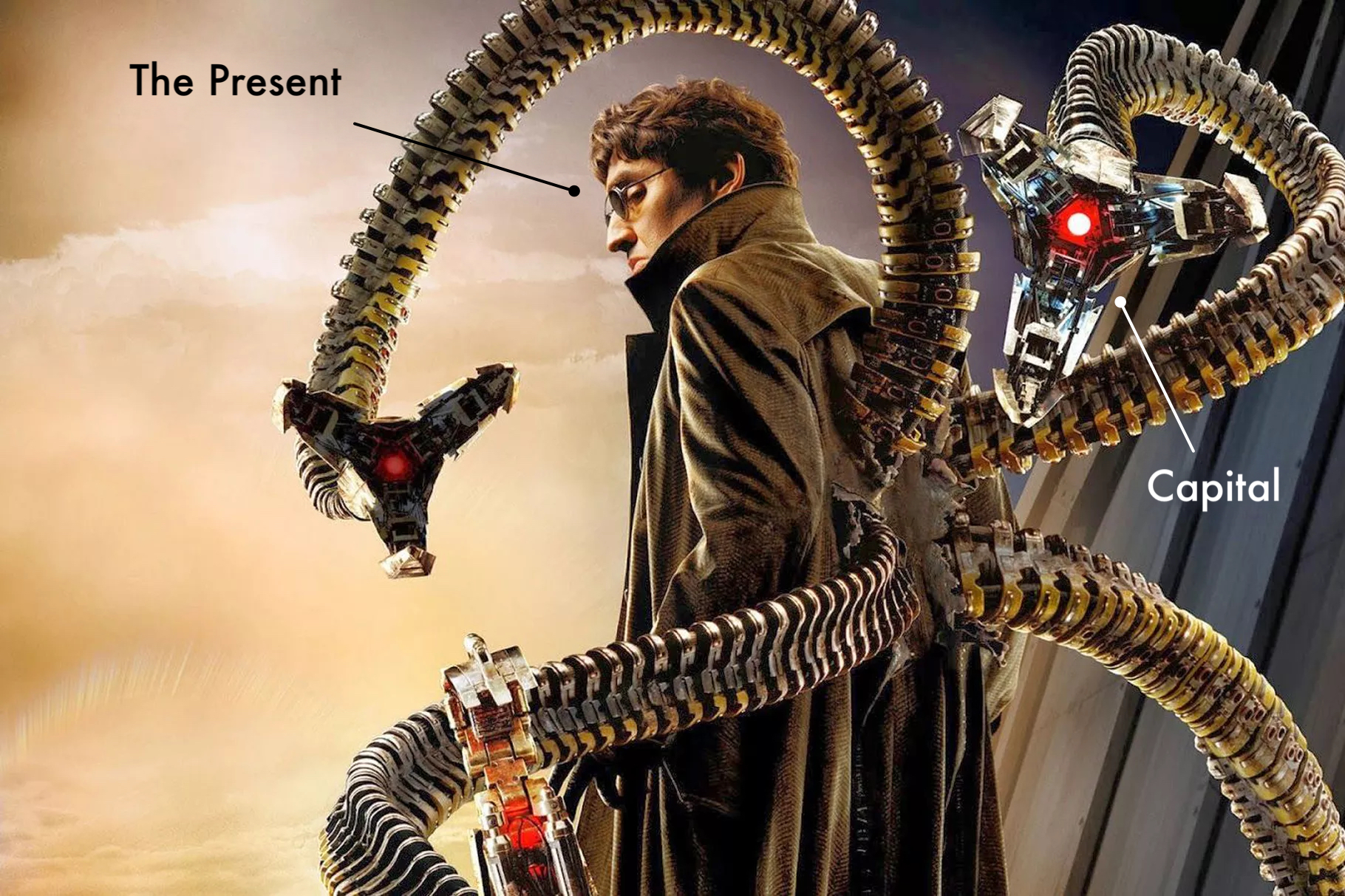
I’ve been thinking a lot lately about the idea of the present moment as a Power, a power in the Pauline sense of a massively distributed, massively influential, universal agency directing the course of this world. It seems to me that the Present is a jealous God: it wants us to think only of itself, and never of the past or the future except insofar as images of them serve this instant.
But if we must think of either the past or the future, the Present prefers for us to think of the future, for two reasons: one, any future we imagine is just that, imaginary, and is really a kind of projection of our hopes and fears for our own moment. And two, thinking about the future produces anxiety, which has the effect of driving us back towards the Present, where we can be distracted from that anxiety. That is to say, the future is potentially useful to the Present in a way that the past is not.
Now, to be sure, we can interpret the past in such a way that we reinforce our current habits and attitudes and prejudices. (I have written about this in Breaking Bread with the Dead.) But this is of limited usefulness to the Present and is not really worth the risks. From the perspective of the Present, any genuine immersion in the past is likely to complicate our understanding of this moment and make it harder for us to know precisely what to do, because of all the complexity, good and bad, of the behavior of those who lived and fought and prayed and loved before us. If we learn to have compassion for those people, we just might translate that into compassion for the people who share this world with us but do not think just as we think. And that the Present cannot have.
Why does the Present not want this? Because present-mindedness is instantaneousness, it is automatic response, it is the gratification of whatever emotion happens to arise. As the poet Craig Raine has said, “all emotion is pleasurable” — this fact is the constant pole star of the Present.
These thoughts, though they’ve occupied me for a long time, were recently brought to the forefront of my mind by an essay on Harper Lee by Casey Cep, which contains this passage:
There is an important and interesting conversation happening now about the relevance of To Kill a Mockingbird to our country’s pursuit of racial justice and how we teach civic virtues like tolerance. For a long time, Lee’s novel has been one of the most banned books in the country, first criticized by conservatives who disapproved of its integrationist politics, then by liberals who disapproved of its use of racial slurs, and all along by censors of all persuasions who object to its depiction of rape and incest. Lately, though, the novel’s detractors are not calling for a ban or censorship, just retirement: taking it off of syllabi in order to make room for books by a more diverse group of authors, offering students work written with an eye to the current fight for racial justice, not one from the last century.
I don’t really care whether people keep reading To Kill a Mockingbird. What interests me about this paragraph is the idea — and it’s not necessarily Cep’s idea, just one that she rightly discerns as common — that there is a “current fight for racial justice” that’s different from “one from the last century.” But, you know, Dorothy Counts is still alive.

And Ruby Bridges is still alive — indeed, just now reaching retirement age.

John Lewis, the last of the Big Six, just died a few months ago. I myself remember quite vividly the integration of Birmingham’s schools. This isn’t ancient history we’re talking about, and we shouldn’t allow the artificial convention of “centuries” deceive us into believing that it is. The story of Dorothy Counts and Ruby Bridges and John Lewis and all the rest of those amazing people who now get lumped into that comforting abstraction we call the Civil Rights Movement is our story, though the Present wants us to forget that, wants to separate us from our brothers and sisters, wants to break all chains that link us to one another — so that we can be wholly absorbed into Now and indulge our instantaneous emotions rather than reflect thoughtfully on the ways that the past is not dead, it is not even past.
The Present wants to infect us with what I have decided to call palaiphobia, from παλαιός, palaiós, old, worn out. That’s how it alienates us from one another, makes us wholly dependent on what it can offer: sentimentality and rage.
UPDATE: My friend Adam Roberts has, quite justifiably, wondered whether my coinage uses the right word. Here's what I wrote in reply to him:
I have to say something about my decision to write of palaiphobia rather than archephobia. It was an agonizing one, I assure you. In these matters I take my bearings primarily from New Testament Greek, as you know, and of course there’s considerable overlap between the two words. When Paul writes in 2 Corinthians 5 that the old has gone and the new is here, he uses ἀρχαῖα; but when he talks about the “old leaven” in 1 Corinthians 5 he uses παλαιὰν ζύμην. As far as I can tell ἀρχαῖα and παλαιὰν would be interchangeable in those contexts. Both words can be neutral in their valence. But if you look at the overall patterns of usage, it seems that there’s something more generally disparaging about παλαιὸς, whereas there’s at least a potential dignity in ἀρχαῖα. When Paul talks, as he often does, about the “old man” that we must put off, he says παλαιὸς ἄνθρωπος. And παλαιὸς often has the connotation of something worn out, as when Jesus talks (in Matthew 9:16) about patching old clothes, ἱματίῳ παλαιῷ. I wanted to capture that disparagement in my coinage, the sense that the past is worn out, useless, of no value. I wonder if you think that makes sense?
UPDATE 2: after a conversation with Robin Sloan:
under pressure
Technology Review has a good article on ex-Google employee Timnit Gebru, an AI researcher who recently co-authored a paper questioning the social and environmental effects of some of Google’s projects and got herself sacked for it. One specific element of the story has caught my attention.
Only one of Gebru’s co-authors talked with Technology Review about their troublesome paper: Emily Bender, a professor of computational linguistics at the University of Washington. From the article:
Gebru and Bender’s paper has six coauthors, four of whom are Google researchers. Bender asked to avoid disclosing their names for fear of repercussions. (Bender, by contrast, is a tenured professor: “I think this is underscoring the value of academic freedom,” she says.)
Please consider that story in light of this one from the WSJ, which describes how Medaille College and other American colleges and universities are eliminating tenure in response to financial troubles. At Medaille the word tenure is still used but, as the article makes clear, it doesn’t mean anything: “Professors remain tenured but the term no longer carries traditional protections. Tenured faculty will work on three-year renewable contracts, class loads are about 20% larger, and even they can be laid off with two months’ notice."
Add to that the situations — some listed here — in which insufficient wokeness is cause for the dismissal of non-tenured faculty and ongoing harassment and public humiliation of the tenured. (Though I suspect that for us academics getting in trouble with the Woke Police ought to be pretty far down on our list of worries.)
Now, ask youself: When researchers in the academy are subjected to political pressures from the left and financial pressures from budget-slashing administrators — who never, by the way, slash administrative budgets: those continue to grow apace — and when researchers outside the academy are subject to immediate dismissal for speaking truths that are inconvenient to their employers, what’s the outlook for truly groundbreaking research, in any field? Spoiler: Not great.
an intractable problem
For anyone who thinks about the relations between the past and the present, intellectual maturity consists in understanding that (a) the world is always getting better in some ways and worse in other ways, and that (b) we have no reliable calculus by which we might assign a single composite value to those changes.