hidden features of micro.blog
Micro.blog has some cool features that many users are not aware of. (They’re not really hidden, but that made for a better title than “not especially well-known.”) Here are some of my favorites:
1) An emoji-based system of tagging: for instance, 📚, which will show you books that micro.blog users are currently reading. And here’s a pandemic phenomenon: a tag for 🍞 — next time I’m baking I need to take a picture. And another pandemic-enhanced tag I like: 🌱
2) Related (and discoverable from the 📚 page): a grid layout of the covers of those books.
3) If you are a micro.blog user and want to record what you are currently reading, the best way to do that is to go to this page and enter the title — or, better, the ISBN — of the book you’re reading. The ISBN will return an image of the cover of the specific edition you’re reading, like so:

Click on that image, and you get something like this:

Note the link to indiebookclub, a simple, open-web work-in-progress alternative to the bloated, chaotic locked-down mess that is GoodReads. But if you choose to start a new micro.blog post, you get a text field pre-populated with the relevant information. Just click “Post” and you get something like this.
4) Micro.blog can also be an open-web, streamlined alternative to the monstrosity that Instagram has become, and if you want to see a good selection of the photos that micro.blog users are posting, then this infinitely-scrollable page is the best way to do it. And if you are interested only in a photo service and have an iPhone, then you might consider downloading the Sunlit app. It’s excellent. If you are on Android, I don’t think there is a photos-only app right now, but there are several micro.blog options for that platform. You can get a list of all the third-party clients for micro.blog here.
5) I think this has to be enabled by individual users, but if you’re only interested in the photos that a particular user posts (as opposed to text), then you can usually find a dedicated photos page. Here’s mine.
6) One feature I have been meaning to use: podcasting! That link will take you to the relevant information, but in brief: You can use micro.blog to post short-form podcasts (longer-form too, though that seems somewhat contrary to the character of the site). The best way to do this is through the microblog companion app Wavelength, which is to podcasts what Sunlit is to photos. I love the implementation of this feature: You can have your podcasts show up in your micro.blog timeline, but you can also register them with Apple so they will show up in the Apple Podcasts directory.
Finally: Not a feature of micro.blog, but if you want to know why I believe that supporting such endeavors is important for our social future, please read this essay of mine.
Cool enough for a hoodie on the morning walk 😯


Currently reading: The Elementary Forms of Religious Life by Emile Durkheim 📚

Currently reading: If Then: How the Simulmatics Corporation Invented the Future by Jill Lepore 📚
simple
XKCD is rarely wrong, but this:
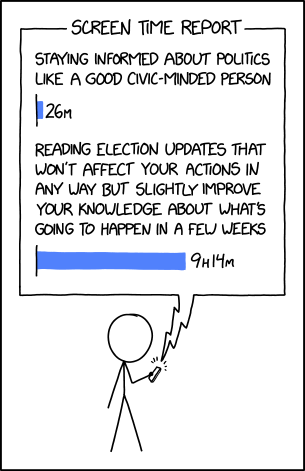
If you have any concern whatsoever for acquiring knowledge, you won’t be on social media at all for the next month. It’s as simple as that.
the Great Crumping revisited
A surprising number of readers of my previous post have written out of concern for my state of mind, which is kind of them, but I think they have read as a cri de coeur what was meant as a simple summary of the facts. Not pleasant facts, I freely admit, but surely uncontroversial ones. Stating them so bluntly is just one element of my current period of reflection.
The primary reason I am not in despair is simply this: I know some history. I think we will probably see, in the coming decades, the dramatic reduction or elimination of humanities requirements and the closure of whole humanities departments in many American universities, but that will not mean the death of the humanities. Humane learning, literature, art, music have all thrived in places where they were altogether without institutional support. Indeed, I have suggested that it is in times of the breaking of institutions that poetry becomes as necessary as bread.
Similarly, while attendance at Episcopalian and other Anglican churches has been dropping at a steep rate for decades, and I expect will in my lifetime dwindle to nearly nothing, there will still be people worshipping with the Book of Common Prayer as long as … well, as long as there are people, I think. And if evangelicalism completely collapses as a movement — for what it’s worth, I think it already has — that will simply mean a return to an earlier state of affairs. The various flagship institutions of American evangelicalism are (in their current form at least) about as old as I am. The collapse I speak of is, or will be, simply a return to a status quo ante bellum, the bellum in question being World War II, more or less. And goodness, it’s not as if even the Great Awakening had the kind of impact on its culture, all things demographically considered, as one might suspect from its name and from its place in historians’ imaginations.
This doesn’t mean I don’t regret the collapse of the institutions that have helped to sustain me throughout my adult life. I do, very much. And I will do my best to help them survive, if in somewhat constrained and diminished form. But Put not your trust in institutions, as no wise man has even quite said, even as you work to sustain them. It’s what (or Who) stands behind those institutions and gives them their purpose that I believe in and ultimately trust.
The Great Crumping is going on all around me. But if there’s one thing that as a Christian and a student of history I know, it’s this: Crump happens.

excerpt from my Sent folder: crumped
I think regularly about Orwell’s “Why I Write,” and especially about the fourth of his four reasons for writing: “Political purpose … Desire to push the world in a certain direction, to alter other people’s idea of the kind of society that they should strive after.” I have always in this broad sense been a political writer. Mainly I have tried to commend, in various ways, a principled yet generous, conservative yet open, living-out of commitment to evangelical Christianity, Anglicanism, and humane learning. (Not always in that order.) And evangelical Christianity, Anglicanism, and humane learning have all crumped.
Have you come across that word? I hadn’t heard it before Covid. Apparently it refers to a patient’s sharp, steep decline — not a complete and irreversible crash, but a plunge into serious danger. Everything I care about and have written to defend has crumped, is crumping, will crump.
civility revisited
My friend and colleague Elizabeth Corey has written a lovely defense of civility as a political virtue. Her case is essentially prudential, grounded in what should be the obvious fact that the winners of any given American political fight will still be living in the same country as the losers:
What happens when one side has won? Will the tactics employed in winning have made the victory worthwhile? Will the winners restore civility, or will they decide that the losers, having held the wrong ideas, must be dominated and forced into submission? These questions highlight the problems with political warfare within a country, just as in a marital fight or neighborhood dispute. What was said in anger and frustration will not be forgotten, and all the participants must still live together. The insults will often outlive the battle and poison the community, foreclosing the possibility of connecting in other ways.
Moreover, Corey argues, the American founders built a system that disincentivizes heatedness and extremism of passion, and rewards instead patience and collaboration:
Recognizing the universal inclination toward excessive self-interest, Alexander Hamilton pleaded for moderation (and implicitly, civility) in Federalist 1. There he lamented that political parties would likely “hope to evince the justness of their opinions, and to increase the number of their converts by the loudness of their declamations and the bitterness of their invectives.” Yet he knew that in politics, “as in religion, it is equally absurd to aim at making proselytes by fire and sword. Heresies in either can rarely be cured by persecution.” Thus Hamilton and others advocated for a system in which power checked power, and no one person or branch of government could dominate opponents in this way.
To practice civility, then, is to work with the grain of the American Constitutional system.
Corey’s argument has received a rather scornful reply by Scott Yenor, but unfortunately Yenor pays no attention to what Corey wrote and devotes his time instead to constructing a straw man. Central to Yenor’s response is his claim that “civility demands that we … put the best construction on everything,” which is, he says, suicidally naïve. But Corey never claims that civility makes such a demand; nor does any other defender of civility that I know of. Civility is a set of practices, and those practices can (and if Corey is correct, should) be cultivated regardless of what the practitioner knows or guesses about the motives and character of the person on the other side of an argument.
Yenor has a long laundry list of situations in which leftists have been uncivil to conservatives — I guess he couldn’t find any examples of the reverse, though I’m sure he looked hard for them — and claims that civility “cannot provide an adequate political response in such circumstances.” If by “adequate” he means “sufficient,” then Corey doesn’t claim that either; the distinction between necessary and sufficient conditions applies here. Civility can be a necessary political virtue without being the only one needful.
Yenor asserts over and over again that civility is useless or worse, but he never once addresses Corey’s arguments for its prudential usefulness, especially within the American constitutional context. If he had tried to address what she actually argued — instead of building straw men and making the utterly ad hominem suggestion that she has “excessive worry about gaining a reputation for incivility” — he might have found the case against civility harder to make than he does.
But there’s something on the other side of prudence and usefulness, at least for some of us. Let’s move towards that.
I want to return to a passage that I earlier quoted with ellipses and quote the whole of it: “civility demands that we teachers (and we Christians) put the best construction on everything.” (Again, the claim is simply false, but never mind.) So Yenor is a Christian. What consequence does that fact have for his thinking about politics? It’s hard to tell from this piece. But I think one ought to be able to discern something even in so brief an essay, if only because of its topic.
At one point he writes,
Civility is a philosophic and scholarly virtue. Still, there is a chasm between philosophy and the city. The place of civility in politics is much more circumscribed. It is pretty to think we are not at war. But if we are at war, then civility is worse than useless. It is unilateral disarmament. Civility is a philosophic and scholarly virtue. Still, there is a chasm between philosophy and the city. The place of civility in politics is much more circumscribed. It is pretty to think we are not at war. But if we are at war, then civility is worse than useless. It is unilateral disarmament. It is a lullaby that prevents us from seeing and acting as is necessary or that presumes that the conflicts are less fundamental than they are.
Insofar as civility has any role in politics whatever, then, it “is a virtue fit for small ball politics, not for civil wars, cold or hot.”
What I wonder is whether civility is a Christian virtue. That depends, as I wrote a while back, “on whether ‘civility’ is a useful shorthand proxy for a series of traits that certainly are Christian virtues: patience, forbearance, kindness, generosity, turning the other cheek, blessing those who spitefully use you, etc.” Whether civility is indeed related to those virtues — for the record, it certainly is — there seems to be no place for any of them in Yenor’s conception of politics. He certainly gives every appearance of conceiving of the sphere of politics as a realm where the writ of Jesus does not run. Jesus seems to be on the other side of the “chasm” Yenor describes.
I hear all the time from my fellow Christians arguments along the lines of Yenor’s: that pollitics is a hard game, that these are not ordinary times, that we are in a crisis, that desperate times require desperate measures, that, yes, trying to practice the virtues we are repeatedly commanded in Scripture to cultivate is in politics naïve and indeed indefensible — that we must do what is “necessary.”
Elizabeth Corey has made an eloquent prudential case for civility in politics, which deserves a more far more careful and attentive engagement than Yenor has given it. But prudence is not the only consideration for the Christian. If anyone lived through extraordinary circumstances, it was a a man who was rejected and scorned by his own people, then arrested, tortured, and crucified by Roman officials, but who nevertheless said of all his killers, as he hung dying, “Father, forgive them, for they know not what they do.” Such absolute forgiveness may be beyond our reach, but perhaps the more easily acquired virtue of civility is achievable. Indeed, I suspect that it is, and moreover is, according to a calculus Yenor disdains, necessary.
P. S. Whenever I make this argument, or one like it, I get at least one email from a reader who reminds me that Jesus drove the moneylenders from the Temple. This event looms large in the imaginations of many Christians, so large that it displaces everything else Jesus ever did or said. Jesus may have made some casual comments about turning the other cheek and blessing those who spitefully use you, but he turned over the moneylenders’ tables so watch me kick some ass. (This is not a tendency confined to the religious right, by the way. The most enthusiastic proponents of this particular hermeneutics I have ever seen are decidedly left-wing pacifists.)
Let’s never see this sight again. Let’s win them all for the big green guy. ⚽️ #JusticeForGunnersaurus