learning from Rod Dreher
My buddy Rod Dreher has a book coming out soon called Live Not By Lies, and it’s about what American Christians can learn about living under an oppressive regime by studying what believers did under the old Soviet Union. I think this is a story that Christians ought to be interested in, whether they agree with Rod’s politics or not. Every thoughtful Christian I know thinks that the cause of Christ has powerful cultural and political enemies, that we are in various ways discouraged or impeded in our discipleship by forces external to the Church. Where we differ is in our assessment of what the chief opposing forces are.
Rod is primarily worried about the rise of a “soft totalitarianism” of the left, what James Poulos calls a “pink police state.” Other Christians I know are equally worried, but about the dangers to Christian life of white supremacy, or the international neoliberal order. For me the chief concern (I have many) is what I call “metaphysical capitalism.” But we all agree that the Church of Jesus Christ is under a kind of ongoing assault, sometimes direct and sometimes indirect, sometimes blunt and sometimes subtle, and that living faithfully under such circumstances is a constant challenge. Why wouldn’t we want to learn from people who faced even greater challenges than we do and who managed to sustain their faith through that experience? Isn’t that valuable to all of us?
I felt the same way about The Benedict Option, which was mostly not an argument but rather a job of reporting, reporting on various intentional Christian communities. I read the book with fascination, because I was and am convinced that the primary reason American Christians are so bent and broken is that we have neglected catechesis while living in a social order that catechizes us incessantly. What can I learn from those communities that would help me in my own catechesis, and that of my family, and that of my parish church? I read The Benedict Option with the same focus I brought to my reading of a marvelous book by another friend of mine, Charles Marsh’s The Beloved Community. Charles’s politics are miles away from Rod’s, but their books share an essential concern: How can the church of Jesus Christ, how can Christ’s followers, be formed in such a way that they can flourish in unpropitious conditions?
That’s exactly the right question, I think, and both The Benedict Option and Live Not By Lies introduce me to people who help me — even when I don’t agree with their strategies! — to think better about what its answers might be. (And The Beloved Community as well. Christians under Marxism and the Black church under Jim Crow offer remarkably similar kinds of help to us, a point that deserves a great deal more reflection than it is likely ever to get in our stupidly polarized time.)
Often when I make this argument people acknowledge the force of it but tell me that Rod is the “wrong messenger.” I understand what they mean. Rod is excitable, and temperamentally a catastrophist, as opposed to a declinist. (That’s Ross Douthat’s distinction.) Like the prophet of Richard Wilbur’s poem, he’s gotten himself “Mad-eyed from stating the obvious,” and I often think that if he writes the phrase “Wake up, people!” one more time I’m gonna drive to Baton Rouge and slap him upside the head.
Also, when Rod rails against “woke capitalism,” he clearly thinks that “woke” is the problem, without giving real assent to the fact that Christians are susceptible to woke capitalism because they were previously susceptible to other kinds. He perceives threats to the Church from the Right, from racism and crude nationalism and general cruelty to whoever isn’t One Of Us, and writes about them sometimes, but they don’t exercise his imagination the way that threats from the Left do. I can see why people whose politics differ from Rod’s don’t what to hear what he has to say.
But, you know, Jonah was definitely the wrong messenger for Ninevah — he even thought so himself — and yet the Ninevites did well to pay attention to him.
And if you think Rod has a potentially useful message but is the wrong conveyer of it, then get off your ass and become the messenger you want to see in the world. Lord knows we need more Christians, not fewer, paying attention to the challenges of deep Christian formation. Wake up, people!

Went down to the river today to make sure it’s still there. ✔️


no, this isn’t about deconstruction
Everyone’s got their wishlist, and mine, like yours, starts with an effective vaccine for COVID–19 and peace and justice in the world. But after than mine probably diverges from yours: I want an end to essays and articles about literary and cultural theory written by people who have no idea what they’re talking about. Like this one by Elizabeth Powers:
These dogmas go by various names (among others, “postmodernism,” “multiculturalism”), but I will gather them under the term “deconstruction,” as it best encapsulates what is at their core. It consists of critiquing the writings of past authors, especially male ones, “deconstructing” them, which means exposing the submerged ideology of power, racism, misogyny, repression, and so on that is hidden below the overt text of a novel. This French cultural product, which began to occupy a prominent place in American university literature departments in the 1970s, has had the effect, over several student generations, of bringing literature departments, especially those of foreign languages, to extinction. Why? It is in the DNA of adolescents, even of those who have never heard of Jacques Derrida, to deconstruct, to tear apart the assumptions of their forebears. When professors stopped talking about Milton’s prose and began pointing out his treatment of his daughters, students got the point immediately. Why would 18-year-olds hang around to confirm what they knew only a year or two earlier, anyway: that anyone born before their own birth year doesn’t have a clue?In the immortal words of Bob Marley, I got so much things to say.
I will try to set aside my small annoyances — If students think anyone older than them is clueless, why would they listen to Derrida? Don’t literature classes read texts other than novels? — and focus on the bigger problem.
All the strategies of reading Powers despises — “exposing the submerged ideology of power, racism, misogyny, repression, and so on that is hidden below the overt text of a novel” [sigh] — are not examples of deconstruction, they are repudiations of deconstruction.
Several generations of students, and their professors too, have learned what literary theory is about primarily from one book: Terry Eagleton’s Literary Theory: An Introduction, now in its third edition (the first was published in 1983). I think almost everyone in my profession, including me, has assigned it at one time or another. A 2001 article in Times Higher Education says that at that point it had sold 750,000 copies, so surely it’s well over a million at this point.
Here’s Eagleton’s wittily polemical summation of deconstruction:
Anglo-American deconstruction largely ignores this real sphere of struggle, and continues to churn out its closed critical texts. Such texts are closed precisely because they are empty: there is little to be done with them beyond admiring the relentlessness with which all positive particles of textual meaning have been dissolved away. Such dissolution is an imperative in the academic game of deconstruction: for you can be sure that if your own critical account of someone else’s critical account of a text has left the tiniest grains of ‘positive’ meaning within its folds, somebody else will come along and deconstruct you in turn. Such deconstruction is a power-game, a mirror-image of orthodox academic competition. It is just that now, in a religious twist to the old ideology, victory is achieved by kenosis or self-emptying: the winner is the one who has managed to get rid of all his cards and sit with empty hands.There are several things to be learned from this passage:
- Deconstruction is fundamentally an inquiry into language and meaning, and in that sense continues the “close reading” model that traditionalists in our time tend to like, especially when it’s exemplified by the American New Critics rather than foreigners. It’s essentially formalist, even if it’s concerned with the dissolution of form rather than formal coherence.
- It is therefore politically quietist.
- Eagleton, as a Marxist, deplores this.
I don’t want to overstress this point. There were influential critics — Robert Scholes most notable among them in his 1985 book Textual Power: Literary Theory and the Teaching of English — who tried to redescribe deconstruction as a tool in the toolbox of the politically motivated professor. Scholes’s book is important because it explicitly describes the task of the teacher as liberating students from texts that have power over them, and giving those students the power to dominate texts. But in general the rise of theories of power — above all those articulated by Michel Foucault — meant an end to the dominance of theories of language. Deconstruction was not the beginning of our current regime of critique, it was the end of the previous regime.

punishing the innocent
Re: Yascha Mounk’s article on leftist mobs punishing the innocent: For the ones doing the mobbing, ruining the lives of innocent people is not a bug in their program, it’s an essential feature. There can be no reign of terror when only the guilty are punished.
Foucault’s Discipline and Punish is the great text for understanding this phenomenon. Punishment of the guilty is, from the perspective of social control, an implicit confession of failure. A social order that has proper control over its members will not have to punish them, because they will be obedient. And you make people obedient by instilling discipline: you carefully and thoroughly train them to say what you want them to say and do what you want them to do, and to refrain from saying or doing what you think inappropriate.
However, the disciplinary systems that do this work — schools, for instance — are scarcely less efficient than punishment. What must be created is an environment in which people discipline themselves. But they will only do this when they fear exposure (and subsequent punishment) so much that they will go to extreme lengths to perform their obedience. And people will only exert the energy to enact this ongoing self-policing if they believe that anything they do or say can be seen. They need to believe that they are living in a Panopticon.
This is where social media come in. If everyone has a smartphone and access to social media accounts, then anything you do or say might be recorded and published. Anything those to whom you are related do or say may be recorded and published, to shame you before the entire world. From the perspective of those who lust for social control, this is an ideal situation, because if they make you sufficiently fearful of exposure then you will not only police yourself, you will police your friends and family. And if you can be exposed and punished not only for what you intentionally do and say, but for what you inadvertently do and say, and for what people you know do and say, then you will become obsessively vigilant in your policing.
That is why, for those who want to effect social change by exposure and shaming, punishing the innocent is a feature of their system, not a bug. It increases fear, which increases discipline, not only of oneself but of others. And every employer who fires an employee because they’re afraid of a social-media mob draws us closer to a fully Panoptic society, a social tyranny with an efficiency beyond the dreams of totalitarian societies of the past.
“Slowly”?

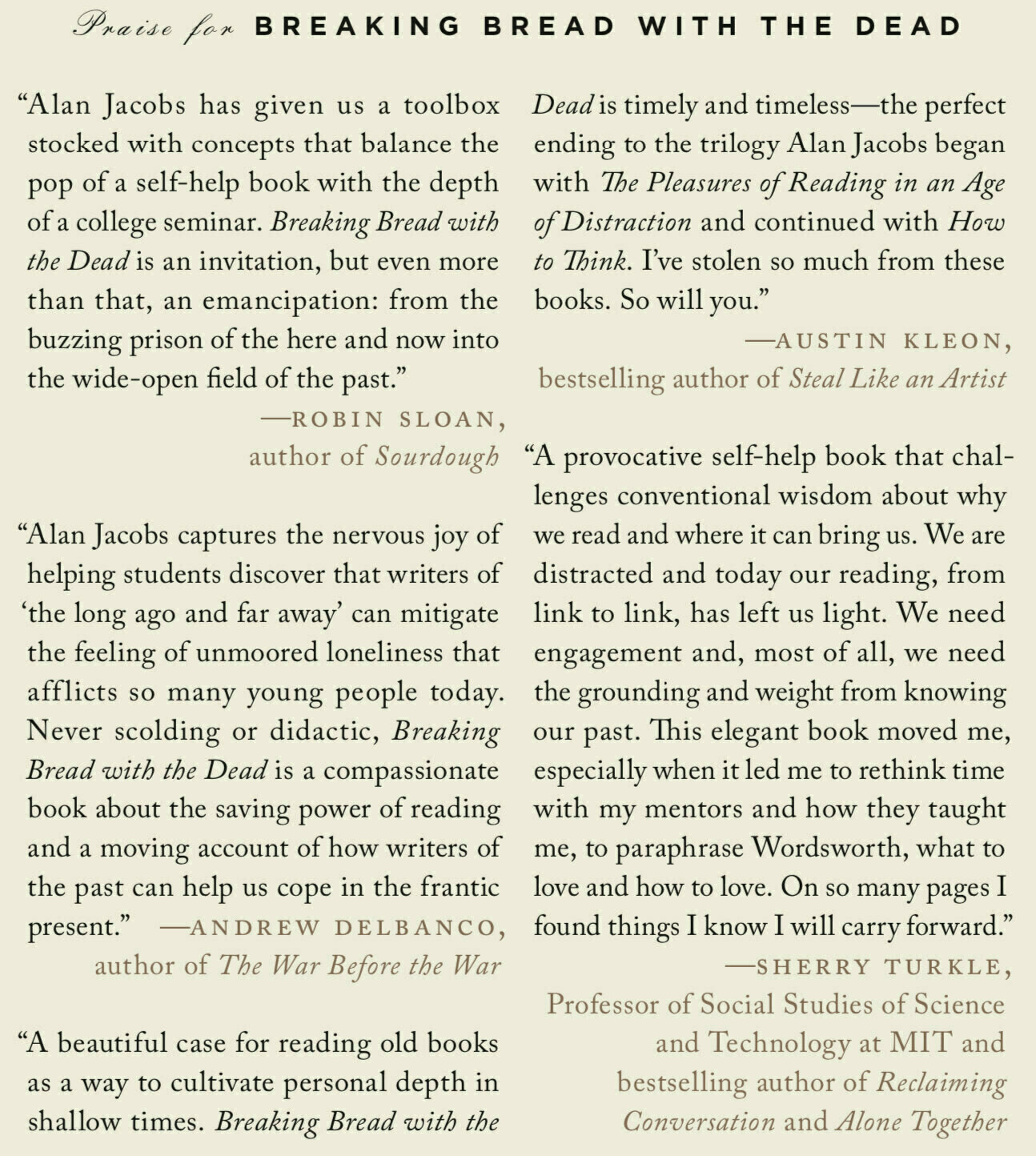
Couldn’t possibly be more delighted with the blurbs for my forthcoming book.

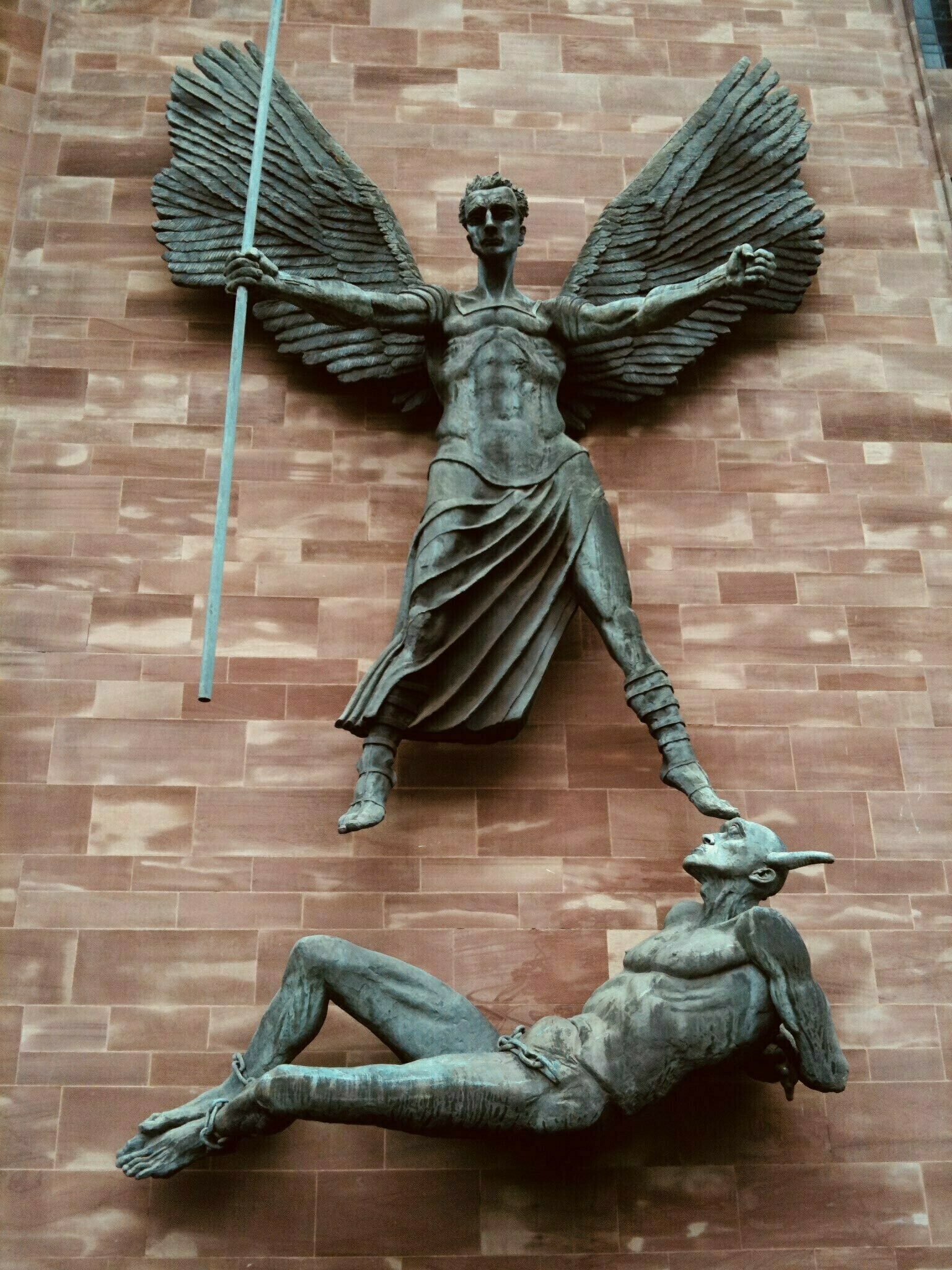
Jacob Epstein’s great sculpture of St. Michael’s victory over Satan at Coventry Cathedral — a memorable image of the ultimate binding of all the forces of evil and darkness.