
not so much
On January 25, Joe Biden tweeted that “Transgender equality is the civil rights issue of our time.” The. I texted a friend, “Because we’ve fixed all the problems Martin Luther King was concerned about?”
When the #MeToo movement was dominating public attention, I remember hearing Christian commentators say that if you‘re a preacher and you’re not preaching about #MeToo you’re failing your congregation. Later, or maybe before, it was the border crisis that was the obligatory homiletic topic. Those same commentators are now equally insistent about preaching on George Floyd and systemic racism — and yet, as far as I know, neither systemic sexism nor government-sponsored xenophobia have been conquered.
I’m reminded of a motif in Gabriel Garcia Marquez’s One Hundred Years of Solitude. From time to time in the book some character comments that “Time passes” — to which some other character replies, “That’s how it goes. But not so much.” This is the correct reply: Not so much.
A couple of years ago I gave a lecture at a university on difference and civility — it wasn’t this talk but it was on similar themes — and in the Q&A afterwards I got some pushback against my reliance on examples from the Civil Rights Movement and the broader history of American racial politics. The people pushing back thought I should’ve been talking about … topics of more recent attention. I replied with two points. First, I said, I grew up in Alabama during the Civil Rights era and what happened there and then has left a permanent mark on me. I didn’t end up making it my academic speciality to work on such matters, but I have written about them off and on my entire career, and expect that I will continue to do so. Second, I said, I don’t believe matters of race are any less fraught in America 2018 than they were in America 1968.
Human beings have overwhelmingly powerful cravings for novelty and unanimity. We want new problems to face, because we’re tired of the old ones: they bore us, and remind us of our failures to solve them. And, especially in times of stress, we crave environments in which dissent is silenced and even mere difference is erased. We call that “solidarity,” but it‘s more like an instinctual bullying. You must attend to the thing I am attending to. I despise both of those tendencies. They’ve turned everyone into attention muggers.
If three months ago you were primarily focused on addressing sexism in the workplace, it seems to me that you ought to be allowed, indeed encouraged, to keep thinking about and working on that now, when everyone else is talking about police brutality. If your passionate concern is the lack of health care in poor communities, here or abroad, I think you should feel free to stick with that, even if it means not joining in protests against police racism. If you’ve turned your farm into a shelter for abused or neglected animals, and caring for them doesn’t leave you time to get on social media with today’s approved hashtags, bless you. You’re doing the Lord’s work.
As for me, I will probably continue to do what I’ve done most of my life, which is to think and pray and sometimes write about racism — even when Twitter and the media that are governed by Twitter have moved on, as assuredly they will, to some new topic about which they will insist that everyone state the correct opinion. Neither novelty nor unanimity is a social good.
Here’s Auden:
Anywhere you like, somewhere on broad-chested life-giving Earth,anywhere between her thirstlands and undrinkable Ocean,
the crowd stands perfectly still, its eyes (which seem one) and its mouths
(which seem infinitely many) expressionless, perfectly blank.
The crowd does not see (what everyone sees) a boxing match, a train wreck,
a battleship being launched, does not wonder (as everyone wonders)
who will win, what flag she will fly, how many will be burned alive,
is never distracted (as everyone is always distracted)
by a barking dog, a smell of fish, a mosquito on a bald head:
the crowd sees only one thing (which only the crowd can see)
an epiphany of that which does whatever is done.
Whatever god a person believes in, in whatever way he believes,
(no two are exactly alike) as one of the crowd he believes
and only believes in that in which there is only one way of believing.
Few people accept each other and most will never do anything properly,
but the crowd rejects no one, joining the crowd is the only thing all men can do.
a green thought in a green shade


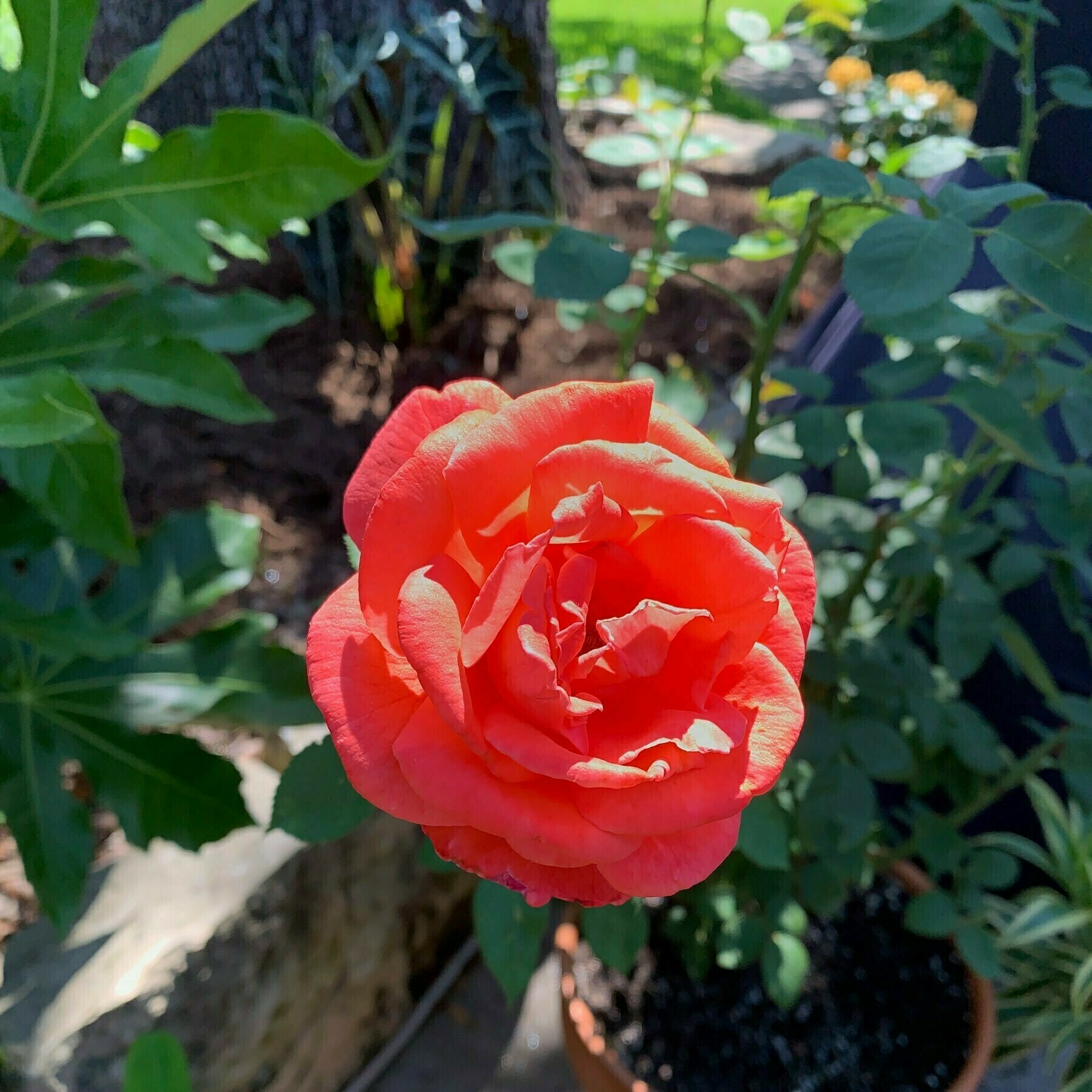
I’m just taking picture after picture of my garden because (a) I like growing flowers and (b) I ain’t going anywhere else except my own back yard these days.

tiptoe stance
I’ve read several articles and posts recently featuring the same conceit: that COVID–19 and police violence are the “twin plagues” or “parallel plagues” of black America. This is in one important sense highly misleading. It’s too simple and therefore easy to refute or ignore. But that’s not the whole story.
If you visit the Mapping Police Violence site, you’ll see near the top of the page this statement: “Police killed 1,098 people in 2019.” Then, a little farther down the page, you get the information that “Black people were 24% of those killed despite being only 13% of the population.” Which means that American police killed 263 black people last year. It’s not clear how many black people have died from COVID–19, but a reasonable estimate would be 25,000. That means that the coronavirus has killed 95 times more black Americans in just a few months than police killed in all of 2019. Put that way, the plagues scarcely seem comparable, do they?
But let’s not leave it at that. What we need here, if we’re going to continue to speak the language of plague, that is, the language of disease, is the distinction between acute and chronic affliction. I’m speaking metaphorically here, in terms of how whole populations are affected by some invasive, destructive force, whether it’s a literal biological disease or not. I’m thinking of the black population of America as a single body. And in relation to that body COVID–19 is an acute disorder. It has sprung up quickly, out of nowhere, and afflicted people intensely. It just might go away. (From my keyboard to God’s ears.)
Police violence, by contrast, is a chronic disorder. It goes on year after year after year, decade after decade after decade. I have not experienced anything like that, but I expect that something of the endless tension of it is captured in this famous passage from Martin Luther King’s “Letter from the Birmingham Jail”:
Perhaps it is easy for those who have never felt the stinging darts of segregation to say, “Wait.” But when you have seen vicious mobs lynch your mothers and fathers at will and drown your sisters and brothers at whim; when you have seen hate filled policemen curse, kick and even kill your black brothers and sisters; when you see the vast majority of your twenty million Negro brothers smothering in an airtight cage of poverty in the midst of an affluent society; when you suddenly find your tongue twisted and your speech stammering as you seek to explain to your six year old daughter why she can’t go to the public amusement park that has just been advertised on television, and see tears welling up in her eyes when she is told that Funtown is closed to colored children, and see ominous clouds of inferiority beginning to form in her little mental sky, and see her beginning to distort her personality by developing an unconscious bitterness toward white people; when you have to concoct an answer for a five year old son who is asking: “Daddy, why do white people treat colored people so mean?”; when you take a cross county drive and find it necessary to sleep night after night in the uncomfortable corners of your automobile because no motel will accept you; when you are humiliated day in and day out by nagging signs reading “white” and “colored”; when your first name becomes “n****r,” your middle name becomes “boy” (however old you are) and your last name becomes “John,” and your wife and mother are never given the respected title “Mrs.”; when you are harried by day and haunted by night by the fact that you are a Negro, living constantly at tiptoe stance, never quite knowing what to expect next, and are plagued with inner fears and outer resentments; when you are forever fighting a degenerating sense of “nobodiness” — then you will understand why we find it difficult to wait. There comes a time when the cup of endurance runs over, and men are no longer willing to be plunged into the abyss of despair. I hope, sirs, you can understand our legitimate and unavoidable impatience.Take a look again at that long, long sentence in the middle of the passage, how it goes on and on, how you keep pausing for a second but only a second, never being able to stop long enough to catch your breath. “Living constantly at tiptoe stance.” A chronic affliction.
My dear friend Garnette Cadogan just posted a reflection on these matters, and if you listen to the music he chose to accompany his words you’ll note this theme again and again. To cite just one example, this from KRS-One:
My grandfather had to deal with the cops My great-grandfather dealt with the cops My great grandfather had to deal with the cops And then my great, great, great, great — when it’s gonna stop?That’s why Toni Morrison, in a passage also quoted by Garnette, speaks of a cry that has “no bottom and no top, just circles and circles of sorrow.”
If you think of the black population of this country as a body, then COVID–19 is indeed a terrible plague ravaging it. The fear, the expectation, of police violence isn’t like that: it’s instead a misery that the body (the whole body of black Americans) must suffer and suffer and suffer, with no end in sight. People who have chronic diseases know that what’s attacking them probably won’t kill them — but even if it doesn’t, it might make them wish they were dead. It frays their nerves. It disrupts their sleep. It damages their relationships and weakens their judgment. It makes them vulnerable to other afflictions that really could kill them.
If you’re a black person in America, walking down the streets of a city, the cops probably won’t stop you. But they might. If a cop stops you, he probably won’t kill you. But he might. It’s a non-trivial possibility. The constant awareness of that possibility is itself an affliction. Garnette’s essay and the music associated with it testify to that.
We shouldn’t conflate the sudden onset of COVID–19 and the endless tension that arises from walking, or doing anything else, while black. But keeping them conceptually distinct, we can still see them as have this essential thing in common: they attack the bodies of black Americans, they attack the social body that is Black America.
Those of us who are white don’t know much, firsthand, about that chronic affliction. But you know, while the coronavirus itself might be acute, for all of us concern about it has become chronic. Buying groceries probably won’t make us ill. But it might. And if we get ill, we probably won’t die. But we might. It’s a non-trivial possibility. We’re learning how to live at tiptoe stance. Our nerves are fraying after just a few months. Imagine what it would be like to live this way all our lives long.



two quotes by Jesse Singal
One:
I am not arguing for a return to some sort of view-from-nowhere style of journalism. I have no problem identifying as both a journalist but also as a progressive and someone who dislikes Trump rather fiercely. There is nothing wrong with having your journalism be driven by a sense of general ideological mission; some of the best journalists covering the working poor care deeply about the working poor, believe they are treated unfairly, and want to see their station improved. They’re still capable of, and produce, honest journalism.
What I am saying is that if you call yourself a journalist, there needs to be some distance, somewhere, between your tribal allegiances and the way you do your job.
Two:
Accuracy norms are about, well, accuracy: People who subscribe to accuracy norms are most concerned with spreading true claims, and with debunking false ones. Rightside norms are about being on the right ‘side’ of a given controversy: People who subscribe to rightside norms are more concerned with showing that they are on the right side of a given controversy, and that the people on the other side are morally suspect, than they are with accuracy, at least in a zoomed-in sense. […]
If you’re in a group in which rightside norms prevail, you face a weird set of incentives:
1) It will often harm your group standing to point out that a false claim is false
2) It will often benefit your group standing to pile on a figure who has been unfairly accused of something by broadcasting evidence pertaining not to the claim in question, but to his or her broader (ostensible) moral worthlessness
3) It will often benefit your group standing to punish those who seek to debunk false claims against ‘bad’ figures
Imagine experiencing all this over and over, outrage after outrage.