
And one of the desserts: corn mochi with blackberry sorbet and various delicious accessories.

A highlight from last night’s anniversary dinner at Barley Swine: fried buns (like a steamed bun except … fried) with shrimp dumplings.

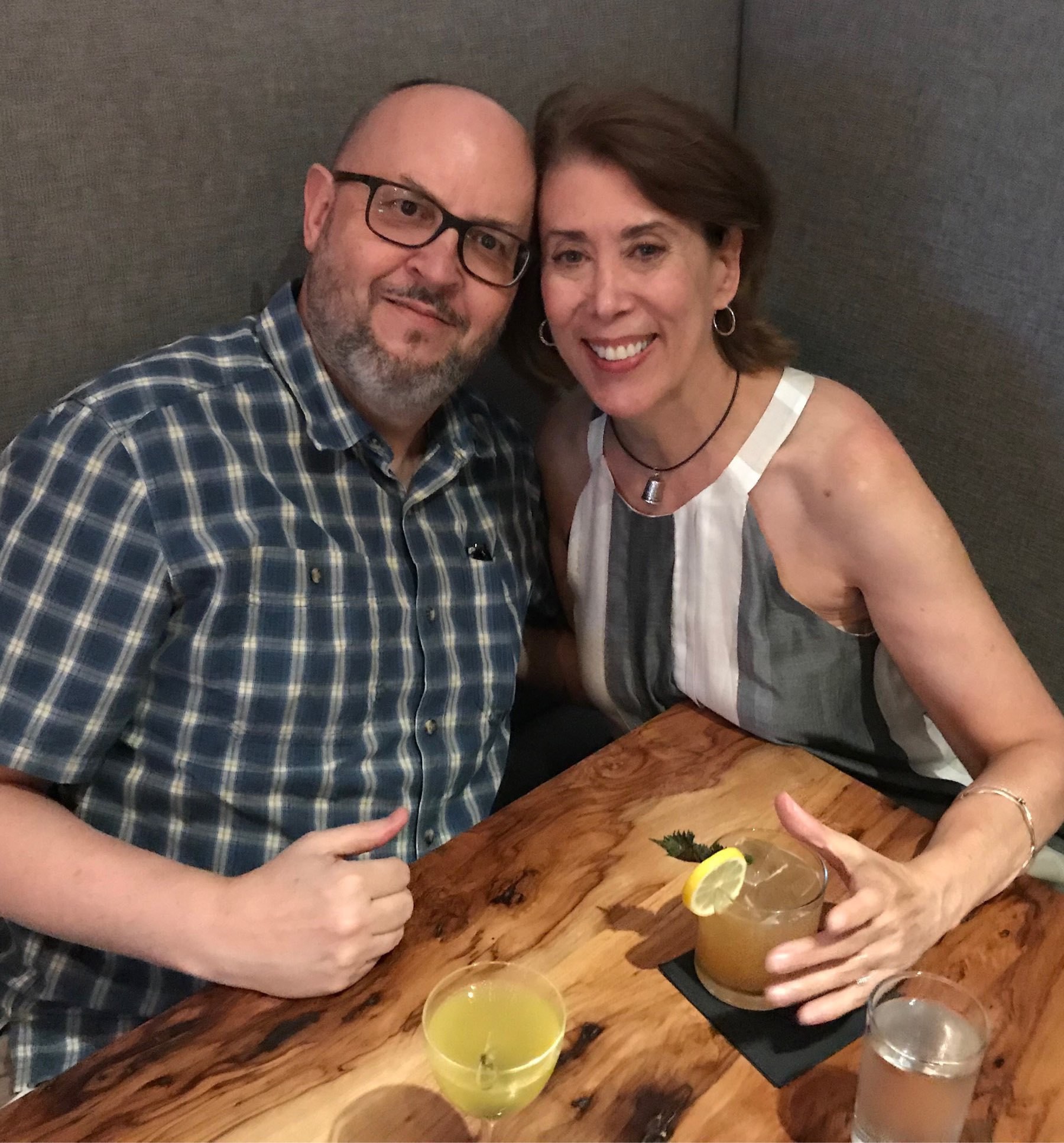
39th anniversary dinner at the amazing Barley Swine in Austin. So, so grateful for my beloved.
here and there
As some of you may have noticed, I’m not posting here very frequently. I think for the foreseeable future I’m only going to be using this blog for longer reflections – long by internet standards, anyway.
From day to day you’ll find me posting to my micro.blog account – and if you haven’t checked out micro.blog, please do! People sometimes describe micro.blog as a “Twitter replacement,” but that’s not quite right. It may be better to think of it as what services like Twitter and Instagram could have been if they had been devoted to the open web and not subservient to the demands of venture capital. It’s a great place for low-key connection with others, and the best possible way to get started in blogging. It’s not free, but then Twitter and Instagram aren’t free either – those services just make you may in currencies other than money. Micro.blog serves no ads, respects your privacy, and allows you to own your turf. Try it!
I continue to post bookmarks – with useful excerpts! – at my Pinboard page, which I have been using for … [checks site] … ten years and two weeks.
Finally, I think my newsletter is pretty fun – a bit of a break from the incessant seriousness of our political moment.
Hose time

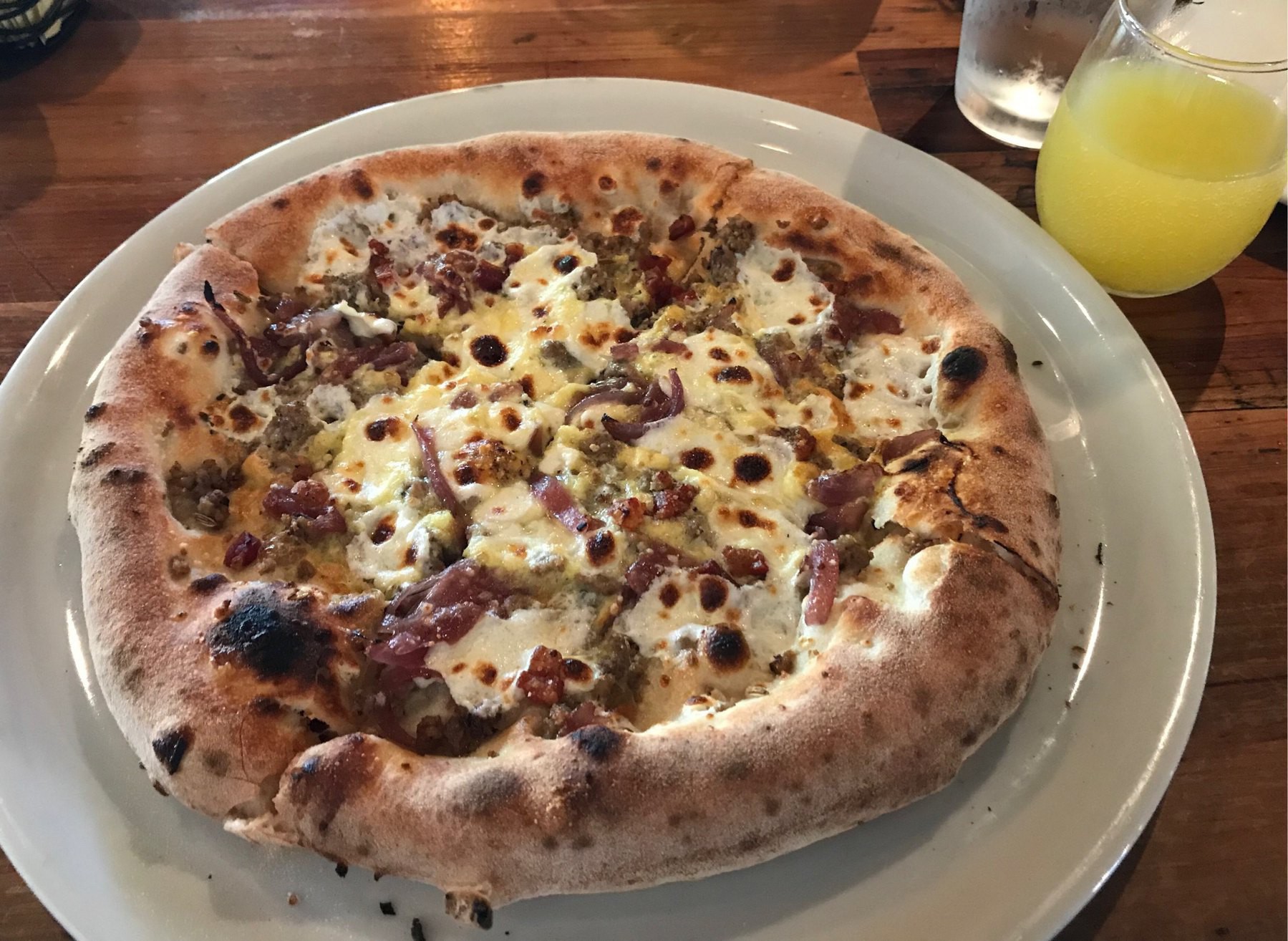
First the Eucharistic Feast, then the Breakfast Pizza at Moroso Feast.
the airless room
This is an interview with Kathryn Scanlan about her very peculiar new book, which is made up of selections from a person’s diary — read the interview to learn more, it’s really fascinating.
But I want to talk about a distraction from the real subject of the interview. Here’s a passage:
Etter: Now this is a question I have coming from a journalism background: what does it mean for fiction to take a real life and remix it, scramble it, and fine tune it into something that becomes non-real? What is it like to play with that?Scanlan: A little bit weird. From the beginning, I felt like it was a weird thing I was doing. I don’t necessarily think it’s any particular genre, I think it has elements of all genres. I think it can be called fiction and I would call it that because of the way it’s been selected. If you are only showing part of something, it’s fiction. If you’re omitting lots of things, or if you’re focusing on only something particular, it’s fiction in my mind.
Etter: I think most journalists would probably agree with that definition — maybe not our president.
I read that and thought: Is there any chance of my getting through a recent essay, an article, a story, an interview, without a reference to That Man? Is it really necessary for every member of The Cultured to signal their disdain for him in every single conversation?
I want to say: He’s not sucking the air out of the room, you are.
Yes, I know, it’s just a passing comment. But when “passing comments” of that kind show up twenty times a day, it wears on a fella.
This is why I make my newsletter. It’s a place that I can guarantee will be free from that kind of thing, that will allow me and my readers to spend time in a broader world than that of posted and tweeted and retweeted political vaporing, posturing, and rancor.
Many of you will know this famous letter from John Adams to his wife Abigail: “The Science of Government it is my Duty to study, more than all other Sciences: the Art of Legislation and Administration and Negotiation, ought to take Place, indeed to exclude in a manner all other Arts. I must study Politicks and War that my sons may have liberty to study Mathematicks and Philosophy. My sons ought to study Mathematicks and Philosophy, Geography, natural History, Naval Architecture, navigation, Commerce and Agriculture, in order to give their Children a right to study Painting, Poetry, Musick, Architecture, Statuary, Tapestry and Porcelaine.” Let not Adams have studied in vain.
on social acceleration
Recently I’ve read two of the most stimulating, provocative, generative books I’ve read in a long time. One of them is Bewilderments: Reflections on the Book of Numbers, by Avivah Gottlieb Zornberg. I hope to have something to say about that in the near future.
The other, and the one I want to talk about here, is Hartmut Rosa’s Social Acceleration. This one poses some real challenges to me, primarily because it bears so directly on the book I’m writing but is not the sort of thing — it gets deep into the weeds of social theory — that I can treat at length in a book for a general audience. So as relevant as it is to the argument of Breaking Bread with the Dead, I won’t say much about it there, though it will surely end up in the notes a few times. (One of the things I most want to do in my writing for general audiences is to translate complex work in theology, philosophy, and social, cultural, and literary theory into terms accessible to the common reader — and to do so without defacing the ideas by oversimplifying them.)
I’ll unpack a bit of Rosa’s argument here, then. Rosa looks at the phenomenon of acceleration in three dimensions:
- “technical acceleration, that is, the intentional acceleration of goal-directed processes”;
- “acceleration of social change, that is, the escalation of the rate of social change with respect to associational structures, knowledge (theoretical, practical, and moral), social practices, and action orientations”;
- “acceleration of the pace of life represents a reaction to the scarcity of (uncommitted) time resources. This is why, on the one hand, it is expressed in the experience of stress and a lack of time, and, on the other, it can be defined as an increase in the number of episodes of action and/or experience per unit of time."
The relationship between these three dimensions, Rosa shows, is complex: after all, when you have technical acceleration, especially in the form of what we call “labor-saving devices,” shouldn’t our pace of life slow down? And yet it often doesn’t — or, perhaps more accurately, we don’t feel that it does.
Rosa also discusses various “decelerating” forces or institutions, and it’s the last of those that I want to focus on here. Unlike the deceleration of a technologically backward society with scant or no access to the most current technologies — and also unlike the deliberate choice, long term or short, of technological limitation (the family living “off the grid” or the techbro vacationing in a monastery) — this final kind of deceleration is “the paradoxical flip side of social acceleration.” Many people in our time have “the experience of an uneventfulness and standstill that underlies the rapidly changing surface of social conditions and events, one that accompanies the modern perception of dynamization from the very beginning as a second fundamental experience of modernization.” Rosa often uses in the book a phrase by the cultural theorist Paul Virilio: “frenetic standstill” — the widespread sense that the world around us is in constant flux and yet nothing essential is happening — nothing essential can happen. (There’s a fascinating section of the book on the ways that depression is a natural response to this and therefore the characteristic disease of late modernity.)
This sense of “frenetic standstill” is especially common when the second dimension, acceleration of social change, crosses a certain threshold. Rosa looks at three social conditions, divided by two thresholds. In the first condition no obviously major change happens over several generations, or if it does happen it happens with imperceptible slowness, which lends to everyone in that society a feeling of stability, even permanence. Thus it was, thus it is, thus it shall ever be.
But when a major change occurs fast enough so that one generation of people can see that they’re living in a different form of life than their parents, or grandparents, did, then a threshold has been crossed. And Rosa argues that when this happens people tend to perceive that change as progressive: the world is going somewhere, it has a direction, and if I go with it my life can have a progressive direction too.
However: there’s another threshold to cross, as we have recently learned, and that’s when significant social change happens within a generation. Not only is your social world different than the one your parents experienced and came to count on, it’s different than the social world you experienced even a short time ago. When that happens, you see a couple getting a divorce because when they married they were “different people.” You get Farhad Manjoo feeling that the gender that he absolutely took for granted just a few years ago is now an “ubiquitous prison for the mind.” You get a Christian academic like David Gushee making a career of chastising people for holding views he himself held quite recently. And everyone thinks this kind of thing is normal: to look upon your very self of five years ago as a stranger, and presumably one for whose beliefs and actions your NowSelf cannot possibly be held responsible.
But, Rosa reminds us, we don’t really how what life on this side of that second threshold is going to do to us.
An intragenerational tempo of change thus undeniably raises the question of the temporally specific, so to speak, load-bearing capacity of cultural reproduction and social integration. The consequences of the growing intergenerational divide in lifeworld orientations and everyday practices as well as the ongoing devaluation of experience for the exchange between generations, for the passing on of cultural knowledge, and for the maintenance of intergenerational solidarity have hardly been studied at all.
It hasn’t been studied, but the consequences are going to be interesting (and, I think, not pleasant) to see unfold. For instance, here’s one aspect of the “ongoing devaluation of experience for the exchange between generations, for the passing on of cultural knowledge, and for the maintenance of intergenerational solidarity”: a currently small but increasing number of parents live in absolute terror of “assigning” gender to their children. Some decades from now there will surely be some powerfully embittered people who will despise their parents for having forced such choices on them when they were wholly unprepared to make them.
And yet many of those same parents don’t hesitate to forbid the eating of meat or Twinkies or Doritos to those same children, and will be deeply grieved when, as is inevitable, some of those kids end up as junk-food junkies. So I don’t think there will ever be a wholesale abandonment of “the passing on of cultural knowledge,” or of a desire for “the maintenance of intergenerational solidarity.” But what, specifically, people will want to pass down to their children will change. And there’s no doubt that as long as social change happens, or is felt to, at the current rate, parents will want to give their children free choices as often as they can possibly bear to. The “load-bearing capacity of cultural reproduction and social integration” will continue to decline, it seems likely.
And yet maybe not inevitable. There’s a passage from Adorno’s Minima Moralia that I think of often — and that Rosa refers briefly to at one point: “Perhaps the true society will grow tired of development and, out of freedom, leave possibilities unused, instead of storming under a confused compulsion to the conquest of strange stars.”
bookmaking
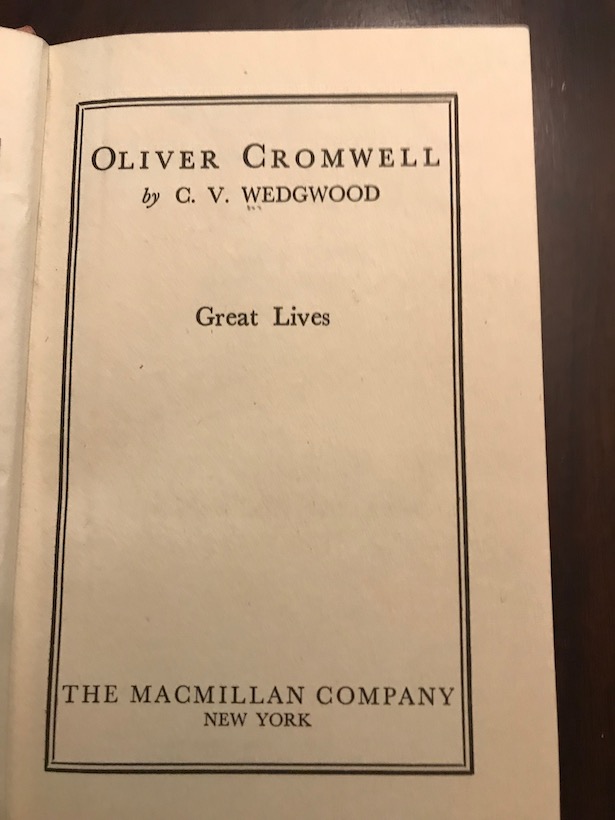
After writing my recent post on my enthusiasm for the writing of C. V. Wedgwood, I realized that I didn’t have a copy of her brief biography of Oliver Cromwell, so I ordered one from AbeBooks. It duly arrived, and I have just read it, and can report that it’s fine but by no means one of her best works. But I find myself thinking about the actual physical book, the codex.
It’s a discarded library book — from Stephens College in Missouri — and was acquired by that library in 1956. It’s a small book (4.5 x 7.5 inches) and has a basic, unadorned cover, and when I first opened the book I thought that the paper wasn’t great. But then I realized that the paper is sixty-three years old, and in that context it’s pretty darn good. It hasn’t yellowed much, and isn’t as brittle as paper that age often is. The binding is sewn, and the book easily lies flat.
Though the book, as you can see, was published by a New York house, it was actually printed in England.

The Jarrold Group sold their printing business around fifteen years ago, after which it seems to have closed, leaving only a small and rarely open museum of printing.
But in their day they knew their craft. It’s the typography that really struck me, even though it’s not unusual or obviously distinctive. Here’s a sample page:

As I say, not dramatic — but look at how lovely all the proportions are: the layout on the page, the spacing and kerning, the simple but elegant (and highly readable) typeface — Baskerville, I think — you can’t go wrong with Baskerville. It’s very rare for a book to get almost every element of typesetting and layout right the way this one does. (The kerning might be a tiny bit wide at times, but that’s because the book is small and the lines are therefore short. The compositors have done very well to make you forget about that.)
Consider this recent and nicely-designed book, Shoshana Zuboff’s The Age of Surveillance Capitalism:

Now that’s a lovely typeface — Minion, I think? I’m not expert in these things — and note the generous spacing between lines: important when a book is as big as this one (over 600 pages). But the margins are too narrow. Look how the ends of the lines disappear into the gutter. I think with slightly wider margins and slightly narrower spacing between the lines the book could have been more readable at the same length. (Though, as you can see, the paper is too thin. Compare the older book, in which nothing shows through from the other side.)
Obviously, every typesetting decision creates tradeoffs: you get a good feature in exchange for putting up with something a little less good. It’s like working with a stringed instrument: something is always out of tune, at least a little, thanks to the perversities of equal temperament. But those bookmaking people at Jarrold & Sons did the job about as well as it can be done. Hats off to them. I wish I could buy new books made by them, or by craftsmen who can do what they could do.