
TinyLetter woes

Well, I was excited about my new newsletter until, four days in, I got the above message. TinyLetter kept asking me incomprehensible questions ("Is there a record available to support that each of these contacts have gone through an opt-in process?” — to which the answer is, Yes, and you have that record, since they’ve signed up through your form) but wouldn’t answer any of mine, and now have fallen silent. So at the moment it looks like the newsletter is dead before it even really gets started. But we’ll see.
Derrida's Margins
Derrida’s Margins is a remarkable project: a digital unpacking of Jacques Derrida’s library, starting with De la grammatologie.


It’s an astonishing resource — I’m going to spend hours and hours here. Ninety years ago, John Livingston Lowes published a book called The Road to Xanadu: A Study in the Ways of the Imagination, that purported to track down all the reading that had gone into the writing of Coleridge’s great poems “The Rime of the Ancient Mariner” and “Kubla Khan.” It was, and remains, a remarkable work of scholarship, though necessarily highly (and sometimes dubiously) speculative. What we have in Derrida’s Margins is a kind of digital extension of Lowes’s project — and that’s fitting, because Derrida is in some ways the Coleridge of modern literary theory: enormously learned, quirkily imaginative, sensitive to strange connectors and attractors.
And I am especially pleased that the technical lead on this project is Rebecca Sutton Koeser, a former student of mine! Even as an undergrad Rebecca was equally interested in literary study and computer science; she went on to get her PhD in English from Emory, and has continued to straddle these two worlds. Here’s her account of what she learned in working on this project.
excerpt from my Sent folder: Twitter
I left Twitter because I watched people who spent a lot of time on Twitter get stupider and stupider, and it finally occurred to me that I was probably getting stupider too. And after some reflection I decided that I couldn't afford to get any stupider.
![mp-photo-alt[]=mp-photo-alt[]=](https://cdn.uploads.micro.blog/404/2018/827d150afc.jpg)


A December volunteer

Christians, Pagans, Jews
Richard Schragger and Micah Schwartzman discern a renewal of Christian critiques of paganism and they’re not happy about it. On Twitter, Schwartzman has applied his argument to a recent column by Ross Douthat in what I think are unhelpful ways — but I also think Ross’s column blurs some issues that invite the unhelpful response from Schwartzman. Let’s see if we can do some disentangling.
The key reference point for Douthat’s column and Schragger and Schwartzman’s essay is a recent book by Steven D. Smith, Pagans and Christians in the City: Culture Wars from the Tiber to the Potomac, in which Smith attempts to reclaim and update the argument made by T. S. Eliot in The Idea of a Christian Society that English culture was then (80 years ago) faced with the increasing dominance of a kind of “modern paganism.” Wrote Eliot, “The choice before us is between the formation of a new Christian culture, and the acceptance of a pagan one.”
But what does Eliot mean by “pagan”? Alas, he never clearly defines it. But when he says that he thinks England has reached “the point at which practising Christians must be recognised as a minority (whether static or diminishing) in a society which has ceased to be Christian,” that seems to be what he means by a “pagan society.”
For C. S. Lewis, this is just carelessness. In a passage from a lecture in which he does not mention Eliot but clearly has him in mind, Lewis says,
It is hard to have patience with those Jeremiahs, in Press or pulpit, who warn us that we are " relapsing into Paganism". It might be rather fun if we were. It would be pleasant to see some future Prime Minister trying to kill a large and lively milk-white bull in Westminster Hall. But we shan't. What lurks behind such idle prophecies, if they are anything but careless language, is the false idea that the historical process allows mere reversal; that Europe can come out of Christianity "by the same door as in she went" and find herself back where she was. It is not what happens. A post-Christian man is not a Pagan; you might as well think that a married woman recovers her virginity by divorce. The post-Christian is cut off from the Christian past and therefore doubly from the Pagan past.And elsewhere in the lecture Lewis says, “Christians and Pagans had much more in common with each other than either has with a post-Christian. The gap between those who worship different gods is not so wide as that between those who worship and those who do not.”
What’s interesting about Smith’s book is that he knows this critique by Lewis, indeed he quotes it — but then he ignores it, and instead uses “pagan” in the frustratingly loose, and in my view indefensibly inaccurate, way Eliot uses it.
Because Smith uses the term “pagan” in this way, Schragger and Schwartzman assume that every Christian critic of paganism does the same. In this respect they’re careless, and indeed, I don’t get the sense that they’ve paid much attention to the writings they’re denouncing. In their first footnote, where they purport to list such critiques, they name an essay by Adrian Vermeule in which the term “pagan” is used only in a historical sense, and they don’t even get the title of Rod Dreher’s book right. In Schwartzman’s Twitter critique of Douthat, he assumes that Douthat is using “pagan” to mean “non-Christian” — but it’s not obvious that that’s right.
In fact, Douthat (following Smith in this) demonstrates awareness of multiple forms of post-Christianity:
- “First, there is a tradition of intellectual and aesthetic pantheism that includes figures like Spinoza, Nietzsche, Emerson and Whitman, and that’s manifest in certain highbrow spiritual-but-not-religious writers today. Smith recruits Sam Harris, Barbara Ehrenreich and even Ronald Dworkin to this club; he notes that we even have an explicit framing of this tradition as paganism, in the former Yale Law School dean Anthony Kronman’s rich 2016 work ‘Confessions of a Born-Again Pagan.’”
- “Second, there is a civic religion that like the civic paganism of old makes religious and political duties identical, and treats the city of man as the city of God (or the gods), the place where we make heaven ourselves instead of waiting for the next life or the apocalypse.”
- Third, “there are forms of modern paganism that ... offer ritual and observance, augury and prayer, that do promise that in some form gods or spirits really might exist and might offer succor or help if appropriately invoked. I have in mind the countless New Age practices that promise health and well-being and good fortune, the psychics and mediums who promise communication with the spirit world, and also the world of explicit neo-paganism, Wiccan and otherwise.”
First, it leaves us unable to respond appropriately to something really interesting, which involves Douthat’s third category: those who — from the right and the left, as I noted yesterday — are genuinely attempting to renew paganism as such, are striving to disprove Lewis’s account of “the false idea that the historical process allows mere reversal.” How many of these people are there? And how successful are they likely to be in their project of restoration?
Second, we’re faced with a kind of Jewish problem, which is what Schragger and Schwartzman, in their essay are primarily interested in. S&S argue that when people like Eliot and Smith and Douthat seek the renewal of some kind of Christian society — Douthat recently wrote, with tongue just barely touching his cheek, that his ideal ruling elite for the Americas is “a multiracial, multilingual Catholic aristocracy ruling from Quebec to Chile” — and present that society as an alternative to paganism, then that tends to cast Jews as pagans. (This is especially true of what Eliot called “free-thinking” Jews, that is, people who are ethnically Jewish but lack religious belief.) Here again some distinctions need to be made, this time among several groups who resist the secularization of Western societies:
- Those, like Eliot, who seem interested in the cultural and indeed legal dominance of a kind of generic Christianity (it’s hard for me to see just how specifically Anglican Eliot’s ideal is);
- Those — like Milton Himmelfarb (whom S&S quote) and Will Herberg (whom they don’t but should) — who appeal to a highly generalized “Judeo-Christian” inheritance which they typically want to be dominant in civil society but not enshrined in law;
- Proponents of Catholic integralism —perhaps including Douthat, whose comments on integralism over the years have oscillated between wariness and admiration — who want Roman Catholicism to regain what they believe to be its proper temporal as well as spiritual power.
Maybe it’s because I suffer from nostalgia for the philosophical thinness of liberal proceduralism, but I’m suspicious of all these models. They all, it seems to me, think about politics from the position of power, from some imagined world in which Our Boys are the ones making decisions. In contrast, I find myself recalling and admiring — as I often have in the past — George Washington’s great letter to the leader of the Newport synagogue in which, responding to their gratitude for his tolerance of their religion, he says, “It is now no more that toleration is spoken of, as if it was by the indulgence of one class of people, that another enjoyed the exercise of their inherent national gifts.”
argumentum ad Hitlerum
Less persuasive, though, are Sullivan’s two other claims about New Religions, in the American context. The first is that liberalism lacks meaning and various forms of illiberalism (nationalism, theocracy, authoritarianism, etc.) do not.... Nazi philosophers favored meaning (“the triumph of the will”) and said that procedural liberalism, divorced from nationhood, was a Jewish, internationalist poison that would weaken the only true source of German power.
You know who else was a critic of liberalism?
Mail!
neopagans
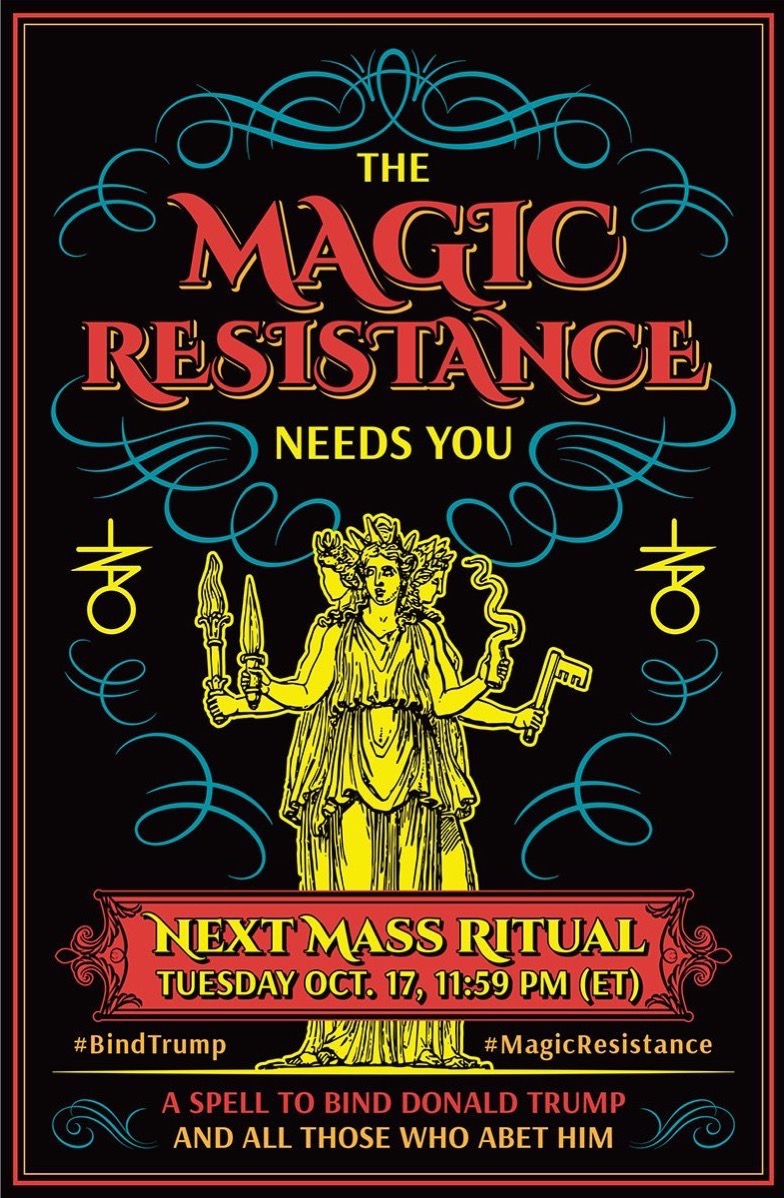
Neopagans come in many styles, from celebrants of white-supremacist revisions of Norse religion to witches who cast binding spells against Donald Trump, but they generally have a few things in common:
- They’re interested in the past only insofar as it supports what they already want and believe on thoroughly presentist grounds;
- They hate Jews;
- They hate Catholics almost as much as they hate Jews;
- They hate other Christians almost as much as they hate Catholics.
excerpt from my Sent Folder: to someone who wants to be a writer
Here are some thoughts:
- Wanting to “be a writer” is, generally speaking, not a good sign. That suggests not a commitment to a vocation but wanting to see yourself, or to be seen by others, in a particular way. By contrast, to have a story that you’re desperate to tell; to have some truth you want to serve, and share with others; to find the crafting of sentences irresistible — those are good signs, because they suggest a person turned outward rather than inward, and the most worthwhile writing is done by people who are turned outward.
- Writing that matters will therefore be in service to something or someone, and in order to serve well, you must undergo training and discipline. You have to learn things. You have to have a full mind as well as a lively heart. First you must develop the expertise of crafting sentences, and this can only be done by, first, reading and reading and reading. There is no other path than hard-earned expertise to producing anything that’s worth the time and attention of readers. Why should anybody care what you think? You must earn their care through especially vivid writing, or especially clear thinking, or especially detailed knowledge — or (ideally) some combination of the above.
- It takes many years to develop any genuine expertise. That doesn't mean you don't share your thoughts along the way, but remembering it should keep your expectations in line. Remember, Jesus didn’t begin his public ministry until he was thirty; all those previous years were spent in preparation.
- Normally I despise self-help books and “creativity” books, but there are two exceptions, and both of them are by the same person, Austin Kleon: Steal Like an Artist and Show Your Work. Small books, but really wise. They’ll lead you to some other good things, also.