Sustainability and Solidarity
Sustainability and Solidarity – Kathleen Fitzpatrick:
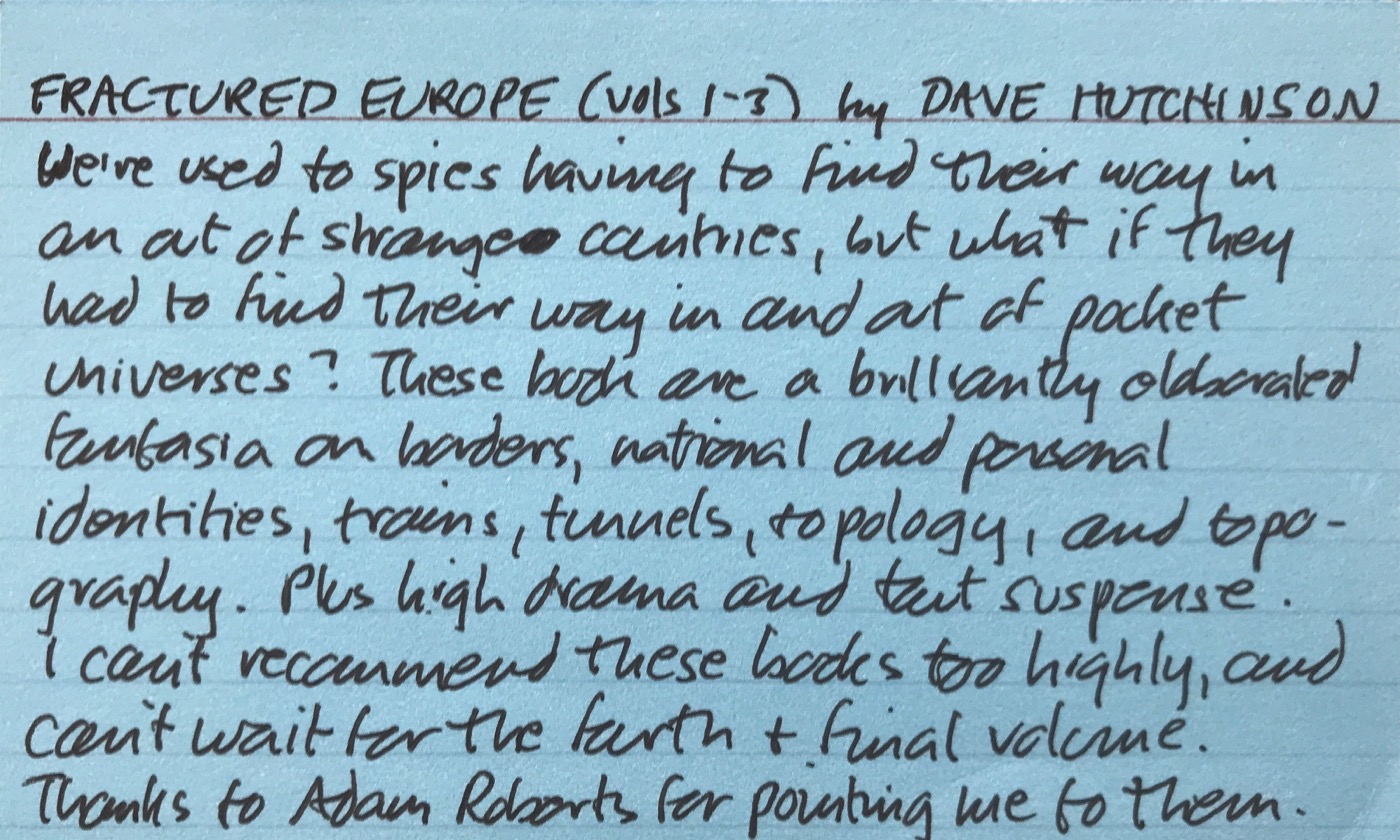
There is absolutely an institutional responsibility involved in sustaining these projects, but, as I argue in Generous Thinking, individual institutions cannot manage such responsibilities on their own. Cross-institutional collaborations are required in order to keep open-source software projects sustainable, and those collaborations demand that the staff participating in them be supported in dedicating some portion of their time to the collective good, rather than strictly to local requirements.
Sustainability in open-source development thus increasingly seems to me to have solidarity as a prerequisite, a recognition that the interests of the group require commitment from its members to that group, at times over and above their own individual interests. What I’m interested in thinking about is how we foster that commitment: how, in fact, we understand that commitment itself as a crucial form of social sustainability.
Kathleen’s blog has been full of ideas recently — more than I can respond to with some travel and talking coming up — but this is an especially important idea, and applies to more realms than the one she’s discussing. Collective achievements require collective virtues; but collective achievements also encourage collective virtues. The academic world — or at least the part of it I occupy — is dominated by incentive structures that discourage this kind of positive feedback loop. Those of us at the senior level of our profession need to be doing some serious work to restructure the incentives we’re bequeathing to our junior colleagues.
political mistrust in the long term
The gravity and legality of the two exercises in meddling differ, certainly. But they both operate to wound our faith in democratic legitimacy. It has gone this way before. It took several incidents, from Vietnam to Watergate to scattered episodes of civil unrest, to permanently damage American trust in government; but as distinct as each event was, they all fractured the same essential faith. We haven’t returned to consistent levels of pre-’70s levels of trust in 40 years, and I doubt this current civic unease will fade much sooner.
This particular horror — Trump and his failures, whatever ridiculous thing he has said or done today, whatever international incident he causes on Twitter tomorrow, however authentic the next panic is — will pass. What will last is the frank revelation of a point that, while ugly and dark, is at least true: You really don’t have the choices you ought to in American democracy, because of decisions made without your consent by people of wealth and power behind closed doors. It’s possible to continue to participate in a democracy after that. But not with a quiet mind.
common prayer
I have many faithful Catholic friends who are hurting right now — who are in deep pain, even anguish. They stay in the forefront of my prayers, along with the victims of clerical abuse. (And of course, many of those victims remain faithful Catholics, though who knows how many have left Catholicism and even the Christian faith altogether.)
I am also praying for the clerical abusers and their enablers, my primary emphasis being that they find true repentance and express that repentance publicly. For what it’s worth, I wholly (and quite seriously) endorse Sohrab Amari’s suggestion:
But the first step is, as I say, sackcloth and ashes. I mean that quite literally. Following ancient Israel’s footsteps, the early Church adopted ashes as an expression of sorrow for sin. Depending on the sin, public penitents were required to wear ashes and sackcloth. The Church should bring back such practices. Whatever criminal and civil consequences await McCarrick, he should also be called to Rome and forced to circle Saint Peter’s Square in sackcloth and ashes, perhaps while the pope observes from the steps of the basilica. Or how about having McCarrick spend hours kneeling at a prie-dieu while Pope Francis looks upon him with anger and contempt? Others have proposed corporal punishments. I’m not opposed to these, either. The point is that the old apologies and settlements won’t do.
But I am not dwelling on the clerics. It’s those who are wounded by clerical sin and crime who primarily concern me.
And, I think it essential to say, these are not the wounds of Roman Catholicism. These are the wounds of the Body of Christ. Insofar as we are members of that Body those wounds are ours. This is no time for those of us who belong to the Reformation traditions to be smug (as though we have a leg to stand on anyway). This is time for every Christian to weep with those who weep. This is the time to confess our own sins of omission and commission. This is a time to ask God to reveal to us all that we have done and left undone that pride and complacency and fear do not allow us to perceive. This is a time to bear one another’s burdens. This is a time to pray a common prayer, and die a common death. "For if we have been united with him in a death like his, we will certainly be united with him in a resurrection like his.”
saving journalism:
What can be done? Start figuring out how to make journalism work as a philanthropic enterprise. If you’re a journalist at one of the countless struggling papers, get together with other journalists and start feeling out philanthropists. Make the case that local journalism’s traditional mission — poking around in the details of city budgets, monitoring what the school board is getting up to, investigating self-dealing politicians — benefits the community and is worthy of their involvement. Who knows, maybe a few subscribers will turn up when they see the local paper as a philanthropy instead of as vulture bait.
There are no obvious treatments for journalism’s profound malaise, but I think Megan has identified the most plausible direction to take.
pronoun trouble
Political philosopher Jason Brennan on the case for epistocracy:
Here’s what I propose we do: Everyone can vote, even children. No one gets excluded. But when you vote, you do three things.
First, you tell us what you want. You cast your vote for a politician, or for a party, or you take a position on a referendum, whatever it might be. Second, you tell us who you are. We get your demographic information, which is anonymously coded, because that stuff affects how you vote and what you support.
And the third thing you do is take a quiz of very basic political knowledge. When we have those three bits of information, we can then statistically estimate what the public would have wanted if it was fully informed.
There’s an intellectual habit, one very common to academics, at work in Brennan’s formulations that I’ve called attention to before, and you can get at it by noting his use of pronouns: We get your demographic information. You tell us what you want. You take the quiz, we administer and assess the quiz. We ask, you answer; you give us the information we require and we decide what to do with it, and how it should be interpreted. We’re running the experiment, you’re our experimental subject. Pay no attention to the man behind the curtain!
Which means, of course, that none of us will ever have our vote discounted.
As I’ve noted in a slightly different (but not altogether different) context, "There is a kind of philosopher — an all too common kind of philosopher — who when considering such topics habitually identifies himself or herself with power.” It’s enough to make a Franz Fanon disciple out of me.
do not make room for the devil
If you’ve never been told by your fellow Christians that the personal object of your desire — not just what you might want to do sinfully with that person, but rather the personal object him- or herself — is wrong for you to have, period, then this might not resonate with you as much as it does with me. But for those of us who have been told that, in subtle and not-so-subtle ways — for those of us who have been told that the way to godliness is by removing ourselves altogether from the kinds of friendships in which we might be tempted — it comes as healing balm when you’re told instead, “Christianity… is to regulate, not to eradicate, our affections.”
Bear with me as I (seem to) digress: This reminds me of something that happened to me long ago, when I was a youngish teacher at Wheaton College. In those days — and for that matter until I moved to Waco — I played basketball several days a week, and one morning I almost got into a fight. A guy on the other team said something snarky to me after fouling me pretty hard, and I completely lost my temper, called him him some choice names, and tried to punch him. (It’s probably a good thing that I didn’t, because he was younger and stronger than me and could certainly have kicked my ass.)
This was a pickup game mainly populated by faculty, staff, a few graduate students, and a handful of undergrads, and later that day I found myself wondering what they thought of me. Here I was, a faculty member at a Christian college, cursing like a sailor and trying to slug someone who offended me. What kind of Christian witness is that? I thought and prayed and decided: If I can’t behave any better than that on the basketball court, then I should give up basketball. No matter how much I love it, I need to give it up if it’s standing between me and a decent public life as a Christian.
I also decided that I was going to tell my students about my decision, on the “confession is good for the soul” principle — and because I wanted them to see that (supposedly) more mature Christians can struggle too. And maybe, if I am honest, also because I wanted them to see how humble I was. So the next day in class I told the story and explained my decision — expecting, I suppose some admiration for my Christian commitment.
I was therefore quite disconcerted to see, in my first class, as I related my edifying tale, a student sitting in the front row and, in obvious discomfort, shaking his head. That student was an older student, an ex-con named Manny Mill — you can read a bit of Manny’s story here. His head-shaking was very odd, because Manny was exceedingly, even excessively, respectful of me. I managed to get through my story and teach the class, and when we were done Manny bolted to the front and asked — in his Cuban accent and with what was in those days a pronounced stutter — if he could talk to me. I couldn’t see him that day, but we made an appointment for the following one.
When he came to my office, Manny began by apologizing repeatedly for being so bold, but then took a deep breath and said: “Dr. Jacobs, please do not make room for the Devil.” I found this statement incomprehensible, but he went on, nervous and stammering, to explain. He asked me if I enjoyed playing basketball. I told him that I loved it. Then, he replied, I should not allow the Evil One to take a good thing I love away from me. By giving up basketball, I was saying, whether I meant to say it or not, that that part of my life belonged to the devil, was impervious to God’s grace, was an arena in which God could not win. Manny asked when, if I were still playing basketball, I would next play, and I told him that it would be the very next day. He then pleaded with me to get back out there on the court — but do so only after having prayed for patience and a peaceable spirit.
This was strange news to me. I had thought that “not making room for the Devil” was the very principle I had followed in giving up my favorite recreation, but if Manny was right I was accomplishing the opposite of what I hoped to accomplish: I was ceding territory to my Enemy — an enemy who does not give territory back. By going back onto the basketball court I was putting myself in moral danger, wasn’t I? Surely I was. But what if the alternative to moral risk, especially for Christians, is ceding spiritual territory you can’t get back?
I did what Manny asked. And I have always been very, very glad I did.
When I reflect on such matters, I remember Don Quixote, who once stops on the road a man who is transporting lions in a cage and orders him to open the cage so that he, Don Quixote de la Mancha, can perhaps have the opportunity to fight a lion or two. After the lions, remarkably, show no interest in fighting the knight, Don Quixote considers his honor satisfied. He then addresses an observer of the scene:
“Who can doubt, Señor Don Diego de Miranda, that in the opinion of your grace I am a foolish and witless man? And it would not be surprising if you did, because my actions do not attest to anything else. Even so, I would like your grace to observe that I am not as mad or as foolish as I must have seemed to you….
It was my rightful place to attack the lions which I now attacked, although I knew it was exceedingly reckless, because I know very well what valor means; it is a virtue that occupies a place between two wicked extremes, which are cowardice and temerity, but it is better for the valiant man to touch on and climb to the heights of temerity than to touch on and fall to the depths of cowardice; and just as it is easier for the prodigal to be generous than the miser, it is easier for the reckless man to become truly brave than for the coward; and in the matter of undertaking adventures, your grace may believe me, Señor Don Diego, it is better to lose with too many cards than too few, because ‘This knight is reckless and daring’ sounds better to the ear of those who hear it than ‘This knight is timid and cowardly.’”
Ours is not a spirit of fear.