
signed with that cross
African-American Christianity has continuously confronted the nation with troubling questions about American exceptionalism. Perhaps the most troubling was this: If Christ came as the Suffering Servant, who resembled Him more, the master or the slave? Suffering-slave Christianity stood as a prophetic condemnation of Americas obsession with power, status, and possessions. African-American Christians perceived in American exceptionalism a dangerous tendency to turn the nation into an idol and Christianity into a clan religion. Divine election brings not preeminence, elevation, and glory, but — as black Christians know all too well — humiliation, suffering, and rejection. Chosenness, as reflected in the life of Jesus, led to a cross. The lives of his disciples have been signed with that cross. To be chosen, in this perspective, means joining company not with the powerful and the rich but with those who suffer: the outcast, the poor, and the despised.
where citizens were, there shall users be
The real problem is that [the scooters] just appeared out of nowhere one day, suddenly seizing the sidewalks, and many citizens felt they had no real agency in the decision. They were here to stay, whatever nonusers felt about them.Which was all by design. The scooter companies were just following Travis’s Law. In Santa Monica, Bird’s scooters appeared on city streets in September. Lawmakers balked; in December, the city filed a nine-count criminal complaint against Bird.
Bird responded with a button in its app to flood local lawmakers with emails of support. The city yielded: Bird signed a $300,000 settlement with Santa Monica, a pittance of its funding haul, and lawmakers authorized its operations.
If you love the scooters, you see nothing wrong with this. But there was a time, in America, when the government paid for infrastructure and the public had a say in important local services. With Ubers ruling the roads, Birds ruling the sidewalks, Elon Musk running our subways and Domino’s paving our roads, that age is gone.
The Atomic Theory of Human Life
To me, the most interesting and significant element of the opposition to Amy Coney Barrett is the inability of some of her critics to achieve even the most basic comprehension of the character of an organization like People of Praise. Many Americans are so thoroughly catechized into the Atomic Theory of Human Life — the belief that all significant life-decisions are properly made by autonomous monads, with only the State to set boundaries and provide a safety net — that a genuinely functional community, in which some of the burdens of decision-making are distributed throughout a network of people bound to one another by mutual affection, can only be seen as a “cult.”
Alan Jacobs is a writer who
Alan Jacobs is a writer who has a degree of talent in this app that I would love for you haven’t heard anything from the app that I would love for you haven’t seen you haven’t been able for you a couple weeks was a couple weeks is a couple weeks I would like a couple more opportunities for y’all and I will make you happy again if I can get it done
a position in life
It happens that I have practically some connexion with schools for different classes of youth; and I receive many letters from parents respecting the education of their children. In the mass of these letters I am always struck by the precedence which the idea of a "position in life" takes above all other thoughts in the parents'—more especially in the mothers'—minds. "The education befitting such and such a STATION IN LIFE"—this is the phrase, this the object, always. They never seek, as far as I can make out, an education good in itself; even the conception of abstract rightness in training rarely seems reached by the writers. But, an education "which shall keep a good coat on my son's back;—which shall enable him to ring with confidence the visitors' bell at double-belled doors; which shall result ultimately in establishment of a double-belled door to his own house;—in a word, which shall lead to advancement in life;—THIS we pray for on bent knees—and this is ALL we pray for." It never seems to occur to the parents that there may be an education which, in itself, IS advancement in Life;—that any other than that may perhaps be advancement in Death; and that this essential education might be more easily got, or given, than they fancy, if they set about it in the right way; while it is for no price, and by no favour, to be got, if they set about it in the wrong.
— John Ruskin, Sesame and Lilies. I know a number of people who work to recruit students to Baylor (where I now teach) and to other universities, and they have commented that it is virtually impossible to get parents interested in what kind of education, what kind of experience, their children will have in their undergraduate years. Parents only want to know whether their children will get into medical school or dental school or law school -- the four years of undergraduate education are simply a very large hurdle to be leaped over to get to that STATION IN LIFE that they want for their children. Many, many parents do not care one iota about what their offspring will actually do and read and think between the ages of 18 and 22, as long as whatever it is helps (or at least does not impede) their admission to professional training.
Update: I should add that I don’t blame the parents for this — they’re being asked to pay a shocking amount of money for their children’s education, and they are desperately hoping for a return on investment. I get that. But when your job is to teach those young people, the situation is regrettable — especially since so many of the students have adopted the attitudes of their parents.
the social utility of religious freedom
Reading this post by Rod Dreher, which considers (among other things) the extent to which overt hostility towards tradition-minded Christians is a product of the Trump years or, by contrast, predates the current shitstorm -- spoiler alert: it's the latter -- I was reminded of a conversation I had on Twitter some years ago with a friendly, easygoing academic acquaintance. I had posted something in relation to religious freedom, and he replied along these lines: I just want you to know that religious freedom is not something I see any value in.
I said, You know religious freedom is deeply embedded in the Constitution, right? And of course he did. And that it's a key part of the United Nations Universal Declaration of Human Rights? Yeah, he knew that too. I don't expect legal commitments to religious freedom to go away any time soon, he said, but I wish I could get rid of them. They have negative social utility.
The conversation has stuck with me primarily because, as I noted above, this is a perfectly friendly and easygoing guy, and someone that I am confident strives to treat all his students fairly, even when they're Christian fundamentalists. But if he could wave a magic wand and eliminate all legal protections of religious freedom, he would, simply because he thinks religion in general does more harm than good. It occurred to me that there are probably millions of people like him in America, which I find a sobering thought, to say the least.
intra-Anglican ecumenism
TEC and ACNA are still suing one another. The day, now foreseeable, when the suits are over, one way or another, is the day when a serious conversation between them could occur. As an Episcopalian, I would challenge my own church with this question: If we can consider full communion with Methodists, why could we not, on that post-litigious day, open ecumenical talks with our own fellow Anglicans? Perhaps the offer would be refused. But then again, a day finally came, for example, when combatants in Northern Ireland were willing to talk with one another. Could such a day come for us? Would the Archbishop of Canterbury not be an appropriate convener of such a meeting, someday, given his own evangelical commitments and his interest in reconciliation?Let us hope.
but how far Underground?
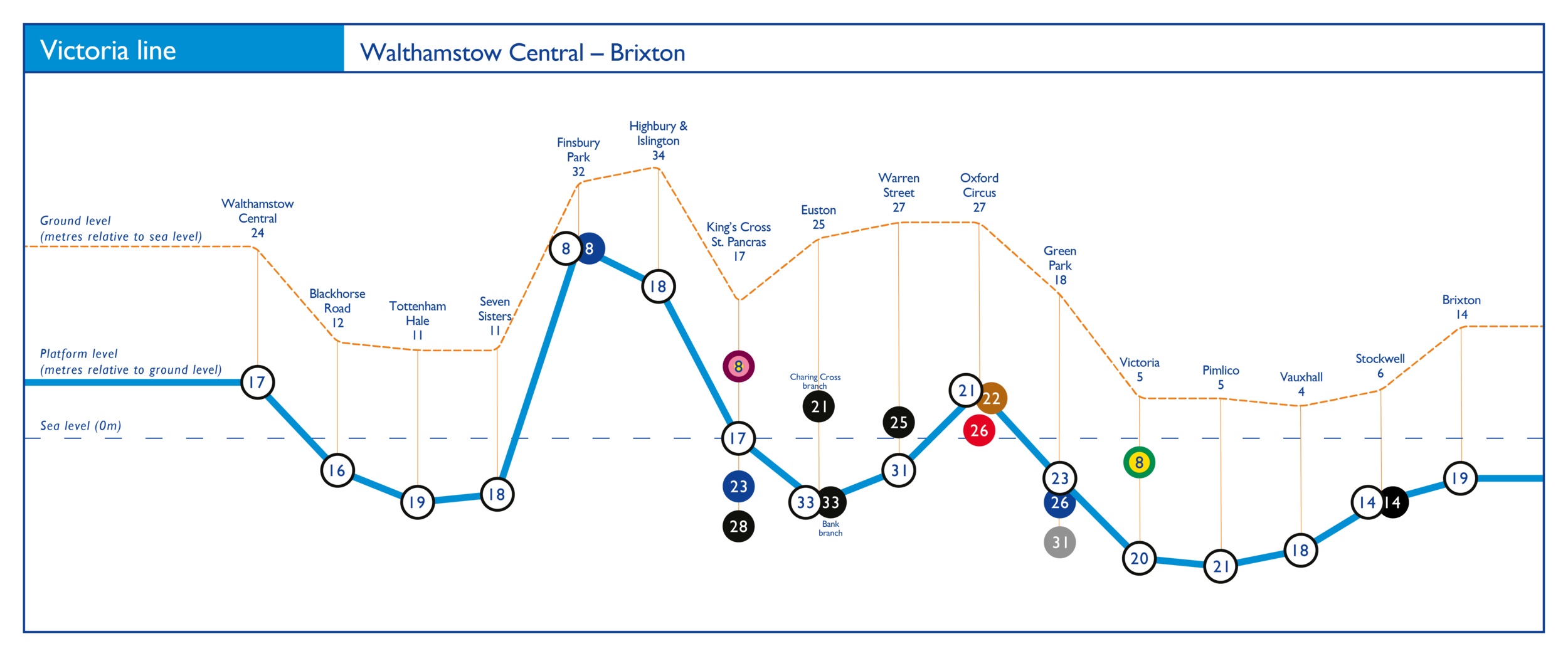 This is amazing. Daniel Silva has created a series of maps showing just how far underground any given station of the London Underground is. Note that the brown dotted line traces the changes in ground elevation, while the blue line below shows the depth of the railway. Some of the lines (like the Victoria, above) maintain a general consistency of depth in relation to the ground, but others don’t. Silva has created a simple representation of what had to have been some very complicated engineering decisions.
the Aspen Tech Solutionism Festival
I have long loved the Atlantic and am proud of my association with it, but every time the Aspen Ideas Festival rolls around my inner Unabomber emerges and wants to burn the entire endeavor to the ground. It’s the only time of year when reading posts in the Atlantic makes me so angry I want to go kick something.
I think I would be okay with it if the shindig had a more accurate name, like the Ideas from Our Technocratic Overlords Festival. Often it seems that there are no ideas at the Aspen Ideas Festival that don’t serve to consolidate transnational technocracy, even the ones that seem to be offering critiques.
Maybe Code for America is reconsidering some of its priorities but it’s still Code for America and its “solutions” inevitably involve deepening people’s dependence on Big Tech. (“We can give you a texting tool that allows you to text with people and it’s been shown to decrease the rates of failure to appear.”)
Is there a crisis of affordable housing in Silicon Valley? Indeed there is. So let’s see what Google can do about it!
This is how it goes, session after session, year after year.
My recommendation: stop calling it an Ideas festival until at least two or three ideas featured there don’t defer to, appeal to, or consolidate the authority of, the world’s biggest technology corporations.
I’m exaggerating, of course. There are always a few sessions about “sustainable development” and “rethinking nutrition” and “civic engagement.” But nine times out of ten there’s an app for that — and, probably, an accelerated Master’s degree at a mid-tier university for only $80,000, please click through to apply for a loan.
For those of us who think there are interesting non-smartphone-connected ideas to be had about family, or faith, or poetry, Aspen is the one place you don’t want to be this summer, or any other.
memory and invention
In her book The Craft of Thought, Mary Carruthers identifies the purpose of memorization in medieval intellectual culture:
The orator’s “art of memory” was not an art of recitation and reiteration but an art of invention, an art that made it possible for a person to act competently within the “arena” of debate (a favorite commonplace), to respond to interruptions and questions, or to dilate upon the ideas that momentarily occurred to him, without becoming hopelessly distracted, or losing his place in the scheme of his basic speech. That was the elementary good of having an “artificial memory.” …Today people will tell you that memorization is the enemy of creativity; these medieval thinkers understood that precisely the opposite is true: the more you have memorized the greater will be your powers of invention.I repeat: the goal of rhetorical mnemotechnical craft was not to give students a prodigious memory for all the information they might be asked to repeat in an examination, but to give an orator the means and wherewithal to invent his material, both beforehand and — crucially — on the spot. Memoria is most usefully thought of as a compositional art. The arts of memory are among the arts of thinking, especially involved with fostering the qualities we now revere as “imagination” and “creativity.”