



exegetical puzzlement
Much of Paul Baumann’s review of Ross Douthat’s new book is devoted to intra-Catholic disputes that I won’t presume to adjudicate, but there’s one passage that strikes me as extremely odd:
Douthat is right about Jesus’ intransigence regarding marriage in Mark’s Gospel : “What God has joined together, let no one put asunder” (10:9). Matthew, however, finds this teaching too hard, and exercising his authority as an Apostle, an authority conferred by Jesus, grants an exception for “unchastity” (5:32; 19:9).Now, the passages Baumann cites are from extended teachings by Jesus. So Baumann’s interpretation of those passages is that when Matthew claims to be reporting what Jesus said, what he’s actually doing is presenting his own teaching about marriage — but that’s okay because his authority to do so was conferred on him by Jesus. Which is one of the more peculiar bits of exegesis I have ever come across.
Madonna della Misericordia
[caption id="" align=“aligncenter” width=“2500”] (click image for more details)[/caption]
brain
[caption id="" align=“aligncenter” width=“1233”]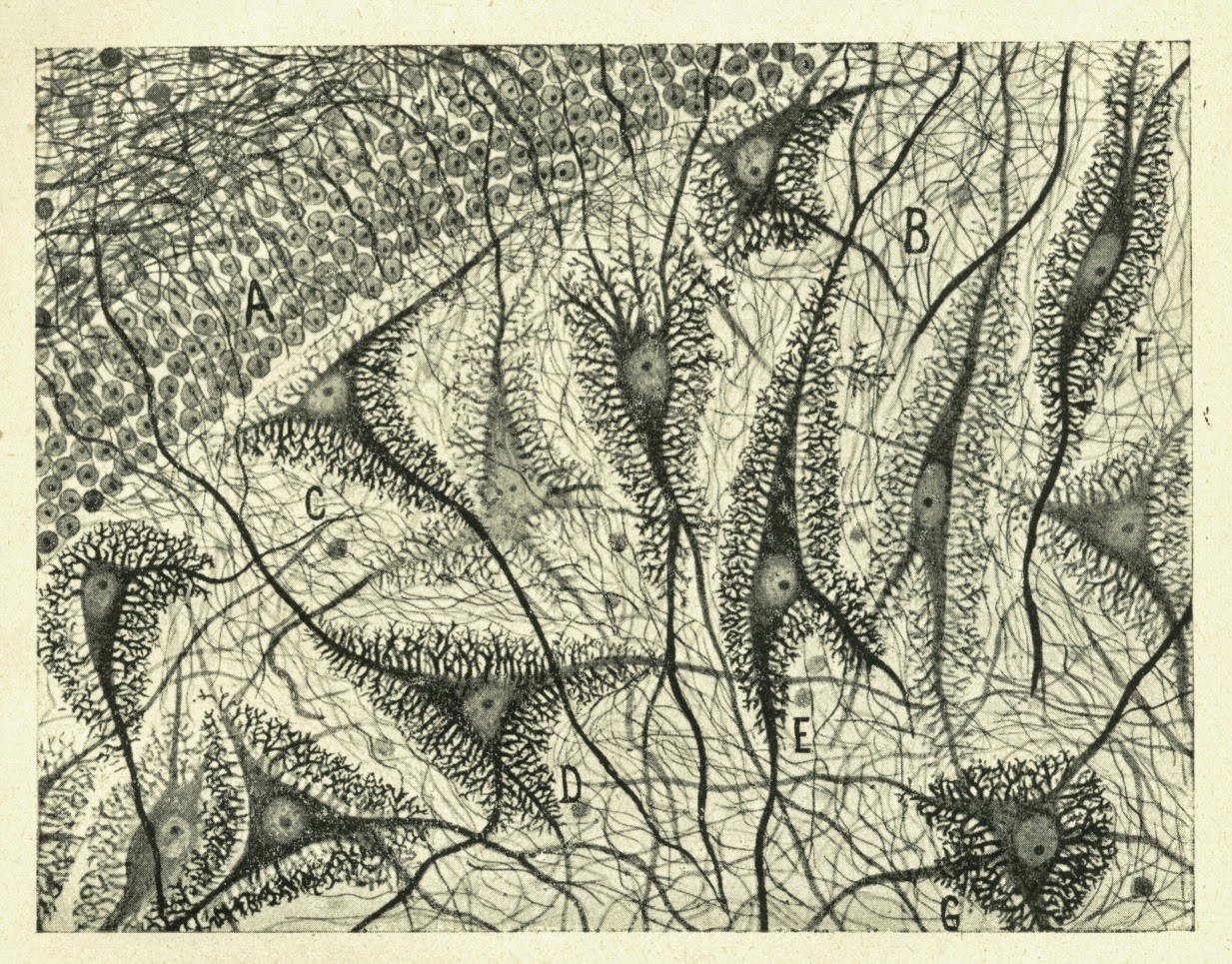 A drawing of neurons by Santiago Ramón y Cajal (click photo for more information)[/caption]
the Berlin sketchbooks of Keir Edmonds


[caption id="" align=“aligncenter” width=“750”] (click an image for more information)[/caption]
Annihilation
The best thing about Jeff Vandermeer’s Southern Reach Trilogy is its uncompromising weirdness — its straightforward facing of the possibility that, should we ever make contact with an alien intelligence, that intelligence might be so alien that we simply cannot understand it at all, in any way — that its motives (if it has “motives”) and its technology (if it has “technology”) could be so utterly disconnected from what we think of as motives and technology as to be utterly inscrutable. The movie Annihilation is pretty weird at times, but not nearly as weird as its source material, and its steady domestication of that material takes the edge off the story. In the moments that it embraces the weirdness, it’s memorable, but there aren’t very any such moments. It’s okay; but no more than okay.

engagement 24/7
I’ve talked about this before, in bits and pieces, but just for the record: My wife Teri and I believe that our calling as followers of Jesus Christ is to tend to the seamless garment of life — our understanding of which I’ve tried to describe in some detail here — and we try to back that up in various ways. Teri does more of this than I do: she tutors a middle-schooler who lives in poverty and a broken home, and has been supportive of Waco’s immigrant population. In addition to tithing to our church, we have contributed to Sandy Hook Promise and are members of the Nature Conservancy. But we also are strongly, passionately pro-life in the everyday use of that term, so we also support, among other like-minded organizations, Anglicans for Life.
All that by way of context.
Yesterday we were watching one of our favorite shows, The Starters on NBA TV, and to our surprise were treated to a little in-show infomercial for Planned Parenthood … and our hearts sank like stones. Now you may adore PP — and if so, there’s no need to tell me why, I’ve heard it all before — but just understand: in our view, there’s no nonprofit organization in America that does as much harm as PP. (The NRA doesn’t come within miles of it, though, speaking more objectively, it may be the only nonprofit that’s more controversial than PP). So we were no longer in the mood to enjoy funny banter about basketball; we turned off the TV, and may not watch the show again. Time will tell. We’re not the boycotting type, but that was a serious annoyance.
Later on I was thinking about my reaction, and recalled the recent absurd kerfuffle about that arose when some Fox News yammerer chastised NBA players for their political activism and told them to shut up and dribble. I asked myself: How am I any different? Am I not saying to The Starters, “Shut up and make basketball jokes"?
I’ve been turning over the question in my mind, and I think there is a difference. As it happens, when players like LeBron James speak out about racism in America I almost always agree with them, but even if I didn’t, their views don’t alter my experience of the game they play. (The same is true of NFL players kneeling during the national anthem, though I don’t watch the NFL. If I did, I could just wait until kickoff to turn the TV on.) Similarly, I don’t care whether the chef at my favorite restaurant has totally different politics than mine, nor am I interested in what charities he or she supports.
But if that chef came out between the appetizer and the entrée to explain what charities she supports and to press me to support them too, I would be pretty pissed off (even if I supported those charities myself). If LeBron could call a time out in the middle of the third quarter, grab a microphone, and give the audience a lecture about Black Lives Matter, I would be seriously annoyed (even if I were a fervent supporter of BLM).
So that was my problem with what happened on The Starters. I would never try to find out what charities the hosts of a show I watch supports or what their politics are, and if I happened to find out I wouldn’t stop watching the show. But for them to use show time to cheerlead for one of the most controversial, one of the most widely despised, nonprofits in America — that strikes me as a violation of the implicit contract between the entertainers and the audience. And once that implicit contract is violated, then there’s no way to know whether or not it will become a regular feature — which is why I may not be watching the show again.
But here’s the thing: what I have called "the implicit contract between the entertainers and the audience” no longer holds, at least not generally. The infiltration of every corner of culture by politics, of every former site of pleasure by culture wars, is nearly complete now. I have no doubt that The Starters see promoting their politics on the show as a mark of seriousness, a mark of true virtue, and will therefore be pleased rather than chagrined by any pushback they get.
If you don’t want to be engaged in the struggle 24/7, your only refuge now — if you’re lucky — is your dreams.
farewell to Twitter?
(Cross-posted, with edits, from Text Patterns)
A few weeks ago I deleted my private Twitter account — it was a good way to keep up with friends, but I found it impossible to control it (via disabled RTs, muted strings, etc.) well enough to prevent the frustration from exceeding the pleasure. That left me just with my public account, which I have been using primarily for linking to my own writing (e.g. blog posts like this one) and to cool things I’ve read by others. But I really really want to be out of the Twitter ecosystem completely — for obvious reasons: everybody knows that Twitter is horrible, there’s no need to belabor that point — so I have now deleted the public account too.
My chief concern with being off Twitter altogether is that I’ll be unable to provide a signal boost to people who are writing or making interesting things that other folks might not notice — and for that reason I could, I must admit, come back. So when Twitter notifies me, 29 days from now, that my account is about to be deleted, I might have a moment of weakness and log back in. (Twitter does prompt you when your account is about to be deleted … doesn’t it?)
I am aware, of course, that most people who read this blog get to it via my Twitter links, so I am perhaps making myself more marginal than ever. Who will even see this post? But if you happen to see it, and want to see more, please try RSS. It’s great. Most of the cool things I read or see are posted here, or on Text Patterns, or on my Pinboard page. And all of those have RSS feeds.
P.S. Have I written before about quitting Twitter? Have I quit Twitter before? Yes on both counts. I am pathetically irresolute.
UPDATE (a few days later): Several people emailed me pleading with me to come back to Twitter, just for linkage. I guess for a great many people RSS is just a foreign technology. And since I can set up automatic posting to Twitter, why not? So that little experiment didn’t last long….