
religion and public life revisited
I’m late to this party, but there’s something to be said for taking time to think things over. The already-much-discussed book review in First Things by Romanus Cessario, in which Cessario defends the kidnapping of a Jewish child by Pope Pius IX, raises many important issues, and I want to focus on just one of them here. But first some clarifications.
First of all, there can be no question that Cessario is not simply defending Pio Nono’s action within the context of the governance of the Papal States, but is also laying down a more general principle. Thus:
No one who considers the Mortara affair can fail to be moved by its natural dimensions. It is a grievous thing to sever familial bonds. But the honor we give to mother and father will be imperfect if we do not render a higher honor to God above. Christ’s authority perfects all natural institutions — the family as well as the state. This is why he said that he came bearing a sword that would sunder father and son. One’s judgment of Pius will depend on one’s acceptance of Christ’s claim.The lesson is clear: If you accept Christ’s claim, you will support Pius’s decision; if you do not support Pius’s decision, then you are ipso facto denying, or at the very best questioning, “Christ’s claim.” Cessario reaffirms this view when he says, in his last paragraph, “Those examining the Mortara case today are left with a final question: Should putative civil liberties trump the requirements of faith?” Civil liberties are merely “putative”; Pio Nono acted in accordance with the requirements of faith. He could do no other and be faithful to his vocation and his office. And the “claim of Christ,” and the consequent “requirements of faith,” surely do not change from time to time and place to place. (Note that Cessario does not have any questions to pose to those who support Pio Nono’s actions.)
A second point of clarification: As Robert T. Miller points out in this post, that Edgardo Mortaro was Jewish is culturally significant, in that time and place and perhaps in ours as well, but theologically not to the point. For doctrinally speaking what underlies Pius’s action was not the fact that Mortara was ethnically Jewish but the fact that his family was not Catholic.
The operative assumption in Cessario’s argument is not that the child’s parents were Jewish but that they could not reasonably be expected to give the child a Catholic upbringing and education. Hence, if it is right to terminate the custodial rights of Jewish parents if their child somehow gets baptized, it will be right to do the same to parents who are pagans, Muslims, Hindus, Buddhists, atheists, or — it certainly seems — Protestants and even fallen-away Catholics. I don’t deny that, as a historical matter, the Mortaras were treated so badly because they were Jewish — of course, they were. I mean only that Cessario’s argument to justify Pius’s actions in the case would, by its terms, apply to many parents other than Jewish ones, and it helps in keeping the analysis clear to think in the broader terms in which that argument is cast.Miller concludes his post by asking Rusty Reno, the editor of First Things, to “disavow the position Cessario takes on the Mortara case and to reaffirm the journal’s historical commitment to the freedom of religion as understood in liberal states.”
Writing in response, Rusty very straightforwardly does the former: “The Edgardo Mortara episode is a stain on the Catholic Church. Whatever one thinks about the efficacy of baptism, forcibly separating a child from his parents is a grievous act. And even if one can construct a theoretical rationale for doing so, as Romanus Cessario does, it was wildly imprudent of Pius IX to take Edgardo from his parents, given the scandal it brought upon the Catholic Church, a scandal that continues to this day.” The latter request he does not explicitly address, though much of his post does so implicitly.
However, Rusty certainly does not apologize for running Cessario’s review. He argues rather that “Cessario, however, wants to challenge me. I must not imagine complacently that my natural moral sentiments and the modern liberal principles I endorse will always happily correspond with the demands that flow from ‘the reality of the Lord’s things.’” He adds, further, that “Cessario, a priest, is perhaps more perceptive that I am about our spiritual challenges” — which, for what it’s worth, I do not read as a qualification of his repudiation of Pius’s action, though I suppose some have taken it as such.
Rusty goes on, quite movingly, to describe his own family situation: his wife is Jewish and his children have been raised as Jews, and going to church alone has been his portion for many years now. So in this light you can see what he means, and that what he means is quite powerful, when he says that Cessario wants to challenge him.
And yet, it should be said — and I hope I can say it without seeming to minimize the painful complexities that Rusty has experienced — that the challenge that Cessario poses to people who, like Rusty, already believe that the Pope stands at the head of the One True Church is different, and less offensive, than the challenge it offers to non-Catholic Christians; and that challenge is less scandalous still than the one Cessario poses to non-Christians — primarily, though not only, Jews.
Which leads me, finally, to the one point I want to make. Imagine that I, an Anglican, were the editor of First Things, and I published an essay by a priest of the Church of England arguing that Elizabeth I was perfectly justified in carrying out her lengthy persecution of English Catholics, since she was ordained by God as His royal servant implementing the True Biblical Faith in England, and the Roman Catholic Church by contrast is the Whore of Babylon as described in the Revelation to John. Imagine further that I responded to criticism by saying that I don’t agree with that argument but find that it challenges me in salutary ways. Would Catholic readers of the magazine be mollified by that explanation? I suspect not — even if my wife were a Catholic and my children were being raised in that communion.
Of course, the real-world First Things would never run such an essay, any more than it would run an essay by a Muslim arguing that the right and proper place of Christians and Jews in the world is dhimmitude under a restored Caliphate, or one by a Jew arguing that Christianity in all its forms is necessarily and intrinsically anti-Semitic and should therefore be repudiated and marginalized by all right-thinking people. As I have noted several times on this blog and elsewhere, the Overton window of acceptable positions for First Things articles has been moving for several years now, but moving in only one direction: towards an increasing acceptance of the claims of the Roman Catholic Church over against other religious communities. Whether it might be defensible for non-Catholics to be in a position of dhimmitude vis-a-vis Catholicism is a question to be asked in the pages of First Things; but the legitimacy of Catholicism is never similarly open to question. For some time now it has been quite clear who at First Things are the first-class citizens and who need to make their way the back of the cabin. And this cannot be surprising, given that the entire editorial staff of the journal, as far as I tell, is Roman Catholic.
Not that there’s anything wrong with that. But the Institute on Religion and Public Life, which publishes First Things, describes itself as “an interreligious, nonpartisan research and educational 501(c)(3) organization.” To what extent can the Institute’s flagship publication be “interreligious” when its entire staff belongs not just to one religion but one communion within that religion? Certain questions about “religion and public life” — First Things calls itself “a journal of religion and public life” — will perforce be explored narrowly and (I think) in limited ways if one religious communion always takes the role of arbiter, if its core commitments are always considered normative while others’ fall under deeper scrutiny.
I have made arguments similar to this one before, and they haven’t been heeded or even acknowledged. But is is precisely because I believe in the stated mission of First Things, and regret its dramatically constrained current understanding of that mission, that I have become involved with Comment, which I believe is trying, in its currently small way, to take up the torch that First Things has, in my judgment, dropped. But I would be very pleased if First Things would pick it up also and we could carry it together.
making life simpler
A great many intellectual positions are obvious and incontestable to people who are ignorant of and incurious about history. That’s why they go to such great lengths to maintain that ignorance.
between vanity and avarice
In studying your own pages I find that the great majority of the names which are quoted as those of important young writers are wholly unfamiliar to me. That will demonstrate how ignorant I am of recent literary movements. I don’t think this is a particularly unhealthy condition for an elderly writer. There are flibbertigibbets who in middle-age attend international cultural congresses and busy themselves with the latest fashions. Few of those are notable for their literary production. A writer should have found his métier before he is 50. After that he reads only for pleasure; not for curiosity about what others are doing. Please do not interpret this as scorn or jealousy of the young. It is simply that they are tastes and achievements are irrelevant to his work.[The middle-aged writer] can contribute either to popular papers or to those of small circulation. In the first case he will find his work mutilated by sub-editors and scrawled over with inappropriate titles, but he will be paid 20 times as much as by a more humane employer. The choice is between vanity and avarice.
— Evelyn Waugh, letter to David Wright, 21 April 1960
the gifts of the Owner of the World
To some of us the Owner of the World has apportioned the gift to tell their fellows that the time to get up has finally come. To others He gives the eagerness to rise when they hear the call; to rise with racing blood and put on their garbs of war and go to the boundary of their town to engage the invading enemy boldly in battle. And then there are those others whose part is to wait and when the struggle is ended, to take over and recount its story.The sounding of the battle-drum is important; the fierce waging of the war itself is important; and the telling of the story afterwards—each is important in its own way. I tell you there is not one of them we could do without. But if you ask me which of them takes the eagle-feather I will say boldly: the story. Do you hear me? . . .
So why do I say the story is chief among his fellow? The same reason I think that our people sometimes will give the name Nkolika to their daughters — Recalling-is-Greatest. Why? Because it is only the story that can continue beyond the war and the warrior. It is the story that outlives the sound of war-drums and the exploits of brave fighters. It is the story, not the others, that saves our progeny from blundering like blind beggars into the spikes of the cactus-fence. The story is our escort; without it, we are blind. Does the blind man own his escort? No, neither do we the story; rather it is the story that owns us and directs us. It is the thing that makes us different from cattle; it is the mark on the face that sets one people apart from their neighbours.
—an old man, in China Achebe’s Anthills of the Savannah [1987]


The Black Prince of Burgess and Roberts
So: Anthony Burgess, back when he was alive, thought that a movie should be made about Edward the Black Prince and that he should write the screenplay. (Whether he is equally interested in the project now that he is dead I cannot say.) He drafted said screenplay, but nothing ever came of it. But, thought Adam Roberts, if the story cannot be a movie might it not become a novel? So he wrote said novel. (More details here.)
I have now read the novel, and it is remarkable: the imagination of Burgess combined with the imagination of Roberts and inspired technically by the method of John dos Passos in his U.S.A. Trilogy) — with a soupçon of Eliot’s “The Waste Land.” Literary collage: highly imagistic scenes rendered by Camera Eye, March-of-Time-style newsreels, brief character portraits, chunks of sermons. The story of a soldier called Black George is especially powerfully rendered. Roberts captures with precise and sometimes disturbing fidelity that interlacing of deep piety and sheer brutality that we discern when we look closely at the world of Medieval Latin Christendom.
The publication of the book, through Unbound, still needs to be fully funded. You can, and should, support the project by going here and paying the merest pittance. If you do, then I shall pray God to have mercy on your soul. If not….

choice
You can’t understand the place and time you’re in by immersion; the opposite’s true. You have to step out and away and back and forward, through books and art and music, and you have to do it regularly. Then you come back to the Here and Now, and say: Ah. That’s how it is.
But maybe 2% of the people you encounter will do this. The other 98% are wholly creatures of this particular intersection in spacetime, and can’t be made to care about anything else.
You can, then, have understanding or attention. Pick.
Frank Lloyd Wright, draftsman

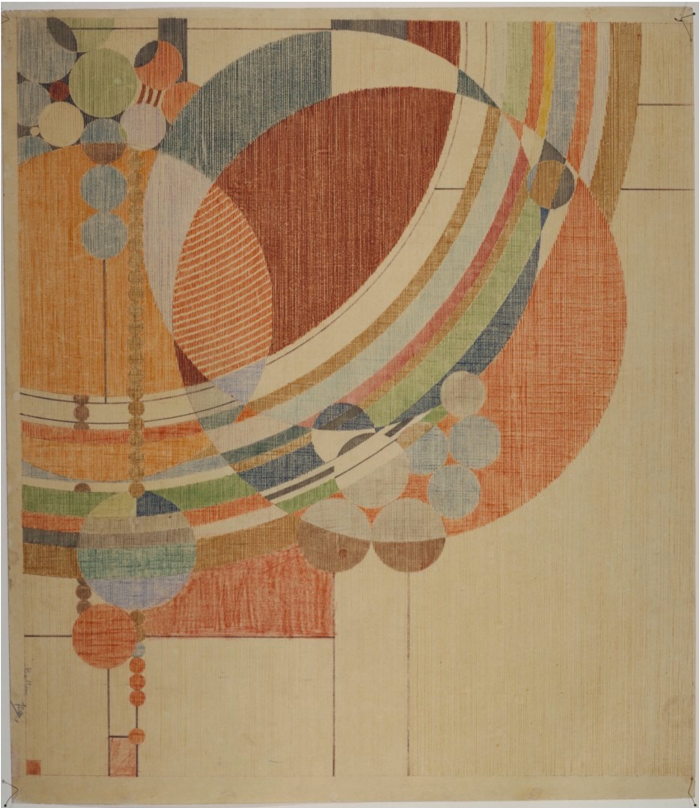

In Huxtable’s biography of Wright she often comments on the beauty and precision of his pencil sketches: all his professional life he started his days by sharpening, with a knife, his colored pencils. These are from Time.