
leaving the Oasis
I’m pretty sure my body has a peculiar electromagnetic field that wreaks havoc on the batteries of electronic devices. Not all of them: all of my iPhones have had more-or-less the advertised battery life. But all of my Mac laptops, going back fifteen years, have gotten around four hours from a charge. No announced improvement in battery power has ever changed that. (I’m typing this on a MacBook that’s supposed to get around 10 hours from a charge under normal use. It gets four. It has always gotten four.) And my Kindles have been even worse — though never quite as bad as my new Kindle Oasis, which promises “weeks” of battery life on a single charge and gets … about two days. And that’s with limited use of the light. Two days.
So I’m sending it back. It’s all boxed up and ready to go, which leaves me, if I want to read on an e-reader, with this old thing:
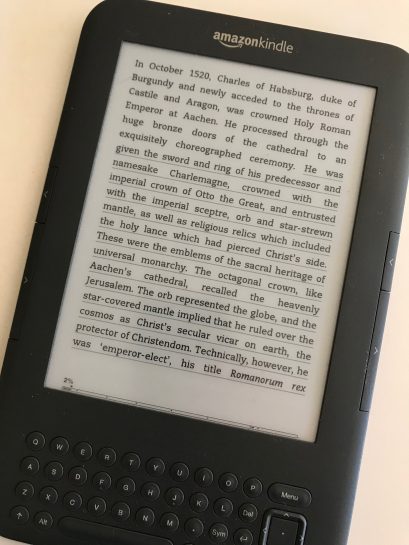
And you know, it’s not bad — not bad at all. Yes, it’s a little heavier and the type isn’t quite as sharp, but it has advantages: no touchscreen, so I don’t have to wipe off prints; a hardware keyboard, which is much more user-friendly for someone like me who actually annotates books; underlining of marked text, which I think more readable and less distracting than highlighting. It doesn’t have a light, of course, but I rarely use the light because I read outdoors a lot and even when reading inside it’s easier on my eyes to read by lamplight.
So maybe I’ll just keep using this device I bought seven years ago — as long as the battery holds out.
Babette the Artist
This is a slightly edited version of a post I published a long time ago at The American Conservative. The original has disappeared — removed, I suspect, by someone who has a different interpretation of Babette than I do. Well, this is another reason for me to own my own turf!
Rod Dreher calls our attention to this post about cooking the central dish from Babette’s Feast. The movie is rightly legendary among food lovers and cooks, partly for reasons specified by J. Bryan Lowder here:
Contrast that with Babette. My favorite scene in the film comes after the last, glistening course has been served, when she finally sits for a moment in the kitchen, her skin dewy from work, quietly sipping a glass of wine. The satisfaction on her face is the kind that can only come from the knowledge that you have created something that sustains both the bodies and the spirits of the people in your care. Indeed, Babette’s story is an argument for the idea that spending money, time, and energy cooking for friends is the best gift a home cook can give, especially if they enjoy themselves so much that they practically forget who’s behind the stove.But: in the great story by Isak Dinesen on which the movie is based, Babette isn’t cooking for anyone else at all. She knows that when she cooks she makes people happy, but that isn’t why she cooks. At the end of the story, when the women who employ her learn that she spent all her savings to buy the ingredients for the magnificent meal they and their friends have just eaten, they are deeply moved. But they get a response from Babette they don’t expect.
Philippa’s heart was melting in her bosom. It seemed that an unforgettable evening was to be finished off with an unforgettable proof of human loyalty and self-sacrifice.Indeed, Babette’s art gives great pleasure to others — but she does not care. How other people feel about her work is a matter of complete indifference to her, because she knows herself to be a great artist and therefore to be utterly superior to them, to be made of different stuff. Lowder writes, “The satisfaction on her face is the kind that can only come from the knowledge that you have created something that sustains both the bodies and the spirits of the people in your care” — but nothing could be farther from the truth for the Babette of the original story.“Dear Babette,” she said softly, “you ought not to have given away all you had for our sake.”
Babette gave her mistress a deep glance, a strange glance. Was there not pity, even scorn, at the bottom of it?
“For your sake?” she replied. “No. For my own.”
She rose from the chopping block and stood up before the two sisters.
“I am a great artist!” she said.
She waited a moment and then repeated: “I arn a great artist, Mesdames.”
Again for a long time there was deep silence in the kitchen.
Then Martine said: “So you will be poor now all your life, Babette?”
“Poor?” said Babette. She smiled as if to herself. “No, I shall never be poor. I told you that I am a great artist. A great artist, Mesdames, is never poor. We have something, Mesdames, of which other people know nothing.”
There is, from our point of view, which is necessarily that of the sisters, something inhuman about Babette. “Philippa went up to Babette and put her arms round her. She felt the cook’s body like a marble monument against her own, but she herself shook and trembled from head to foot.” Lowder believes, and I guess the movie believes, and certainly I believe, in the beauty of a gift that is both given and received in love. But that is not what happens in the story. There Babette loves only her art. That that art pleases us is not, in her view, worthy even of consideration, and when the importance of our pleasure is suggested to her she responds with contempt.
The movie of Babette’s Feast is lovely, I think, but it takes, or can be read to take, Philippa’s view of the matter: “It seemed that an unforgettable evening was to be finished off with an unforgettable proof of human loyalty and self-sacrifice.” It is therefore something of a sentimentalizing of the story on which it is based, which does not care about gift and grace but rather limns the peculiar character of the capital-A Artist.
on evidence and the life of the mind: a follow-up
A twofold follow-up to yesterday’s post:
- Some people have written to ask me what my evidence is for the claims I made in that post. There’s a good bit of general evidence for what American evangelicals believe, as well as what larger populations of young Americans believe; and there have been some excellent in-depth ethnographies of small groups of believers; and some studies over several years of, for example, biblical knowledge among students at one Christian college — that last badly in need of updating. But we don’t have (and probably can’t have, given the work that would be required) large-scale, longitudinal studies of how evangelicalism operates day-to-day, of whether what churches preach and teach match up with what they say they believe, of the degree to which congregants accept that they’re taught in church, and so on.
So I have supplemented those accounts with my experience, over 35 years, of talking with young evangelicals from all around the country (and often from overseas as well) about their upbringing and their church experiences; talking with friends and family about their churches; visiting many churches, evangelical and otherwise, often in the role of guest speaker; and reading a great many first-person accounts online. I don’t have an ideal body of data, but it’s not negligible either.
- In the tweet that kicked this off, Ross Douthat asked specifically about the intellectual life of young evangelicals, so let me say something about that. Mostly, of course, it’s shaped by forces altogether outside of Christianity: as I have frequently commented, our current power/knowledge regime is far better at catechesis than any churches are. But insofar as the Young Evangelical Mind is shaped by forces within Christianity, those almost never involve the local church. The minds of young evangelicals are shaped overwhelmingly by music and stories — I have tried to sketch the emergence of the latter development in this essay. In general, evangelical churches have not understood the intellectual formation of their congregants as part of their mission. As always you reap what you sow — and when you fail to sow….
Ray's Yellow Plane
[caption id="" align=“aligncenter” width=“1920”] Ray’s Yellow Plane (Film Notes), 2013 by Rose Wylie. Photograph: Soon-Hak Kwon/Courtesy the artist and David Zwirner, London[/caption]
where young evangelicals are headed
A long, long time ago, Ross Douthat tweeted this:
Reading this makes me wish for an @ayjay take on what he sees as the trends in young-evangelical intellectual life:https://t.co/lKxxMVPhkh
— Ross Douthat (@DouthatNYT) September 26, 2017
I’ve been thinking this over. I may not be as well-placed to answer that question as I was when I taught at Wheaton College — Baylor is a much more religiously diverse institution — but then Wheaton was not exactly representative of the people who now call themselves evangelicals, so maybe I have a clearer view from Waco?
Anyway, as far as I can tell, where young evangelicals are headed is simply out of evangelicalism. They have been, as Jared C. Wilson recently wrote, theologically and spiritually orphaned by pastors and other Christian leaders who were willing to entertain them and occasionally to hector them but who had no interest whatsoever in Christian discipleship. Millions of today’s young evangelicals have been utterly betrayed by a generation of pastors who could pontificate about how essential sexual purity is while simultaneously insisting that every real Christian should vote for Donald Trump, supporting their claims by a random handful of Bible verses wrenched from their context and utterly severed from the great arc of biblical story without which no piece of scriptural teaching can make sense. As I noted here, they cannot even distinguish a penitent from an impenitent sinner — that is how thoroughly they have emptied themselves of moral and spiritual understanding.
And yes: betrayed is precisely the word. A great mass of many* evangelical leaders have betrayed their young followers and congregants — and, equally, betrayed the theological and spiritual inheritance they received from their mothers and fathers in the faith. They exchanged a rich and truly evangelical birthright for a cold pottage of vague moral uplift and cultural resentment. Verily, they have their reward.

So if young evangelicals are leaving evangelicalism, where are they going? Not many, I think, will head for complete unbelief, but some will; a great many will drift further and further into moralistic therapeutic deism, which will offer them very little but, on the plus side, will ask even less from them; a smaller but still significant number will head for the older liturgical traditions, either for aesthetic or theological reasons.
There will of course continue to be vibrant congregations that define themselves as evangelical, but fewer and fewer as the years go by, I think. Most churches that would claim the label have abandoned their historic mission, and the historic Christian faith, no matter what their explicit theological formularies might say. (This, for instance, is simple idolatry, served up straight, no chaser.) As my old friend and long-time colleague Mark Noll has long contended, evangelicalism at its heart a renewal movement within orthodox Christianity, and such renewal will continue — but not in the forms that some of us have grown accustomed to over the past half-century. Renewal will need to find new strategies, new institutions. Some corpses can’t be revived.
UPDATE: See follow-up post here.
*Edited to avoid association with the phrase “the great mass,” typically meaning “a substantial majority.” Thanks to Ted Olsen for the heads-up.
Auden adapted
The desires of the heart are as crooked as corkscrews, Not to be born is the best for man; The second-best is a formal order, Tweet, tweet, for the figure is easy, The tune is catching and will not stop; Tweet till the stars come down from the rafters; Tweet, tweet, tweet till you drop.
Hazlitt hating
In private life do we not see hypocrisy, servility, selfishness, folly, and impudence succeed, while modesty shrinks from the encounter, and merit is trodden under foot? How often is "the rose plucked from the forehead of a virtuous love to plant a blister there!" What chance is there of the success of real passion? What certainty of its continuance? Seeing all this as I do, and unravelling the web of human life into its various threads of meanness, spite, cowardice, want of feeling, and want of understanding, of indifference towards others, and ignorance of ourselves, — seeing custom prevail over all excellence, itself giving way to infamy — mistaken as I have been in my public and private hopes, calculating others from myself, and calculating wrong; always disappointed where I placed most reliance; the dupe of friendship, and the fool of love; — have I not reason to hate and to despise myself? Indeed I do; and chiefly for not having hated and despised the world enough.
— William Hazlitt, "On the Pleasure of Hating" (1826)
the enlightenment of books
I think all the time about alternative ways of organizing my books, but am always thwarted by the fact that some are at home and some at the office. Probably what I’m most looking forward to about retirement is having all my books in one place. (But that may be what my wife is least looking forward to.) I think at least half of the Kindle books I own I bought because that was easier than getting into the car and driving to the office where I already had a codex copy. I cherish the fantasy that when I finally have all my books in the same building, and discover the ideal way to organize them, then all the chaos of my mind will resolves itself in a single great orderly pattern, and all the connections I have failed to make over the years will suddenly snap into place, and everything I have so persistently proved incapable of understanding will reveal itself in a moment of perfect clarity and unity. And then I will sit cross-legged in the midst of my books smiling like a Buddha. Enlightenment at last.
Verticals
[caption id="" align=“aligncenter” width=“1600”] Anni Albers, With Verticals (1946)[/caption]
the poison of consequentialism
From this conversation:
Rebecca Traister: ... the argument for keeping Clinton ... was in part that the power he wielded could theoretically shore up or increase the very set of policies and protections that are supposed to ameliorate the gender-imbalanced conditions that make sexual harassment so pervasive, i.e., it was to some degree a compromise on a feminist issue designed specifically to further a feminist agenda. I don’t think there’s the same moral symmetry with Trump voters: that they’ll vote for a man who spews open racism or is accused of groping women specifically because they think that if elected, he’s going to strengthen defenses for women or for people of color; in some cases, the opposite. This week, Kellyanne Conway said that voters should pick Moore because he’ll help pass the tax bill. Is there a line of logic that says that voters upset about pedophilia charges should vote for the accused pedophile, despite their distress, because a lower corporate tax rate would lead to a systemic reduction of child abuse?
Ross Douthat: It’s not precisely the same, but many of Trump’s supporters framed it as “we’re compromising Christian values by electing a man who doesn’t live up to them, because that’s the only way in order to further a Christian agenda on abortion or religious liberty.” There’s some overlap with your view of how feminists thought about Clinton there.
You know what both of these arguments sound like to me? "It became necessary to destroy the town to save it."
Or consider this story that Rod Dreher recounted the other day:
Back in 2002, I interviewed a Catholic woman who had been blackmailed by her confessor into having an affair with him, even though she was married. She finally broke down psychologically, and sought professional help from a psychiatrist who was known to be a faithful Catholic. (I interviewed him too, and he confirmed her account.) When she and her psychiatrist went to the local bishop (who is now dead, by the way), the bishop told her he had sent the priest away overseas (as he had — that I confirmed), and that if she pursued charges against the offending priest, or made his abuse public, then he, the bishop, would be forced to go after her publicly for her messy past.She quoted him as saying, “I have to protect the people of God.”
Protect the people of God ... by destroying this woman who is one of the people of God. As I have suggested in a different context, consequentialism poisons character.