
two minutes
The horrible thing about the Two Minutes Hate was not that one was obliged to act a part, but, on the contrary, that it was impossible to avoid joining in. Within thirty seconds any pretence was always unnecessary. A hideous ecstasy of fear and vindictiveness, a desire to kill, to torture, to smash faces in with a sledge-hammer, seemed to flow through the whole group of people like an electric current, turning one even against one's will into a grimacing, screaming lunatic. And yet the rage that one felt was an abstract, undirected emotion which could be switched from one object to another like the flame of a blowlamp.
— George Orwell, Nineteen Eighty-Four
free speech ≠ chronic stress
The articles Barrett links to are mostly about chronic stress — the stress elicited by, for example, spending one’s childhood in an impoverished environment of serious neglect and violence. Growing up in a dangerous neighborhood with a poor single mother who has to work so much she doesn’t have time to nurture you is not the same as being a college student at a campus where [Milo] Yiannopoulos is coming to speak, and where you are free to ignore him or to protest his presence there. One situation involves a level of chronic stress that is inflicted on you against your will and which really could harm you in the long run; the other doesn’t. Nowhere does Barrett fully explain how the presence on campus of a speaker like Yiannopoulos for a couple of hours is going to lead to students being afflicted with the sort of serious, chronic stress correlated with health difficulties. It’s simply disingenuous to compare the two types of situations — in a way, it’s an insult both to people who do deal with chronic stress and to student activists.
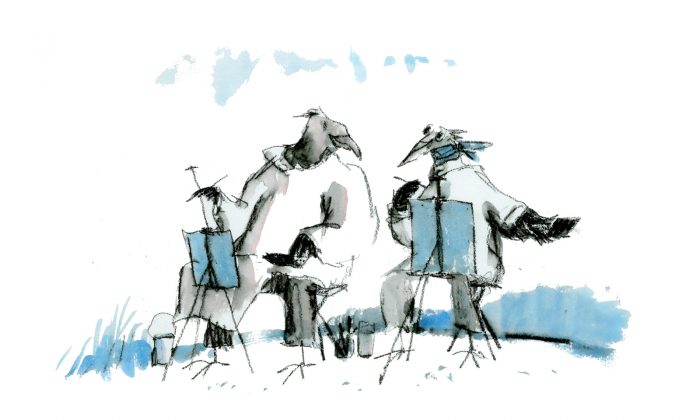


Cheri Smith, The Art Room Stone (2016); watercolour on paper, 504 × 666 mm
sacraments
I often think I’m the only person in the world who cares about this, but … here’s a very nice piece on dystopian fiction that uses the terms “sacrament” and “sacramental” far too loosely. It’s an unfortunately common trope (especially but not only among Christians) to use “sacramental” as a synonym for “meaningful” or “comforting” or “reassuring.” Experience or objects can be deeply meaningful, even life-transforming, without being sacramental. Sacrament requires not just meaning but the divine promise of meaning: the Eucharist is a sacrament because God promises to be present in it. And the same is true of the other sacraments. Where there is no promise, there is no sacrament, though for the attentive person there will often be deep meaning.

Claremont-McKenna statement
In the aftermath of the blockade on April 6, the College learned important lessons that must further strengthen our resolve. Our Athenaeum must continue to invite the broadest array of speakers on the most pressing issues of the day. Our faculty must help us understand how to mitigate the forces that divide our society. Our students must master the skills of respectful dialogue across all barriers. Our community must protect the right to learn from others, especially those with whom we strongly disagree. And Claremont McKenna College must take every step necessary to uphold these vital commitments.
— here
Handy-Dandy Benedict Option Flowchart
I see Rod is still engaging his critics, and now we’re into the deep weeds of just how important Obergefell is or is not for the future of American Christianity, something about which I don’t have any firm opinion. I wonder whether it might not be possible to simplify the issues at stake a bit, and in that cause I have prepared the following chart. You’re welcome.

civility rethought
What contemporary theorists of civility can and should take away from [Roger] Williams is his recognition of the inevitable disagreeableness of disagreement.... Faced with a heated disagreement, both participants and observers find it difficult to separate the condemnation of another’s position and contempt for her person. It’s precisely this difficulty that we call upon the virtue of “civility” to alleviate.If we think all of the ethical work remains to be done by others, that our opponents alone are the uncivil ones, we are mistaken. As long as we are determined to trace every difference of opinion to some aspect of identity or perspectival privilege, we will continue to win arguments by proclaiming our own epistemic authority and to refute our opponents by impugning theirs. In the face of this politics of purity and the resultant proliferation of ad hominem, Williams reminds us that responses other than ostracism and outrage are possible, while providing a model of how coexistence and cooperation might work.
late-career Papacy: two models
It strikes me that the future of the Roman Catholic Church in my lifetime, and perhaps well beyond, may largely be determined by which of his two predecessors Pope Francis takes as his model for the final stage of a papacy. For John Paul II, the increasing frailty and illness of his last years were almost a sacrament: an outward and visible sign of an inner radical dependence on God. (“Though he slay me, I will yet trust in him.”) For him, the public bearing of affliction was a necessary consequence of the burden he had taken on when he assumed the seat of St. Peter. For Benedict, by contrast, those burdens were to be set aside when honest self-reflection told him he could no longer stand under them.
I am not interested in judging either choice – indeed, only God can do that – but rather merely in pointing out that if Francis follows John Paul’s model he could be Pope for a very long time, and therefore, even if (or especially if) he gradually turns over more and more decisions to his subordinates and allies, could reshape the Church so thoroughly that it is hard to imagine how it could be set back on the path that both John Paul and Benedict set it on. Conversely, if he follows Benedict’s model and resigns – which it has been reported he has occasionally said he would do – then there is at least a chance for the next conclave to engineer a reversal of course.
I do not know whether any Pope has ever made a more significant decision than the one that Francis will make about how his papacy should end. And it is deeply ironic that a decision must be made only because of a dramatic innovation by that great traditionalist, Benedict.
Sinaia Monastery
[caption id=“attachment_34274” align=“aligncenter” width=“700”] Sinaia Monastery, Romania; interior of the Old Church (finished in 1695); by Flickr user fusion-of-horizons[/caption]