
remix? culture?
“Everyone can see it,” she told me. “It’s identical except for the signature. I was very shocked. Someone just took my hard work.” Devins, however, is perturbed by the suggestion that he stole anything. “I look at it, really, as an after-the-fact collaboration between an urban planner and an artist,” he told me.
— Remix Culture Nears Its Logical Conclusion. The whole plagiarism/remixing debate is really complicated, but when you take someone’s work without telling them, editing out their name and replacing it with yours, and then call it “an after-the-fact collaboration,” you should definitely be tarred and feathered and ridden out of town on a rail.
all hat, no cattle
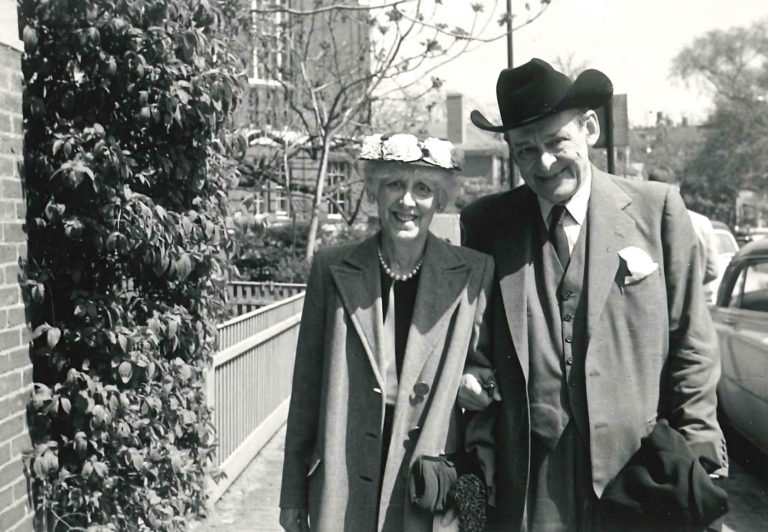
T. S. Eliot and his sister Marion, during Eliot’s 1958 visit to the U.S. with his new wife Valerie. At one point in the trip they visited Dallas, where Eliot was named an honorary sherriff and received both a badge and the Stetson he’s sporting here.
life in Texas
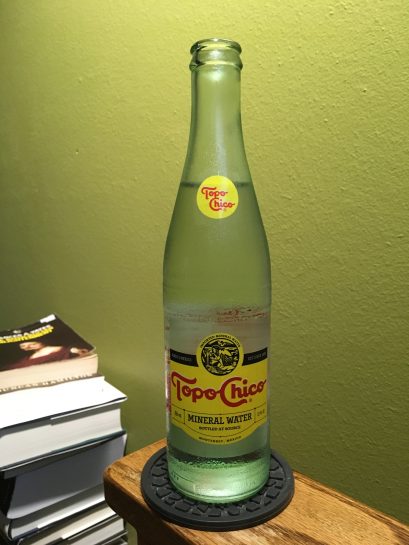 Just enjoying my usual tableside refresher here as Teri returns from H-E-B, where she bought another case of this life-giving substance. When she was grabbing the case an elderly man next to her said, “I had my first Topo Chico in Mexico. In 1972. Been drinking it ever since. Mama and me don’t drink sodas, but we have some Topo Chico every day.” Teri noticed that he was slim and trim and had beautiful skin. “Can I introduce you to Mama?” His wife, of course. She beamed at the mention of Topo Chico. “We met on that same trip,” he said.
I love living in Texas, I really do.
The BCP and me
I’m pretty happy with my biography of the Book of Common Prayer. It has some typos and other embarrassing errors that didn’t get caught in the editing process, and I wish I could fix those; but overall, I think I did a decent job of capturing a very complex history in a very small compass, and to make it an interesting story too. The book got largely positive reviews and has sold well, by my standards anyway, and by those of the series of which it’s a part. So all that’s good.
There’s one thing that troubles me, though: Anglicans don’t seem to care about the book at all. Embarrassing admission: when I wrote the book I thought one of the fringe benefits would be the opportunity to go around to churches, and maybe seminaries, to celebrate the inheritance of the BCP and discuss its possible future. But unless I am forgetting something, not one church, or seminary, or diocese — well, let’s be honest here, no one at all has asked my to talk about this book (though I often get asked to talk about other matters, and especially about, well, you know who).
For a while this flummoxed me, but I think I’ve figured it out. Here are my suspicions, laid out in highly general terms:
- Liberal Anglicans aren’t especially interested in the existing BCP or its predecessors because all of those books embody sexist language for God, a heterosexual definition of marriage, exclusivist soteriology, and many other retrograde ideas from which they hope to escape.
- Anglo-Catholics aren’t especially interested in the existing BCP or its predecessors because those books are all deeply implicated in Reformational theologies that the A-Cs would like to ignore or overcome.
- Evangelical Anglicans aren’t especially interested in the existing BCP or its predecessors because they want to reach people they think might be alienated or confused by formal language and liturgy.
Michael and Jemele
Just for the record, this old socially conservative white guy thinks Michael Smith and Jemele Hill are the best thing that’s ever happened to SportsCenter. I never watched the early installment, and now I watch it every day. Jemele and Michael are smart and funny and have a remarkably wide tonal/emotional range, and are therefore infinitely preferable to the business-suited cheerleaders who usually populate ESPN’s news shows.
hurt the people first
Among the many takes I’ve read on yesterday’s ESPN layoffs, the most incisive, I think, is this one from Tom Ley:
And so today’s layoffs seem to follow a kind of logic: If ESPN is bleeding money from subscriber losses, they need to offset the damage by making cuts elsewhere in the company. That doesn’t, though, really follow, mathematically. Look at the people who have been laid off today. Sure, it’s possible that veterans like McManus and Stark and Ed Werder were carrying hefty salaries, but no amount of fired reporters and columnists is going to put even the tiniest dent in ESPN’s rights fees. Add up all the salaries of the people who lost their jobs today, and how much of a single Monday Night Football broadcast does it buy? Ten minutes? Fifteen?So, then, what was the point? The memo released this morning by ESPN president John Skipper is instructive. It was hollow and buzzword-laden in the precise way that is meant to speak to Disney investors who want to be assured that ESPN is still capable of “navigating changes in technology and fan behavior in order to continue to deliver quality, breakthrough content.” That’s what today appears to have been really about—assuring Disney stakeholders that ESPN is taking things very seriously and is prepared to keep itself lean and competitive. Don’t think too much about how we’re going to continue to pay rights fees with sustained subscriber loss! We’re making cuts! We have a handle on things!
I was still thinking about that post when, this morning, I read Annalee Newitz’s report on the people employed by Google and Leapforce to rate Google’s algorithms. I say “employed by Google and Leapforce,” but the situation is actually more complicated than that: all of the work the raters do is for Google, but they are officially employees only of Leapforce — which has just cut all of the raters working full-time back to 26 hours per week max, in order to avoid having to meet certain expensive conditions laid down by Federal law. Though it’s Google who benefits — and openly admits to benefitting — from these people’s work, Google won’t take them on as employees, even though paying them directly for their work, even at full-time salaries with full benefits, would be less than a drop taken from Google’s fiscal bucket.
Thus we see ESPN/Disney and Leapforce/Google operating on what has become one of the most fundamental rules of our current economic system: When things go badly, hurt the people first.
the great distillery tour!
My former student Gabriel RiCharde is now working for the pride of Waco, Balcones Distilling, and today he gave me a tour. It was really fascinating. I have read a bit over the years about the process of distilling spirits, and I knew that it is complicated — but when you actually get walked through each stage … wow. At every step of the process complex science is involved, but also decisions that require artful intuition.
Here’s a closeup of the door to the mash tun, which was bought from the Speyburn distillery in Scotland, and which has been used to make whisky for about 75 years:

And here’s one of the amazing new stills, just arrived a few weeks ago from Scotland:

And this steampunky thing is attached to the stills — I don’t know what it is, but it looks super cool:

Here’s the tasting and blending room, where I could have stayed for quite some time:

And here the aging process, in barrels made variously of American, French, and other European oak:

And finally, after all that hard work of listening and gaping, I had to take a couple of presents home for myself:

ANNOUNCEMENT: The Charles Murray Award for Inciting the Hatred of People Who Have Never Read a Word You've Written and Never Will
This year’s winner: Rod Dreher!
the absolutizing of fright
In Silicon Valley, current events tend to fade into the background. The Sept. 11 attacks, the Iraq war, the financial crisis and every recent presidential election occurred, for the tech industry, on some parallel but distant timeline divorced from the everyday business of digitizing the world. Then Donald Trump won. In the 17 years I’ve spent covering Silicon Valley, I’ve never seen anything shake the place like his victory. In the span of a few months, the Valley has been transformed from a politically disengaged company town into a center of anti-Trump resistance and fear. A week after the election, one start-up founder sent me a private message on Twitter: “I think it’s worse than I thought,” he wrote. “Originally I thought 18 months. I’ve cut that in half.” Until what? “Apocalypse. End of the world.”
So by the end of 2017 the Earth will be a dead ball of rock spinning through space? Is that the idea? You reply, Obviously not. But if not that, then what?
I have the same questions about the notorious “Flight 93 Election” essay, which says “2016 is the Flight 93 election: charge the cockpit or you die.” And also says, “a Hillary Clinton presidency is Russian Roulette with a semi-auto.” And also says, “we are headed off a cliff.” Later our pseudonymous author says that conservatives will be “persecuted,” will be “crushed,” and under a Hillary presidency America will be “doomed.” But what precisely is he talking about? It’s absolutely impossible to tell. He doesn’t give even a hint.
Under a Clinton presidency, would socially-conservative evangelical Christians like me have been fired from our jobs, driven from our homes, and sent to re-education camps? Would we have been forced to sign some sort of Pledge of Allegiance to the Sexual Revolution, under threat of imprisonment? What?
And if, now that we have a Trumpery presidency, the world won’t literally end, what exactly is it that Manjoo’s texter fears? A nuclear war that renders most of the planet uninhabitable? A further acceleration of global warming? Or a Handmaid’s Tale-style Republic of Gilead? What? Those are very different scenarios, and it would be nice to know just what we’re supposed to be terrified of.
(This absolutizing of fright reminds me of the expanding scope of disasters in superhero comics and movies: People will die! — no wait, a whole city will be destroyed! — A city? Small stuff. The planet will be vaporized! — A mere planet? The universe will disappear in a puff of smoke! — Just this universe? No: all the universes there are or ever were or ever will be! All gone! Save us, O mighty ones!)
Such escalation of rhetoric means the deflation of care. All this pearl-clutching disguised as apocalyptic prophecy is not only intellectually vacuous, it’s counterproductive. You scream long enough and people stop hearing you, you become just another element of the background noise. If you are concerned and want others to share your concern, tell us precisely what you think will happen, why you think it will happen, and how you think it will happen. Otherwise you are merely darkening counsel by words without knowledge.
ANGELS ANGELS ANGELS ANGELS ANGELS

Back in the day (i.e. the 1970s) when I worked in a bookstore, it was fairly common for people to come in and ask, “Do you have Billy Graham’s book Angels Angels Angels Angels Angels?” This cover explains why.