
origins of the Tories and Whigs
The recess of the English Parliament [in 1641] lasted six weeks. The day on which the Houses met again is one of the most remarkable epochs in our history. From that day dates the corporate existence of the two great parties which have ever since alternately governed the country. In one sense, indeed, the distinction which then became obvious had always existed, and always must exist. For it has its origin in diversities of temper, of understanding, and of interest, which are found in all societies, and which will be found till the human mind ceases to be drawn in opposite directions by the charm of habit and by the charm of novelty. Not only in politics but in literature, in art, in science, in surgery and mechanics, in navigation and agriculture, nay, even in mathematics, we find this distinction. Everywhere there is a class of men who cling with fondness to whatever is ancient, and who, even when convinced by overpowering reasons that innovation would be beneficial, consent to it with many misgivings and forebodings. We find also everywhere another class of men, sanguine in hope, bold in speculation, always pressing forward, quick to discern the imperfections of whatever exists, disposed to think lightly of the risks and inconveniences which attend improvements and disposed to give every change credit for being an improvement. In the sentiments of both classes there is something to approve. But of both the best specimens will be found not far from the common frontier. The extreme section of one class consists of bigoted dotards: the extreme section of the other consists of shallow and reckless empirics.
— Macaulay, The History of England from the Accession of James II
the archangel on his bicycle
[caption id="attachment_15841" align="aligncenter" width="788"]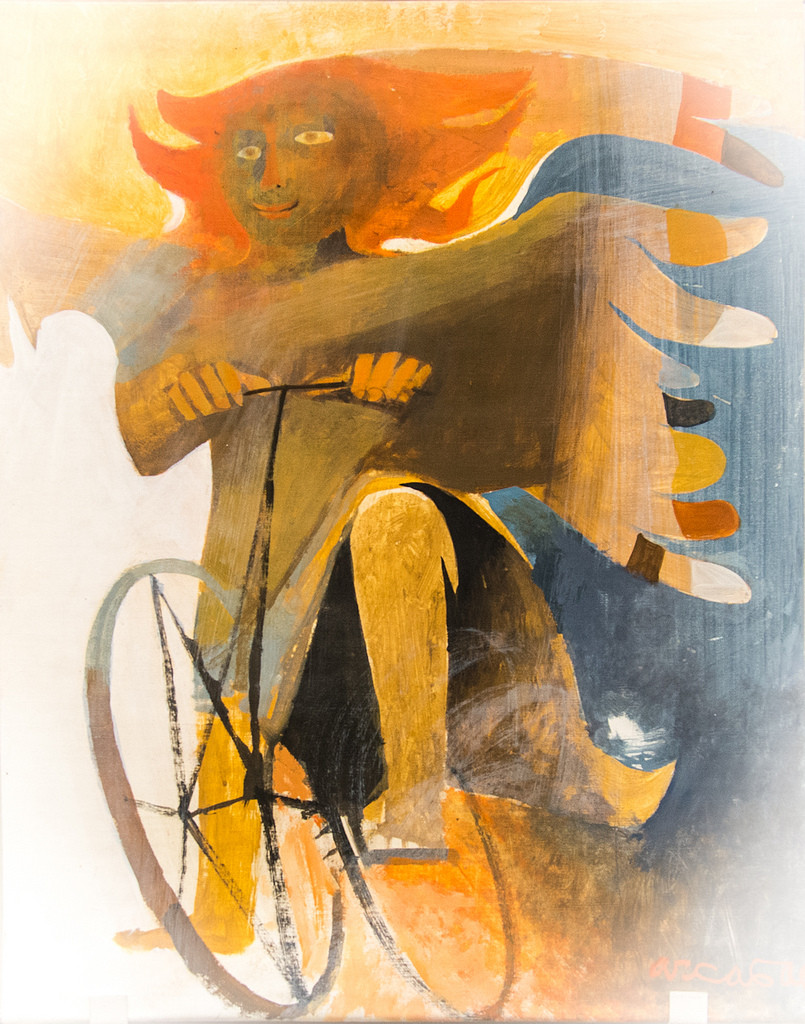 Arcabas[/caption]
young Jesus in the Temple
[caption id="attachment_15837" align="aligncenter" width="545"] Arcabas[/caption]
a painful truth
Prolonged, indiscriminate reviewing of books involves constantly inventing reactions towards books about which one has no spontaneous feelings whatever.
— George Orwell, "Confessions of a Book Reviewer"
McLuhan at Hogwarts
In one of my classes we’re reading McLuhan’s Understanding Media, and today I called my students’ attention to this passage:
Alexis de Tocqueville was the first to master the grammar of print and typography. He was thus able to read off the message of coming change in France and America as if he were reading aloud from a text that had been handed to him…. Tocqueville was a highly literate aristocrat who was quite able to be detached from the values and assumptions of typography. That is why he alone understood the grammar of typography. And it is only on those terms, standing aside from any structure or medium, that its principles and lines of force can be discerned. For any medium has the power of imposing its own assumption on the unwary. Prediction and control consist in avoiding this subliminal state of Narcissus trance. But the greatest aid to this end is simply in knowing that the spell can occur immediately upon contact, as in the first bars of a melody.I pointed out to them McLuhan's implicit claim: that he stands in the same relation to the new electronic age as Tocqueville stood to “typographic man.” He is an acute observer of the world he is describing to us, but not a native of it, and his slight distance is the key to his perceptiveness. I asked them to be especially attentive to his metaphor of “the spell” – and then I told them, “Basically, McLuhan is applying for the position of Defense Against the Dark Arts teacher for our entire culture.”
Most of them looked blankly at me.
snaky codex

This, by Leigh McCloskey, looks like the cover of the visitors’ book at Slytherin House.
political twins
Some of the more aggressive leftist student protestors — these people, for instance, or these — have three things in common with the more aggressive Trump supporters:
- A belief that American society has profoundly victimized them;
- A belief that error has no rights;
- A political strategy that embraces anger, threats, and attempts to bully opponents into submission.
Christian ethics in time of political turmoil
- When a man’s ways please the LORD, he makes even his enemies to be at peace with him. — Proverbs 16:7
- You keep him in perfect peace whose mind is stayed on you, because he trusts in you. — Isaiah 26:3
- But I say to you who hear, Love your enemies, do good to those who hate you, bless those who curse you, pray for those who abuse you. — Luke 6:27-28
- But the wisdom from above is first pure, then peaceable, gentle, open to reason, full of mercy and good fruits, impartial and sincere. — James 3:17
astronomical drawings
[caption id="" align=“aligncenter” width=“540”] astronomical drawings from the NYPL[/caption]
