
LOTR revisited
Isn’t it time to start imagining a remake of Lord of the Rings? Not time to have one just yet, mind you, but time to consider what it ought to be like. I don’t think there’s any question that, whenever it gets made, it’s going to be a post-Game of Thrones version, bleaker, darker, muted in its colors, more violent. I don’t think those are necessarily bad things, though it could be.
I’m thinking Alfonso Cuarón should direct and music should be by Eno. That’s what I’m thinking.
a conclusion and a beginning
Now that the crisis at Wheaton College has been more or less sorted out — though the repercussions will continue to be felt for years, and the lawyerly curse of “confidential agreements” means that we’ll never know exactly how it all went down — what should happen is the beginning of a long period of reflection by all involved.
But that’s not the tone of what I’m hearing — though I can only hope that what I’m hearing is not representative. Because it seems that many of the supporters of Prof. Hawkins are in no mood to forgive members of Wheaton’s administration. In a widely leaked email to the college community, Provost Stan Jones wrote, “I asked Dr. Hawkins for her forgiveness for the ways I contributed to the fracture of our relationship, and to the fracture of Dr. Hawkins’ relationship with the College…. I apologized for my lack of wisdom and collegiality as I initially approached Dr. Hawkins, and for imposing an administrative leave more precipitously than was necessary.” And so on. It’s a very full apology. But I have already read a number of comments from Christians that this apology is problematic because it does not acknowledge Wheaton’s history (and present) of structural racism and sexism.
This kind of response strikes me as uncharitable, unproductive, and shortsighted. And I say this as someone who believes that Wheaton really does have serious problems in knowing how to deal with faculty and students who are not white males.
What if, when a brother in Christ apologizes and asks for forgiveness, one were to grant that forgiveness — instead of immediately criticizing him for not having provided a fully adequate account of the reasons he went astray? What about that as a strategy? It has some advantages:
- It’s a matter of obedience to a commandment: “Be kind to one another, tenderhearted, forgiving one another, as God in Christ forgave you.” And if the response is, “Well of course I forgive him” — no. Forgiveness is never a matter of course. It is too important, and too hard, mere to assume. When asked for and granted, forgiveness should, for a time, be the only air we breathe, we who have been at odds with one another.
- To grant forgiveness to one who has offended against us is to open ourselves to the possibility of our sins against them. We may need to ask for the very benefit we have just granted; if so, it is good for us to know we have that need.
- It is on the basis of forgiveness requested and received that we can then go on to explore, together, the deeper structural causes of our sins against each other. Those who have been reconciled in Christ can be bold in exploring these deeper causes; knowing the peace of reconciliation, we need not fear even the darkest truths.
- To think in this way is to accept that reconciliation that lasts, reconciliation that bears spiritual and moral fruit, is an ongoing process. There is a sense in which the exchange of forgiveness instantly reconciles us to one another; but there is a deeper reconciliation that happens only over a long period of living in one another’s presence (and the presence of the living Christ within us).
So why not see an apology such as this not as the conclusion to something, but rather the beginning of something? President Ryken has asked Wheaton’s Board of Trustees to begin an inquiry into this whole mess, to try to understand how it became such a mess. I think that process is more likely to bear good fruit if those who feel, and especially those who have genuinely been, most wounded by Wheaton are willing to be patient and hopeful and generous-spirited as the inquiry proceeds, not least because God has been patient and hopeful and generous-spirited with all of us.
Virginia Tech and Flint
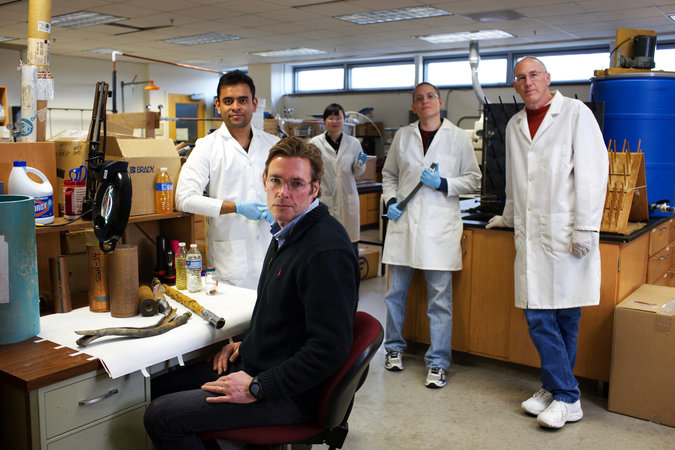
— As Flint Fought to Be Heard, Virginia Tech Team Sounded Alarm. I think every college and university should be asking itself, What are we doing that resembles what Virginia Tech did for Flint? What are we doing to serve people who are neglected or abused by our political regime?
Fripp's fire

That’s one of my favorite images of Robert Fripp. Lately I’ve been listening rather obsessively to a relatively neglected track from Eno’s masterful Another Green World, “St. Elmo’s Fire.” Eno had asked Fripp to come up with an aural equivalent of the dance of St. Elmo’s fire among the masts of a ship — and I’ll be rubbished if he didn’t do exactly that. Technically brilliant, yes, but, more, so wonderfully imaginative.
theorist-consumers
The present age is demented. It is possessed by a sense of dislocation, a loss of personal identity, an alternating sentimentality and rage which, in an individual patient, could be characterized as dementia.As the century draws to a close, it does not yet have a name, but it can be described.
It is the most scientifically advanced, savage, democratic, inhuman, sentimental, murderous century in human history.
I will give it a name which at least describes what it does. I would call it the age of the theorist-consumer. All denizens of the age tend to be one or the other or both….
In the old Christendom, everyone was a Christian and hardly anyone thought twice about it. But in the present age the survivor of theory and consumption becomes a wayfarer in the desert, like St. Anthony; which is to say, open to signs.
— Walker Percy, "Why Are You a Catholic?" (1990)
same old, same old
I had to get to my iPad in order to read Walt Mossberg and John Gruber’s articles about poorly performing Apple software because my brand-new MacBook with the newest version of El Capitan still can’t reliably connect to the internet.
How to Raise a Creative Child?
In adulthood, many prodigies become experts in their fields and leaders in their organizations. Yet “only a fraction of gifted children eventually become revolutionary adult creators,” laments the psychologist Ellen Winner. “Those who do must make a painful transition” to an adult who “ultimately remakes a domain.”— Adam Grant. You're not thinking this through. "Revolutionary adult creators" are by definition fantastically rare. It is not possible to create a world in which artistic and scientific revolutions are happening every day. By all means let's get the elites rethinking the absurd ways they raise their children, but in the process let's not kid ourselves. The fact of the matter is that nothing — nothing — can be done to increase the world's proportion of radically generative minds. If that's your goal you're pipe-dreaming.
it has come
when you cut a red pepper and end up with some sort of malevolent barbershop quartet straight from the hellmouth pic.twitter.com/eWFRA4zFHc
— Timothy Thornton (@HINIONGE) January 24, 2016
Dies iræ, dies illa Solvet sæclum in favilla, Teste David cum Sibylla
Beauty
Beauty demands for itself at least as much courage and decision as do truth and goodness, and she will not allow herself to be separated and banned from her two sisters without taking them along with herself in an act of mysterious vengeance. We can be sure that whoever sneers at her name as if she were the ornament of a bourgeois past — whether he admits it or not — can no longer pray and soon will no longer be able to love.
— Hans Urs von Balthasar, The Glory of the Lord (I:18)
the artist in her place
[caption id="" align=“alignnone” width=“1050”] Louise Bourgeois in her studio, 1974[/caption]