
∞
On the left, Ryan’s getting called a hypocrite. Salon’s Joan Walsh became an instant hero when she claimed Ryan was getting “credit for something a woman could absolutely never ask for.” And several media outlets outright called Ryan a hypocrite — or an “enemy of women” — for asking for family time for himself while opposing federally mandated paid family leave and other policies that liberals believe are important for family support.
This makes no sense. Ryan is identifying a problem that millions of Americans face and shouldn’t have to — and forcing people to acknowledge the problem is the first step to solving it. If you believe parents in two-parent households should share the responsibility of raising a family, it is a good thing when high-profile men acknowledge it’s their responsibility, too — especially when those men represent groups that tend to favor traditional gender roles. And if you believe raising a family shouldn’t impede career advancement, it’s a good thing when someone points out that right now, it still does.
∞
The university was once a microcosm, a miniature world offering the whole of knowledge in a restricted arena. Every discipline represented had its professor who was the supreme local authority on the subject. That supremacy faded long ago as the growth of our great libraries over the last [i.e., the 19th] century brought the world to our door and students found more ways to learn about their subject than to sit and listen to the local professor, but the structure of our institutions of higher learning still reflects that origin. The old model may still be powerful and useful, and we should think carefully about how to adapt it to the future, while remembering that new metaphors can be useful as well.The real roles of the professor in an information-rich world will be not to provide information but to advise, guide, and encourage students wading through the deep waters of the information flood.
James O'Donnell, Avatars of the Word: From Papyrus to Cyberspace, 1998. I have been thinking about this passage since I first read it, about sixteen years ago.
∞

[gallery] via Adam Roberts


∞
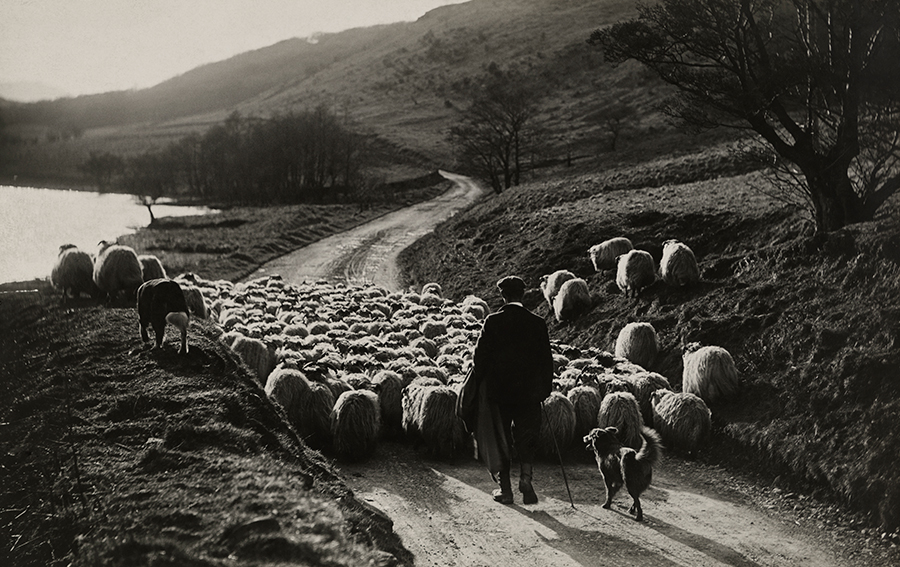
[gallery columns=“1” size=“full” ids=“17598”]
A man herds sheep with the help of his collies in Scotland, 1919. Photograph by William Reed, National Geographic Creative
∞
However, Downs offers readers far more than just a historical record and campaign manual. He explores the social and political developments that have resulted in censorship being seen as a progressive rather than an authoritarian force. He tells me that when a society has a strong sense of itself and of its own culture, it can afford to be tolerant of dissent. When society is not strong, but ‘existentially insecure’, ‘illiberal elements can come to the fore and people become dogmatic’. He argues that this pervasive insecurity, which began to afflict the Western world in the late 1980s, has also had an impact on individuals. ‘People have begun to feel more insecure and vulnerable. They readily identify as victims and define themselves by traumas, real or imagined.’ He argues that many of the original advocates of speech codes shared a view that students needed an ‘administrative apparatus to support their self-esteem, psychological wellbeing and identities’. He is clear: ‘In reality this represented a return of in loco parentis legislation to campus in a new and politicised guise after its banishment in the 1960s.’
∞
One of the most regular running jokes in my family, for many years now, is that I don’t play Wii Boxing because I think it’s too violent. We make a joke of my tender conscience, but I really do wince when a little Mii’s head snaps back. I can’t play for more than a couple of minutes. I pause the game; I switch to golf, or tennis, or frisbee. My discomfort is genuine, and deeper than any reasonable standard would deem appropriate, and (to me, anyway) not funny at all. The roots of it sink deep into my life; follow those roots 40 years deep — give or take a few days — and eventually you’ll find yourself in front of a little black-and-white television set, in Birmingham, Alabama, on the first day of October 1975. Three days earlier I had turned seventeen.
∞
Instead of design, there is calculation: the more erratic the path, eccentric the loops, hidden the blueprint, the more efficient the exposure, inevitable the transaction. In this war, graphic designers are the great turncoats: where once signage promised to deliver you to where you wanted to be, it now obfuscates and entangles you in a thicket of cuteness that forces you past unwanted detours, turns you back when you’re lost.
∞
A wall covered in spines, shelved from floor to ceiling, recognises the correspondence between bricks and books. It is the point at which knowledge becomes embedded in structure and the appearance is of books holding up the ceiling. The implication is that enlightenment, the journey towards the sky or the sublime is available within these pages. It is a metaphor made clearer by the special pieces of furniture, the chairs and stools which ingeniously convert to become ladders or in the sliding steps which glide along the floor scanning the shelves. And just as bricks humanise the scale of even a vast wall by introducing an element of human scale – a solid unit designed to fit perfectly into the hand, so books define the space and give scale to even the largest the wall. They are endlessly reproduced and faked in a game of trompe l’oeil in which their symbolic role alone is invoked. There are bookish wallpapers, there are rows of fake books spines, there are hidden jib doors hidden amongst the bookshelves which open, just as do books themselves to reveal another world and there are dealers who specialise in slightly-worn, leather-spined books by the yard, not for reading but for recreating a country house effect, the impression of history and wisdom. Already in the 1st Century AD Seneca swore by a small library, for knowledge rather than vanity, not ‘endless bookshelves for the ignorant to decorate their dining rooms.’
∞

[gallery] Mike Joyce, from Print Process