
[gallery] Pictures I took in England in 2011 (Tintagel, Oxford, Canterbury, London), posted today for no particular reason.


[gallery] houghtonlib:
MacGregor, John, 1825-1892. The ascent of Mont Blanc, a series of four views, printed in oil colours by George Baxter, [1855?]Houghton Library, Harvard University


The world which issued from the Renaissance and the Reformation has been ravaged since that time by powerful and truly monstrous energies, in which error and truth are closely commingled and feed upon each other – truths which lie, and “lies which speak the truth.” It is the duty of those who love wisdom to try to purify these unnatural and deadly products, and to save the truths that they distort.It would be fruitless to try to conceal from oneself that this is a particularly thankless task. Those who carry in the world the energies of which I am speaking think that they have no need of being purified; their adversaries see in them only utter impurity. In vain will the philosopher arm himself with perfect instruments of purification; he runs the risk of having the whole world against him. If he is a Christian, he knows this from of old, and scarcely cares about it, being the disciple of a God hated by both the Pharisees and Sadducees, condemned by the chief priests and by the civil power, and mocked and scorned by the Roman soldiers.
Many, many factors account for physician burnout and cynicism in different specialties, including lifestyle, geographic area of practice, private versus hospital practice, and so forth, and I will continue to write about this because it can affect patient care. But among the many factors involved, I do think that the patient population one deals with affects the feelings a physician has toward the patient. After all, it is much harder to sympathize with those who have made mistakes and poor decisions than with those who are only a victim of circumstance.The job of the physician, and the art of medicine, involves trying to put aside the idea of the culpable adult or the blameless child and to treat the person as he or she stands before the doctor. This is incredibly difficult, but I suspect this push and pull is integral to the imperfect system that we have — a system that deals with human beings and human relationships as well as with science.
churches and self-sufficiency
There’s a danger of complacency in the Catholic approach to the Church’s future. It’s very foolish indeed not to read deeply in Protestant theology and to draw upon its traditions of worship, hymnody, and piety. And the ecumenical imperative is just that—an imperative. When a Catholic’s sense of the encompassing reality of the Church dampens his ardor for Christian unity something has gone wrong.But dangers aside, the Catholic presumption of self-sufficiency is for the best. The conviction that our future comes from within provides an important freedom. For when we’re too dependent on negation, we allow ourselves to be defined by changing winds of fashion. That’s because what we don’t do and believe depends on what others do do and believe.
The Future of Catholicism | R. R. Reno.
I confess that I don’t see how the first paragraph I quote here can be reconciled with the second one. How can the “presumption of self-sufficiency” be “for the best” if “It’s very foolish indeed not to read deeply in Protestant theology and to draw upon its traditions of worship, hymnody, and piety”? And if you’re “drawing on” those traditions, then presumably that’s not “negation” of them, but rather affirmation — isn’t it?
I would also suggest that the distinction between “within” and “without” needs to be made with some care here. Protestant theology and worship are not simply extrinsic to Catholicism in the way that, say, Buddhist theology and worship would be. According to the Catechism of the Catholic Church Protestants are operating in genuine “ecclesial communities” and are, to Catholics, brothers and sisters in Christ. The divine grace that’s at work in those communities is an outgrowth, the Catechism says, of the very grace by which the Catholic Church itself is formed and sustained. So these people and their ecclesial communities are not in any simple sense “outside” the Catholic church.
In short, I think the first paragraph I have quoted makes an important point which the second one unfortunately and wrongly denies.
Addendum: It occurs to me that I would have liked Rusty’s argument much better if he had spoken of self-determination rather than self-sufficiency.
[gallery]


[gallery] Léonard Misonne, Sur la glace, 1908

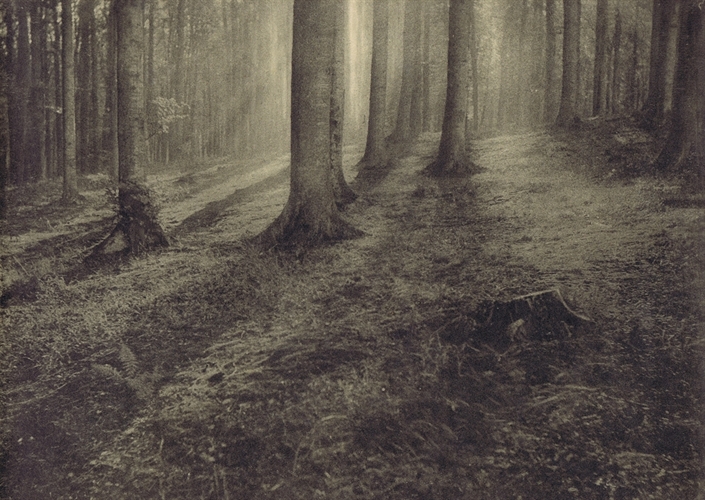
Léonard Misonne, Trees, 1923