
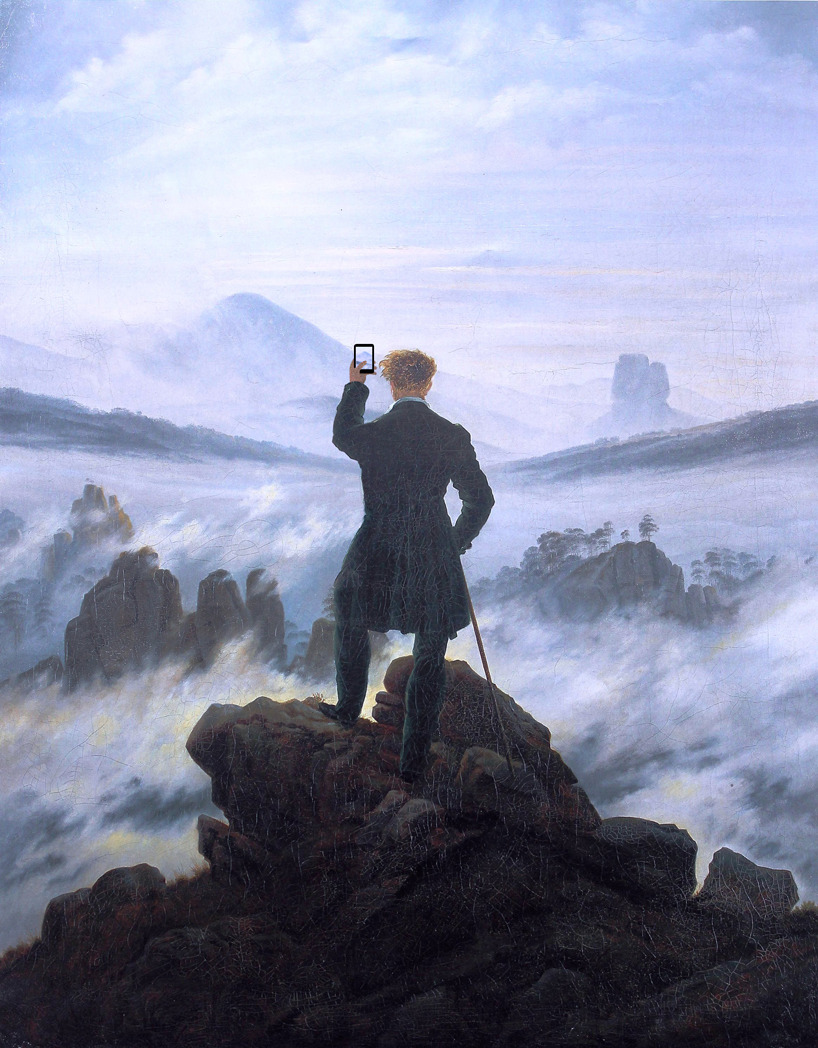
[gallery] Any comment would be superfluous. Via Sonny Bunch on Twitter.

If history and comparative religion alike offer us perspective on world events from the “outside,” the study of theology offers us a chance to study those same events “from within”: an opportunity to get inside the heads of those whose beliefs and choices shaped so much of our history, and who—in the world outside the ivory tower—still shape plenty of the world today. That such avenues of inquiry have virtually vanished from many of the institutions where they were once best explored is hardly a triumph of progress or of secularism. Instead, the absence of theology in our universities is an unfortunate example of blindness—willful or no—to the fact that engagement with the past requires more than mere objective or comparative analysis. It requires a willingness to look outside our own perspectives in order engage with the great questions—and questioners—of history on their own terms. Even Dawkins might well agree with that.
Old technology dominates life much more than we think. We still sit on chairs and eat with utensils that the ancient Mesopotamians would recognize. Beer (early Neolithic), wine (late Neolithic), and tea (1500 BC) are the most popular beverages in the world. Boeing’s 787 would be worthless without a 4th millennium BC artifact: the wheel. As Robert Sutton says in his book Weird Ideas That Work, “All the excitement about building better products and companies can make us forget that most new ideas are bad and most old ideas are good.”
If Google Glass should fail to catch on, if it ends up on the “meh” list in the Sunday Times Magazine, if most people decide they just don’t want this climactic iteration of the screen after all, there will be many reasons given. Those privacy and safety concerns will likely be paramount because they are publicly definable “issues,” so evident, so debatable. But if people also say “I just don’t like it, I don’t like the experience,” it will be because, in fashioning the ultimate personal screen, Google violated the very conditions that made screens so compelling in the first place: the containment of the frame, the placement of the screen on a device—an entity among others—a placement that allows us to look upon the screen from beyond. The mind’s coherence is grounded in the way our bodies are oriented—left and right, up and down, near and far, in and out—and especially in the way we can face or turn away from other things in a surrounding world that contains us all equally. The hovering fusional image Glass provides will disturb those primal orientations. If people choose to stay true to their old-fashioned tablets and smart phones, it will be because the body of the device, especially the portable device that proffers the screen as its face, turned out to be as essential to the magic as the screen itself.
The game than which no funner can be conceived.
online outrage
As a result, when a politician utters a barely outdated cliché, or the slightest impolitic word, we no longer hear it as a faux pas or mere insensitivity. Instead it becomes the latest menacing incarnation of the evil we oppose. Micro-aggression is no longer "micro" at all, but the very real appearance of Patriarchy, or Anti-clericalism, or whatever evil you most fear. If your ideological hearing aids are tuned correctly, a gaffe becomes a threat, returning you to witch-trial-era Salem or the Vendée before the massacre.Worse, this kind of hypermoralized politics has some serious implications for how we look at governance and power. As C.S. Lewis once wrote, “Of all tyrannies a tyranny sincerely exercised for the good of its victims may be the most oppressive.” In other words, if we are simply doing good in the world, and our enemies evil, then there’s no limit to the power we ought to acquire. What a charming fantasy that can be.
Holiday is right to be concerned that our capacity for real outrage is dulled by the sort of “outrage” that we perform, or fake, or convince ourselves to feel in our self-regard. But we should consider the possibility that fake-outrage is popular precisely because it is an indulgence that requires so little from us. Fake outrage allows us to hide within the mob, to feel righteous without doing much of anything, to suffer like martyrs from words not spoken to us. If we subtracted all the outrage porn tomorrow, most of us would continue to do what we already are doing about the Syrian refugee crisis, or faraway famine, or unjust war: nothing.
the Heidegger notebooks
The notebooks also show that for Heidegger, antisemitism overlapped with a strong resentment of American and English culture, all of which he saw as drivers of what he called Machenschaft, variously translated as "machination" or "manipulative domination".In one passage, Heidegger argues that like fascism and “world judaism”, Soviet communism and British parliamentarianism should be seen as part of the imperious dehumanising drive of western modernity: “The bourgeois-Christian form of English ‘bolshevism’ is the most dangerous. Without its destruction, the modern era will remain intact.”
In an almost playful dig at English culture, he writes: “What, other than engineering and metaphysically paving the way for socialism, other than commonplace thinking and tastelessness, has England contributed in terms of ‘culture’?"
— Heidegger's 'black notebooks' reveal antisemitism at core of his philosophy
collections

Seeing the “collections” of Simone Capano I’m reminded of the work of Gregory Blackstock, which I once wrote about here.
UPDATE: via Roberto Greco on Twitter, see this post by Lizette Greco.
adjunct intellectuals
Writers and academics who fret over the fate of public intellectuals may think they are debating vital questions of the culture. But their discussions are myopically focused on the writing habits of a rapidly disappearing elite. The vast majority of potential public intellectuals do not belong to the academic 1 percent. They are not forsaking the snappy op-ed for the arcane article. They are not navigating the shoals of publish or perish. They’re grading.