
I took some apples out of a paper bag where they had been lying for a long time; I had to cut off and throw away half of many of them. Afterwards as I was copying out a sentence of mine the second half of which was bad, I at once saw it as a half-rotten apple. And that’s how it always is with me. Everything that comes my way becomes for me a picture of what I am thinking about.
Delay is natural to a writer. He is like a surfer—he bides his time, waits for the perfect wave on which to ride in. Delay is instinctive with him. He waits for the surge (of emotion? of strength? of courage?) that will carry him along. I have no warm-up exercises, other than to take an occasional drink. I am apt to let something simmer for a while in my mind before trying to put it into words. I walk around, straightening pictures on the wall, rugs on the floor—as though not until everything in the world was lined up and perfectly true could anybody reasonably expect me to set a word down on paper.
It is the nature of an hypothesis, when once a man has conceived it, that it assimilates every thing to itself, as proper nourishment; and, from the first moment of your begetting it, it generally grows the stronger by every thing you see, hear, read, or understand. This is of great use.
And so, among Jews, Braun now becomes a familiar figure: a shanda fur die Goyim. The Yiddish phrase translates, roughly, to “a shame before the non-Jews.” The idea is sort of two-fold: That more is expected of Jews, specifically by Jews; and that when a famous Jew fails to live up to those high standards, it makes us all look bad in the eyes of the rest of the world. Madoff is a shanda. Maybe Weiner and Spitzer. You get the idea. And Braun, now, will surely join their ranks.This is something relatively assimilated Jewish people still say, and still mean sincerely; it’s not just, like, a Twitter thing. But it is interesting that the phrase persists in the original Yiddish. That language, essentially a German dialect written in Hebrew script which is now spoken only by a handful of native speakers from Eastern Europe as well as by members of several Hasidic sects, is explicitly ethnic (yid is Yiddish for “Jew”) and as such unavoidably paints the world in expressly ethnic, tribal terms. To call someone a shanda, in other words, is to think in ethnic terms doubly.
I see so much perdition in this world, that even if my writing has no other effect than to weary this hand that wields the pen, it brings me some comfort.
So parenting has been hard in all times and places, and all times and places have put their unique (and imperfect) spin on it—parenting being hard because living is hard. Having said that, I suspect that the particular flavor of parenting in our time has something to do with our relative affluence—I think we live in a time of just soul-crushing materialism. And by this I mean both that (1) we value material possessions way too much and (2) we believe way too much that the only true or real thing is what can be immediately seen and measured—that is, we live in profoundly anti-spiritual times, and operate under the unfortunate de facto assumption that we just happen to be built such that our mental abilities enable us to know exactly everything there is to know about the universe, just as we are, no strain or work or faith in the reality of things unseen. This is a fundamentally worldly and limited viewpoint: what we see is what there is, period.
credulous skeptics
Of course, I can’t universalize my own experience – but that experience does give me pause when people talk about the immense power of religion to make people do extraordinary things. When people say that they are acting out of religious conviction, I tend to be skeptical; I tend to wonder whether they’re not acting as I usually do, out of motives and impulses over which I could paint a thin religious veneer but which are really not religious at all.Most of today’s leading critics of religion are remarkably trusting in these matters. Card-carrying members of the intelligentsia like Mr. Hitchens, Richard Dawkins and Sam Harris would surely be doubtful, even incredulous, if a politician who had illegally seized power claimed that his motives for doing so were purely patriotic; or if a CEO of a drug company explained a sudden drop in prices by professing her undying compassion for those unable to afford her company’s products. Discerning a difference between people’s professed aims and their real aims is just what intellectuals do. Yet when someone does something nasty and claims to have done it in the name of religion, our leading atheists suddenly become paragons of credulity: If Osama bin Laden claims to be carrying out his program of terrorism in the name of Allah and for the cause of Islam, then what grounds have we to doubt him? It’s not like anyone would lie about something like that as a strategy for justifying the unjustifiable, is it?
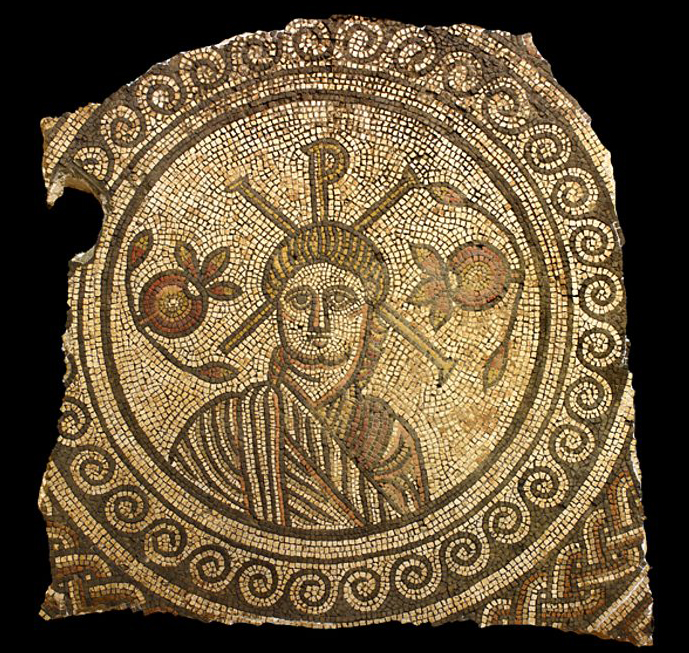
There’s the Hinton St Mary Mosaic – an early Romano-British representation of Christ, with the Chi-Ro symbol monogrammed behind his head, clearly modelled in some ways on images of the sun god, indebted a bit to images of royal authority.
At the same time, this is someone wearing a very simple costume, and when you see something similar in mosaics of later on, very clearly dressed as a philosopher, a wandering teacher. The plain tunic around the shoulder and the unfashionable long hair and beard of philosopher or sage. [RW raises eyebrows. Audience laughter.]
The point being, when you go into one of the great basilicas of the late Roman empire and you see a mosaic of Christ enthroned at the far end, you’re looking at the place where the emperor would sit. And the emperor would be sitting there either dressed in his armour or in cloth of gold with a diadem around his head.
So you’re looking to the throne, but who’s on it? This rather curious and disreputable wandering teacher. So you have a bit of a paradox in visual form there. The person who holds the emperor’s authority in cosmic terms isn’t just another soldier or administrator in uniform, but a philosopher, a sage. So something’s being said there that is on the edge of paradox. It’s been suggested, quite credibly, that some of that tradition of representing Jesus borrows from the ways in which late Classical art used to depict Plato the philosopher or Homer the poet. So it’s a poet, a philosopher, it’s a wordsmith who’s sitting on the throne.
The engagement of understanding is, then, a continuous, self-moved, critical enterprise of theorising. Its principle is: Never ask the end. Of the paths it may follow, some (we may suppose) will soon exhaust their promise. It is an engagement of arrivals and departures. Temporary platforms of conditional understanding are always being reached, and the theorist may turn aside to explore them. But each is an arrival, an enlightenment, and a point of departure. The notion of an unconditional or definitive understanding may hover in the background, but it has no part in the adventure…— Michael Oakeshott, On Human Conduct (1975); cited here as a possible, rare instance of an ‘absolute secularity’, incorruptible by revelation, only for a commenter to point out at once how similar it is to both some kinds of reading and some kinds of religious belief. (via unapologetic-book)Here, theorizing has revealed itself to be an unconditional adventure in which every achievement of understanding is an invitation to investigate itself and where the reports a theorist makes to himself are interim triumphs of temerity over scruple. And for a theorist not to respond to this invitation cannot be on account of his never having received it. It does not reach him from afar and by special messenger; it is implicit in every engagement to understand and is delivered to him whenever he reflects. The irony of all theorizing is its propensity to generate, not an understanding, but a not-yet-understood.
I would guess that if you hired a left-brainiac economist to analyze “the present situation of poetry,” he or she would find that the dynamics of the system match those of an economy with overwhelming quantities of counterfeit money in it. People have given up accepting the tender. There is real value being created, but it is in the gray market, so to speak, in the barter economy of coteries and sometime hermits. It is no one’s fault—America in its wisdom has figured out how to get lots of poems, things that are nominally poems, printed. Recognizing this is important, as I wouldn’t want to ascribe to general venality and the Decline of the West what may just be contingencies in the means of production. Why are the shows on HBO awesome and Hollywood movies terrible, when they are made by the same class of people—the same people, sometimes—in the same place, using the same processes and techniques? Maybe it is that one sells subscriptions to affluent households and the other fishes for fourteen-year olds’ pocket money, that is, one is in a long-term relationship with its audience and the other is not. It may be that vaguely analogous impersonal factors—parameters of our media industries, of our patronage systems, and so on—have pushed our dispensation into a place where it is better at producing Halo 4 than lyric poetry. For the time being.