
All
Paying for Apple Music or Adobe Acrobat is relatively harmless, but an economic model that is progressively turning more and more things into subscriptions — and renting is certainly a form of subscription — is creating conditions that are antithetical to human life freed for public life…. What was once the animal laborans is today homo subscribens, man the subscriber. The possibility of a 50-year mortgage would only confirm this reversion back to the life process, ensuring that people today are no freer than laborers bound by endless necessity.
I'm blessed to have many friends who write beautifully, and I especially love it when I hear their voices in the written words. This whole essay by Sara Hendren is like that:
You think Hyde’s telling you to give your gifts, like “giving back,” I say. But it’s weirder than that. Gifts precede you, mark your life. They invite you to imitate the pattern. This truth is hard for all of us to hear.
And this from Charles Marsh on “making anxiety great again”: “Receive anxiety as an opportunity…. Accept anxiety as an awakening…. Acknowledge anxiety’s capacity to instruct.”
Much wisdom in these two reflections.
So thorough was [Frank] Gehry’s reorientation of architecture as an art form rather than an adjunct of engineering that it’s hard to recall how the high end of his profession was perceived before him, when technocrats in big architectural firms seemed indistinguishable from any other business executives. In the mid-1970s, as he approached fifty, Gehry resolved to throw over his profitable relationship with one of the most enlightened developers of the day—James Rouse, best known for his humanely planned, racially integrated new town of Columbia, Maryland. There Gehry designed several structures, including the Rouse Company Headquarters of 1969–1974, followed by a number of other Rouse projects on both coasts, including his Pop-inflected Santa Monica Place shopping mall of 1972–1980. He then reinvented himself as an artist who used architecture as his medium, a move as risky as Andy Warhol’s decision a decade earlier to abandon his lucrative practice as a commercial illustrator and take up fine art.
The older I get, the more intensely I feel about old trees. I don’t think it’s just a sentimental love of old things. Nor is it just a reactionary or activist desire to preserve old things from destruction – I feel that about old buildings, but what I feel for trees is different. It’s more personal, in more ways than one – as if at some deep level I carry a conviction that trees are persons. I’m not sure what to make of this conviction. The difference between old buildings and old trees is that trees are not our heritage. They don’t belong to us at all; they belong to themselves, because they’re alive. Their importance doesn’t lie in their cultural value, even if they do have that in abundance. They are surely valuable in and of themselves, and for their own sake. A long-lived tree represents the hard-won triumph of life over time and happenstance, a testament to a creation far older than us. The idea that human beings with their mayfly-lives could assume the right to end that long life, suddenly and artificially, is somehow repugnant; and the idea of re-shaping a landscape by wholesale deforestation is more monstrous by orders of magnitude. It happens, of course; and the serried forests we plant, like the forests I grew up close to in the Suffolk Breckland, feel like parodies of the lost greenwood. But it may be the forest – or, in a phrase I coined for a recent book, the ‘arboreal sacred’ – lies at the heart of the pre-Christian religious history of temperate northern Europe, for the forest was everywhere once. In losing it, I fear we have lost a major part of ourselves.

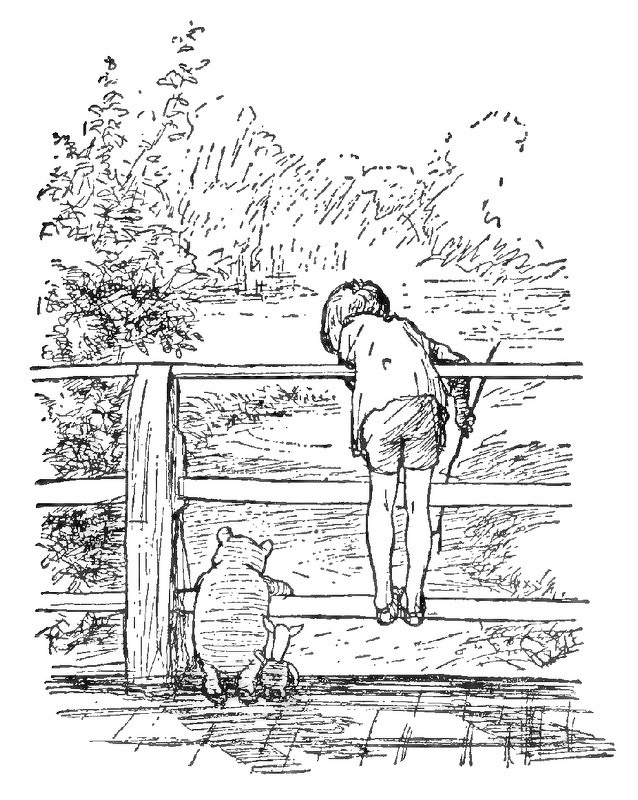
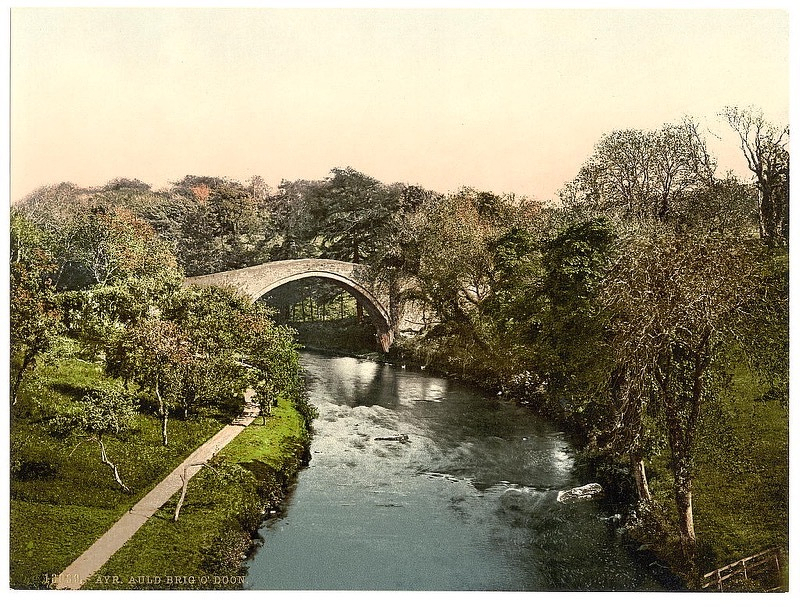
This nice post In Praise of E. H. Shepard’s Illustrations is also a useful reminder that Pooh-sticks is among the very finest of games. I might add that there is no better place to play Pooh-sticks than the Brig o’ Doon. I have played the game there several times and hope to return.
Why are executives pushing the use of new and highly questionable tools on their subordinates, even when they reduce productivity? I speculate that to understand this disconnect, you need to look at what executives do.
Jazz is improvised, but jazz is also a language. Every phrase by every major stylist is in conversation with a lineage.
Miles played with Charlie Parker, the avatar of bebop. As a generic term, “bebop” can cover a lot of terrain, but Parker himself created a specific melodic language, a specificity only matched by Bud Powell. Bird and Bud do not play the same phrases, but they share some mysterious higher ideal when it comes to the improvised line. I don’t know what it is, and I have never seen an accurate description of it, either … for myself, I call it “high bebop” or “true bebop.”
I would love to know what Iverson means by this. It would be fun to hear him play a few phrases illustrative of this “mysterious higher ideal.” ♫
Liu Cixin’s Three-Body Problem has become for China what Asimov’s Foundation was for the United States: a literary scaffolding for thinking about technology, geopolitics, and the fate of civilizations. As Fudan University professor Yan Feng observed, Liu “single-handedly elevated Chinese science fiction to the world stage.” His novels minted phrases that have since entered China’s everyday political and business lexicon: jiangwei daji (dimensional reduction strike), mianbizhe (wallfacer), pobiren (wallbreaker), the “dark forest law,” the “chain of suspicion,” and the “technological explosion.” These terms are now common shorthand in boardrooms and policy circles, invoked to describe competitive landscapes, strategy under uncertainty, or the fragility of trust in both markets and diplomacy. The tech community has seized upon them with particular enthusiasm. Countless essays have drawn “internet strategies of the Three-Body universe” or even “Three-Body management science,” treating Liu’s cosmic metaphors as diagnostic tools for China’s entrepreneurial reality.