
I find that it is much more for most men’s good and edification, to converse with them only in that way of godliness which all are agreed in … and to tell them of little more of your knowledge than what you find them willing to receive from you as mere learners; and therefore to stay till they crave information of you. We mistake men’s diseases, when we think there needeth nothing to cure them of their errors but the evidence of truth. Alas! there are many distempers of mind to be removed before they receive that evidence.
Handed-down wisdom and worked-up information remain the double piers of a cook’s life. The recipe book always contains two things: news of how something is made, and assurance that there’s a way to make it, with the implicit belief that if I know how it is done I can show you how to do it. The premise of the recipe book is that these two things are naturally balanced; the secret of the recipe book is that they’re not. The space between learning the facts about how something is done and learning how to do it always turns out to be large, at times immense. What kids make depends on what moms know: skills, implicit knowledge, inherited craft, buried assumptions, finger know-how that no recipe can sum up. The recipe is a blueprint but also a red herring, a way to do something and a false summing up of a living process that can be handed on only by experience, a knack posing as a knowledge. We say “What’s the recipe?” when we mean “How do you do it?” And though we want the answer to be “Like this!” the honest answer is “Be me!” “What’s the recipe?” you ask the weary pro chef, and he gives you a weary-pro-chef look, since the recipe is the totality of the activity, the real work. The recipe is to spend your life cooking.
To watch the corn grow, and the blossoms set; to draw hard breath over ploughshare or spade; to read, to think, to love, to hope, to pray — these are the things that make men happy; they have always had the power of doing these, they never will have the power to do more. The world’s prosperity or adversity depends upon our knowing and teaching these few things: but upon iron, or glass, or electricity, or steam, in no wise.
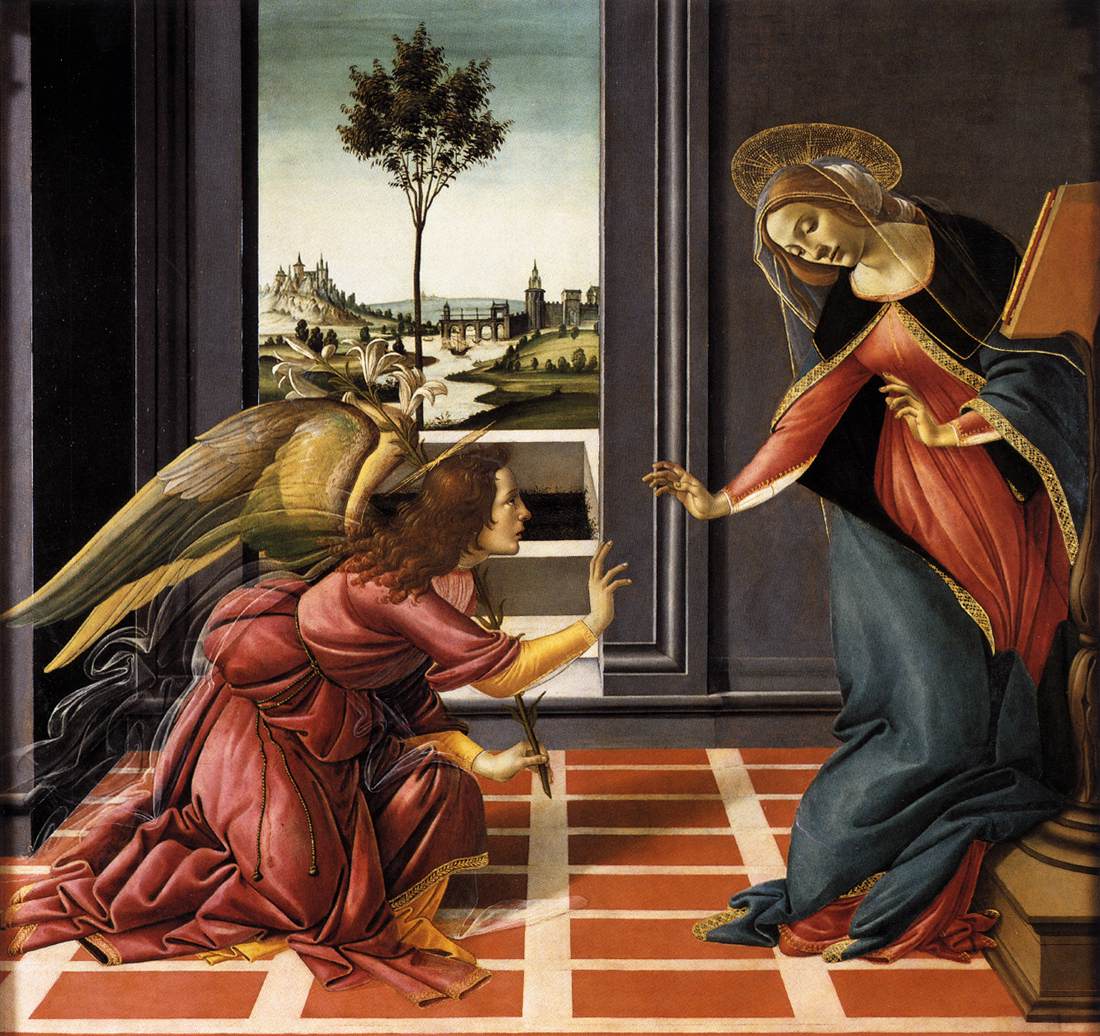
Andrew Hudgins, "The Cestello Annunciation"
The angel has already said, Be not afraid. He’s said, The power of the Most High will darken you. Her eyes are downcast and half closed. And there’s a long pause — a pause here of forever — as the angel crowds her. She backs away, her left side pressed against the picture frame.
He kneels. He’s come in all unearthly innocence to tell her of glory — not knowing, not remembering how terrible it is. And Botticelli gives her eternity to turn, look out the doorway, where on a far hill floats a castle, and halfway across the river toward it juts a bridge, not completed —
and neither is the touch, angel to virgin, both her hands held up, both elegant, one raised as if to say stop, while the other hand, the right one, reaches toward his; and, as it does, it parts her blue robe and reveals the concealed red of her inner garment to the red tiles of the floor and the red folds
of the angel’s robe. But her whole body pulls away. Only her head, already haloed, bows, acquiescing. And though she will, she’s not yet said, Behold, I am the handmaiden of the Lord, as Botticelli, in his great pity,
lets her refuse, accept, refuse, and think again.
Let no man deceive himself; if by vulgarity we mean coarseness of speech, rowdiness of behaviour, gossip, horseplay, and some heavy drinking, vulgarity there always was wherever there was joy, wherever there was faith in the gods. Wherever you have belief you will have hilarity, wherever you have hilarity you will have some dangers. And as creed and mythology produce this gross and vigorous life, so in its turn this gross and vigorous life will always produce creed and mythology.
— G.K. Chesterton, ‘Christmas and the Aesthetes’ (1905).
G. K. Chesterton, "Christmas Poem"
There fared a mother driven forth
Out of an inn to roam;
In the place where she was homeless
All men are at home.
The crazy stable close at hand,
With shaking timber and shifting sand,
Grew a stronger thing to abide and stand
Than the square stones of Rome.
For men are homesick in their homes,
And strangers under the sun,
And they lay their heads in a foreign land
Whenever the day is done.
Here we have battle and blazing eyes,
And chance and honour and high surprise,
But our homes are under miraculous skies
Where the yule tale was begun.
A child in a foul stable,
Where the beasts feed and foam;
Only where He was homeless
Are you and I at home;
We have hands that fashion and heads that know,
But our hearts we lost — how long ago!
In a place no chart nor ship can show
Under the sky’s dome.
This world is wild as an old wife’s tale,
And strange the plain things are,
The earth is enough and the air is enough
For our wonder and our war;
But our rest is as far as the fire-drake swings
And our peace is put in impossible things
Where clashed and thundered unthinkable wings
Round an incredible star.
To an open house in the evening
Home shall all men come,
To an older place than Eden
And a taller town than Rome.
To the end of the way of the wandering star,
To the things that cannot be and that are,
To the place where God was homeless
And all men are at home.
To declare God’s goodness, that hath enabled us to speak, we are bound to speak: speech is the Glue, the Cement, the Soul of Conversation, and of Religion too.
Unfortunately for the US State Department, they clearly shouldn’t have been messing with computers, either. In setting up their SIPRnet, they were trying to grab the advantages of rapid, silo-free, networked communication while preserving the hierarchical proprieties of official confidentiality. That’s the real issue, that’s the big modern problem; national governments and global computer networks don’t mix any more. It’s like trying to eat a very private birthday cake while also distributing it. That scheme is just not working. And that failure has a face now, and that’s Julian Assange.