In the end, [Milosz’s] The Captive Mind also speaks to those left on the other side of the curtain, warning them against letting the tension of their political reality replace their own internal tension—acknowledging their captive times but maintaining the inner life that animates their loves, fears, and fantasies. Miłosz cautions the artists and writers living under repressive regimes not to let the outer pressure determine their inner core. The times may be captive, but the thinking has to remain free.
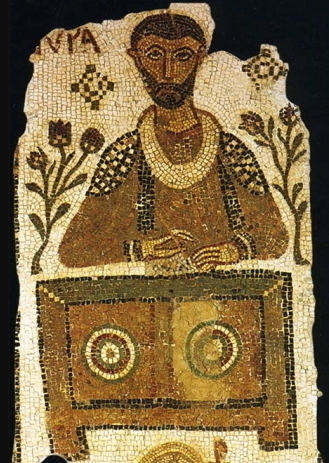
Ancient writers at their desks. Even back then some people knew how to apply ass to chair.
My dear friend Wesley Hill has written a lovely brief book about Easter.

[In the seventeenth century] John Aubrey, the first person to make a serious study of stone circles, put his finger on the problem: ‘These Antiquities are so exceeding old that no Bookes doe reach them.’ He developed a more effective method. Using measurements and comparative surveys of different circles with notes ‘writt upon the spott’, he was able to work out that megalithic monuments were of distinct types and that they predated the Romans, Saxons and Danes. He thus, almost single-handedly, created the concept of prehistory and invented field archaeology.
Re: Oliver Burkeman’s 70% rule — “If you’re roughly 70% happy with a piece of writing you’ve produced, you should publish it. If you’re 70% satisfied with a product you’ve created, launch it” etc. — nothing could be more alien to how my mind works than the quantification of mixed feelings.
Hey kids! Let’s play Uranium Rush! Don’t forget the Geiger counter!