one more word on Kael
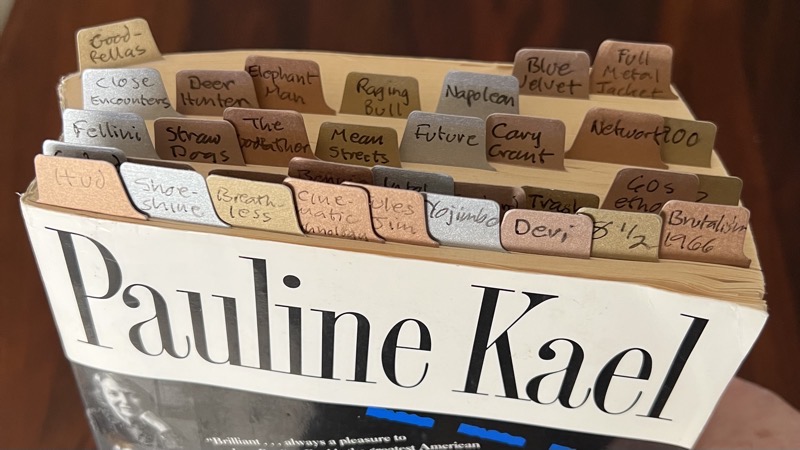
That’s my copy of Pauline Kael's For Keeps, the enormous collection of the essays on and reviews of movies that she most wanted to preserve. It’s pretty marked up, because Kael, more than any other film critic, helps me to understand what I think about movies. Re: my three categories of thinker, Kael is neither a good Explainer nor a reliable Illuminator — nothing in Renata Adler's notorious takedown of Kael is wrong, exactly, even if it relies far too heavily on strategic omission — but she’s one hell of a Provoker.
You’ll notice how much how many more markers there are in the early pages then there are in the later ones. This has something to do with my own interests, but I think it has a lot more to do with how Kael’s relationship to the movies changed over the decades. This first occurred to me as I was reading her review of Blade Runner, which is a largely hostile one … but the hostility really wasn’t, for me, the problem (especially since that initial theatrical release of the movie was indeed badly flawed). Rather, while reading I just felt that Pauline Kael was not made to be reviewing movies like Blade Runner, that by this point the movies had a traveled down a path that was simply alien to her sensibility.
She was still capable of having intense responses to movies, positive ones as well as negative. For instance, there’s a scene in My Left Foot that — in one of her last reviews — she says might be the most emotionally wrenching she had ever seen in movies. (Any of you who have seen My Left Foot will know precisely the scene that she’s talking about.) So it’s not as though she had come to hate new movies; she thought that some were good and most were not so good, and that was no different in the Eighties than it had been in earlier decades. But it is pretty obvious that her intellectual and aesthetic formation is not really suited to the direction that movies take from the Eighties onward.
She retired in 1991, largely because of the onset of Parkinson’s disease, which some people think may have affected her mind. I don’t know about that, but certainly many of the reviews that she wrote in the Eighties were indistinguishable from the work of other critics. That was never true of her earlier work, which was sometimes right and sometimes wrong, sometimes exhilarating and sometimes exasperating, but it was all very obviously written by Pauline Kael and could not have been written by anyone else.
I think maybe she might’ve retired a decade too late; but she certainly should have gotten started a decade earlier. She only began publishing regularly in her forties, and didn’t commence her regular column for the New Yorker until she was fifty. If her talents had been recognized earlier she could have taken over for James Agee, who was only a decade older than her, as the most important American writer about film. It would’ve been wonderful to get Kael’s real-time takes on the films that emerged from the late Forties to the late Fifties.
In 1969 Kael wrote a long essay for Harper’s called “Trash, Art, and the Movies” that I’m going to return to in another post — it helps me think about what I was talking about in yesterday’s post — but I’ll leave you with a passage from it that’s classic Kael, and that shows you what we’ve been missing in writing about movies since she left the scene:
A good movie can take you out of your dull funk and the hopelessness that so often goes with slipping into a theatre; a good movie can make you feel alive again, in contact, not just lost in another city. Good movies make you care, make you believe in possibilities again. If somewhere in the Hollywood-entertainment world someone has managed to break through with something that speaks to you, then it isn't all corruption. The movie doesn't have to be great; it can be stupid and empty and you can still have the joy of a good performance, or the joy in just a good line. An actor's scowl, a small subversive gesture, a dirty remark that someone tosses off with a mock-innocent face, and the world makes a little bit of sense. Sitting there alone or painfully alone because those with you do not react as you do, you know there must be others perhaps in this very theatre or in this city, surely in other theatres in other cities, now, in the past or future, who react as you do. And because movies are the most total and encompassing art form we have, these reactions can seem the most personal and, maybe the most important, imaginable. The romance of movies is not just in those stories and those people on the screen but in the adolescent dream of meeting others who feel as you do about what you've seen. You do meet them, of course, and you know each other at once because you talk less about good movies than about what you love in bad movies.
I’m 100% with MKBHD on this – or rather, even more critical than he is. I’m taking fewer iPhone pictures because I dislike its dramatic overprocessing of images – especially in lower light. (And you can’t undo it!)
truth

“Oh, it's so hard to be good under the capitalistic system.” — Genevieve Larkin (Glenda Farrell) in Gold Diggers of 1937
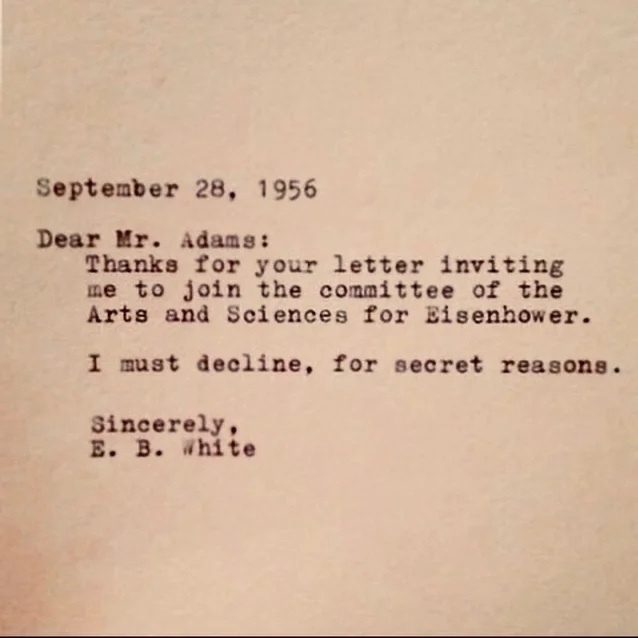
For years I’ve been determined to decline invitations in this way, but I always chicken out.

greatness in film

The 2022 Sight and Sound critics’ poll of the greatest films of all time featured a surprising Number One: Chantal Akerman’s 1975 film Jeanne Dielman, 23 Quai du Commerce, 1080 Bruxelles. I had never watched it, and it’s on the Criterion Channel, which I subscribe to, so I had to watch, didn’t I? I did, and here are my thoughts:
It’s a tract. It’s a powerful tract, but it is purely polemical. It has one message and one mood. The one mood is used to drive home the one message with relentless force; there is no possibility of dissent or even ambivalence. It is not a melodrama, but it is like melodrama in the sense that it allows but a single emotional response. I think that the film is a powerful statement, but is not a great work of art; maybe not a work of art at all.
Now, being a great work of art is not the only thing that a movie, or even a novel or a poem, might aspire to. There are many other worthwhile goals to pursue. But I think that one of the vital contributions that truly major works of art make to our common life is their depiction of situations to which equally intelligent and equally reasonable people might have different responses. In our moment — in which social media have conspired to promote and celebrate the unambiguous taking of sides about everything, this contribution is not recognized as having any value. So of course our critics have chosen as their top film one that disdains such complexity. (Also: Vertigo almost repeating its 2012 top finish? Sigh.)

When Jean Renoir's film The Rules of the Game appeared in 1939, the opening audience hated it. Renoir was shocked and troubled by this response, and took the movie back to the editing room, where he cut out 23 minutes. As Christopher Faulkner explains in a short video on the Criterion Channel, one of the chief effects of the cuts was to make the character he himself played, Octave, a much less complex one – far more straightforwardly craven and selfish than he is in the original film. Renoir inexplicably axed a key scene in which Octave's struggle between self-gratification and generosity is resolved in favor of generosity.
But when the film was restored to its original length — or possibly something a little longer — in 1959, the complexities of Octave were restored. And that is when The Rules of the Game became a truly great movie. Its greatness lies in the richness of its portrayal of this morally compromised world of the French aristocracy. Morally compromised, yes, but not completely without self-knowledge, not completely without standards. (Most of the “rules of the game” are meant to enable hypocrisy … but not all of them.) When you watch the film in its full version, you have a conflicted response to Octave, in very much the same way that you have conflicted responses to many people you know. For one thing, it is Octave’s generosity that results in the death of his friend — had he given in to his selfish impulses he himself would have died. The ironies are multiple and profound. But in the shorter version, we see merely the corruption of the aristocracy — we receive a single message and a single permissible viewpoint. And that is why the shorter version is a dramatically inferior film to the longer one.
In his book about Shakespearean comedy — still, I think, the best thing yet written about those plays — Northrop Frye talks about Shakespeare’s habit of creating characters who are excluded, or perhaps exclude themselves, from the festive reconciliation which the other characters at the end of the play enjoy.
The sense of festivity, which corresponds to pity in tragedy, is always present at the end of a romantic comedy. This takes the part of a party, usually a wedding, in which we feel, to some degree, participants. We are invited to the festivity and we put the best face we can on whatever feelings we may still have about the recent behavior of some of the characters, often including the bridegroom. In Shakespeare the new society is remarkably catholic in its tolerance; but there is always a part of us that remains a spectator, detached and observant, aware of other nuances and values. This sense of alienation, which in tragedy is terror, is almost bound to be represented by somebody or something in the play, and even if, like Shylock, he disappears in the fourth act, we never quite forget him. We seldom consciously feel identified with him, for he himself wants no such identification: we may even hate or despise him, but he is there, the eternal questioning Satan who is still not quite silenced by the vindication of Job….
Think for instance of Malvolio in Twelfth Night, who is exposed as a strutting, delusionally self-satisfied fool … and yet even the characters who so expose him can seem uncomfortable with what they have done; and we the spectators can’t help but be aware, if only subliminally, that some of those included in that festive circle at the end are not necessarily any better than Malvolio the mocked.
I think this kind of character is absolutely essential to the greatness of Shakespearean comedy, in much the same way that in his best tragedies we see comical characters who are detached from the terrible events that we see unfolding. Think for instance of the gravedigger in Hamlet, who goes about his business regardless of what happens to the prince and the other members of the royal family of Denmark. He is a living embodiment of the point Auden makes in “Musée des Beaux Arts.”
In my view, this complication of our responses, this questioning of our priorities, this reminder that we could see the world in rather different colors than those perceived by the most important characters in the story, is one of the essential gifts great art offers to us. That doesn’t mean that there isn’t a place for the tract, the polemic — the story that gives us a single unambiguous message. It just means that excellence in polemic is different than greatness in art.
Whenever anyone says what I’ve just said, what comes back is a mocking Yes, but is it art? — with the assumption that trying to distinguish between what is and what isn’t is a mug’s game. And maybe it is. But it seems to be one that we mugs can’t stop playing: som elf us have a sense that the term art is not a useless one.
I’m going to pause here, with a note for future reference that the question of what makes a movie great is a more difficult one than I have acknowledged here: see, for instance, this post by Adam Roberts on the unrelenting seriousness of the critics’ choices in the S&S poll. More on all these matters soon. Or eventually.
one of the classic blunders
A while back I quoted Amna Khalid’s thoughtful response to the Hamline University kerfuffle; now we have a strong statement from the Muslim Public Affairs Council. It’s not often that you get a big public dispute in which every party on one side of the issue is thoughtful, measured, and well-informed, while every party on the other side gives every indication of being an ignoramus. But here we are.
The Hamline administration has committed one of the classic blunders — right up there with getting involved in a land war in Asia and going up against a Sicilian when death is on the line — and the mistake is not deciding that certain groups on campus are to be protected from perceived insult while others are left to fend for themselves. No, that’s bad academic practice, but it’s not one of the classic blunders. The classic blunder here is assuming that the protected group is intellectually unanimous. The leaders of Hamline obviously believed that if one Muslim is offended by something then that thing is ipso facto “offensive to Muslims.” It’s the kind of error you make when you’re a well-meaning lefty who doesn’t know anyone who isn’t also a well-meaning lefty.
Currently reading: The Sense of an Ending by Frank Kermode 📚
Maybe one day I’ll get tired of taking pictures of trees, but not this day.
Escaping the Malthusian Trap: What an amazing graph-in-motion by Kieran Healy. Malthus believed that as population in a given locale rises, a point is reached at which food supply can’t keep up, which then leads to a decline in population. And if you look at the early moments of this visualization, you see what the Trap looks like (with the added complication of a severe drop in population as a result of the Black Death). But then things start to change.
Forthcoming in Comment.

projects and methods
Perhaps because I write different sorts of books, one of the most important writerly skills I have developed is the ability to adapt my working methods to the project at hand. Not every project calls for the same approach, the same model of organization, or the same tools.
For instance, when I was writing The Year of Our Lord 1943, with its five protagonists, the two most essential tools for me were (a) a color-coded timeline in Excel, so that I could see what each character was doing at any given time, and (b) a set of index cards. I had five protagonists so I got cards in five colors, and gradually accumulated information. Then, laying the cards out on a table or pinning them onto a cork board, I was able to understand the relations among those different pieces of information.
However, when I was writing How to Think I didn't need that kind of system — I needed something very different. In that book, I had a sequential argument to make, one in which each chapter or section built upon the previous one. So I used OmniOutliner to lay out the whole argument in outline format, and then fill in the details.
When I was writing Breaking Bread with the Dead neither of those two methods would work for me. I was trying to create a kind of mosaic of ways in which we can encounter the past — a task that did not require and indeed did not admit a rigid argumentative or historical sequence. I had rather a set of portraits of people engaged in the complex activity that I call breaking bread with the dead, and each of those portraits needed to be coherent, vivid and, to some extent, self-contained. So in writing that book I just kept a set of text files open on my computer. I could go back and forth among them, but I didn't need to do that very often, because each chapter had its own integrity. And on any given day, getting whatever chapter I was working on properly shaped was my primary task.
But now I'm starting a new book. I'm not yet ready to talk about what it is, though I’ll get to that point before too much longer. For now, I'll just say this: After fumbling around for a while to figure out how I could organize my thoughts in for this project, I realized that once again, the good old multicolored index cards were my best friends. And it's actually been very pleasurable to go back and, for the first time in several years, build up a collection of cards and figure out how to relate them to one another. I use my own version of the Zettelkasten system, and maybe one day I’ll write a post about what that looks like.
But for now I just want to say that I think writers make a mistake when they try to use the same method, the same organizational system, for every book. The character of the project — its structure, its form, the demands it makes upon you as a writer — should determine the way you write the book. If you’re writing the same kind of book every time — like Robert Caro, for instance — then by all means use the same system. But if not, exercise your imagination!

Finished reading: Why We Drive by Matthew B. Crawford. Fascinating book — I’ll probably blog about it soon. 📚