

Re: this David French column on why what Christians do matters more they what they (claim to) believe, I think of this sentence from George Eliot’s story “Janet’s Repentance”: “Religious ideas have the fate of melodies, which, once set afloat in the world, are taken up by all sorts of instruments, some woefully coarse, feeble, or out of tune, until people are in danger of crying out that the melody itself is detestable.”
Guadalcanal: 5
If, as I said in my previous post, to confront another soldier in war is to confront yourself, then … isn’t that other soldier … you? Yes. Necessarily.
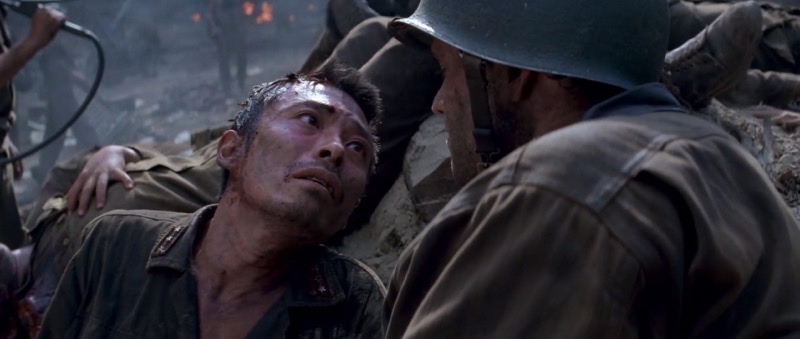
It is this necessity that produces a constant hum of meditation in Malick’s The Thin Red Line: “Maybe all men got one big soul,” thinks one of the soldiers.
Many of the voiceovers in this movie are clearly identified soliloquies: Nick Nolte’s Col. Tall, for instance, or Elias Koteas’s Captain Staros. But three characters in this movie — Private Witt (Jim Caviezel), Private Bell (Ben Chaplin), and Private Train (John Dee Smith) — have distinct Southern accents, and it’s not always easy to tell their voices apart. And I think that is intentional. That is, these thoughts are not supposed to be identifiable with one soldier. They are the thoughts of all the soldiers. (I suspect it matters that all of these speakers are privates, the lowest rank — the ones not differentiated from their neighbors by holding command.)
Sometimes their voices are identifiable. It is Private Witt, the central character in the film, who speculates that all of us share a soul — what Emerson called the “Over-Soul”:
The Supreme Critic on the errors of the past and the present, and the only prophet of that which must be, is that great nature in which we rest, as the earth lies in the soft arms of the atmosphere; that Unity, that Over-soul, within which every man's particular being is contained and made one with all other; that common heart, of which all sincere conversation is the worship, to which all right action is submission; that overpowering reality which confutes our tricks and talents, and constrains every one to pass for what he is, and to speak from his character, and not from his tongue, and which evermore tends to pass into our thought and hand, and become wisdom, and virtue, and power, and beauty. We live in succession, in division, in parts, in particles. Meantime within man is the soul of the whole; the wise silence; the universal beauty, to which every part and particle is equally related; the eternal ONE. And this deep power in which we exist, and whose beatitude is all accessible to us, is not only self-sufficing and perfect in every hour, but the act of seeing and the thing seen, the seer and the spectacle, the subject and the object, are one. We see the world piece by piece, as the sun, the moon, the animal, the tree; but the whole, of which these are the shining parts, is the soul.And it is Private Bell who muses, “Who lit this flame in us? No war can put it out.” In us. The flame of humanity, "the universal beauty, to which every part and particle is equally related."
But I believe, as some of the more attentive viewers of this film have argued, that the character we hear from most often, in voiceover, is Private Train, whom we see at any length only twice: Once as the soldiers are approaching the island, confessing his fear, and once as they are leaving the island, saying that he has had a lifetime of experience already and has earned some peace. Surely in these points as in others he speaks for his colleagues. One big experience for C-for-Charlie Company; one big soul.
(Private Train also has a tattoo on his upper arm, which reads: 1 JOHN 4:4. For those of you keeping score at home, that verse reads: “Ye are of God, little children, and have overcome them: because greater is he that is in you, than he that is in the world.” We may return to this.)
But the Over-Soul is bigger than what can be held on an American troop ship. One of those American soldiers says to a Japanese soldier — see the image at the top of this post — “Where you’re going you’re not coming back from.” And it’s true. But it’s equally true of the man who speaks those words. What you say about your enemy you say about yourself, whether you know it or not.
When I hear that sentence I think of a poem by Horace. David Ferry’s translation follows.
Aequam memento (Odes II.3)
When things are bad, be steady in your mind; Dellius, do not be Too unrestrainedly joyful in good fortune. You are going to die.It does not matter at all whether you spend Your days and nights in sorrow, Or on the other hand, in holiday pleasure, Drinking Falernian wine
Of an excellent vintage year, on the river bank. Why is it, do you suppose, That the dark branches of those tall pines and those Poplars’ silvery leafy
Branches love to join, coming together, Creating a welcoming shade? Have you not noticed how in the quiet river The current shows signs of hurry,
Urging itself to go forward, going somewhere, Making its purposeful way? By all means tell your servants to bring you wine, Perfumes, and the utterly lovely
Too briefly blossoming flowers of the villa garden; Yes, of course, while youth, And circumstance, and the black threads of the Sisters Suffer this to be so.
You are going to have to yield those upland pastures, The ones you bought just lately; You are going to yield the town house, and the villa, The country place whose margin
The Tiber washes as it moves along. Heirs will possess all that Which you have gathered. It does not matter at all If you are rich, with kings
Forefathers of your pride; no matter; or poor, Fatherless under the sky. You will be sacrificed to Orcus without pity. All of us together
Are being gathered; the lot of each of us Is in the shaking urn With all the other lots, and like the others Sooner or later our lot
Will fall out from the urn; and so we are chosen to take Our place in that dark boat, In that dark boat, that bears us all away From here to where no one comes back from ever.
Recent listening: Ralph Vaughan Williams’s wondrous Fifth Symphony. ♫
That admirable journal Current has posted its own list of the 100 best books of the 21st century so far and if you think I’m linking to that because a couple of my books are mentioned I am so offended.
The excellent folks at Reclaim Hosting are doing an upgrade today that is not supposed to affect access to my site (ayjay.org, blog.ayjay.org) — but, alas, my site is down.
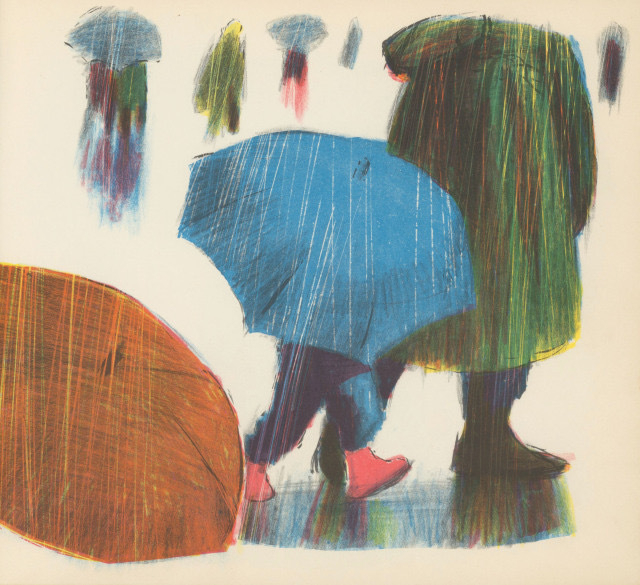
Craig Mod on Tokyo: “The saving grace is that Tokyo has a distinct advantage over other cities in that it extends, effectively, infinitely in most directions that aren’t the ocean (and even there, we’ve added quite a bit in the last hundred years). And is ultra-connected by perfectly-functioning public transportation. So you’re seeing what used to be more centralized ‘cultural texture’ move east and west — out to Kuramae, Kiyosumishirakawa, Gakugeidaigaku, Itabashi, and more; not unlike the Brooklyn migrations from a Duane-Reade-and-Citibank-infested Manhattan in the naughts and 2010s. But for me, one of the great joys is wandering the central neighborhoods of the city, those abutting the ‘Hills’ and mega-developments, finding those rare streets still replete with homes and shops of a city that once was. Finding one of those four-hundred baths. There are still common relationships to luxuriate in, even as the towers loom.”