Peace, Peace
N.B. This post is spoilerful.
A few years ago I read a fascinating post by my colleague Philip Jenkins about Gene Wolfe’s 1975 novel Peace. I had read Peace many years ago but didn’t remember anything about it, and Philip’s post reminded me that there’s a complicated discourse surrounding the book. I decided that I wanted to re-read the book without looking at the interpretations … and only now have I gotten around to it. Here are some things that struck me:It seemed obvious to me that our narrator, Alden Dennis Weer, is dead and is revisiting his life. (Wolfe has cheerfully confirmed that Weer is a ghost.) He clearly lives, or “lives,” in a rambling memory palace of his own making, each room of which is related to some season of his life. But the palace is not complete, and he can temporarily or permanently lose access to some of its rooms.
Severian, the protagonist and narrator of Wolfe’s Book of the New Sun tetralogy — which Wolfe began almost immediately after writing Peace — claims to have a perfect memory, and perhaps he does, but he does not tell us everything he remembers. When he remains silent about some episode in his life, the reader has to sift the evidence to figure out what really happened, or wait for later evidence. The same is true of Weer’s narration in Peace. Often he leaves stories unfinished — and by “stories” I mean both his direct narration of his life’s events and the book’s many tales (some of them fairy tales, some of them anecdotes told to him by others). It’s possible that he has forgotten how some stories end, but in many of the cases he simply does not want to say what happened, and we are left to draw inferences. He does not narrate the death of his Aunt Olivia, but we can piece together an account of her death. He explicitly says that he will not tell us what happened when he and the librarian Lois Arbuthnot visited a farm outside of town to search for an old document, but later it becomes pretty clear what happened: Weer killed her. (And she may not be the only person he murders.)
When declining to tell that story, Weer writes,
You must excuse me. I can write nothing more now about the trip Lois and I made to Gold's, or our search for the buried treasure. Everything we do is unimportant, I know; but some things are, if not more important, at least more immediate than others, and so I must tell you (writing alone in this empty room, my pen scratching on the paper like a mouse in a wall) that I am very ill. Sicker, I think, than I have ever been before — sicker, even, than I was this winter, before Eleanor Bold's tree fell.The falling of that tree — called Eleanor Bold’s because she planted it, but the key point is that she planted it over Weer’s grave — is what awakens his spirit (Wolfe confirmed this in an interview) and inaugurates his assessment of his life. Trees can live a long time, and there’s a hint early in the book that Weer knows himself to be a ghost, and a ghost haunting the place where he had lived long, long before:
And as if by magic — and it may have been magic, for I believe America is the land of magic, and that we, we now past Americans, were once the magical people of it, waiting now to stand to some unguessable generation of the future as the nameless pre-Mycenaean tribes did to the Greeks, ready, at a word, each of us now, to flit piping through groves ungrown, our women ready to haunt as lamioe the rose-red ruins of Chicago and Indianapolis when they are little more than earthen mounds, when the heads of the trees are higher than the hundred-and-twenty-fifth floor — it seemed to me that I found myself in bed again, the old house swaying in silence as though it were moored to the universe by only the thread of smoke from the stove.This narration, then, may take place hundreds of years in the future.
What is the term of Weer’s haunting? Will he forever be a ghost? Or is he, perhaps, like Hamlet’s father, “Doom’d for a certain term to walk the night … Till the foul crimes done in my days of nature / Are burnt and purged away”? I am inclined to believe the latter. That is, I think that Weer will wander through the rooms of his memory until he remembers, and faces, it all. His old house is a purgatorial mansion. (That word makes me wonder whether there is a thematic connection between Peace and an even weirder book by Wolfe’s fellow Roman Catholic SF writer, R. A. Lafferty: Fourth Mansions.)
Those who know Alden Dennis Weer best call him Den, which is interesting because that’s the second half of his first name and the first half of his second name. Den/Den. I take this to indicate that he is a doubled self — like Dr. Jekyll, and like the Major Weir (!) Philip discusses in his post — and may be liberated from his complicated prison only when he has confronted and acknowledged all that he currently denies or evades. Then and only then will he have peace. The title of the novel thus points to what’s missing from it.
The various interpolated tales in Peace comment in various ways on the events that Weer narrates and the people that he knew. For instance, one story about a princess and her suitors clearly mirrors Aunt Olivia and her suitors. And late in the novel the bookseller and forger Mr. Gold reads a tale to Weer that I think is meant to describe to Weer his own situation. The tale comes, Gold says, from a book called The Book That Binds the Dead, though he comments that “It may not be as easy to hold the dead down as we think.” Be that as it may, in the passage Gold reads a man describes how he and a friend tried to summon the spirit of a dead man. They stand over his grave, and eventually he rises before them:
The flesh of his head was as the dust, and there remained only his hair, which hung to his shoulders as in life, but had lost its luster and had in it certain of those small animals which the sun engenders in that which no longer has life. His eyes were no more; their sockets seemed dark pits, save that there flickered behind them a point of light that moved from one to the other and often was gone from both, and appeared just such a spark as is seen at night when the wind blows a fire that is almost gone, and perhaps a single spark, burning red, flies hither and thither in the black air. From what the spirit, that mighty one, had whispered to me, I knew this spark for the soul of the dead man, seeking now in all the chambers under the vault of the skull its old resting places.What does he mean by “the day that is mine”? It is, I think, the day of his purgation. We should remember Pope Adrian V in Dante’s Purgatorio, who speaks briefly the pilgrim but then asks him to go away: “Your presence here distracts me from the tears that make me ready.” The spirit the men in this tale have raised is a true image of Alden Dennis Weer.Then, gathering all my courage, and recollecting what the spirit had divulged to me — that the dead man was not like to harm me save I set my foot upon his grave, or cast aside one of the stones that had sheltered him from the jackals — I spoke to him, saying, “O you who have returned where none return. You waked from the death that men say never dies; speak to us the knowledge of the place from which you have come.”
Then he said to us, “O shades of the unborn years, depart from me, and trouble not the day that is mine.”
I have tried in the above to outline what I think is fundamentally going on in Peace — but what I say has relatively little overlap with the vast online literature about the novel, which, now that I’ve looked it over in the aftermath of my reading, seems mainly concerned to trace the staggeringly dense and complex web of reference that Wolfe weaves into this novel, as he does into most of his stories. To mention just one tiny example that I noticed as I read: Weer early on mentions his childhood fascination with Andrew Lang’s Green Fairy Book, which (I reminded myself by checking Wikipedia) contains a version of the old French fairy tale “The Blue Bird,” in which a man is transformed into a bird. And then one of the characters in Peace narrates his encounter with a man who is gradually being transformed into stone — a man whom he meets in The Bluebird Cafe. This led me to notice the number of characters in the novel who are compared to birds; and I also started thinking of the characters’ various metamorphoses. Aunt Olivia, for instance, once described as being “all bird bones and petticoats,” eventually becomes a corpulent woman whom Weer sees naked in her bath. Plus, “The Blue Bird” also concerns magic eggs, and a major event in Peace involves the quest for a rare and beautiful painted egg.
There is no end to this kind of thing in Wolfe’s fiction: he knits and purls, always stitching stitching stitching, ever complicating the weave, to a degree that seems to me compulsive and often, frankly, counterproductive. The (largely online) discourse about his books is obsessed with these fancy stitchings, and you can read thousands and thousands of words about this connection and that, this allusion and that, without ever finding anyone who asks what a given book is about, why it exists.
I’m reading a lot of mysteries these days, in preparation for a biography of Dorothy L. Sayers, and readers of mysteries may be divided into two camps, those who want to find a good puzzle to solve and those who want to read an interesting story. You can also, generally speaking, divide the writers of mysteries into two camps: those who want to please the puzzle solvers and those who want to please the story lovers.
Gene Wolfe is likewise a maker of puzzles and a teller of tales, and I often find myself wondering which he cared about more. If you look at the online commentary on Wolfe’s novels, you might think that the puzzles are the only things that matter, and certainly Wolfe gives us a superabundance of teasing clues. I call that superabundance “counterproductive” because I like stories more than puzzles — which is also why I’d rather read Dorothy L. Sayers than John Dickson Carr. When reading Wolfe’s fiction I am often frustrated, because I find that the complications of the weave obscure the design of the story. In my reflections above I have tried to set aside many of the puzzles in order to focus on the matters I find essential. But maybe occluding the distinction between the essential and inessential is just what Wolfe wants to do.
The OED has just added 23 Japanese words, mainly involving food and entertainment.
High is Adam Roberts in his thriller mode. Think: Mission: Impossible on Mars. Brilliant. So much fun. 📚
Oleander is enthusiastic.

I wrote a post on how anarchic childhoods can make more politically mature adults.
Waxahatchee’s new album is great.
adult children
I think there’s a strong causal relationship between (a) the overly structured lives of children today and (b) the silly political stunts of protestors and “activists.”
As has often been noted, American children today rarely play: they engage in planned, supervised activities completely dictated by adults. Those of us who were raised in less fearful times spent a lot of time, especially during school vacations, figuring out what to do: what games to play, what sorts of things to build, etc. To do all this, we had to learn strategies of negotiation and persuasion and give-and-take. I might agree to play the game Jerry wants to play today on the condition that we play the game I want to play tomorrow. You could of course refuse to negotiate, but then people would just stop playing with you. Over time, therefore, kids sorted these matters out: maybe one became the regular leader, maybe they took turns, maybe some kids opted out and spent more time by themselves. Some were happy about how things worked out, some less happy; there were occasionally hurt feelings and fights; some kids became the butt of jokes.
I was one of those last because I was always younger and smaller than the others. (Story of my childhood in one sentence.) That’s why I often decided to stay home and read or play with Lego. But eventually I would come back, and when I did I was, more or less, welcomed. We worked it out. It wasn’t painless, but it wasn’t The Lord of the Flies either. We came to an understanding; we negotiated our way to a functional little society of neighborhood children.
But in today’s anti-ludic world of “planned activities,” kids don’t learn those skills. In their tightly managed environments, they basically have two options: acquiescence and “acting out.” And thus when they become politically aware young adults and find themselves in situations they can’t in conscience acquiesce to, acting out is basically the only tool in their toolbox. So they bring a microphone and speaker to a dinner at someone’s house and demand that everyone listen to their speech on their pet issue. Or they blockade a bridge, thereby annoying people who probably agree with their political news and giving decision-makers good reason to condemn them. Or they dress up in American flags and storm the U. S. Capitol building. And they act out because they can’t think of anything else to do when political decisions don’t go their way. After all, they’ve been doing it all their lives.
When kids do this kind of thing, we’re not surprised; we say, hey, kids will be kids. When adults do it, we call them assholes. We raise our children in such a way – this is my thesis – that we almost guarantee that they’ll grow up to be assholes. Congratulations to us! We’ve created a world in which, pretty soon, the Politics of Assholery will be the only kind of politics there is.
P.S. This is why I’m interested in anarchism! As I have said several times, the difference between libertarianism and anarchism is simply this: the goal of libertarianism is to expand the realm of individual freedom, while the goal of anarchism is to expand the realm of collaboration and cooperation. We need more anarchic childhoods today to have a more mature and constructive politics tomorrow.
The Internet’s New Favorite Philosopher | The New Yorker:
Maret is part of a growing coterie of readers who have embraced [Byung-Chul] Han as a kind of sage of the Internet era. Elizabeth Nakamura, a twentysomething art-gallery associate in San Francisco, had a similar conversion experience, during the early days of pandemic lockdown, after someone in a Discord chat suggested that she check out Han’s work. She downloaded “The Agony of Eros” from Libgen, a Web site that is known for pirated e-books. (She possesses Han’s books only in PDF form, like digital samizdat.) The monograph argues that the overexposure and self-aggrandizement encouraged by social media have killed the possibility of truly erotic experience, which requires an encounter with an other. “I’m like queening out reading this,” she told me, using Gen Z slang for effusive enjoyment—fangirling. “It’s a meme but not in the funny way — in the way that it’s sort of concise and easily disseminated. I can send this to my friends who aren’t as into reading to help them think about something,” she said.
“This guy’s thinking has changed my life but of course that doesn’t mean I’m willing to pay for his books.”
Wystan and Erika
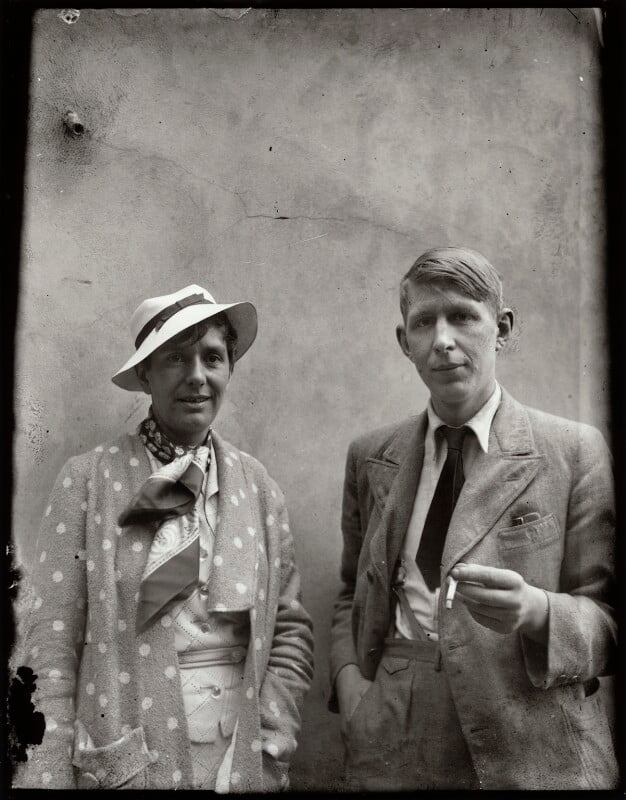
The couple above are W. H. Auden and Erika Mann. The photo was taken by a student at The Downs School, where Auden was then teaching. Erika, the daughter of the novelist Thomas Mann and an ardent opponent of Nazism, had been living in England but was in imminent danger of being repatriated to Germany. To prevent that from happening, Auden agreed to marry her. (Both were gay and not otherwise interested in matrimony.) On June 15, 1935 they were married in Ledbury, a town near the school. This photo was taken around that time, perhaps even on their wedding day.
Thomas and Katia Mann were very worried about Erika’s safety: had she been repatriated, a lengthy prison term was the best that she could have hoped for, especially since on her mother’s side she was of Jewish descent. Thomas and Katia were themselves safely on their way to New York City, traveling by ocean liner, when, on June 16, they received a terse and to-the-point telegram:
ALL LOVE FROM MRS AUDEN
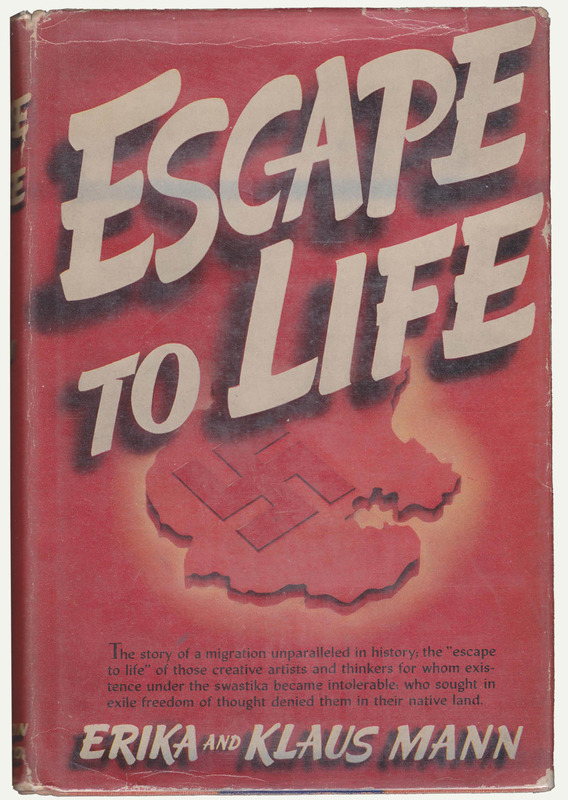
In January of 1939, Auden and his friend Christopher Isherwood arrived in New York City and were greeted at the pier by Erika and Klaus. They all drove down to Princeton to meet Papa and Mama Mann, and Life magazine sent a photographer to capture a family photo:
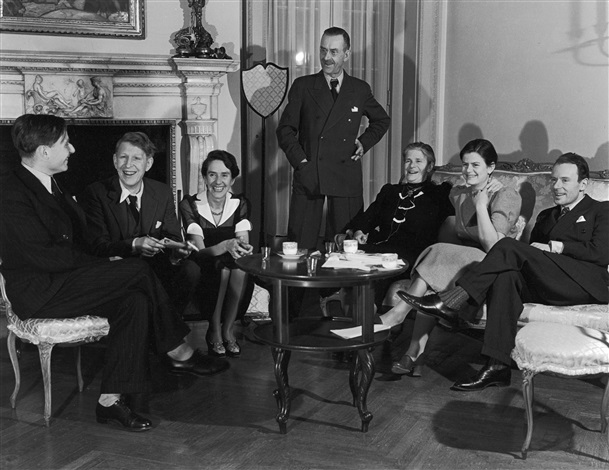
A happy reunion!
Wystan and Erika never divorced, so for decades Auden got to enjoy making jokes about “my father-in-law." When Erika died in 1969 some of the obituaries noted that she was survived by her husband, the poet W. H. Auden — a piece of information that came as rather a shock to some of her friends, and his.
All that said, after their marriage Auden was very eager for his parents to meet Erika and insisted that she travel to Birmingham with him so they could receive the parental blessing. (“My husband is a tyrant,” Erika sighed in a letter to a friend, not thinking Birmingham a sufficiently interesting or beautiful city to make a visit worthwhile.) They remained friends always, and Isherwood thought that later there was even “a touch of eroticism” to their relationship. So to call it a “marriage of convenience” is perhaps not to tell the whole truth.
Audrey Hepburn taking guitar lessons — so she can play as she sings “Moon River.”