
compliance
If, in the face of scientific findings, one lets go of the view that trigger warnings foster mental health or facilitate learning, what reasons might remain for using them? It may well be that, at this point, trigger warnings have developed a spinoff cultural meaning that departs from the aim of providing psychological aid to those who suffer from trauma. A trigger warning might really function as a signal to the subset of students who are looking for it that the teacher is sensitive to their concerns — or at least compliant with their requests — regardless of psychological benefit or harm. The choice to send such a signal is of course part of a teacher’s academic freedom. But it is important to undertake it with the understanding that signalling compassion for students and trauma survivors in this particular way may be at cross purposes with helping them, whether psychologically or pedagogically.
Yep.
taverns and churches
Looking at the rows and rows of seats in an English church, some of them dating back to the 15th century, invites questions. Why so many? Were they ever all filled, apart from an occasional wedding or funeral? The assumption is that they were full on Sundays, at least up to 1689, while parish-church attendance was compulsory. We tend to visualise an age of faith, especially up to the Reformation: a “world we have lost.”
There were, indeed, larger medieval congregations than today. Churchgoing was a valued social occasion when, especially in the countryside, there were few others. But the rows of seats are also misleading. They were put in so that people would have their own seats rather than take whatever was available. The congregation was laid out in an order of social precedence: gentry or merchants in the chancel or side chapels, yeomanry or citizens in the front of the nave, and lesser folk behind them.
They were almost all there on Easter Day, which, up to 1549, was a compulsory day of attendance to receive one’s single annual communion. Christmas and Whit Sunday were also obligatory days, although their congregations seem to have been a little smaller.
Attendance on an ordinary Sunday in medieval England was another matter, however. Contemporaries were clear that many people were absent. A succession of archbishops and bishops raged about the fact. The poet Alexander Barclay wrote in 1508: “the stalls of the tavern are stuffed with drinkers when in the church stalls [you] shall see few or none.”
news as religion
Surveys found a third of Republicans think the asymptomatic don’t transmit Covid-19, or that the disease kills fewer people than the flu or car crashes. But Democrats also test out atrociously, with 41% thinking Covid-19 patients end up hospitalized over half the time — the real number is 1%-5% — while also wildly overestimating dangers to children, the percentage of Covid deaths under the age of 65, the efficacy of masks, and other issues.
This is the result of narrative-driven coverage that focuses huge amounts of resources on the wrongness of the rival faith. Blue audiences love stories about the deathbed recantations of red-state Covid deniers, some of which are real, some more dubious. A typical Fox story, meanwhile, might involve a woman who passed out and crashed into a telephone pole while wearing a mask alone in her car. Tales of each other’s stupidity are the new national religion, and especially among erstwhile liberals, we take them more seriously than any religion has been taken in the smart set in a long, long time.
I know I have been banging this drum for a long time — here, here, and in greatest detail here — but I think it’s better to consider these systems of beliefs as myths, as emerging from what Kołakowski calls “the mythical core of culture,” rather than religion.
UPDATE: This from Sally Satel is relevant:
An ambitious new study ... by the Emory University researcher Thomas H. Costello and five colleagues ... proposes a rigorous new measure of antidemocratic attitudes on the left. And, by drawing on a survey of 7,258 adults, Costello’s team firmly establishes that such attitudes exist on both sides of the American electorate. (One co-author on the paper, I should note, was Costello’s adviser, the late Scott Lilienfeld — with whom I wrote a 2013 book and numerous articles.) Intriguingly, the researchers found some common traits between left-wing and right-wing authoritarians, including a “preference for social uniformity, prejudice towards different others, willingness to wield group authority to coerce behavior, cognitive rigidity, aggression and punitiveness towards perceived enemies, outsized concern for hierarchy, and moral absolutism.”
But before conservatives start up the “the left is worse” chorus, note this:
I asked Costello whether left-wing and right-wing authoritarians exist in equal proportions. “It is hard to know the ratio,” he said, making clear that a subject’s receptivity to authoritarianism falls on a continuum, like other personality characteristics or even height, so using hard-and-fast categories (authoritarian versus nonauthoritarian) can be tricky. “Still, some preliminary work shows the ratio is about the same if you average across the globe,” he said. In the U.S., though, Costello hypothesizes that right-wing authoritarians outnumber left-wing ones by roughly three to one. Other researchers have concluded that the number of strident conservatives in the U.S. far exceeds the number of strident progressives and that American conservatives express more authoritarian attitudes than their counterparts in Britain, Australia, or Canada.
indices
Lots of enjoyable coverage of Dennis Duncan’s new and wonderfully titled Index, A History of the. (You may find a brief excerpt from it as a work-in-progress here.)
The best thing I’ve seen is (unsurprisingly) by Anthony Grafton in the LRB. Here’s a noteworthy passage:
Indexing flowered at a time when readers saw books as great mosaics of useful tags and examples that they could collect and organise for themselves. The chief tool they used to do this job was not the index but the commonplace book: a notebook, preferably organised by subject headings known as loci communes (common places), which provided both a material space in which to store material and a set of designators to help retrieve it. Like indexes, commonplace books were wildly popular. John Foxe, a corrector of the press during his exile years in Switzerland, printed two editions of a blank commonplace book designed to be filled in by users under Foxe’s various headings. One such user, Sir Julius Caesar, crammed his copy so full of notes and excerpts that the British Library classifies it as a manuscript. In his preface to the first edition, Foxe made clear that he knew he was riding a wave. He worked for Johannes Oporinus, the Basel printer who brought out the Magdeburg Centuries, a vast Protestant history built on commonplace books compiled by students. Foxe pointed out, with relish, that everyone who was anyone was making commonplace books and telling others how to do so. Humanists commonplaced to ready themselves for effective speech and writing, medical men, lawyers and theologians to prepare for their professions. Foxe argued that the commonplace book was vastly superior to the index. The index might point you to the materials you need, but the commonplace book actually provided them, handily organised. Holmes, like his contemporary Aby Warburg (another dab hand with scissors and paste), was a late master of the commonplace book, even if he called it an index. If printing made indexes easy to compile, commonplacing made them indispensable to printers and readers alike.
In response to the TLS’s review, my dear friend Tim Larsen wrote in with the following:
I can confirm that one does indeed need a human indexer with a decent knowledge of the topic at hand. I thought I could safely ignore the index for my Oxford Handbook of Christmas (2020), but when it came back with an entry on “Joseph, father of Jesus,” I knew I had to step in. Mercifully, it went to press as “Joseph, husband of Mary.” As to humour in indexes, one of my favourites is E. P. Sanders’s Paul and Palestinian Judaism (1977). Its index has an entry for “Truth, ultimate.” The three pages listed under it lead one to the blank pages that divide the book’s parts.
Let me register a vote for My Favorite Indexer: Hugh Kenner. In some of his books he not only tabulated references to key figures, he offered memorable single-word descriptions of many of them. A few examples from his book on Irish writers, A Colder Eye:
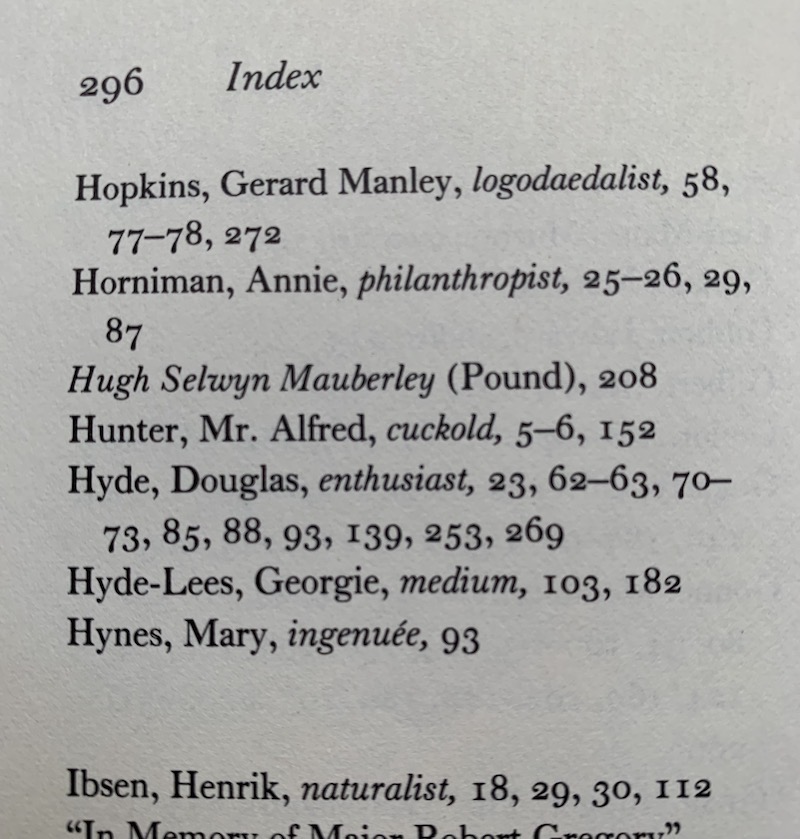

Of course, the delight here is turning to the appropriate pages to find out just how Kenner settled on the identifications he chose.

What a great cover.
excerpt from my Sent folder: strawberries
Adam, I have a story to tell you. It concerns strawberries.
When I was a boy in Birmingham, Alabama, one of my great-aunts lived in the countryside about forty miles north, and we would visit her regularly. I had maybe a dozen great-aunts, most of them formidable Southern ladies schooled in poverty, but this one was an iron-willed widow farmer who rejoiced in the name Bethalee Basenberg. She mainly grew sweet corn and tomatoes, but had a sideline in a few other things, including strawberries and sugar cane.
Now, like all civilized people with a decent palate, I loved strawberries -- but perhaps I carried it to an extreme. I loved strawberries more than any other food. On one visit, when I was ten or eleven years old, Aunt Bethalee allowed me to pick a bag of ripe strawberries and a few canes to take back to the city, and I was absolutely in heaven.
When we got home I put the strawberries in a bowl and squeezed the nectar from the canes over them, then took the bowl to my room and plopped down on the bed with a new book I had just begun: Dune. I ate and read, ate and red.
But I overdid the eating. (One cannot, of course overdo the reading.) I became violently ill and vomited red vomit, over and over again. I had never been that miserable before, and rarely have since.
Afterwards, I became nauseated when I looked at, or even just thought about, ... Dune.
Apparently some executive decision-making region of my brain knew that I loved strawberries too much to be nauseated by them, so it shifted the nausea-induction to Frank Herbert’s innocent book. I continued to eat strawberries whenever they were presented to me, and did so with delight, but I set DUNE aside -- I was maybe a hundred pages in -- for decades. Even as an adult I got queasy when I looked at it. I was in my forties before I worked up the resolve to go back and finish it.
Vive les fraises!
The Washington Post: “The metaverse, to Sweeney, would be an expansive, digitized communal space where users can mingle freely with brands and one another in ways that permit self-expression and spark joy.” Users mingling freely with brands — if that’s not Paradise Regained I don’t know what is.


random Foundational thoughts
- There was absolutely no reason to believe, at any point in the development of this series, that it would be related in a significant way to Asimov’s books, so people complaining about its deviations from them are just being silly.
- The major driver of the plot so far is an event that Asimov never thought of but that Kim Stanley Robinson did — it’s stolen straight from Red Mars.
- I really hope Jared Harris is trying to make Hari Seldon pompous — an obscure academic finding himself in the spotlight and enjoying it overmuch. If it’s purposeful it’s a nice touch. (I don’t buy the whole scene of Hari basking in the glow of the laundry workers’ adoration. If only we had seen a few of them rolling their eyes….)
- Someone clearly told Lee Pace that he needed to chew some scenery; and no scenery remains unchewed.
- That said, the floor-length sleeveless evening gown he wears for most of the first two episodes, even though it gives him a chance to display his guns, tends to have a pretty powerful anti-gravitas effect.
- There are two main threads of plot here, with two sets of characters: the Foundation mission and the imperial court. So far every character in the Foundation thread remains underdeveloped — it’s hard to tell what motivates anyone. I think the writers want to convey the complexity of character, but what they’re mainly conveying, at this point, is confusion.
- Despite Lee Pace’s overacting, the court environment is better-developed and more interesting, at least at this point. The idea of the Imperial Trinity — three clones of an ancient emperor at three different ages, the young Brother Dawn, the mature Brother Day (Pace), the elderly Brother Dusk — seemed at first like a gimmick, but I’ve come to like it. It’s an intriguing way to represent psychodynamics.
- The best thing about the show so far is Laura Birn.
- Nice to get a little plot twist at the end of the second episode, because before that things were ploddingly expositional.

A fun little acquisition. Text by Arthur C. Clarke.

waiting
I made an interesting discovery yesterday. (I’m sure others have already noticed it, but the insight is new to me.) Many readers will know this famous passage from Martin Luther King’s “Letter from the Birmingham Jail”:
We have waited for more than 340 years for our constitutional and God given rights. The nations of Asia and Africa are moving with jetlike speed toward gaining political independence, but we still creep at horse and buggy pace toward gaining a cup of coffee at a lunch counter. Perhaps it is easy for those who have never felt the stinging darts of segregation to say, "Wait." But when you have seen vicious mobs lynch your mothers and fathers at will and drown your sisters and brothers at whim; when you have seen hate-filled policemen curse, kick and even kill your black brothers and sisters; when you see the vast majority of your twenty million Negro brothers smothering in an airtight cage of poverty in the midst of an affluent society; when you suddenly find your tongue twisted and your speech stammering as you seek to explain to your six year old daughter why she can't go to the public amusement park that has just been advertised on television, and see tears welling up in her eyes when she is told that Funtown is closed to colored children, and see ominous clouds of inferiority beginning to form in her little mental sky, and see her beginning to distort her personality by developing an unconscious bitterness toward white people; when you have to concoct an answer for a five year old son who is asking: "Daddy, why do white people treat colored people so mean?"; when you take a cross county drive and find it necessary to sleep night after night in the uncomfortable corners of your automobile because no motel will accept you; when you are humiliated day in and day out by nagging signs reading "white" and "colored"; when your first name becomes “n****r," your middle name becomes "boy" (however old you are) and your last name becomes "John," and your wife and mother are never given the respected title "Mrs."; when you are harried by day and haunted by night by the fact that you are a Negro, living constantly at tiptoe stance, never quite knowing what to expect next, and are plagued with inner fears and outer resentments; when you are forever fighting a degenerating sense of "nobodiness"--then you will understand why we find it difficult to wait. There comes a time when the cup of endurance runs over, and men are no longer willing to be plunged into the abyss of despair. I hope, sirs, you can understand our legitimate and unavoidable impatience.
I have taught this essay many, many times over the years, and I have always zeroed in on this passage as an excellent illustration of the use of imitative form. King wants his (largely white) readers to know what it feels like to wait … and wait … and wait … — so he makes those readers wait … and wait … and wait … for the conclusion of the 316-word sentence that’s at the heart of this paragraph.
Here’s my discovery. Right now I’m teaching Frederick Douglass’s Narrative, and in the final chapter of that mesmerizing book he writes this, an account of his experience as an escaped slave in the North when the Fugitive Slave Act was in effect:
I have been frequently asked how I felt when I found myself in a free State. I have never been able to answer the question with any satisfaction to myself. It was a moment of the highest excitement I ever experienced. I suppose I felt as one may imagine the unarmed mariner to feel when he is rescued by a friendly man-of-war from the pursuit of a pirate. In writing to a dear friend, immediately after my arrival at New York, I said I felt like one who had escaped a den of hungry lions. This state of mind, however, very soon subsided; and I was again seized with a feeling of great insecurity and loneliness. I was yet liable to be taken back, and subjected to all the tortures of slavery. This in itself was enough to damp the ardor of my enthusiasm. But the loneliness overcame me. There I was in the midst of thousands, and yet a perfect stranger; without home and without friends, in the midst of thousands of my own brethren — children of a common Father, and yet I dared not to unfold to any one of them my sad condition. I was afraid to speak to any one for fear of speaking to the wrong one, and thereby falling into the hands of money-loving kidnappers, whose business it was to lie in wait for the panting fugitive, as the ferocious beasts of the forest lie in wait for their prey. The motto which I adopted when I started from slavery was this — “Trust no man!” I saw in every white man an enemy, and in almost every colored man cause for distrust. It was a most painful situation; and, to understand it, one must needs experience it, or imagine himself in similar circumstances. Let him be a fugitive slave in a strange land — a land given up to be the hunting-ground for slaveholders — whose inhabitants are legalized kidnappers — where he is every moment subjected to the terrible liability of being seized upon by his fellowmen, as the hideous crocodile seizes upon his prey! — I say, let him place himself in my situation — without home or friends — without money or credit — wanting shelter, and no one to give it — wanting bread, and no money to buy it, — and at the same time let him feel that he is pursued by merciless men-hunters, and in total darkness as to what to do, where to go, or where to stay, — perfectly helpless both as to the means of defence and means of escape, — in the midst of plenty, yet suffering the terrible gnawings of hunger, — in the midst of houses, yet having no home, — among fellow-men, yet feeling as if in the midst of wild beasts, whose greediness to swallow up the trembling and half-famished fugitive is only equalled by that with which the monsters of the deep swallow up the helpless fish upon which they subsist, — I say, let him be placed in this most trying situation, — the situation in which I was placed, — then, and not till then, will he fully appreciate the hardships of, and know how to sympathize with, the toil-worn and whip-scarred fugitive slave.
A brilliant paragraph ending with a 239-word sentence that does exactly what MLK’s still-longer sentence would do more than a century later. I can’t help but think that MLK had this passage from Douglass in mind, if only unconsciously. Where Douglass uses dashes MLK uses semicolons; where Douglass uses “let him” MLK uses “when” — but the strategy and the effect are the same: holding the reader at a point of tension that the writer will offer release from only when the point is well-made. (The ultimate example of this strategy is Wagner’s use of the Tristan chord, which he resolves after fours hours or so, but only a madman would take the business that far.) “Notice how tense you were as you were waiting for the conclusion to that sentence? Imagine that intensified and prolonged by a factor of ten thousand.”
neighbors
While it's not much like European nation-states, the U.S. has plenty of similarities to other post-colonial, pluralistic societies in North and South America.
Take religiosity. Despite trends toward non-affiliation, Americans' largely favorable attitudes toward religion contrast sharply with most European countries' secularism. That quality isn't specific to the U.S., though. In fact, we rank around the middle of North and South American religiosity, similar to Mexico but lower than Brazil and most Central American countries. The continental outlier isn't the U.S. but Canada, which reports the lowest religiosity in the Western hemisphere. Yet even there, 27 percent report religion is very important in their lives, more than double the rate in comparably rich parts of Europe.
Murder rates are another good illustration. Here too, the U.S. resembles our neighbors more than our European cousins. Our national murder rate of around five homicides per 100,000 inhabitants is about four times that of the United Kingdom, France, Germany. But it's lower than every country in the Americas except Chile, Martinique, Aruba, and Canada. (Even Greenland has a higher murder rate than we do.)
And so on. Fascinating essay on the ways the U.S. more closely resembles other nations in the Americas than it does any place in Europe.


So let me get this straight: From plants you’ve developed sentient chickens, and you expect me to eat them?
the Mondragon moment
In 1990, for a then-new magazine called First Things, the historian Christopher Lasch wrote about the incompatibility of conservatism and free-market capitalism, at least as capitalism is currently constituted. For instance, he argues that
If conservatism is understood to imply a respect for limits, it is clearly incompatible with modern capitalism or with the liberal ideology of unlimited economic growth. Historically, economic liberalism rested on the belief that man’s insatiable appetites, formerly condemned as a source of social instability and personal unhappiness, could drive the economic machine — just as man’s insatiable curiosity drove the scientific project — and thus ensure a never-ending expansion of productive forces. For the eighteenth-century founders of political economy, the self-generating character of rising expectations, newly acquired needs and tastes, and new standards of personal comfort gave rise to a form of society capable of indefinite expansion. Their break with older ways of thinking lay in the assertion that human needs should be regarded not as natural but as historical, hence insatiable. As the supply of material comforts increased, standards of comfort increased as well, and the category of necessities came to include goods formerly regarded as luxuries. Envy, pride, and ambition made human beings want more than they needed, but these “private vices” became “public virtues” by stimulating industry and invention. Thrift and self-denial, on the other hand, meant economic stagnation. “We shall find innocence and honesty no more general,” wrote Bernard Mandeville, “than among the most illiterate, the poor silly country people.” The “pleasures of luxury and the profit of commerce,” according to David Hume, “roused men from their indolence” and led to “further improvements in every branch of domestic as well as foreign trade.”Early apostles of the pursuit of “the pleasures of luxury and the profit of commerce,” like Hume and Adam Smith, freely acknowledged the damage that such pursuit would likely do to traditional institutions and values, but a century later, “Nineteenth-century philanthropists, humanitarians, and social reformers argued with one voice that the revolution of rising expectations meant a higher standard of domestic life, not an orgy of self-indulgence activated by fantasies of inordinate personal wealth, of riches painlessly acquired through speculation or fraud, of an abundance of wine and women.”
This was of course nonsense, either a manipulative sales pitch or wishful thinking. Lasch:
In the long run, of course, this attempt to build up the family as a counterweight to the acquisitive spirit was a lost cause. The more closely capitalism came to be identified with immediate gratification and planned obsolescence, the more relentlessly it wore away the moral foundations of family life. The rising divorce rate, already a source of anxious concern in the last quarter of the nineteenth century, seemed to reflect a growing impatience with the constraints imposed by long-term responsibilities and commitments. The passion to get ahead had begun to imply the right to make a fresh start whenever earlier commitments became unduly burdensome.Conservatives were slow to acknowledge these (in retrospect obvious) facts because they did not want to give aid and comfort to a leftist politics that was even less tolerant, though in different ways and for different reasons, of families and other traditional institutions. What these celebrants of capitalism could not see at all — and what is rarely seen even today — is the essential truth that “Marxists ... shared the liberal view of nature [including human nature] as so much raw material to be turned to the purpose of human enjoyment.” So when faced with runaway acquisitiveness they merely exhorted people to work harder and save more.
To which Lasch:
That most conservatives have contented themselves with such exhortations provides a measure of the intellectual bankruptcy of twentieth-century conservatism. The bankruptcy of the left, on the other hand, reveals itself in the left’s refusal to concede the validity of conservative objections to the welfare state. The only consistent criticism of the “servile state,” as it was called by Hilaire Belloc, came from those who demanded either the restoration of proprietorship (together with the drastic measures required to prevent the accumulation of wealth and property in the hands of the few) or the equivalent of proprietorship in the form of some kind of cooperative production. The first solution describes the position of populists like Belloc and G. K. Chesterton; the second, that of syndicalists and guild socialists, who briefly challenged social democrats for leadership of the labor movement in the period immediately preceding World War I. According to Georges Sorel, the superiority of syndicalism to socialism lay in its appreciation of proprietorship, dismissed by socialists as the source of “petit-bourgeois” provincialism and cultural backwardness. Unimpressed by Marxian diatribes against the idiocy of rural life, syndicalists, Sorel thought, valued the “feelings of attachment inspired in every truly qualified worker by the productive forces entrusted to him.” They respected the “peasant’s love of his field, his vineyard, his barn, his cattle, and his bees.”“Proprietorship” is a key concept for Lasch, and he think it ought to be central to what he wants to see emerge, which is a kind of conservative populism — a genuine populism, not what goes by that name in 2021 and often did in 1990, a mélange of petty social and cultural resentments.
The cultural populism of the right is a populism largely divested of its economic and political content, and it therefore does not address the issue that ought to engage the imagination of conservatives: how to preserve the moral advantages of proprietorship in a world of large-scale production and giant organizations.That those giant organizations have now added to their arsenal the resources of what Shoshana Zuboff calls “surveillance capitalism” makes the addressing of this issue even more urgent. Lasch: “The ideal of universal proprietorship embodies a humbler set of expectations than the ideal of universal consumption, universal access to a proliferating supply of goods. At the same time, it embodies a more strenuous and morally demanding definition of the good life.” But it will be very difficult for anyone successfully to promote universal proprietorship because “a more equitable distribution of wealth, it is now clear, requires at the same time a drastic reduction in the standard of living enjoyed by the rich nations and the privileged classes.”
Still, the issue must be confronted, the question must be raised. “Our grandchildren will find it hard to understand, let alone to forgive, our unwillingness to raise it.”
Lasch’s whole essay points towards two solutions — that of the Distributists, whom he calls “populists,” and that of the guild syndicalists. But after he introduces both, he speaks thereafter only of populism. He doesn’t say why, but I suspect — indeed I am sure — that he sees such populism as compatible with American history and the American character in ways that syndicalism simply is not. A William Jennings Bryan is imaginable in America but not in the Basque country; a Mondragon collective is imaginable in the Basque country but not in America, the Amana Colonies notwithstanding.
I have some questions about this. First of all, I am not sure that it makes sense to call Distributism populist, though perhaps all Lasch means to indicate there is an appeal to a deeply ingrained American preference for rugged individualism, for freedom conceived in purely personal terms, as opposed to the collective, communal character of guild syndicalism. But along the lines of that distinction: Is it possible, though, that recent changes in the American psyche, the American character – many of us are, after all, pretty thoroughly disconnected from our own history, though mere ignorance and through a set of habits newly enforced by our technologies – could make at least some of us more receptive to a model of social organization that acknowledges the limits of individualism while simultaneously declining to take the path of state socialism? Could, after all, a Mondragon moment happen here?
There’s a lot to unpack here. I am especially interested in asking whether anarcho-syndicalism might be more conducive to healthy families than either state socialism or surveillance capitalism are. (My fear about populism, at least as we have it now, is that it is prone to generate the former as a reaction or be absorbed into the latter.) But I want to keep thinking along these lines.
UPDATE: Russell Arben Fox wrote to share an excellent recent post of his on these matters — I had somehow missed it. I’m going to reflect on that too and report back later. Russell is right to note that movements along the lines I suggest are already happening, but on a small scale and not really in the public eye. And maybe that’s the way these endeavors, by their very nature, have to happen. But I’d like to see a larger public conversation about political and social options beyond the ones we have to hear about every single day.
I’ll never say anything authoritative about any of these matters, but I do want to think better about them.


Detachment and objectivity are not to be found in the Confessions. Analysis of divine affairs is not only not kept apart from self-analysis, but the two streams are run together in what often appears to first readers to be an uncontrolled and illogical melange. This book's fascination for modern readers stems in large part from its vivid portrayal of a man in the presence of his God, of God and the self intimately related but still separated by sin, and of a struggle for mastery within the self longing for final peace. It is an extraordinary book, no matter how studied.
The rest of Augustine's life was spent writing books of a more conventional sort. He would analyze in painstaking detail the inner workings of the Trinity, the whole course of salvation history, and the delicate commerce between God and man in the workings of grace and the will, all in an objective, detached, and impersonal style. What is different about them is that they were written by a man who had already written the Confessions, made his peace with God insofar as that was possible, and drawn from that peace (the forerunner of heavenly rest) the confidence he needed to stand at the altar and preach or to sit in his study dictating works of polemic and instruction for the world to read….
The Confessions are not to be read merely as a look back at Augustine's spiritual development; rather the text itself is an essential stage in that development, and a work aware both of what had already passed into history and of what lay ahead. No other work of Christian literature does what Augustine accomplishes in this volume; only Dante's Commedia even rivals it.