

This by Jonathan Liew is beautiful:
Certainly this final felt like a turning point of sorts: a pause in hostilities, perhaps even a burying of the hatchet. “My heart is filled with joy and I’m the happiest man alive,” Djokovic said after the match, paying tribute to the crowd. He had just lost a devastating final. His tilt at immortality had come crashing down at the last. And yet it was hard to shake the suspicion that on some level, he finally had what he had always wanted.
where have you gone, Hamburger University?
I just spent a few days in Chicagoland, visiting dear old friends and my very dear son. I got a deal from Expedia and stayed at the Hyatt Lodge in Oak Brook, which used to be a hotel owned by McDonald’s as part of the Hamburger University campus. But Hamburger University is no more. (At least, not in Oak Brook.)
If you walk around the site you see immaculately-tended grounds:

And the buildings are well-kept also:
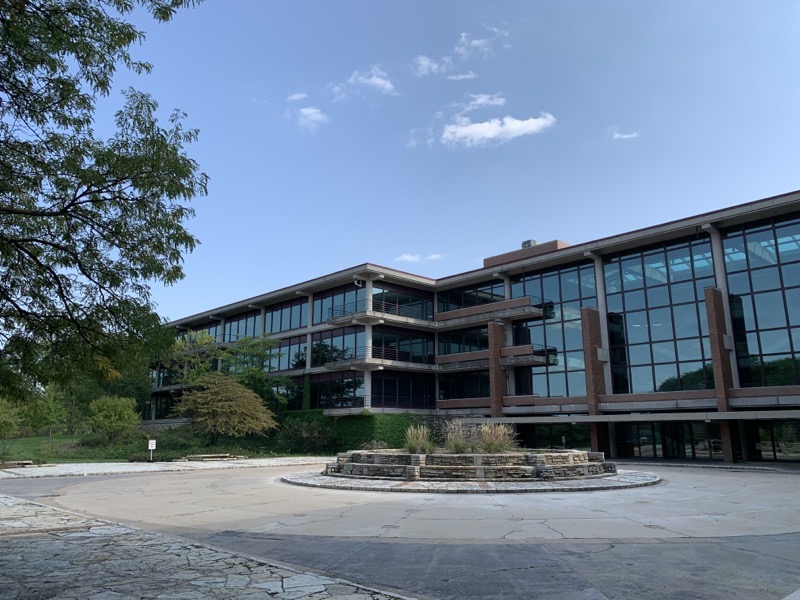
Very mid-century modern. But as you look closer you see that the buildings are totally empty:


Rather disconcerting. The property has been purchased, and its billionaire owner appears to have undisclosed plans for it. But nothing is happening at the moment, and around the edges things are starting to look a little shabby.
I think it would be an ideal location for The School for Scale. Just saying.



Eventually, all discussions about sterilizing immunity become nerdy quibbles over semantics. Clearly, not every infection is clinically meaningful, or even logistically detectable, given the limits of our technology — nor do they need to be, if there’s no sickness or transmission. (A koan for pandemic times: If a microbe silently and inconsequentially copies itself in a tissue, and the body doesn’t notice, did it actually infect?) There is, for every pathogen, a threshold at which an infection becomes problematic; all the immune system has to do is suppress its rise below this line to keep someone safe.
But that might be exactly the point. Say that sterilizing immunity is impossible, that our immune systems cannot, in fact, be trained to achieve perfection. Then it’s neither a surprise nor a shortcoming that COVID-19 vaccines, or other vaccines, don’t manage it: An inoculation that guards marvelously well against disease — offering as much protection as it can — can still end an outbreak. Life would certainly be easier if vaccines offered invincible armor, with pathogens simply ricocheting off. But they don’t, and assuming or expecting them to manage that can be dangerous. The dubiousness of sterilizing immunity is a reminder that just about any immune response can be overwhelmed, if exposures are heavy and frequent enough, Grad told me. The best we can all hope for is functional immunity, more like a flame retardant than a firewall, that still keeps bad burns at bay.
One thing I don’t understand (and I’ve read a good deal of legal commentary on this issue) about United States v. Texas: The suit says that the Defendant is “the State of Texas” and that “The State of Texas includes all of its officers, employees, and agents, including private parties who would bring suit under S.B. 8,” but what does “private parties who would bring suit” mean? As far as I can tell the United States is suing unspecified people for some envisioned future action. How is that possible, unless the government has a Precog Division I don’t know about? How is is possible for any of us who live in Texas to know whether we are among the Defendants in the suit?
beyond the strongman
In a previous post I wrote:
This tension between the ancient vessels of culture and what they contain is not indefinitely sustainable: in the long run, either we will adjust our thinking and feeling to match the shapes of our familiar institutions, or we will reshape those institutions so that they suit our thoughts and feelings. The latter is quite obviously what’s happening, because new institutions — the catechizing and propagandizing ones, which cunningly present themselves as non- or trans-institutional — are co-opting the old ones. “The media creates us in its image” — but the existing institutions are incompatible with the shape in which we are being remade. So they must either be transformed or destroyed.I want to link this with an earlier post on the idea of a “long march through the institutions”:
You sometimes hear Dutschke’s phrase from conservative commentators frustrated by the success of the left in making just such a march through American civil society, through the media and the arts and the universities. They are correct that this has happened, but they rarely draw the appropriate conclusions from it. Instead of imitating the patience and persistence of the leftist marchers, they long for a strongman, a Trump or an Orban, to relieve them of the responsibility for reshaping civil society. If reshaping those institutions seems hard, then why not dream of someone powerful enough to blow them up and start over? Dreams of an omnicompetent strongman are the natural refuge of people too lazy and feckless to begin, much less complete, a long march.What’s the purpose of a strongman? The strongman props up the decaying institutions on which we have come to depend. The strongman postpones the day of reckoning. The strongman kicks the can down the road so we can go peacefully to our graves knowing that institutional collapse will be our grandchildren’s problem to deal with, not ours. Sweet dreams to us.
You know what the Trumpistas and Orbanistas remind me of? Denethor. Last year, I gestured at some of the issues I’m here concerned with in a post about intellectual/political “fascist architecture,” about the ways in which laziness leads to hopelessness and hopelessness to a kind of nihilistic wrath:
“I would have things as they were in all the days of my life … and in the days of my longfathers before me: to be the Lord of this City in peace, and leave my chair to a son after me, who would be his own master and no wizard’s pupil. But if doom denies this to me, then I will have naught: neither life diminished, nor love halved, nor honour abated.”For all Denethor’s talk of “honour,” his behavior is shameful. But there are two reasonable and, yes, honorable alternatives to authoritarian nihilism, especially for my fellow Christians. (Much of what I say in the following paragraphs also applies to cultural conservatives more generally.)
The first is to seek the renewal of those institutions that are not too far gone for rescue — genuine renewal, not turning them into puppets for strongmen. For guidelines to that project, see my posts on Invitation and Repair.
The second is, when institutions cannot be renewed, to follow the example of James Joyce’s Stephen Dedalus, who strove to create for himself an environment in which he could, in the face of cultural indifference or opposition, thrive as an artist. “I will tell you what I will do and what I will not do. I will not serve that in which I no longer believe, whether it call itself my home, my fatherland, or my church: and I will try to express myself in some mode of life or art as freely as I can and as wholly as I can, using for my defence the only arms I allow myself to use — silence, exile and cunning.” Let Stephen be our model, even though his enemy — I am not unaware of the irony — was the Church, along with his nation and his family. Stephen is our model because he thought hard about how to survive, and even thrive, while still in thrall to Powers he could not directly challenge.
Silence: Not a permanent silence, but a refusal to speak at the frantic pace set by social media; silence as the first option — the preferential option for the poor in spirit, you might say; silence as a form of patience, a form of reflection, a form of prayer. A refusal to be baited; a renewal of the old and forgotten virtue called “keeping my counsel.”
Exile: The idea of the Church in exile is an increasingly popular one these days, and for good reason. I’m a little suspicious of some of its potential implications, but overall, I think, we do well to think of ourselves not simply as on pilgrimage — though yes, always that, we are a pilgrim people — but more specifically as pilgrims who are also exiles, who are on the way because we have been cast out of the place where we had hoped to rest. (Call it Christendom, America the Christian Nation, what you will.) Whether this casting out is primarily due to our sins or the ruthlessness of our enemies is something we can debate as we walk, though my counsel is that we should always focus primarily on where we have missed the mark, because that leads to repentance and amendment of life. Moreover, while some exiles are simple this one is complex, because we have not all been exiled to the same place. The body of Christ is not just wounded but divided: our exile is of that particularly painful type known as Diaspora. In such circumstances we travel light, our luggage reduced to the barest essentials; we regularly send out messengers to seek the brothers and sisters whom we have lost; and we relentlessly recite to ourselves the terms that mark our identity. These are the prime virtues of a people in exile.
Cunning: Many traditional communities rely heavily on the kind of person that in England used to be called “cunning men” and “cunning women” — every American Indian community likewise had its “wise woman.” If you had a bad tooth, of course, you’d go to the surgeon — who was usually also a barber — and he’d yank it out. But you’d go to the cunning folk if you didn’t know what was wrong with you, or if anything was wrong with you at all, other than a suspicion that something was wrong with you. The cunning folk had no technique — if they had technique they’d belong to some proper profession — but could draw on experience, and a body of lore passed down from generation to generation, and a certain undefinable shrewdness: a nose for trouble. The cunning man or woman needs, above all, attentiveness and imagination — especially in relation to the beauty hidden in filth. We Christians are in likewise desperate need, not of better techniques for management of our “diminished thing” called the church — as though our highest ambition were to make our spiritual nest egg last just a little bit longer; kicking that can down the road — but of theological and pastoral cunning. What do we have to lose but our chains?
we all know but won't say
I just don’t believe people, on this issue. When they say that they think all people have the same innate ability to perform well in school or on other cognitive tasks, that any difference is environmental, what I think inside is, I don’t believe that you believe that. When researchers in genetics and evolution who believe that the genome influences every aspect of our physiological selves say that they don’t believe that the genome has any influence on our behavioral selves, what I think inside is, I don’t believe you. I think people feel compelled to say this stuff because the idea of intrinsic differences in academic ability offend their sense of justice, and because the social and professional consequences of appearing to believe that idea are profound. But I think everyone who ever went to school as a kid knew in their heart back then that some kids were just smarter than others, and I think most people quietly believe that now.
I have often had exactly this thought! We all know but we choose not to say.
(Also, Freddie is correct to say, elsewhere in this post, that there are hundreds of supposedly reputable people who a few years ago lied relentlessly about his book — the book he hadn’t yet written! — in the hope of getting his contract canceled, and have never apologized or retracted their falsehoods. Having a blue check means never having to say “I was wrong,” I guess. That was one of the events, one of several, that permanently and definitively soured me on Twitter: seeing how enthusiastically professional journalists and academics would lie in order to bring down someone for wrongthink — when in fact the person wasn’t even guilty of the heresy they accused him of. It’s the act of burning witches that justifies you; the question of whether the people you’re burning actually are witches doesn’t arise, then or later.)




the breaking of the inherited vessels
But the Enlightenment has for us a strange form of continuing life: everything about it seems alien, and yet everything about it seems familiar; it is simultaneously dead, undead, and full of life. The reason for this, I will suggest, is that we still live within institutions and practices created in the eighteenth century, the institutions and practices of the free market, of free speech and freedom of religion, and of the written constitution. These institutions and practices embody ideas, and the ideas they embody are those of the Enlightenment paradigm. The institutions, the practices, and the ideas are intertwined and inseparable. The Enlightenment lives on in us, even as we attack it or deny that it ever really existed, because Enlightenment forms of life (to adopt a phrase from Ludwig Wittgenstein) continue to be our forms of life. Those forms of life are certainly under strain, and it would be wrong to assume they will survive indefinitely. Indeed their life may be coming to an end. In a postindustrial, digital world, a world of artificial intelligence and of boundless supplies of energy, new categories of thought and new institutions may supplant them; and perhaps we can see more clearly now what the Enlightenment paradigm was precisely because we are beginning to emerge from it. As G. W. F. Hegel said, "the owl of Minerva spreads its wings only with the falling of the dusk.”
— David Wootton, from Power, Pleasure, and Profit (p. 13). This insight seems to me relevant to Christian life also. There is a kind of mismatch between the forms we have inherited and what we believe — what we believe because we are being catechized in certain beliefs by a culture of ambient propaganda. This tension between the ancient vessels of culture and what they contain is not indefinitely sustainable: in the long run, either we will adjust our thinking and feeling to match the shapes of our familiar institutions, or we will reshape those institutions so that they suit our thoughts and feelings. The latter is quite obviously what’s happening, because new institutions — the catechizing and propagandizing ones, which cunningly present themselves as non- or trans-institutional — are co-opting the old ones. “The media creates us in its image” — but the existing institutions are incompatible with the shape in which we are being remade. So they must either be transformed or destroyed.

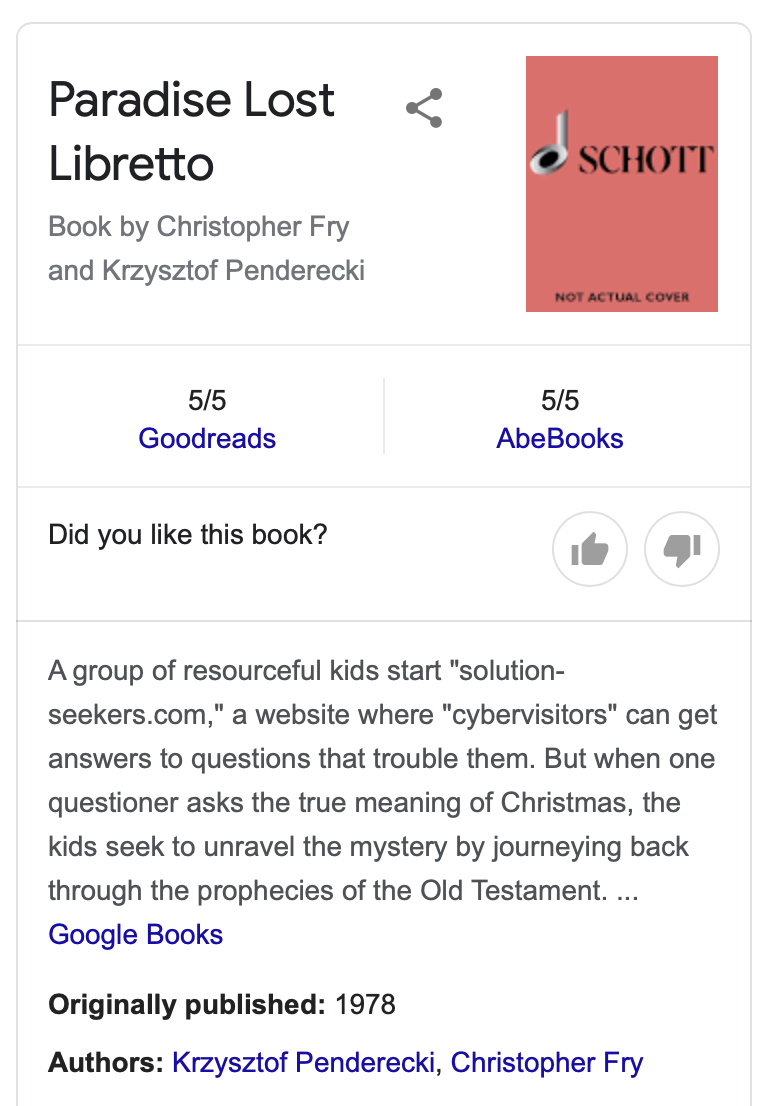
Well now, this is a more innovative adaptation than I thought it would be. As I said, research is fun!

afterwards
This lovely post by my friend Wesley Hill on carrying and using a Bible reminds me of a question I ask myself on a regular basis: What is Christianity when it is no longer a religion of the book? Because I think Christianity around the world, for varying reasons, is becoming and in some places has already fully become a post-book practice. I don’t think we Christians have reckoned as seriously as we ought to with that change — and especially how those of us who remain People of the Book are best to relate to and connect with those whose Christian faith doesn’t employ books.
Elon's plan
Musk owns Tesla Energy. And I think he's going to turn a profit on Starship by using it to launch Space based solar power satellites. By my back of the envelope calculation, a Starship can put roughly 5-10MW of space-rate photovoltaic cells into orbit in one shot. ROSA—Roll Out Solar Arrays now installed on the ISS are ridiculously light by historic standards, and flexible: they can be rolled up for launch, then unrolled on orbit. Current ROSA panels have a mass of 325kg and three pairs provide 120kW of power to the ISS: 2 tonnes for 120KW suggests that a 100 tonne Starship payload could produce 6MW using current generation panels, and I suspect a lot of that weight is structural overhead. The PV material used in ROSA reportedly weighs a mere 50 grams per square metre, comparable to lightweight laser printer paper, so a payload of pure PV material could have an area of up to 20 million square metres. At 100 watts of usable sunlight per square metre at Earth's orbit, that translates to 2GW. So Starship is definitely getting into the payload ball-park we'd need to make orbital SBSP stations practical. 1970s proposals foundered on the costs of the Space Shuttle, which was billed as offering $300/lb launch costs (a sad and pathetic joke), but Musk is selling Starship as a $2M/launch system, which works out at $20/kg.
So: disruptive launch system meets disruptive power technology, and if Tesla Energy isn't currently brainstorming how to build lightweight space-rated PV sheeting in gigawatt-up quantities I'll eat my hat.
just for the record
Matt Taibbi has posted a newsletter edition in which he complains about what he calls a “just-released On the Media episode” about free speech — but I think the episode, which you can find here, merely re-posts an episode from two years ago. (Probably? I don’t have time to do a comparative listening.) I only want to make a brief comment, in two points.
One: Marantz thinks that Richard Rorty, whom he admires, was an “analytical philosopher” until the 1990s, but Rorty made his definitive break with analytic philosophy in his 1979 book Philosophy and the Mirror of Nature. Marantz’s fuzzy sense of the shape of Rorty’s career is matched by his cringe-makingly fuzzy sense of what Rorty meant by “contingency” and what he was arguing in his late and explicitly political work. If you want to get a sense of what Rorty actually thought, from someone whose politics are probably pretty close to Marantz’s, read this 2012 essay by Charles Marsh. (Charles and I were grad students at UVA together, he in Religion and me in English, when Rorty joined the faculty. I got to know Rorty a little bit; Charles knew him much better.) Rorty is definitely an important, though not an infallible, thinker for our moment, and it’s worth approaching him via a reliable guide. Of course, best of all would be to read him directly! — but please don’t focus only on the decontextualized passages that went viral when Trump was elected.
Two: — and this is a more important point, for me anyway — Marantz has no idea what Mill argued in On Liberty. For instance, Marantz says, “In his book, On Liberty, John Stuart Mill argues for one simple principle — the harm principle. It amounts to this: the state, my neighbors and everyone else should let me get on with my life as long as I don’t harm anyone in the process. One way of thinking of this is my freedom to swing my fist, ends at the tip of your nose. Mill favors free speech too, up to the point where it inflames violence. But merely causing offence, he thinks, is no grounds for intervention. Because in his view, that is not a harm.” Nope. Nopenopenope.
Throughout On Liberty, Mill has very little — almost nothing — to say about physical harm. He is much more interested in (real or potential) moral harm. Being a serious thinker, he makes a series of distinctions. For instance, he distinguishes between the kinds of actions that deserve legal punishment from those that deserve social opprobrium. You would never know it from Marantz, but Mill thinks there are circumstances in which a person who hasn’t violated any laws should still suffer “moral reprobation” and even a kind of social punishment:
What I contend for is, that the inconveniences which are strictly inseparable from the unfavourable judgment of others, are the only ones to which a person should ever be subjected for that portion of his conduct and character which concerns his own good, but which does not affect the interests of others in their relations with him. Acts injurious to others require a totally different treatment. Encroachment on their rights; infliction on them of any loss or damage not justified by his own rights; falsehood or duplicity in dealing with them; unfair or ungenerous use of advantages over them; even selfish abstinence from defending them against injury — these are fit objects of moral reprobation, and, in grave cases, of moral retribution and punishment.
And notice another thing about that passage: when speaking of “acts injurious to others” Mill is not thinking of fists striking noses but rather of “falsehood or duplicity” and even “selfish abstinence from defending them against injury”!
Furthermore, Mill advocates for legal limits on speech itself in terms that even the more censorious among us might approve: “An opinion that corn-dealers are starvers of the poor, or that private property is robbery, ought to be unmolested when simply circulated through the press, but may justly incur punishment when delivered orally to an excited mob assembled before the house of a corn-dealer, or when handed about among the same mob in the form of a placard.” (This is Mill’s version of the doctrine of “fighting words.”)
Mill is a much more sophisticated and nuanced figure that either his celebrants or enemies think. I wish people would stop using him as cudgels in their culture wars and read him with care.
on me
Wyatt Mason on Jon Fosse's Septology:
The practice of prayer, the practice of painting, the products of prose: all buoy us as we live and as those we love die — as those whom Asle has loved will. Like all members of our species have before him, Asle leaves his own inscrutable lines on the world, “the innermost picture inside me,” he says, “that all the pictures I’ve tried to paint are attempting to look like, this innermost picture, that’s a kind of soul and a kind of body in one, yes, that’s my spirit, what I call spirit.” And with Asle, in this remarkable novel, we pray:
and I hold the brown wooden cross between my thumb and my finger and then I say, again and again, inside myself, as I breathe in deeply Lord and as I breathe out slowly Jesus and as I breathe in deeply Christ and as I breathe out slowly Have mercy and as I breathe in deeply On me.
I’m gonna have to read this absolutely enormous one-sentenced book, dammit.