
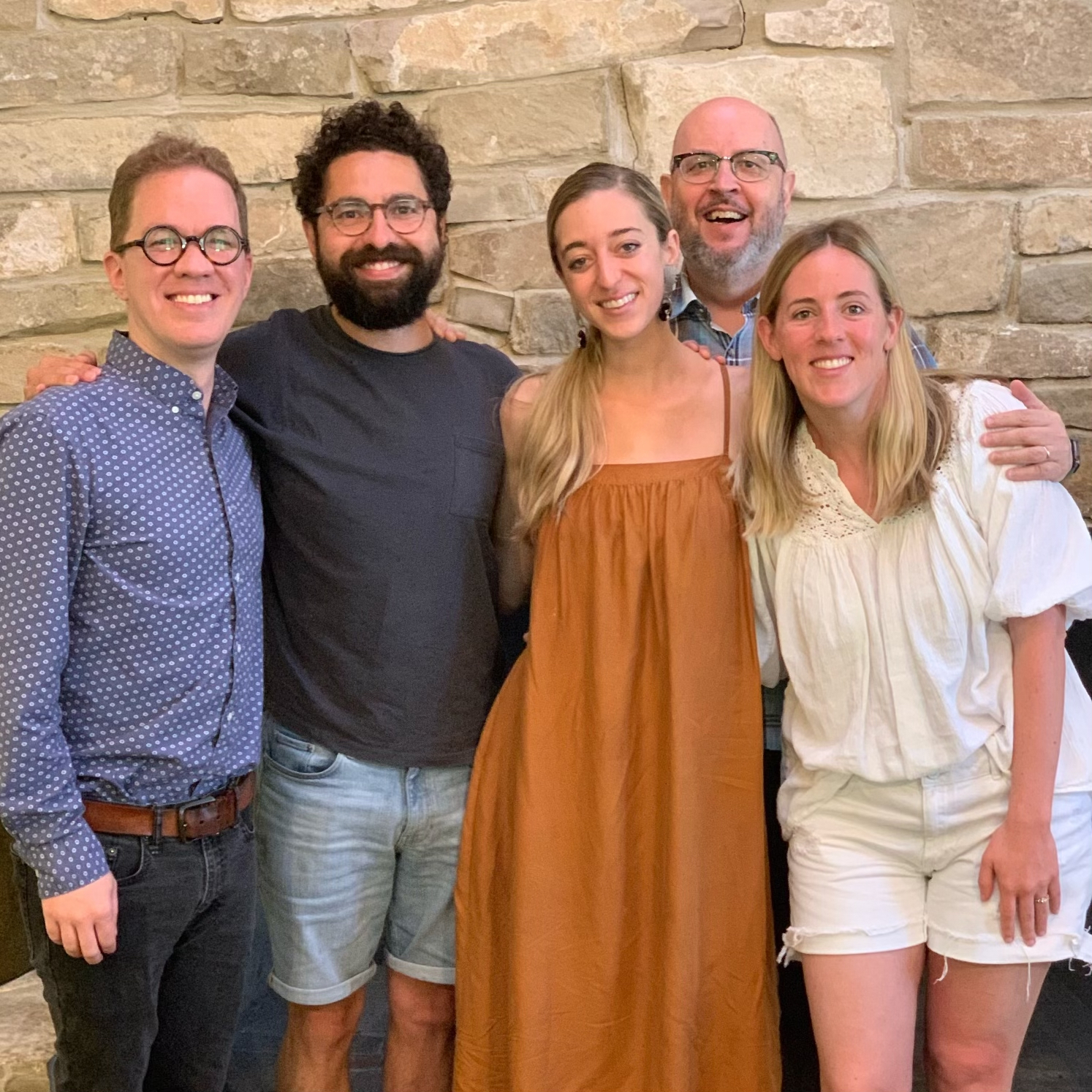
So grateful for the time at Laity Lodge with these dear people.
citizens
I’ve just returned from Laity Lodge, where I had a glorious time with my dear friend Wesley Hill: talking about “praying with Jesus”; joyously embracing old friends — including our artist-in-residence Mia Carameros — but also making new friends; worshipping; listening; singing … what a memorable three days it was.
Among the many delights was getting to know Jon and Valerie Guerra, whose music greatly enlivened our time together. A real highlight was the Saturday evening concert, where they gave us a song I want to share with you all. There’s a lovely studio version, but maybe because I heard it live, I’m inclined to post this powerful solo performance by Jon, who gives us in song a prophetic word that I answer with an emphatic Amen:
Every time I’m at Laity Lodge I take pictures of this Japanese maple, because the light is always bouncing off it in different ways.


He likes parsley, I have too much parsley. So we’re cool.



the Campanile of Giotto

John Ruskin, Tracery from the Campanile of Giotto in Florence; in The Seven Lamps of Architecture
tablets
When the iPad came out, more than a decade ago, I tweeted that I didn’t especially want an iPad but would really love an e-ink tablet, one on which I could read books and magazines and PDFs, and then make annotations on them. That didn’t seem very likely at the time, but now some of those devices have been produced, and I recently tried a couple of them.
The first device I bought was a reMarkable tablet, which features
- excellent build quality
- responsive software, especially its handwriting recognition
- very good OCR of handwriting
- reliable syncing
The one problem I had with it turned out to be an insurmountable one. The device has no light of any kind, and the color of the screen is a disconcertingly dark gray; I found the contrast between black type and the gray screen so limited that I couldn’t read anything on the device without strain, except in the very brightest light. It was perfect outdoors, but usable indoors only at my desk, where I could point my desk lamp directly at the screen. So I had to return the reMarkable – with regrets, because it’s a cool device in other respects. I’m sure people with younger eyes than mine can enjoy it.
So after returning the reMarkable, I bought the Kobo Elipsa, which seemed more promising largely because it does have a so-called ComfortLight, which works well. However, that was the only good thing about the device. The build quality is mediocre at best – it feels flimsy – and the software is so unresponsive that I just couldn’t use it. I would tap something on the screen, the software keyboard would either not respond at all or respond only after a delay of several seconds. Writing with the included stylus was painful, so long was the delay between the movement of the stylus and the appearance of text on the screen.
If the reMarkable tablet featured the same lighting that the Elipsa does, I would’ve kept it and been very happy with it. It’s better-designed and better-built.
Finally: both companies make it hard to return their devices. You really have to hunt on the reMarkable website to find the page that tells you how to initiate a return, though once you do find that page the process is relatively straightforward. Kobo, though, doesn’t let you initiate a return without engaging a representative in chat or on the phone. And that’s a very slow process – they seem to be hoping that you will get tired of the delays, give up, and keep the device you don’t really want. When you obscure and complicate the process of returning devices, you make me disinclined to buy anything else from your company.
Shadow Kingdom

An amazing show, but too short. The best versions I’ve ever heard of “Queen Jane Approximately” and “Forever Young” — the latter a tearjerker.
Sant'Andrea al Quirinale

From the Met. Bernini’s Sant’Andrea al Quirinale in Rome is to me the most beautiful of churches. I am reading and thinking about Paradise Lost right now, and I have long thought that Paradise Lost is the Sant’Andrea al Quirinale of poems, and Sant’Andrea al Quirinale the Paradise Lost of churches. Maybe that analogy will make its way into my book.

asymmetrical charity
I mean my title to describe a peculiarity of the current Pope, who speaks often of the need for charity but seems to have little for people he thinks err — or anyway err in a certain direction. Thus his new Motu proprio on the use of the Latin Mass.
Francis is not at the moment completely forbidding the Latin Mass, but only because he finds slow asphyxiation more convenient than summary execution. As he says in his accompanying letter, he wants “to provide for the good of those who are rooted in the previous form of celebration” — but he also insists that these people “need to return in due time to the Roman Rite.” Note the forceful distinction between the Latin Mass and the Roman Rite — there can only be one Roman Rite; the Latin Mass is not a form of it but rather something … different. Indeed, those who adhere to the Latin Mass do not merely depart from the Roman Rite but effectively from the Church itself: they violate the Church’s unity, and “This unity I intend to re-establish throughout the Church of the Roman Rite.” Again: slow asphyxiation. He has not killed the Latin Mass but he intends it to die, and not in the distant future either.
Why? Francis says that “ever more plain in the words and attitudes of many is the close connection between the choice of celebrations according to the liturgical books prior to Vatican Council II and the rejection of the Church and her institutions in the name of what is called the ‘true Church.’” An enormous weight is being placed here on the word “many.” I do not doubt that the attitude describes is held by some. But, for what it’s worth, the Catholics I know who are drawn to the Latin Mass are not drawn to it because it sets them apart from other Catholics but because it binds them to the great cloud of witnesses who have preceded them in their faith. They do not despise their Church but rather love it; the Latin Mass for them is an excellent means of expressing and strengthening that love.
It is sad and strange to me that Francis can be so warm in his sympathy for those who openly reject his Church and its teachings, but so icy-cold, so corrosively skeptical, towards some of that Church’s most faithful sons and daughters. Sad, strange — and, I believe, profoundly unwise.
passing
Freddie deBoer writing about his sense that what Wesley Yang calls the “successor ideology” might be losing momentum:
This could lead to a Great Wokelash, and that could lead to genuinely conservative cultural politics (80%) or a redefined and newly-serious left-wing society (20%). This may very well come to pass. But I think it may be more likely that our elite institutions will just quietly get tired of it and gradually move on, in much the same way as those who spend their adolescence doing yelling social justice activism and then go on to get their MBAs and get less and less strident and eventually just become absentminded flavorless Democrats. There will still be an identitarian left, but it will develop new fixations and likely lose influence. When I was in high school and college Free Tibet and sweatshops were huge concerns with the exact same kind of people as the woke armies now, but you never hear a single word about those causes from the new generation. Politics is faddish. In five years 27 year old passionate midlevel nonprofit workers who yell about CRT for six hours a day will have become overtired soccer moms whose ascendancy to executive positions and executive paychecks inevitably dulls that old fire inside. The new kids will be too busy livestreaming their prescribed ketamine treatments to do all that social justice stuff.
I think this is almost certain to be correct. We as a culture just don’t have what it takes to stick with a set of core convictions for very long — our innate neophilia, or rather neomania, is too strong. Similarly, the hold of Donald Trump upon his worshippers is weakening — it’s not by any means gone, and I wish it were weakening faster, but it will decline year by year, if only because people will crave something new.
It’s almost enough to make you feel sorry for the hatemongers on the left and right alike, who will surely worry a bit that their occupation’s gone, but fear not: The one certainty is that whatever replaces the successor ideology on the left — the successor of the successor ideology, you might say, which is why we need a better term than Yang’s — will be met by shouts from the right that this is The End Of The World As We Know It, and whatever replaces Trumpdom on the right will be met by shouts from the left that this is The End Of The World As We Know It. Some things never change.
Earlier this year we planted this burgundy-leaved crepe (or crape) myrtle and (a) it’s absolutely thriving and (b) it’s utterly gorgeous. 🌱

literary journalism
In the preface to Continuities, a collection of his reviews and essays written for magazines, the late great Frank Kermode makes a strong assertion: “Good literary journalism is valuable and rare…. [T]o dismiss it as irremediably ephemeral, and at the same time to promote the preservation of the average doctoral dissertation, is to fall into what could very well be named ‘the common cant’.”
One of the essays in the book concerns Edmund Wilson, and in that preface Kermode uses the example of Wilson to illustrate his point:
Wilson can deal justly with other writers without neglecting the meditative movement of his own mind, and he can satisfy, without loss of intellectual integrity, the nonspecialist's urgent and entirely proper demand for amenity of exposition and fine texture. This is the kind of journalism I call valuable and rare. It is rare not because those who could easily do it have better things to do, but because it is more demanding than most of what passes for scholarship. It calls incessantly for mental activity, fresh information, and civility into the bargain. Of course I agree that they do not always come.
I’ve written a lot of literary journalism and will continue to do so — for instance, I have an essay-review on Jonathan Franzen’s new novel Crossroads coming out in Harper’s in a couple of months — and I couldn’t agree more with Kermode’s general commendation. Literary journalism is often belittled by academics who haven’t tried to write it and couldn’t write it if they tried. To speak to interested nonspecialists “without loss of intellectual integrity” is an extremely difficult challenge, and while it’s not for me to say whether I have ever managed it, I have certainly made every effort to do so. And that effort seems to me not only worthwhile but often more worthwhile than to publish one more article for a scholarly journal. (Though of course many universities, including my own, don’t recognize the value of such work. My essay on Franzen will not “count” as scholarship because it’s not peer-reviewed.)
I especially admire Kermode’s list of the desiderata of good literary journalism: “mental activity, fresh information, and civility.”
linkages

As Eve Tushnet has reminded us, “Mercy to the guilty is the only kind of mercy there is,” which is something to remember as you read about Shirley Chisholm and George Wallace.
This Stefani McDade report in Christianity Today about the post-Trump reckoning among charismatic Christian leaders is absolutely superb.
I am so pleased to be named (by my dear friend Richard Gibson) among my people, the idiosyncratic readers.
Re: this reflection on printed books: for the last decade, e-books have comprised about 10% of the sales of my books, and that’s been pretty constant.
Zito Madu, speaking strong and bitter truth:
The feeling of dread before Saka took his penalty betrayed a truth about the relationship between the Black English players and members of their country. The wish for Saka to score in order to avoid racist abuse only reveals a deeper truth: that respect for him as a person and recognition of his dignity is only possible if he and the other Black players keep making the people who hate them happy. A conditional respect of a person’s humanity, which means that it’s no recognition at all. [...]
It was heartening to see some fans, teams and politicians push back against the bigotry by showering the players with love and support. A group of people decorated the defaced Rashford mural with hearts. Yet, while the players surely appreciate the support, and hopefully will one day have a chance to have success at the highest level, it’s not hard to imagine that they will never forget that many of their supporters see them as sub-human — and no level of sporting achievement will change that.
evasions and approaches

Above is a painting on the wall of the Commandery, a building said to have been built as a hospital by Wulfstan, then Bishop of Worcester, later St. Wulfstan. The painting is damaged — the chief injuries having been inflicted on it by iconoclasts who erased the faces of the people represented — but the story is easy enough to read. The central figure in the scene is the Archangel Michael, holding scales with which sinners are weighed in the balance. On the left you see a small demon, trying with all his might to drag that pan down to enforce damnation; but on the right the Blessed Virgin Mary lowers rosary beads onto her pan to ensure that the sinner, who seems to be tucked in quite snugly, will indeed be saved.
It is a vivid drama of our eternal destiny in which Jesus Christ plays no role whatsoever.
I am of course tempted to say “And that’s why we needed the Reformation!” — and I would say it except that Jesus is just as irrelevant to much Protestant theology and spirituality as he was to the debased pseudo-theology that inspired that wall painting in Worcester. H. Richard Niebuhr famously described the message of liberal Protestantism: “A God without wrath brought men without sin into a kingdom without judgment through the ministrations of a Christ without a cross” — but what need had those sinless ones for a Christ, with or without a cross? After all, “The Kingdom of God is within you”! (As someone once said, or near enough.)
Jesus is, generally speaking, a distraction and an embarrassment both to religious people and to those who want to be spiritual-but-not-religious — people who check “Christian” when completing surveys but who more truly affirm the Inner Light, or Natural Law, or Judeo-Christian Values, or Holy Tradition, or Mindfulness, or A Christian Nation, or My Personal Relationship With God — basically, anything but Jesus, who is perceived to be … shall we say, unpredictable? More than a little wild. It’s better to evade him, or set him aside, or just look the other way. It’s certainly safer — it leaves us free to make a religion that suits our preferences and our understanding.
Charles Williams’s book The Descent of the Dove is subtitled “A Short History of the Holy Spirit in the Church,” which is rather an ambitious description, and I have often thought of writing a companion book which I would call Evasions: A Short History of Jesus and the Church.
As for me, Jesus is the only reason I am in this game, half-hearted and inconstant a Christian as I am. I hang on to this one figure with desperation. When all else fails to console, he consoles me. In his famous Divinity School address, Emerson described, with a fastidious moue of distaste, “Historical Christianity” as a movement that “has dwelt, it dwells, with noxious exaggeration about the person of Jesus.” May all the Emersons of the world say that about me! God forbid that I should fail to give them cause to say it!
I am drawn magnetically to the Jesus depicted in the canonical Gospels because it seems manifest to me that he is not someone any of us would have invented. (The contrast with the later narratives of his life, especially the Gnostic-inflected ones, is striking: The extravagantly thaumaturgic Jesus depicted therein is precisely the kind of figure a pinwheel-eyed enthusiast of mysteries would invent.) Given the uncompromising strangeness of the canonical Jesus — his oscillation between a prophetic fierceness that rattles us all and an infinite tenderness that may be in its own way even more disconcerting — I find myself warmly endorsing Auden’s statement: “I believe because He fulfills none of my dreams, because He is in every respect the opposite of what He would be if I could have made Him in my own image.” Which is followed by the real zinger:
Thus, if a Christian is asked: “Why Jesus and not Socrates or Buddha or Confucius or Mahomet?” perhaps all he can say is: “None of the others arouse all sides of my being to cry ‘Crucify Him’.”
Even those not compelled, as Auden and I have been, to kneel before this man — those who, as one might say, perceive him merely as “this swell figure from the East” — can be affected by the compelling, and in the ancient Hellenistic context utterly unique, depiction of him in the Gospels. Iris Murdoch, pausing in a philosophical exposition to reflect on these strange texts, notes that they “are in a sense easy to read, can seem so (even I would think for a complete stranger to them), because they are the kind of great art where we feel: It is so.” But what they narrate — is it so? “What happened immediately after Christ’s death, how it all went on, how the Gospel writers and Paul became persuaded He had risen: this is one of the great mysteries of history. It is difficult to imagine any explanation in purely historical terms, though the unbeliever must assume there is one.”
That is an assumption I have been unable to make. And so I cling to Jesus, and only to Jesus. And as I strive to do so, certain words have become touchstones for me, sources of strength and encouragement. Some of them are well-known, like a passage from one of George MacDonald’s novels, and the magnificent answer given by the Heidelberg Catechism to the question “What is your only comfort in life and death?” Others are perhaps less well-known: Reynolds Price’s wrestling with Jesus, in delight and terror, in his Three Gospels; many set-pieces from Romano Guardini’s The Lord; the entry on “Jesus” in Frederick Buechner’s Peculiar Treasures; the chapter called “Yeshua” in Francis Spufford’s Unapologetic. All these draw me back towards the center of things, towards the One who is the heart and soul of all Creation. Every day I want to evade him, to look the other way, and when I do my faith wanes and weakens; but when I look, when I draw near, I remember what I’m all about, what the world is all about. When I look towards Jesus I am caught and held, even if sometimes shattered by what I see.
Probably the most regular re-centering in my life comes when, in the middle of an Anglican Eucharistic service — for this is a distinctively Anglican thing — we hear what we call the Comfortable Words. I commend them to you all.
Hear the Word of God to all who truly turn to him.
Come unto me, all ye that travail and are heavy laden, and I will refresh you. (Matthew 11:28)
God so loved the world, that he gave his only-begotten Son, to the end that all that believe in him should not perish, but have everlasting life. (John 3:16)
This is a true saying, and worthy of all men to be received, that Christ Jesus came into the world to save sinners. (1 Timothy 1:15)
If any man sin, we have an Advocate with the Father, Jesus Christ the righteous; and he is the perfect offering for our sins, and not for ours only, but for the sins of the whole world. (1 John 2:1-2)
dialogue
In an age when the word “dialogue” has acquired so potent a charge of verbal magic, it is worth reminding ourselves that in Plato, who seems to have invented the conception, dialogue exists solely for the purpose of destroying false knowledge.
— Northrop Frye (1966)
two quotations: great words and grand themes
Connie went slowly home to Wragby. 'Home!'...it was a warm word to use for that great, weary warren. But then it was a word that had had its day. It was somehow cancelled. All the great words, it seemed to Connie, were cancelled for her generation: love, joy, happiness, home, mother, father, husband, all these great, dynamic words were half dead now, and dying from day to day. Home was a place you lived in, love was a thing you didn't fool yourself about, joy was a word you applied to a good Charleston, happiness was a term of hypocrisy used to bluff other people, a father was an individual who enjoyed his own existence, a husband was a man you lived with and kept going in spirits. As for sex, the last of the great words, it was just a cocktail term for an excitement that bucked you up for a while, then left you more raggy than ever. Frayed! It was as if the very material you were made of was cheap stuff, and was fraying out to nothing.
― D.H. Lawrence, Lady Chatterley's Lover (1928)
Nobody wants any more poems on the grander themes for a few years, but at the same time nobody wants any more poems about philosophers or paintings or novelists or art galleries or mythology or foreign cities or other poems. At least I hope nobody wants them.
— Kinsgley Amis, introduction to Poets of the 1950s
a reminder
When social media companies say they can’t do anything about filthy, racist abuse on their platforms, what they mean is: We can’t do anything about that abuse without changing our policies in ways that might inconvenience us. Right now the foulest abuse imaginable is being poured out on a 19-year-old English soccer player because Twitter and Instagram can’t be bothered to deal with it. Dealing with it would require money and resources, and might make people less likely to sign up to be surveilled (for financial purposes only, of course). And that’s why they won’t deal with it.
Around the world legislators are lazily considering laws that might force the social media companies to care. I doubt that many such laws will be passed, and I am sure that any that do get passed will first undergo a very thorough watering-down. But even the strongest proposals now being considered are not strong enough to suit me. It’s time for a Butlerian jihad against the social-media giants. Raze them to the ground and salt the foundations. It’s them or us.
UPDATE 12 July: Barney Ronay this morning:
The idea social media companies can’t police this abuse is laughable. This is their property, their coding. Never mind algorithms. A teenage intern could have policed these players’ accounts on Sunday night with a smartphone and a delete button. All that is required is the genuine will to do it. This is step one.But given the bottomless moral corruption of the social media companies, can we even imagine step one happening?
I think the only thing that will change the behavior of these malicious, misery-dealing, greed-besotted people is if celebrities — let’s say, as a start, everyone with over a million followers on whatever platform — boycott those platforms. Those celebrities have the power that even governments don’t seem to have. But my suspicion is that they are as addicted as everyone else….
thoughts after 90 minutes
- Southgate set up to play for penalties, and he just might get his wish.
- Chiellini spent the entire second half playing way up the pitch, like a left wingback, because he knew England wouldn’t try to attack. (Saka finally had a chance to run at him and old Giorgio dragged him to the ground. Maybe he’ll drop a little deeper in extra time.)
- Losing Chiesa is huge for Italy — he was their biggest threat by far, and it’s hard to see where their attacks will come from now. Which, again, means that Southgate will likely get his heart’s desire: pens.
- I’ll venture this: If Grealish comes on in the first half of extra time, England will win; if not, they’ll lose on penalties.
(Possible updates coming when it’s over.)
UPDATE: Saka is incredibly mature for his age, but I just don’t understand why Southgate put him in that situation. Southgate did a great job bringing this team together and keeping them together, but he got almost everything wrong tonight. Alas.
The better team won. And remember: Mancini took over a team that didn’t even qualify for the last World Cup.
