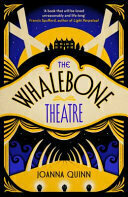
Finished reading: The Whalebone Theatre by Joanna Quinn. A lovely novel, at once melancholy and hopeful, about learning to cope with a changed world, and about the many forms and meanings of family. 📚

Much of the social energy of the old internet has now retreated underground to the cozyweb. Except for a few old-fashioned blogs like this one, there’s not much of it left above-ground now. But there’s an odd sort of romance to holding down a public WordPress-based fortress in the grimdark bleakness, even as almost everything (including the bulk of what I do) retreats to various substacks, discords, and such.
Amen to that. Though I really do believe that there will be a slow and perhaps not readily noticeable renewal of blogging. I’m keeping my eyes peeled. See the “blogging” tag at the bottom of this post for more thoughts along these lines.
on Wagner

As part of my ongoing project to understand myth and mythmaking in the modern era I have been sitting down to a full encounter with Wagner’s Ring cycle — which I’ve never before listened to completely and in sequence. I’m doing this by listening to the legendary Georg Solti Decca recording and following along with the excellent Penguin Classics bilingual edition of the libretto. I have some reservations about John Deathridge’s translation, but fortunately my German is (barely) good enough that I can make it through without only occasional consultations of the English version. (I’ve got the beautiful hardcover edition, which I think may have been printed only in the U.K.)

I’m not finished yet but I have gotten far enough along to say with some confidence that Wagner’s celebrants who think him a nearly incomparable genius are absolutely correct, and Wagner’s detractors who think him unforgivably self-indulgent are also correct. And I’ve also come to some conclusions about why both of these things are true. (Probably many other people have come to the same conclusions, but I have read very little Wagner criticism, with one major exception noted below.)
Again, I am not fluent in German but anyone with even minimal competence in the language can see how brilliant a poet Wagner is, and especially how skillfully he employs alliteration and assonance to create his effects — and with a remarkable economy of language. Nietzsche’s inclination to compare Wagner as poet only with Goethe is remarkable but not utterly extravagant.
But in a way Wagner’s greatness as a poet is a problem — or perhaps I should say that it became a problem when he made the fateful decision to write the entire libretto before composing a single note of music. Why was that decision so fateful? Because Wagner knew he was a great poet. He knew that he had written magnificent poetry and he didn’t want to sacrifice any of it once he got to the stage of musical composition
That isn’t that big of a problem in Das Rheingold, which in fact moves with remarkable fluidity and pace: it has almost none of the longeurs that the later dramas in the cycle suffer from. The difficulties kick in with the first act of Die Walküre. If you haven’t heard this work … well, imagine something like the Prologue to Peter Jackson’s Lord of the Rings, except instead of lasting six minutes it lasts more than an hour. More than an hour of pure exposition, in which characters — well, mainly one character, Siegmund, tells us his entire history. C. S. Lewis (famously) wrote that the final books of Paradise Lost, in which the archangel Michael tells Adam of the future of humanity, is an “untransmuted lump of futurity”; likewise, the first act of Die Walküre is an untransmuted lump of historicity, with only occasional orchestral coloration to enliven matters.
Wagner trusts overmuch in the power of his own verse, or is simply overly attached to it — which is a reminder that often it’s good to divide the labor of the librettist and the poet. When Auden was writing his Christmas oratorio, For the Time Being, he did so hoping that his friend Benjamin Britten would set it to music. But when he gave to Britten the magnificent fugal chorus on Caesar he had written, Britten couldn’t help laughing. He told Auden that if he wanted an actual fugue to be written, and a figure that would set a single scene in an oratorio with many scenes, then he should have written three lines, not seventy. So Auden kept the poem as written and gave up on the idea of having it set to music. By contrast, Wagner never had anyone to remind him of the necessary constraints; so he ignored them.
And there’s another problem as well. Recently I read Walter Murch’s famous meditation on film editing, In the Blink of an Eye, and was taken by his articulation of one of his chief rules: “You want to do only what is necessary to engage the imagination of the audience — suggestion is always more effective than exposition.” It’s interesting that Wagner understands this principle so well in his music, which often is rich and deep with suggestion, without understanding it at all in his writing. Exposition often dominates. I think his addiction to detailed exposition has something to do with his belief in himself as a sage and a mythographer.
I may have more to say as I move through this extraordinary work of art — though maybe not, because the experience is tiring. Right now I feel about it much as Virginia Woolf felt about Joyce’s Ulysses, which she called "a memorable catastrophe — immense in daring, terrific in disaster.” But it fascinates me as a myth, especially as a humanist myth — a myth about the ending of the gods and what Bonhoeffer would later call the “coming of age” of humanity. I think that is why Roger Scruton — a man convinced of the absolute necessity of religion to humans but without any firm faith in Christianity — loves the Ring cycle so much. His book about it is magnificent, I think, but also somewhat depressing, because as a Christian I certainly don’t think that a humanist myth has the power to sustain us. But Wagner put an enormous charge into his effort to make it do so.
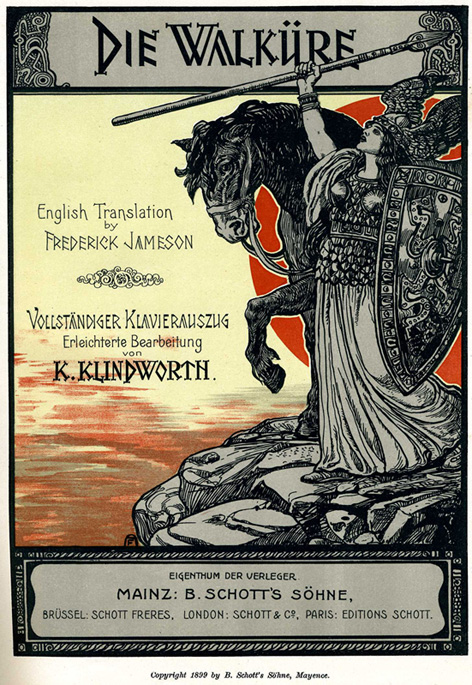
Francis Spufford on picking through the ruins of Christendom:
Those of us who, despite everything, think there’s something precious in the words jumbled-up now among the rubble, do not do so because we are pro-tyranny or anti-self discovery. We do so because we know that what was written on those towering walls wasn’t the credo of an authoritarian certainty at all. But instead — mixed up, yeah, with some heterogenous other stuff over the centuries, some questionable — a song of liberation, a startling declaration that power, that love, that justice, that order, that God the creator of all things, weren’t what we thought they were, but came closest to us in paradoxes. Wisdom, in foolishness; strength, in weakness; sovereignty over the immense empire of matter, in helpless self-sacrifice, in a choking man brought to death by a shrugging government. What’s written on the bricks still has the power to shock, when you join them together. GREATER LOVE HATH NO MAN THAN THIS turns out to lead to, THAN THAT HE LAY DOWN HIS LIFE FOR HIS FRIEND. Not very positive, is it? LOVE YOUR EN- continues, -EMY, AND PRAY FOR THOSE WHO PERSECUTE YOU. What’s that about? How will that help me to be thinner, richer, stronger, more sexually successful? It won’t. It will only help you to be kinder, braver, more tolerant of our inevitable imperfections, and more hopeful; more convinced that the worst than can happen to us, as humans, is not the last word, because there is a love we should try to copy in our small ways, which never rests, never gives up, is never defeated.
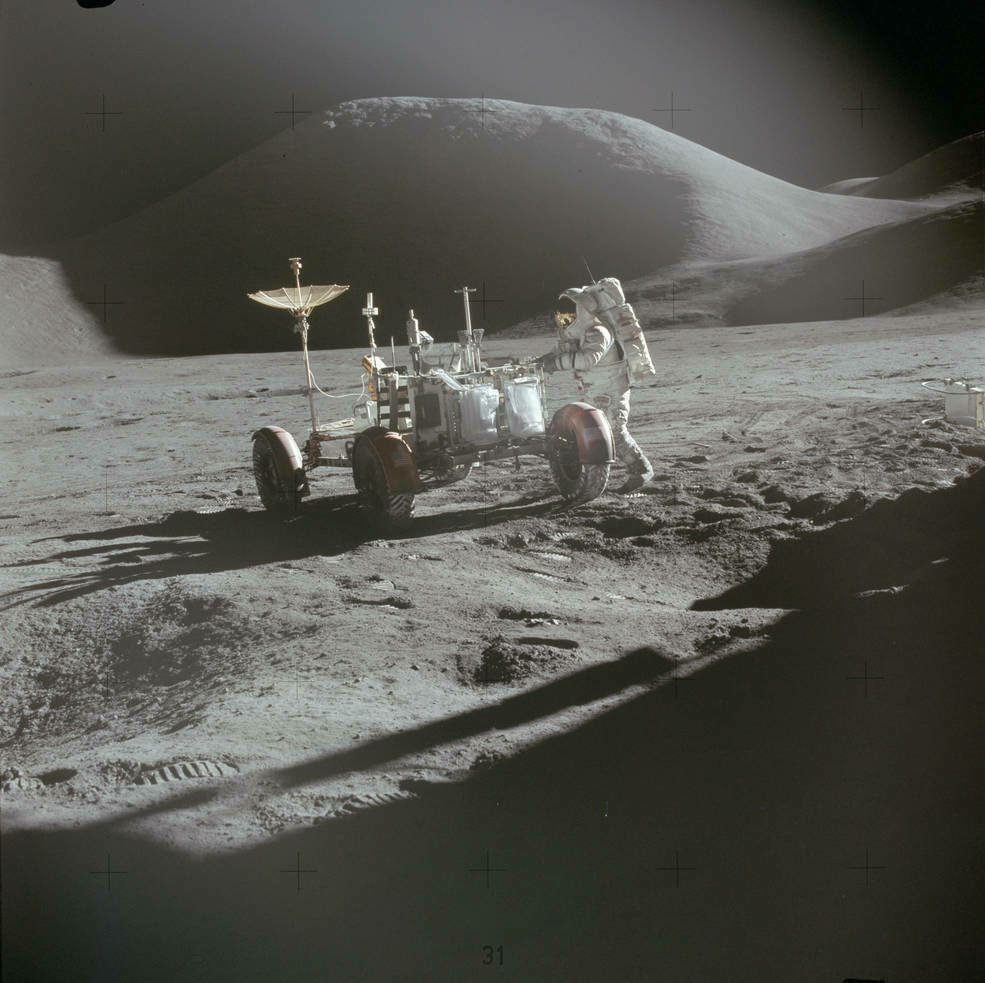
Man, Moon, Book

My family gave me a wonderful Christmas present: the Folio Society edition of Andrew Chaikin’s A Man on the Moon: The Voyages of the Apollo Astronauts. In chronological terms, Chaikin’s book basically picks up where Tom Wolfe’s The Right Stuff left off, but Chaikin is the anti-Wolfe: restrained and businesslike, rather than flamboyant and hilarious. Still, he tells the story well, and this edition is magnificently complemented by dozens and dozens of perfectly-chosen photographs. What a delight.
And, like many Folio Society editions — I have about a dozen of them — this book prompts me to reflect on what an extraordinary thing a book can be. When a book is well-written, well-edited, well-designed, well-printed and bound, so many skills have been practiced at a high level, from journalistic research to paper-making to photographic reproduction, that it amounts to a genuine Gesamtkunstwerk. To me, few things are as beautiful as a beautiful book.
Also, you have to love the fact that the book’s text is set in Adrian Frutiger’s Apollo, with Futura for display.